THE
ATMOSPHERE
Biology and Geology
The atmosphere is the gaseous layer that surrounds the Earth. In addition to
gases, the atmosphere contains solid particles in suspension.
•The particules that compose it cannot be distinguished with the naked eye.
They form a homogeneous mixture that we call air.
•Gaseous state: Fixed mass, variable volumen and variable shape.
•The primitive atmosphere was compounded by the volcanic activity gases and
the gases produced by the collisions of planetesimals.
•The Earth´s primitive atmosphere contained many gases, such as nitrogen,
carbon dioxide, carbon monoxide, methane, a large amount of water vapour and
much less oxygen than the present-day atmosphere.
•About 3.5 billions years ago, the first photosynthetic organisms appeared, and
the amount of atmospheric carbon dioxide decreased. At the same time, the
amount of oxygen increased.
THE ATMOSPHERE
2
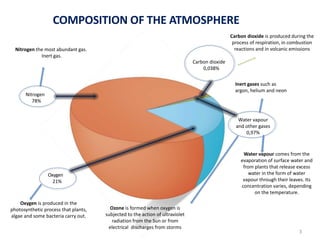
Nitrogen
78%
Oxygen
21%
Water vapour
and other gases
0,97%
Carbon dioxide
0,038%
Carbon dioxide is produced during the
process of respiration, in combustion
reactions and in volcanic emissions
Inert gases such as
argon, helium and neon
Water vapour comes from the
evaporation of surface water and
from plants that release excess
water in the form of water
vapour through their leaves. Its
concentration varies, depending
on the temperature.
Ozone is formed when oxygen is
subjected to the action of ultraviolet
radiation from the Sun or from
electrical discharges from storms
Oxygen is produced in the
photosynthetic process that plants,
algae and some bacteria carry out.
Nitrogen the most abundant gas.
Inert gas.
COMPOSITION OF THE ATMOSPHERE
3
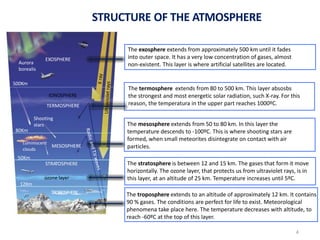
The mesosphere extends from 50 to 80 km. In this layer the
temperature descends to -100ºC. This is where shooting stars are
formed, when small meteorites disintegrate on contact with air
particles.
The stratosphere is between 12 and 15 km. The gases that form it move
horizontally. The ozone layer, that protects us from ultraviolet rays, is in
this layer, at an altitude of 25 km. Temperature increases until 5ºC.
The exosphere extends from approximately 500 km until it fades
into outer space. It has a very low concentration of gases, almost
non-existent. This layer is where artificial satellites are located.
The termosphere extends from 80 to 500 km. This layer absosbs
the strongest and most energetic solar radiation, such X-ray. For this
reason, the temperatura in the upper part reaches 1000ºC.
The troposphere extends to an altitude of approximately 12 km. It contains
90 % gases. The conditions are perfect for life to exist. Meteorological
phenomena take place here. The temperature decreases with altitude, to
reach -60ºC at the top of this layer.
EXOSPHERE
MESOSPHERE
STRATOSPHERE
500Km
IONOSPHERE
TERMOSPHERE
Aurora
borealis
Shooting
stars
50Km
12Km
ozone layer
STRUCTURE OF THE ATMOSPHERE
4
TROPOSPHERE
80Km
Luminiscent
clouds
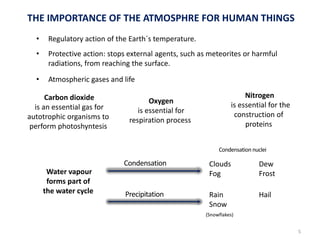
• Regulatory action of the Earth´s temperature.
• Protective action: stops external agents, such as meteorites or harmful
radiations, from reaching the surface.
• Atmospheric gases and life
Carbon dioxide
is an essential gas for
autotrophic organisms to
perform photoshyntesis
Oxygen
is essential for
respiration process
Nitrogen
is essential for the
construction of
proteins
Water vapour
forms part of
the water cycle
Condensation
Precipitation
Clouds
Fog
Dew
Frost
Rain
Snow
Hail
THE IMPORTANCE OF THE ATMOSPHRE FOR HUMAN THINGS
5
Condensationnuclei
(Snowflakes)
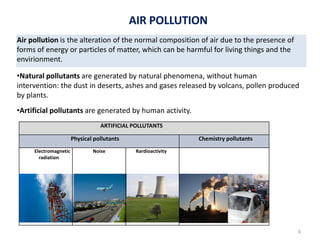
Air pollution is the alteration of the normal composition of air due to the presence of
forms of energy or particles of matter, which can be harmful for living things and the
envirionment.
•Natural pollutants are generated by natural phenomena, without human
intervention: the dust in deserts, ashes and gases released by volcans, pollen produced
by plants.
•Artificial pollutants are generated by human activity.
ARTIFICIAL POLLUTANTS
Physical pollutants Chemistry pollutants
Electromagnetic
radiation
Noise Rardioactivity
AIR POLLUTION
6
La atmósfera
Consequences of air pollution:
• Global level: acid rain.
• In ecosystems: destroy natural habitats and extiction.
• Individual level: respiratory problems and other disorders.
Preventive and corrective measures:
• Clean and purify the smoke and gases produced by the industry.
• Reduce emissions of toxic and dangerous pollutants.
• Encourage reforestation of ancient green areas or forest.
• Reduce energy consumption, especially fossil fuels and derivatives.
• Substitute traditional sources of energy or non-renewable energy
sources for renewable energy sources.
• Reduce the amount of residues and rubbish, and reuse and recycle.
AIR POLLUTION
7
La atmósfera
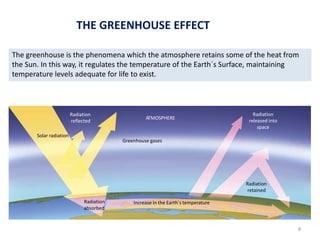
The greenhouse is the phenomena which the atmosphere retains some of the heat from
the Sun. In this way, it regulates the temperature of the Earth´s Surface, maintaining
temperature levels adequate for life to exist.
Solar radiation
Greenhouse gases
8
Radiation
absorbed
Radiation
retained
Increase in the Earth´s temperature
Radiation
reflected
Radiation
released into
space
ATMOSPHERE
THE GREENHOUSE EFFECT
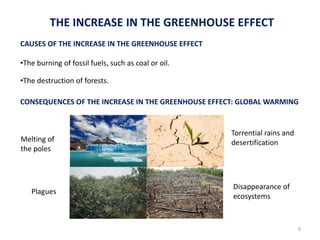
THE INCREASE IN THE GREENHOUSE EFFECTa
CAUSES OF THE INCREASE IN THE GREENHOUSE EFFECT
•The burning of fossil fuels, such as coal or oil.
•The destruction of forests.
CONSEQUENCES OF THE INCREASE IN THE GREENHOUSE EFFECT: GLOBAL WARMING
9
Plagues
Torrential rains and
desertification
Disappearance of
ecosystems
Melting of
the poles
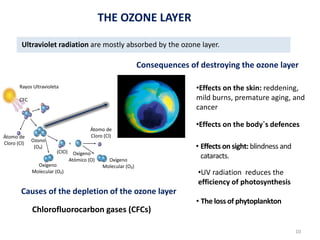
Átomo de
Cloro (Cl)
Ozono
(O₃)
Oxígeno
Molecular (O₂)
(ClO) Oxígeno
Atómico (O) Oxígeno
Molecular (O₂)
Rayos Ultravioleta
CFC
10
Átomo de
Cloro (Cl)
Ultraviolet radiation are mostly absorbed by the ozone layer.
Consequences of destroying the ozone layer
•Effects on the body´s defences
• Effects on sight: blindness and
cataracts.
•UV radiation reduces the
efficiency of photosynthesis
• The loss of phytoplankton
THE OZONE LAYER
Chlorofluorocarbon gases (CFCs)
Causes of the depletion of the ozone layer
•Effects on the skin: reddening,
mild burns, premature aging, and
cancer

T.4 the atmosphere

  • 1.
  • 2.
    The atmosphere isthe gaseous layer that surrounds the Earth. In addition to gases, the atmosphere contains solid particles in suspension. •The particules that compose it cannot be distinguished with the naked eye. They form a homogeneous mixture that we call air. •Gaseous state: Fixed mass, variable volumen and variable shape. •The primitive atmosphere was compounded by the volcanic activity gases and the gases produced by the collisions of planetesimals. •The Earth´s primitive atmosphere contained many gases, such as nitrogen, carbon dioxide, carbon monoxide, methane, a large amount of water vapour and much less oxygen than the present-day atmosphere. •About 3.5 billions years ago, the first photosynthetic organisms appeared, and the amount of atmospheric carbon dioxide decreased. At the same time, the amount of oxygen increased. THE ATMOSPHERE 2
  • 3.
    Nitrogen 78% Oxygen 21% Water vapour and othergases 0,97% Carbon dioxide 0,038% Carbon dioxide is produced during the process of respiration, in combustion reactions and in volcanic emissions Inert gases such as argon, helium and neon Water vapour comes from the evaporation of surface water and from plants that release excess water in the form of water vapour through their leaves. Its concentration varies, depending on the temperature. Ozone is formed when oxygen is subjected to the action of ultraviolet radiation from the Sun or from electrical discharges from storms Oxygen is produced in the photosynthetic process that plants, algae and some bacteria carry out. Nitrogen the most abundant gas. Inert gas. COMPOSITION OF THE ATMOSPHERE 3
  • 4.
    The mesosphere extendsfrom 50 to 80 km. In this layer the temperature descends to -100ºC. This is where shooting stars are formed, when small meteorites disintegrate on contact with air particles. The stratosphere is between 12 and 15 km. The gases that form it move horizontally. The ozone layer, that protects us from ultraviolet rays, is in this layer, at an altitude of 25 km. Temperature increases until 5ºC. The exosphere extends from approximately 500 km until it fades into outer space. It has a very low concentration of gases, almost non-existent. This layer is where artificial satellites are located. The termosphere extends from 80 to 500 km. This layer absosbs the strongest and most energetic solar radiation, such X-ray. For this reason, the temperatura in the upper part reaches 1000ºC. The troposphere extends to an altitude of approximately 12 km. It contains 90 % gases. The conditions are perfect for life to exist. Meteorological phenomena take place here. The temperature decreases with altitude, to reach -60ºC at the top of this layer. EXOSPHERE MESOSPHERE STRATOSPHERE 500Km IONOSPHERE TERMOSPHERE Aurora borealis Shooting stars 50Km 12Km ozone layer STRUCTURE OF THE ATMOSPHERE 4 TROPOSPHERE 80Km Luminiscent clouds
  • 5.
    • Regulatory actionof the Earth´s temperature. • Protective action: stops external agents, such as meteorites or harmful radiations, from reaching the surface. • Atmospheric gases and life Carbon dioxide is an essential gas for autotrophic organisms to perform photoshyntesis Oxygen is essential for respiration process Nitrogen is essential for the construction of proteins Water vapour forms part of the water cycle Condensation Precipitation Clouds Fog Dew Frost Rain Snow Hail THE IMPORTANCE OF THE ATMOSPHRE FOR HUMAN THINGS 5 Condensationnuclei (Snowflakes)
  • 6.
    Air pollution isthe alteration of the normal composition of air due to the presence of forms of energy or particles of matter, which can be harmful for living things and the envirionment. •Natural pollutants are generated by natural phenomena, without human intervention: the dust in deserts, ashes and gases released by volcans, pollen produced by plants. •Artificial pollutants are generated by human activity. ARTIFICIAL POLLUTANTS Physical pollutants Chemistry pollutants Electromagnetic radiation Noise Rardioactivity AIR POLLUTION 6
  • 7.
    La atmósfera Consequences ofair pollution: • Global level: acid rain. • In ecosystems: destroy natural habitats and extiction. • Individual level: respiratory problems and other disorders. Preventive and corrective measures: • Clean and purify the smoke and gases produced by the industry. • Reduce emissions of toxic and dangerous pollutants. • Encourage reforestation of ancient green areas or forest. • Reduce energy consumption, especially fossil fuels and derivatives. • Substitute traditional sources of energy or non-renewable energy sources for renewable energy sources. • Reduce the amount of residues and rubbish, and reuse and recycle. AIR POLLUTION 7
  • 8.
    La atmósfera The greenhouseis the phenomena which the atmosphere retains some of the heat from the Sun. In this way, it regulates the temperature of the Earth´s Surface, maintaining temperature levels adequate for life to exist. Solar radiation Greenhouse gases 8 Radiation absorbed Radiation retained Increase in the Earth´s temperature Radiation reflected Radiation released into space ATMOSPHERE THE GREENHOUSE EFFECT
  • 9.
    THE INCREASE INTHE GREENHOUSE EFFECTa CAUSES OF THE INCREASE IN THE GREENHOUSE EFFECT •The burning of fossil fuels, such as coal or oil. •The destruction of forests. CONSEQUENCES OF THE INCREASE IN THE GREENHOUSE EFFECT: GLOBAL WARMING 9 Plagues Torrential rains and desertification Disappearance of ecosystems Melting of the poles
  • 10.
    Átomo de Cloro (Cl) Ozono (O₃) Oxígeno Molecular(O₂) (ClO) Oxígeno Atómico (O) Oxígeno Molecular (O₂) Rayos Ultravioleta CFC 10 Átomo de Cloro (Cl) Ultraviolet radiation are mostly absorbed by the ozone layer. Consequences of destroying the ozone layer •Effects on the body´s defences • Effects on sight: blindness and cataracts. •UV radiation reduces the efficiency of photosynthesis • The loss of phytoplankton THE OZONE LAYER Chlorofluorocarbon gases (CFCs) Causes of the depletion of the ozone layer •Effects on the skin: reddening, mild burns, premature aging, and cancer