AIR POLLUTION
AND CONTROL
POWER POINT PRESENTATION
OF AIR POLLUTION
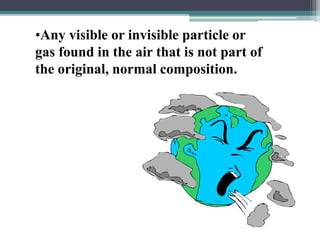
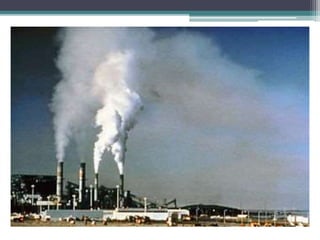
•Any visible or invisible particle or
gas found in the air that is not part of
the original, normal composition.
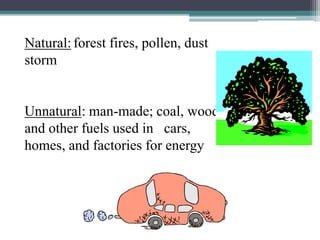
Natural: forest fires, pollen, dust
storm
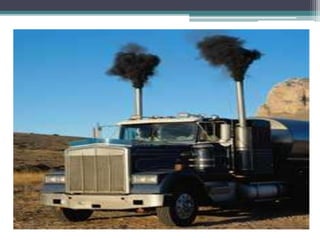
Unnatural: man-made; coal, wood
and other fuels used in cars,
homes, and factories for energy
DEFINITION
• There is a gas, liquid or particles contained in
the air so that the change and affect the life or
other materials.
• The materials are suspended in the air and a
negative impact on humans, plants and
animals.
• This is due to these materials will enter the
body through breathing and can block the
flow of oxygen into the blood vessels.
• This can cause various diseases such as
cramps, cancer, asthma, cramps, and
anemia.
Dust, smoke, mist, vapor or other substances
that can block eyesight is different form of air
pollution
Pollutants
Pollutants can be classified as either
primary or secondary
Primary pollutants:-Are substances
directly emitted from a process, such as
the carbon monoxide gas from a motor
vehicle exhaust or sulfur dioxide released
from factories.
Pollutants
Secondary pollutants:- Are not
emitted directly. Rather, they form in the air
when primary pollutants react or interact. An
important example of a secondary pollutant is
ground level ozone.
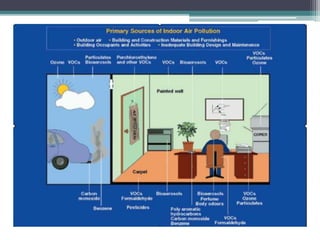
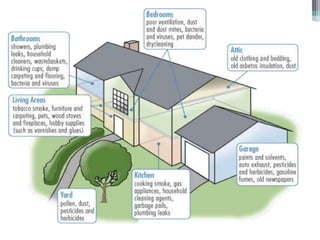
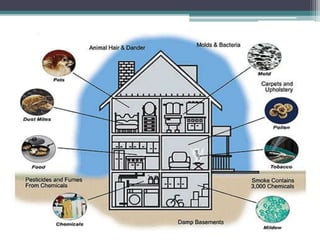
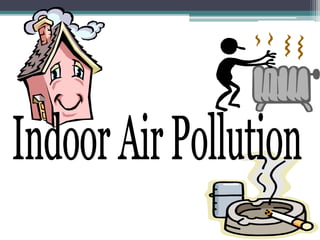
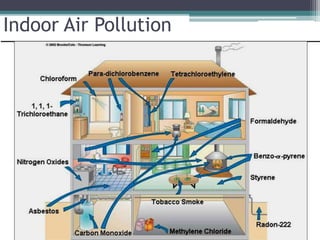
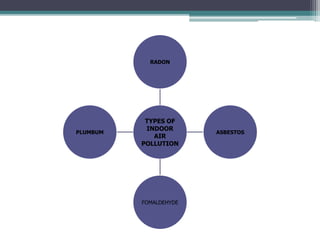
Indoor Air Pollution
TYPES OF
INDOOR
AIR
POLLUTION
RADON
ASBESTOS
FOMALDEHYDE
PLUMBUM
RADON
• Radon is a chemical element in the periodic table that
has the symbol Rn and atomic number 86.
• Noble gas that is formed by the disintegration of radium,
radon is the heaviest gases and is considered a health
hazard.
• The most stable isotope is Rn-222 which has a half life of
3.8 days and used in radiotherapy.
Radon gas can accumulate in homes and cause lung
cancer [1], causing potentially 20,000 deaths in Europe
alone each year.
RADON
• Radioactive gas found in soil & earth bricks that
exist in the original form of radium that is
damaged - such as the decay products of
uranium.
• Progeny, decay products @ daughtera.
• Damage lung tissue & lung cancer.
• Smokers are likely to die from this cancer.
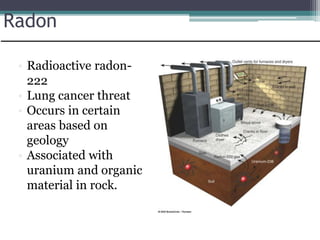
Radon
• Radioactive radon-
222
• Lung cancer threat
• Occurs in certain
areas based on
geology
• Associated with
uranium and organic
material in rock.
ASBESTOS
• Minerals in the formation of crystals / crystal.
• Long & thin fibers.
• Divided 2: serpentine & amphibole - depending
on the crystal element.
• Individuals at risk, building maintenance,
repairs, cleaning, plumber & carpenter.
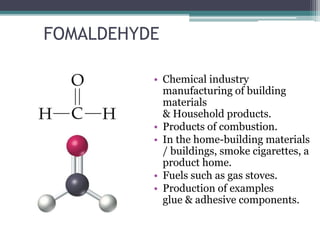
FOMALDEHYDE
• Chemical industry
manufacturing of building
materials
& Household products.
• Products of combustion.
• In the home-building materials
/ buildings, smoke cigarettes, a
product home.
• Fuels such as gas stoves.
• Production of examples
glue & adhesive components.
PLUMBUM
• Abundant in the earth's crust.
• In water, soil & plants.
• Easily obtained from the spread in the soil &
water.
• May occur during the combustion of the battery
container @ container of old paint contains lead.
• Increased burning of leaded gasoline.
TYPES OF
AIR
POLLUTION
Ozone
Sulfur
Dioxide
Nitrogen
Dioxide
Carbon
Monoxide
Lead Dust
Dust
(particular
Matter)
Sulfur Dioxide
•produced when coal and fuel oil
are burned
•present in power plant exhaust
•narrows the airway, causing
wheezing and shortness of
breath, especially in those with
asthma

AIR POLLUTION.pptx

  • 1.
    AIR POLLUTION AND CONTROL POWERPOINT PRESENTATION OF AIR POLLUTION
  • 3.
    •Any visible orinvisible particle or gas found in the air that is not part of the original, normal composition.
  • 4.
    Natural: forest fires,pollen, dust storm Unnatural: man-made; coal, wood and other fuels used in cars, homes, and factories for energy
  • 6.
    DEFINITION • There isa gas, liquid or particles contained in the air so that the change and affect the life or other materials. • The materials are suspended in the air and a negative impact on humans, plants and animals. • This is due to these materials will enter the body through breathing and can block the flow of oxygen into the blood vessels. • This can cause various diseases such as cramps, cancer, asthma, cramps, and anemia. Dust, smoke, mist, vapor or other substances that can block eyesight is different form of air pollution
  • 10.
    Pollutants Pollutants can beclassified as either primary or secondary Primary pollutants:-Are substances directly emitted from a process, such as the carbon monoxide gas from a motor vehicle exhaust or sulfur dioxide released from factories.
  • 11.
    Pollutants Secondary pollutants:- Arenot emitted directly. Rather, they form in the air when primary pollutants react or interact. An important example of a secondary pollutant is ground level ozone.
  • 17.
  • 18.
  • 19.
    RADON • Radon isa chemical element in the periodic table that has the symbol Rn and atomic number 86. • Noble gas that is formed by the disintegration of radium, radon is the heaviest gases and is considered a health hazard. • The most stable isotope is Rn-222 which has a half life of 3.8 days and used in radiotherapy. Radon gas can accumulate in homes and cause lung cancer [1], causing potentially 20,000 deaths in Europe alone each year.
  • 20.
    RADON • Radioactive gasfound in soil & earth bricks that exist in the original form of radium that is damaged - such as the decay products of uranium. • Progeny, decay products @ daughtera. • Damage lung tissue & lung cancer. • Smokers are likely to die from this cancer.
  • 21.
    Radon • Radioactive radon- 222 •Lung cancer threat • Occurs in certain areas based on geology • Associated with uranium and organic material in rock.
  • 22.
    ASBESTOS • Minerals inthe formation of crystals / crystal. • Long & thin fibers. • Divided 2: serpentine & amphibole - depending on the crystal element. • Individuals at risk, building maintenance, repairs, cleaning, plumber & carpenter.
  • 23.
    FOMALDEHYDE • Chemical industry manufacturingof building materials & Household products. • Products of combustion. • In the home-building materials / buildings, smoke cigarettes, a product home. • Fuels such as gas stoves. • Production of examples glue & adhesive components.
  • 24.
    PLUMBUM • Abundant inthe earth's crust. • In water, soil & plants. • Easily obtained from the spread in the soil & water. • May occur during the combustion of the battery container @ container of old paint contains lead. • Increased burning of leaded gasoline.
  • 25.
  • 26.
    Sulfur Dioxide •produced whencoal and fuel oil are burned •present in power plant exhaust •narrows the airway, causing wheezing and shortness of breath, especially in those with asthma