Air Pollution
Basics
Causes
Pollutants
Effects
Prevention and Control
Air and its Components
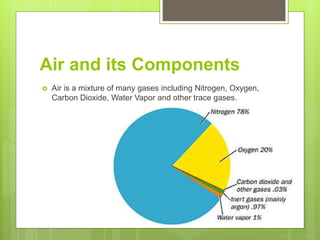
 Air is a mixture of many gases including Nitrogen, Oxygen,
Carbon Dioxide, Water Vapor and other trace gases.
What is Air Pollution…??
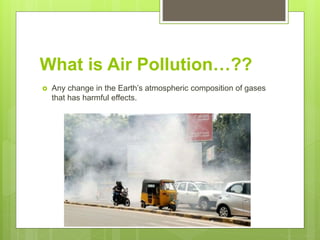
 Any change in the Earth’s atmospheric composition of gases
that has harmful effects.
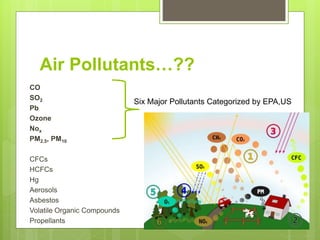
Air Pollutants…??
CO
SO2
Pb
Ozone
Nox
PM2.5, PM10
CFCs
HCFCs
Hg
Aerosols
Asbestos
Volatile Organic Compounds
Propellants
Six Major Pollutants Categorized by EPA,US
Causes – Natural sources??
 Dust
 Gases released from the body processes of living beings (CO2 during
respiration, CH4 from cattle’s digestion, oxygen from plants during
photosynthesis)
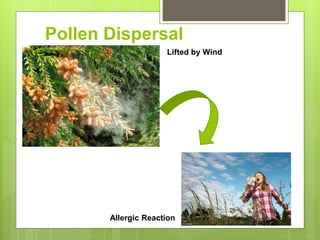
 Pollen Dispersal
 Smoke from forest fires, volcanos
 Evaporation of organic compounds
 Natural radioactivity
Dust Pollution
Wind erosion
Sweeping of Roads
Other Gases Pollution
CO2, O2 Release
NH3 Release
Pollen Dispersal
Allergic Reaction
Lifted by Wind
Smoke Pollution
Forest Fire Forest Fire
Volcano eruption
Uttarakhand Forest Fire
Forest Fire
Evaporation of organic
Compounds
Large group of carbon-based chemicals that easily evaporate at room
temperature.
E.g :
Personal care products such
as perfume and hair spray
Cleaning agents
Dry cleaning fluid, paints,
Lacquers, varnishes,
Hobby supplies
Copying and printing machines
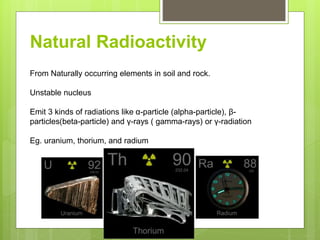
Natural Radioactivity
From Naturally occurring elements in soil and rock.
Unstable nucleus
Emit 3 kinds of radiations like α-particle (alpha-particle), β-
particles(beta-particle) and γ-rays ( gamma-rays) or γ-radiation
Eg. uranium, thorium, and radium
Causes- Man Made Sources??
 Burning of Fossil Fuels – Coal, oil, natural gas and gasoline to produce
electricity and power vehicles. – SO2, CO, NOx, SPM
 Agricultural activities – NH3 is very common byproduct.
 Landfill activities- CH4
 Exhaust from factories and industries - CO, Hydrocarbons, organic
compounds.
 Mining Operation – Dust
 Use of chemicals like cleaning products, painting supplies
 Artificial radioactivity
Fossil Fuel Burning
Vehicular Emission
Allergic Reaction
Agricultural Activities
Landfill Activities
Exhaust from factories and
Industries
Bhopal Gas Leak
 Happened in Dec, 1984
 Company Responsible : Union Carbide
(Now Dow Chemicals)
 Leak of Methyl Isocyanate Gas
Mining Operations
Chemical Products
Pesticide DDT
 Happened in 1962
 Synthetic pesticides DDT used to
combat typhus and malaria.
 It is non degradable so
accumulated in the environment.
 Decimated Bald eagle and other
bird populations
 Later turned up in human
breast milk and was linked with
premature births.
Artificial Radioactivity
Chernobyl Nuclear Accident
 Happened in April, 1986
 Plant’s core went melt down
 Released 100 times more
radiation than the atom bombs
dropped on Japan.
 19-mile exclusion zone around
the plant remains uninhabitable.
 4000 cases of thyroid cancer
were diagnosed among children
and adolescents, mainly due to
contaminated milk.
Effects…??
 Human health – Respiratory and heart problems, Cancer
 Poor Visibility
 Global warming – Greenhouse gases like CO2
 Acid Rain - Water droplets + NOx, SOx
 Eutrophication – Depletion of Oxygen content in water bodies
 Depletion of Ozone Layer – Presence of chlorofluorocarbons, hydro
chlorofluorocarbons
Poor Visibility - Smog = Smoke + Fog
Sulfurous smog (or 'London-type' smog)
Happened in Dec, 1952 due to Industrial revolution.
Use of sulfur-bearing fossil fuels, particularly coal
High concentration of Sox, Humidity and low temperature in the air
Thermal Inversion
Smoke + SOx + Fog droplets = Sulfurous Smog
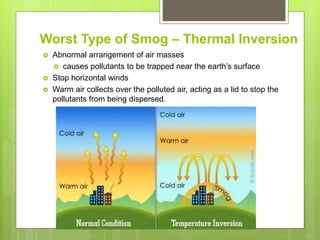
Worst Type of Smog – Thermal Inversion
 Abnormal arrangement of air masses
 causes pollutants to be trapped near the earth’s surface
 Stop horizontal winds
 Warm air collects over the polluted air, acting as a lid to stop the
pollutants from being dispersed.
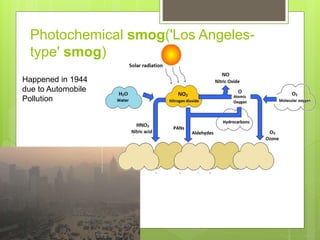
Photochemical smog('Los Angeles-
type' smog)
Happened in 1944
due to Automobile
Pollution
London-type smog in Beijing, China
New York-type' smog
Happened in Nov,1966 in New York
Delhi -type' smog
Due to high vehicular and industrial emissions, construction work and
crop burning in adjoining states.
Solutions to reduce Smog
 Alkaline Scrubbers reduce SO2 and SO3 levels
 Electrostatic precipitators reduce particulates
 Catalytic Converters change NO to N2,
 Lean burning engines reduce Nox but create more CO and
Hydrocarbons.
Global Warming
Major Greenhouse Gases Major Sectors releasing
Greenhouse Gases
Acid Rain
Eutrophication
Eutrophication Decrease in Oxygen Content
in water bodies
Depletion of Ozone Layer
How does Air Pollution Move?
Emission Source
(i.e., smokestack, chimney, exhaust
pipe)
Receptor
(i.e., soil, vegetation, water bodies,
human lungs)
Solutions…??
 Use public mode of transportation
 Conserve energy – Switch off fans and lights – Save
electricity – Save fuel burning
 Understand the Concept of Reduce, Reuse and Recycle
 Emphasis on clean energy resources like solar, wind and
geothermal
 Use energy efficient devices – CFL lights against
conventional lights
Conclusion…??
 Air Pollution is one of the major concerns and a challenge we
need to overcome to see a tomorrow.
 This is a direct attempt at slacking Global warming.
 World wide on personal, industrial and Govt level know the
intensity at which Air Pollution is rising.
 We must not forget that air is what we breathe in to survive
every day.
Keep the air clean because we
breathe 7 or 8 liters
of Air per minute

Air Pollution Basics

  • 1.
  • 2.
    Air and itsComponents  Air is a mixture of many gases including Nitrogen, Oxygen, Carbon Dioxide, Water Vapor and other trace gases.
  • 3.
    What is AirPollution…??  Any change in the Earth’s atmospheric composition of gases that has harmful effects.
  • 4.
    Air Pollutants…?? CO SO2 Pb Ozone Nox PM2.5, PM10 CFCs HCFCs Hg Aerosols Asbestos VolatileOrganic Compounds Propellants Six Major Pollutants Categorized by EPA,US
  • 5.
    Causes – Naturalsources??  Dust  Gases released from the body processes of living beings (CO2 during respiration, CH4 from cattle’s digestion, oxygen from plants during photosynthesis)  Pollen Dispersal  Smoke from forest fires, volcanos  Evaporation of organic compounds  Natural radioactivity
  • 6.
  • 7.
    Other Gases Pollution CO2,O2 Release NH3 Release
  • 8.
  • 9.
    Smoke Pollution Forest FireForest Fire Volcano eruption
  • 10.
  • 11.
    Evaporation of organic Compounds Largegroup of carbon-based chemicals that easily evaporate at room temperature. E.g : Personal care products such as perfume and hair spray Cleaning agents Dry cleaning fluid, paints, Lacquers, varnishes, Hobby supplies Copying and printing machines
  • 12.
    Natural Radioactivity From Naturallyoccurring elements in soil and rock. Unstable nucleus Emit 3 kinds of radiations like α-particle (alpha-particle), β- particles(beta-particle) and γ-rays ( gamma-rays) or γ-radiation Eg. uranium, thorium, and radium
  • 13.
    Causes- Man MadeSources??  Burning of Fossil Fuels – Coal, oil, natural gas and gasoline to produce electricity and power vehicles. – SO2, CO, NOx, SPM  Agricultural activities – NH3 is very common byproduct.  Landfill activities- CH4  Exhaust from factories and industries - CO, Hydrocarbons, organic compounds.  Mining Operation – Dust  Use of chemicals like cleaning products, painting supplies  Artificial radioactivity
  • 14.
  • 15.
  • 16.
  • 17.
  • 18.
    Exhaust from factoriesand Industries
  • 19.
    Bhopal Gas Leak Happened in Dec, 1984  Company Responsible : Union Carbide (Now Dow Chemicals)  Leak of Methyl Isocyanate Gas
  • 20.
  • 21.
  • 22.
    Pesticide DDT  Happenedin 1962  Synthetic pesticides DDT used to combat typhus and malaria.  It is non degradable so accumulated in the environment.  Decimated Bald eagle and other bird populations  Later turned up in human breast milk and was linked with premature births.
  • 23.
  • 24.
    Chernobyl Nuclear Accident Happened in April, 1986  Plant’s core went melt down  Released 100 times more radiation than the atom bombs dropped on Japan.  19-mile exclusion zone around the plant remains uninhabitable.  4000 cases of thyroid cancer were diagnosed among children and adolescents, mainly due to contaminated milk.
  • 25.
    Effects…??  Human health– Respiratory and heart problems, Cancer  Poor Visibility  Global warming – Greenhouse gases like CO2  Acid Rain - Water droplets + NOx, SOx  Eutrophication – Depletion of Oxygen content in water bodies  Depletion of Ozone Layer – Presence of chlorofluorocarbons, hydro chlorofluorocarbons
  • 27.
    Poor Visibility -Smog = Smoke + Fog
  • 28.
    Sulfurous smog (or'London-type' smog) Happened in Dec, 1952 due to Industrial revolution. Use of sulfur-bearing fossil fuels, particularly coal High concentration of Sox, Humidity and low temperature in the air Thermal Inversion Smoke + SOx + Fog droplets = Sulfurous Smog
  • 29.
    Worst Type ofSmog – Thermal Inversion  Abnormal arrangement of air masses  causes pollutants to be trapped near the earth’s surface  Stop horizontal winds  Warm air collects over the polluted air, acting as a lid to stop the pollutants from being dispersed.
  • 30.
    Photochemical smog('Los Angeles- type'smog) Happened in 1944 due to Automobile Pollution
  • 31.
    London-type smog inBeijing, China
  • 32.
    New York-type' smog Happenedin Nov,1966 in New York
  • 33.
    Delhi -type' smog Dueto high vehicular and industrial emissions, construction work and crop burning in adjoining states.
  • 34.
    Solutions to reduceSmog  Alkaline Scrubbers reduce SO2 and SO3 levels  Electrostatic precipitators reduce particulates  Catalytic Converters change NO to N2,  Lean burning engines reduce Nox but create more CO and Hydrocarbons.
  • 35.
  • 36.
    Major Greenhouse GasesMajor Sectors releasing Greenhouse Gases
  • 38.
  • 39.
  • 40.
    Eutrophication Decrease inOxygen Content in water bodies
  • 41.
  • 42.
    How does AirPollution Move? Emission Source (i.e., smokestack, chimney, exhaust pipe) Receptor (i.e., soil, vegetation, water bodies, human lungs)
  • 44.
    Solutions…??  Use publicmode of transportation  Conserve energy – Switch off fans and lights – Save electricity – Save fuel burning  Understand the Concept of Reduce, Reuse and Recycle  Emphasis on clean energy resources like solar, wind and geothermal  Use energy efficient devices – CFL lights against conventional lights
  • 45.
    Conclusion…??  Air Pollutionis one of the major concerns and a challenge we need to overcome to see a tomorrow.  This is a direct attempt at slacking Global warming.  World wide on personal, industrial and Govt level know the intensity at which Air Pollution is rising.  We must not forget that air is what we breathe in to survive every day.
  • 46.
    Keep the airclean because we breathe 7 or 8 liters of Air per minute