SMOG: AWERNES &
CONTROL
Rohina Tabassam
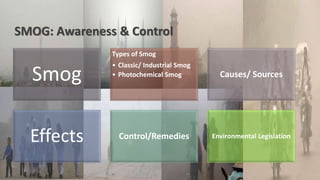
SMOG: Awareness & Control
Smog
Types of Smog
• Classic/ Industrial Smog
• Photochemical Smog Causes/ Sources
Effects Control/Remedies Environmental Legislation
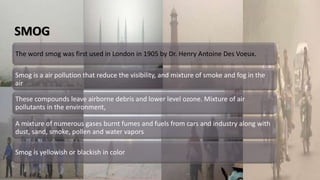
SMOG
The word smog was first used in London in 1905 by Dr. Henry Antoine Des Voeux.
Smog is a air pollution that reduce the visibility, and mixture of smoke and fog in the
air
These compounds leave airborne debris and lower level ozone. Mixture of air
pollutants in the environment,
A mixture of numerous gases burnt fumes and fuels from cars and industry along with
dust, sand, smoke, pollen and water vapors
Smog is yellowish or blackish in color
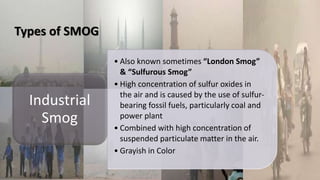
Types of SMOG
• Also known sometimes “London Smog”
& “Sulfurous Smog”
• High concentration of sulfur oxides in
the air and is caused by the use of sulfur-
bearing fossil fuels, particularly coal and
power plant
• Combined with high concentration of
suspended particulate matter in the air.
• Grayish in Color
Industrial
Smog
Types of SMOG
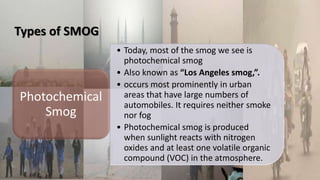
• Today, most of the smog we see is
photochemical smog
• Also known as “Los Angeles smog,”.
• occurs most prominently in urban
areas that have large numbers of
automobiles. It requires neither smoke
nor fog
• Photochemical smog is produced
when sunlight reacts with nitrogen
oxides and at least one volatile organic
compound (VOC) in the atmosphere.
Photochemical
Smog
Types of SMOG
• Nitrogen oxides come from car
exhaust, coal power plants, and
factory emissions. VOCs are released
from gasoline, paints, and many
cleaning solvents.
• When sunlight hits these chemicals,
they form airborne particles and
ground-level ozone—or smog.
• Brownish in Color
Photochemical
Smog
• Barbecues and domestic emissions
• Increasingly high polluted environment.
• Large number of factories, heavy traffic,
extraordinary construction work and
unchecked cutting of trees due to
urbanization
• There are around 20,000 brick kilns in
Pakistan. Many are located around urban
areas and contribute significantly to air
pollution
• Lawnmowers, oil based solvent, Paints and
Cleaners
• Pesticides, Pollutants carried by the winds
Causes/Sources
• Open residue burning is a common
practice in many areas of the world
including China, India, Pakistan, Nepal,
and Indonesia
• Every year in October to November
farmers burns crop residues after
harvesting which results in poor air
quality in the region of Punjab
• Levels of particulate matter (PM2.5) in
Lahore touched levels of 1,077
micrograms per cubic meter whereas
permissible limit in Pakistan is 35 µg/m3
(WHO).
Causes/Sources
• Seven million people die every year
from the effects of air pollution. More
than 90% of such deaths are in
developing countries
• Ground level ozone present in the smog
also inhibits plant growth and causes
immense damage to crops and forests.
Crops, vegetables like soybeans, wheat,
tomatoes, peanuts, and cotton are
subject to infection when they are
exposed to smog
Effects
• Smog is unhealthy to humans and
animals, and it can kill plants. It makes
the sky brown or gray
• Heavy smog results in low production of
the crucial natural element vitamin D
leading to cases of rickets among
people.
• Eye, nose and throat irritation,
Decreased lung function, Aggravation of
respiratory or heart disease, in some
cases death
Effects
• Urban Plantation
• Conserve energy at home, at work, everywhere
• Drive less. Walk, bike, carpool, and use public
transportation whenever possible
• Take care of cars. Getting regular tune-ups,
changing oil on schedule, and inflating tires to the
proper level can improve gas mileage and reduce
emissions.
• Fuel up during the cooler hours of the day—night
or early morning. This prevents gas fumes from
heating up and producing ozone.
Control/Remedies
• Look for the Energy Star label when
buying equipment for office and home
.
• Use Environment friendly and low-VOC
paints and cleaning products.
• Avoid gas-powered yard equipment,
Use electric appliances instead.
• Mulch or compost leave and yard
waste, avoid burn trash and other
material openly
Control/Remedies
• Go for EIA/IEE for Chemical, Textile,
Manufacturing, Construction, Oil & Gas
Industries and Power plants
• Carbon Credits
• UFOR Models
• OSH & ISO Quality and Quantity Standards
• Air Pollutant Criteria NAAQS
• Polluter Pays Policies
• Strongly Implement Environmental
legislation
Environmental
Legislation
Smog

Smog

  • 1.
  • 2.
    SMOG: Awareness &Control Smog Types of Smog • Classic/ Industrial Smog • Photochemical Smog Causes/ Sources Effects Control/Remedies Environmental Legislation
  • 4.
    SMOG The word smogwas first used in London in 1905 by Dr. Henry Antoine Des Voeux. Smog is a air pollution that reduce the visibility, and mixture of smoke and fog in the air These compounds leave airborne debris and lower level ozone. Mixture of air pollutants in the environment, A mixture of numerous gases burnt fumes and fuels from cars and industry along with dust, sand, smoke, pollen and water vapors Smog is yellowish or blackish in color
  • 5.
    Types of SMOG •Also known sometimes “London Smog” & “Sulfurous Smog” • High concentration of sulfur oxides in the air and is caused by the use of sulfur- bearing fossil fuels, particularly coal and power plant • Combined with high concentration of suspended particulate matter in the air. • Grayish in Color Industrial Smog
  • 6.
    Types of SMOG •Today, most of the smog we see is photochemical smog • Also known as “Los Angeles smog,”. • occurs most prominently in urban areas that have large numbers of automobiles. It requires neither smoke nor fog • Photochemical smog is produced when sunlight reacts with nitrogen oxides and at least one volatile organic compound (VOC) in the atmosphere. Photochemical Smog
  • 7.
    Types of SMOG •Nitrogen oxides come from car exhaust, coal power plants, and factory emissions. VOCs are released from gasoline, paints, and many cleaning solvents. • When sunlight hits these chemicals, they form airborne particles and ground-level ozone—or smog. • Brownish in Color Photochemical Smog
  • 8.
    • Barbecues anddomestic emissions • Increasingly high polluted environment. • Large number of factories, heavy traffic, extraordinary construction work and unchecked cutting of trees due to urbanization • There are around 20,000 brick kilns in Pakistan. Many are located around urban areas and contribute significantly to air pollution • Lawnmowers, oil based solvent, Paints and Cleaners • Pesticides, Pollutants carried by the winds Causes/Sources
  • 9.
    • Open residueburning is a common practice in many areas of the world including China, India, Pakistan, Nepal, and Indonesia • Every year in October to November farmers burns crop residues after harvesting which results in poor air quality in the region of Punjab • Levels of particulate matter (PM2.5) in Lahore touched levels of 1,077 micrograms per cubic meter whereas permissible limit in Pakistan is 35 µg/m3 (WHO). Causes/Sources
  • 10.
    • Seven millionpeople die every year from the effects of air pollution. More than 90% of such deaths are in developing countries • Ground level ozone present in the smog also inhibits plant growth and causes immense damage to crops and forests. Crops, vegetables like soybeans, wheat, tomatoes, peanuts, and cotton are subject to infection when they are exposed to smog Effects
  • 11.
    • Smog isunhealthy to humans and animals, and it can kill plants. It makes the sky brown or gray • Heavy smog results in low production of the crucial natural element vitamin D leading to cases of rickets among people. • Eye, nose and throat irritation, Decreased lung function, Aggravation of respiratory or heart disease, in some cases death Effects
  • 12.
    • Urban Plantation •Conserve energy at home, at work, everywhere • Drive less. Walk, bike, carpool, and use public transportation whenever possible • Take care of cars. Getting regular tune-ups, changing oil on schedule, and inflating tires to the proper level can improve gas mileage and reduce emissions. • Fuel up during the cooler hours of the day—night or early morning. This prevents gas fumes from heating up and producing ozone. Control/Remedies
  • 13.
    • Look forthe Energy Star label when buying equipment for office and home . • Use Environment friendly and low-VOC paints and cleaning products. • Avoid gas-powered yard equipment, Use electric appliances instead. • Mulch or compost leave and yard waste, avoid burn trash and other material openly Control/Remedies
  • 14.
    • Go forEIA/IEE for Chemical, Textile, Manufacturing, Construction, Oil & Gas Industries and Power plants • Carbon Credits • UFOR Models • OSH & ISO Quality and Quantity Standards • Air Pollutant Criteria NAAQS • Polluter Pays Policies • Strongly Implement Environmental legislation Environmental Legislation