Air Pollution -Solutions
•India is Leading in Air pollution as per the Annual
Environmental Performance Index
•Two Major Pollution control measures
•Input Control - Prevention
•Output Control - Cure
2.
Control By Equipment
•Reduction of pollutant discharge at the source by the
application of the control equipment.
• Reduction at the source through raw material changes,
operational changes, or modification, or replacement of
process equipment.
• Dilution of the source discharge by the use of all tall stacks.
• Dispersion of source locations through allocation of land
usage, i.e. proper planning and zoning of industrial areas.
3.
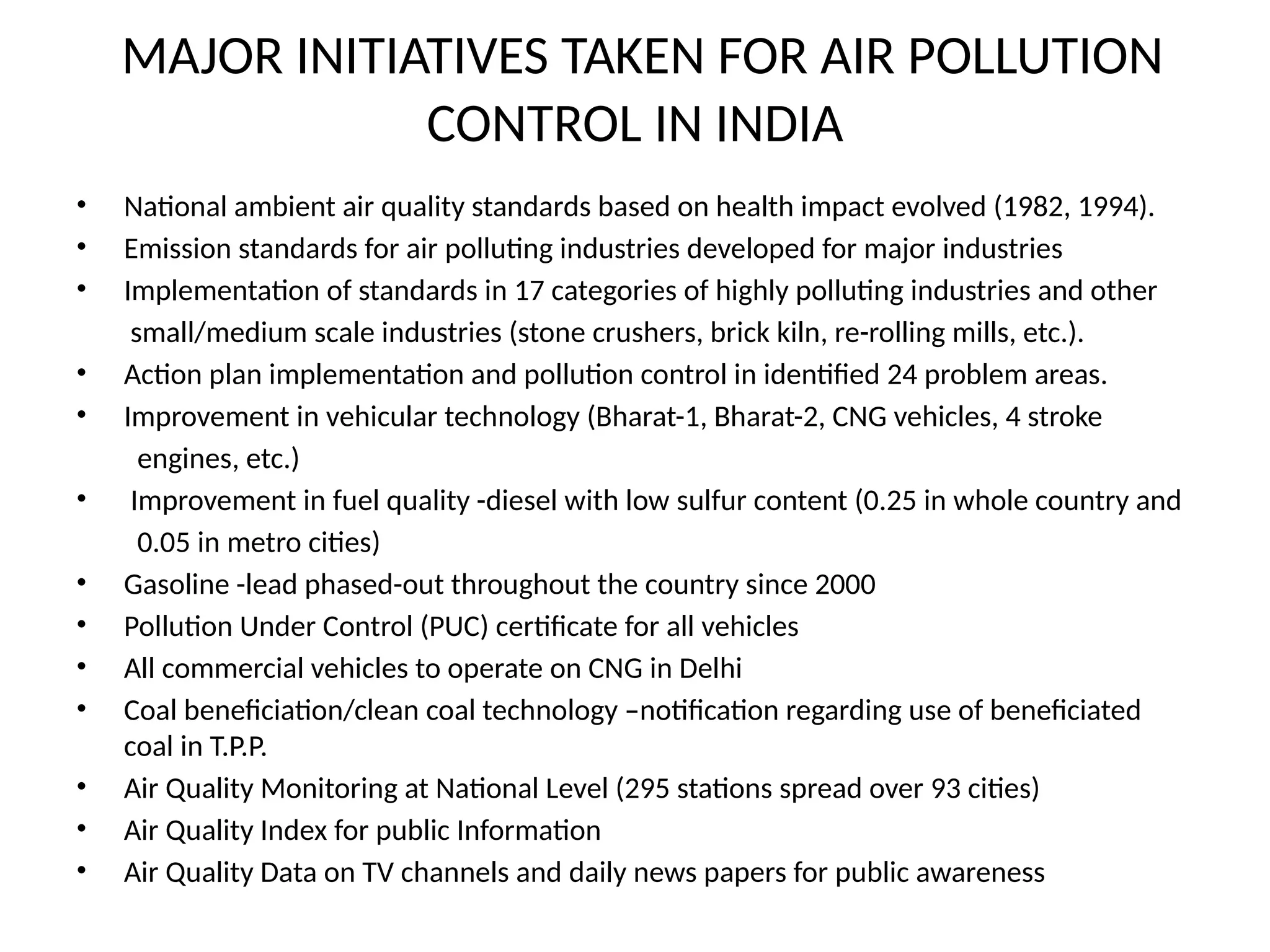
MAJOR INITIATIVES TAKENFOR AIR POLLUTION
CONTROL IN INDIA
• National ambient air quality standards based on health impact evolved (1982, 1994).
• Emission standards for air polluting industries developed for major industries
• Implementation of standards in 17 categories of highly polluting industries and other
small/medium scale industries (stone crushers, brick kiln, re-rolling mills, etc.).
• Action plan implementation and pollution control in identified 24 problem areas.
• Improvement in vehicular technology (Bharat-1, Bharat-2, CNG vehicles, 4 stroke
engines, etc.)
• Improvement in fuel quality -diesel with low sulfur content (0.25 in whole country and
0.05 in metro cities)
• Gasoline -lead phased-out throughout the country since 2000
• Pollution Under Control (PUC) certificate for all vehicles
• All commercial vehicles to operate on CNG in Delhi
• Coal beneficiation/clean coal technology –notification regarding use of beneficiated
coal in T.P.P.
• Air Quality Monitoring at National Level (295 stations spread over 93 cities)
• Air Quality Index for public Information
• Air Quality Data on TV channels and daily news papers for public awareness
4.
EMERGING NEW AREASFOR AIR POLLUTION
CONTROL IN INDIA
• Development of Low Cost ash removal technology from Coal and promotion of Clean
• Coal Technologies (IGCC, PFBC, etc.)
• Technology for reduction of Fluoride emission (primary & Secondary) from pot room
Development of NOx control Standard for Thermal Power Plants and Refineries
• Prevention and control of Fugitive Emission in Cement Industry, development of good
practice guidelines
• Use of high calorific value Hazardous Waste including Petroleum Coke in Cement Kiln
• Low Cost Flue Gas Desulphurization Technology for Thermal Power Plants
• Technology Development of Fugitive Emission Control from Coke Oven Plants of Iron
& Steel Industry (PLL, PLD)
• Development of Technology and Standard to control emission of VOC, Methyl Chloride,
P2O5, HCl etc. From Pesticide Industry
• Development of Odor Control Technology for Paper & Pulp industry and Standardization
the method of odor measurement
• Fluidized Bed Combustion (FBC/CFBC) technology for Solid Fuel containing Higher Ash
• Low Cost Flue Gas Desulphurization Technology for Thermal Power Plants
• Technology Development of Fugitive Emission Control from Coke Oven Plants of Iron
& Steel Industry (PLL, PLD)
5.
Conclusion
• Monitoring ofair quality has increased over the
years
• Dissemination of Information on Air Quality Data
through Media
• Judicial Support
• Legal Framework should be established