Suction cleaners
Selectives & fundamentals
SUCTION CLEANERS
(Also popularly known as vacuum Cleaners)


     WHAT IS VACUUM ??
 Vacuum is space which has no matter in it, ie any space
in which pressure is lower than atmosphere pressure
Atmospheric pressure is –

          1 kg/sq.cm    :1 bar :760 nun of mercury
          :10,000 mm of water :1,01.350 pascal
Principle utilized by Vacuum Cleaner
_____________________________________________________________


 All liquids & gases flow from high                               pressure
area to low pressure area.

Common Example : Drinking thru a straw

                   Volume of air
It is the quantity of air in liters for a given unit of time, which enters the vacuum
cleaner or which the fans exhaust.
1000 liters : 1 cu.m.
3600 seconds : 1 hour
e.g. 35 liters/s = 126 cu.m/lh = 0.277 liters/s
OUR PRODUCTS RANGE

R Single Phase – commercial & Industrial

      R Three Phase-Industrial

         R Centra-Vac Solutions
Features to understand in a Suction Cleaner
_____________________________________________________________

    MOTOR
    FILTER
    BODY
    ACCESSORY
    MOBILITY
    WEIGHT
    CONTAINER CAPACITY
    SOUND LEVEL
    AIRFLOW
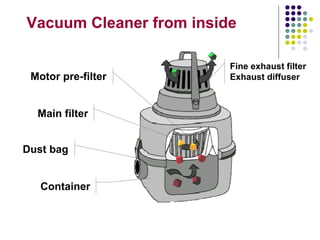
Vacuum Cleaner from inside

                         Fine exhaust filter
 Motor pre-filter        Exhaust diffuser


  Main filter


Dust bag


   Container
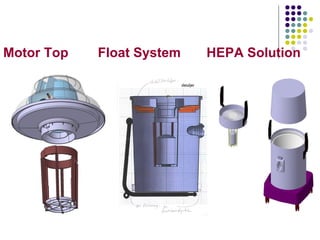
Motor Top   Float System   HEPA Solution
TYPES OF SUCTION CLEANER
_____________________________________________________________


 BY CAPABILITY  DRY TYPE
                        WET & DRY TYPE


 BY CAPACITY            COMMERCIAL (Mobile)
                        INDUSTRIAL (Mobile)
                        FIXED INSTALLATION


 BY POWER               SINGLE PHASE (230 V)
                        THREE PHASE (440 V)


 BY DESIGN              CANNISTER TYPE
                        UPRIGHT TYPE
Explanation of Parameters
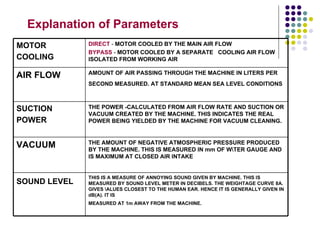
MOTOR         DIRECT - MOTOR COOLED BY THE MAIN AIR FLOW
              BYPASS - MOTOR COOLED BY A SEPARATE COOLING AIR FLOW
COOLING       ISOLATED FROM WORKING AIR

              AMOUNT OF AIR PASSING THROUGH THE MACHINE IN LITERS PER
AIR FLOW
              SECOND MEASURED. AT STANDARD MEAN SEA LEVEL CONDITIONS


SUCTION       THE POWER -CALCULATED FROM AIR FLOW RATE AND SUCTION OR
              VACUUM CREATED BY THE MACHINE. THIS INDICATES THE REAL
POWER         POWER BEING YIELDED BY THE MACHINE FOR VACUUM CLEANING.


              THE AMOUNT OF NEGATIVE ATMOSPHERIC PRESSURE PRODUCED
VACUUM        BY THE MACHINE. THIS IS MEASURED IN mm OF WTER GAUGE AND
              IS MAXIMUM AT CLOSED AIR INTAKE


              THIS IS A MEASURE OF ANNOYING SOUND GIVEN BY MACHINE. THIS lS
SOUND LEVEL   MEASURED BY SOUND LEVEL METER IN DECIBELS. THE WEIGHTAGE CURVE 8A.
              GIVES ALUES CLOSEST TO THE HUMAN EAR. HENCE IT IS GENERALLY GIVEN IN
              dB(A). IT IS
              MEASURED AT 1m AWAY FROM THE MACHINE.
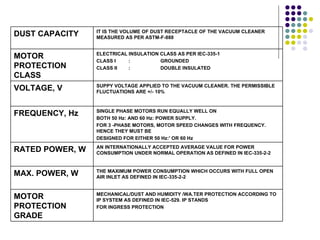
IT IS THE VOLUME OF DUST RECEPTACLE OF THE VACUUM CLEANER
DUST CAPACITY    MEASURED AS PER ASTM-F-888


                 ELECTRICAL INSULATION CLASS AS PER IEC-335-1
MOTOR            CLASS I    :          GROUNDED
PROTECTION       CLASS II   :          DOUBLE INSULATED
CLASS
                 SUPPY VOLTAGE APPLIED TO THE VACUUM CLEANER. THE PERMISSIBLE
VOLTAGE, V       FLUCTUATIONS ARE +/- 10%


                 SINGLE PHASE MOTORS RUN EQUALLY WELL ON
FREQUENCY, Hz    BOTH 50 Hz: AND 60 Hz: POWER SUPPLY.
                 FOR 3 -PHASE MOTORS, MOTOR SPEED CHANGES WITH FREQUENCY.
                 HENCE THEY MUST BE
                 DESIGNED FOR EITHER 50 Hz:' OR 60 Hz
                 AN INTERNATIONALLY ACCEPTED AVERAGE VALUE FOR POWER
RATED POWER, W   CONSUMPTION UNDER NORMAL OPERATION AS DEFINED IN IEC-335-2-2


                 THE MAXIMUM POWER CONSUMPTION WHICH OCCURS WITH FULL OPEN
MAX. POWER, W    AIR INLET AS DEFINED IN IEC-335-2-2


                 MECHANICAL/DUST AND HUMIDITY /WA.TER PROTECTION ACCORDING TO
MOTOR            IP SYSTEM AS DEFINED IN IEC-529. IP STANDS
PROTECTION       FOR INGRESS PROTECTION
GRADE
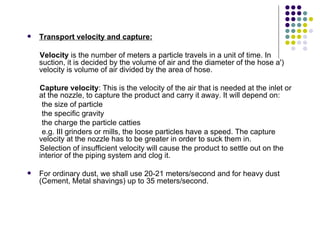
   Transport velocity and capture:

    Velocity is the number of meters a particle travels in a unit of time. In
    suction, it is decided by the volume of air and the diameter of the hose a')
    velocity is volume of air divided by the area of hose.

    Capture velocity: This is the velocity of the air that is needed at the inlet or
    at the nozzle, to capture the product and carry it away. It will depend on:
     the size of particle
     the specific gravity
     the charge the particle catties
     e.g. III grinders or mills, the loose particles have a speed. The capture
    velocity at the nozzle has to be greater in order to suck them in.
    Selection of insufficient velocity will cause the product to settle out on the
    interior of the piping system and clog it.

   For ordinary dust, we shall use 20-21 meters/second and for heavy dust
    (Cement, Metal shavings) up to 35 meters/second.
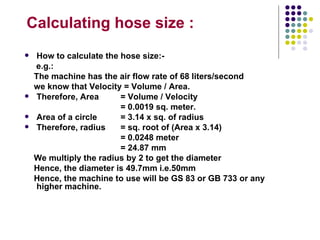
Calculating hose size :
    How to calculate the hose size:-
    e.g.:
    The machine has the air flow rate of 68 liters/second
    we know that Velocity = Volume / Area.
    Therefore, Area      = Volume / Velocity
                          = 0.0019 sq. meter.
    Area of a circle     = 3.14 x sq. of radius
    Therefore, radius    = sq. root of (Area x 3.14)
                          = 0.0248 meter
                          = 24.87 mm
    We multiply the radius by 2 to get the diameter
    Hence, the diameter is 49.7mm i.e.50mm
    Hence, the machine to use will be GS 83 or GB 733 or any
     higher machine.
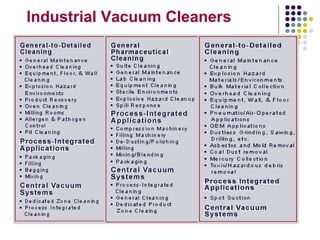
Industrial Vacuum Cleaners
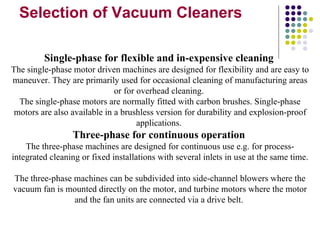
Selection of Vacuum Cleaners

         Single-phase for flexible and in-expensive cleaning
The single-phase motor driven machines are designed for flexibility and are easy to
maneuver. They are primarily used for occasional cleaning of manufacturing areas
                              or for overhead cleaning.
  The single-phase motors are normally fitted with carbon brushes. Single-phase
 motors are also available in a brushless version for durability and explosion-proof
                                     applications.
                 Three-phase for continuous operation
    The three-phase machines are designed for continuous use e.g. for process-
integrated cleaning or fixed installations with several inlets in use at the same time.

The three-phase machines can be subdivided into side-channel blowers where the
vacuum fan is mounted directly on the motor, and turbine motors where the motor
                and the fan units are connected via a drive belt.
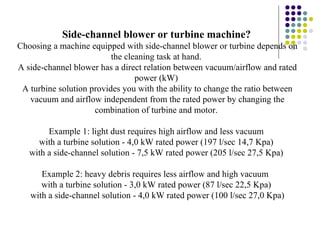
Side-channel blower or turbine machine?
Choosing a machine equipped with side-channel blower or turbine depends on
                          the cleaning task at hand.
A side-channel blower has a direct relation between vacuum/airflow and rated
                                 power (kW)
 A turbine solution provides you with the ability to change the ratio between
   vacuum and airflow independent from the rated power by changing the
                     combination of turbine and motor.

        Example 1: light dust requires high airflow and less vacuum
     with a turbine solution - 4,0 kW rated power (197 l/sec 14,7 Kpa)
   with a side-channel solution - 7,5 kW rated power (205 l/sec 27,5 Kpa)

      Example 2: heavy debris requires less airflow and high vacuum
      with a turbine solution - 3,0 kW rated power (87 l/sec 22,5 Kpa)
   with a side-channel solution - 4,0 kW rated power (100 l/sec 27,0 Kpa)
ADVANTAGES OF USING SUCTION CLEANER
___________________________________________
_
¾ Ease of cleaning
¾ One time cleaning with no displacement of dust
   from one place to another
¾ Removal of fine & embedded dust particles.

¾ Friendly towards the operator

¾ Enhanced company image.
¾ Can be utilized for material retrieval & save
  wastages
LOTS OF KNOWLEDGE
WITH LOTS MORE TO LEARN

 THESE ARE THE TOOLS
 WHICH WILL HELP US EARN

BEST WAY TO GET STARTED
IS TO REVISE,
PRACTISE,
DEMONSTRATE

Vacuum cleaners

  • 1.
  • 2.
    SUCTION CLEANERS (Also popularlyknown as vacuum Cleaners) WHAT IS VACUUM ?? Vacuum is space which has no matter in it, ie any space in which pressure is lower than atmosphere pressure Atmospheric pressure is – 1 kg/sq.cm :1 bar :760 nun of mercury :10,000 mm of water :1,01.350 pascal
  • 3.
    Principle utilized byVacuum Cleaner _____________________________________________________________ All liquids & gases flow from high pressure area to low pressure area. Common Example : Drinking thru a straw Volume of air It is the quantity of air in liters for a given unit of time, which enters the vacuum cleaner or which the fans exhaust. 1000 liters : 1 cu.m. 3600 seconds : 1 hour e.g. 35 liters/s = 126 cu.m/lh = 0.277 liters/s
  • 4.
    OUR PRODUCTS RANGE RSingle Phase – commercial & Industrial R Three Phase-Industrial R Centra-Vac Solutions
  • 5.
    Features to understandin a Suction Cleaner _____________________________________________________________  MOTOR  FILTER  BODY  ACCESSORY  MOBILITY  WEIGHT  CONTAINER CAPACITY  SOUND LEVEL  AIRFLOW
  • 6.
    Vacuum Cleaner frominside Fine exhaust filter Motor pre-filter Exhaust diffuser Main filter Dust bag Container
  • 7.
    Motor Top Float System HEPA Solution
  • 8.
    TYPES OF SUCTIONCLEANER _____________________________________________________________  BY CAPABILITY  DRY TYPE  WET & DRY TYPE  BY CAPACITY  COMMERCIAL (Mobile)  INDUSTRIAL (Mobile)  FIXED INSTALLATION  BY POWER  SINGLE PHASE (230 V)  THREE PHASE (440 V)  BY DESIGN  CANNISTER TYPE  UPRIGHT TYPE
  • 9.
    Explanation of Parameters MOTOR DIRECT - MOTOR COOLED BY THE MAIN AIR FLOW BYPASS - MOTOR COOLED BY A SEPARATE COOLING AIR FLOW COOLING ISOLATED FROM WORKING AIR AMOUNT OF AIR PASSING THROUGH THE MACHINE IN LITERS PER AIR FLOW SECOND MEASURED. AT STANDARD MEAN SEA LEVEL CONDITIONS SUCTION THE POWER -CALCULATED FROM AIR FLOW RATE AND SUCTION OR VACUUM CREATED BY THE MACHINE. THIS INDICATES THE REAL POWER POWER BEING YIELDED BY THE MACHINE FOR VACUUM CLEANING. THE AMOUNT OF NEGATIVE ATMOSPHERIC PRESSURE PRODUCED VACUUM BY THE MACHINE. THIS IS MEASURED IN mm OF WTER GAUGE AND IS MAXIMUM AT CLOSED AIR INTAKE THIS IS A MEASURE OF ANNOYING SOUND GIVEN BY MACHINE. THIS lS SOUND LEVEL MEASURED BY SOUND LEVEL METER IN DECIBELS. THE WEIGHTAGE CURVE 8A. GIVES ALUES CLOSEST TO THE HUMAN EAR. HENCE IT IS GENERALLY GIVEN IN dB(A). IT IS MEASURED AT 1m AWAY FROM THE MACHINE.
  • 10.
    IT IS THEVOLUME OF DUST RECEPTACLE OF THE VACUUM CLEANER DUST CAPACITY MEASURED AS PER ASTM-F-888 ELECTRICAL INSULATION CLASS AS PER IEC-335-1 MOTOR CLASS I : GROUNDED PROTECTION CLASS II : DOUBLE INSULATED CLASS SUPPY VOLTAGE APPLIED TO THE VACUUM CLEANER. THE PERMISSIBLE VOLTAGE, V FLUCTUATIONS ARE +/- 10% SINGLE PHASE MOTORS RUN EQUALLY WELL ON FREQUENCY, Hz BOTH 50 Hz: AND 60 Hz: POWER SUPPLY. FOR 3 -PHASE MOTORS, MOTOR SPEED CHANGES WITH FREQUENCY. HENCE THEY MUST BE DESIGNED FOR EITHER 50 Hz:' OR 60 Hz AN INTERNATIONALLY ACCEPTED AVERAGE VALUE FOR POWER RATED POWER, W CONSUMPTION UNDER NORMAL OPERATION AS DEFINED IN IEC-335-2-2 THE MAXIMUM POWER CONSUMPTION WHICH OCCURS WITH FULL OPEN MAX. POWER, W AIR INLET AS DEFINED IN IEC-335-2-2 MECHANICAL/DUST AND HUMIDITY /WA.TER PROTECTION ACCORDING TO MOTOR IP SYSTEM AS DEFINED IN IEC-529. IP STANDS PROTECTION FOR INGRESS PROTECTION GRADE
  • 11.
    Transport velocity and capture: Velocity is the number of meters a particle travels in a unit of time. In suction, it is decided by the volume of air and the diameter of the hose a') velocity is volume of air divided by the area of hose. Capture velocity: This is the velocity of the air that is needed at the inlet or at the nozzle, to capture the product and carry it away. It will depend on: the size of particle the specific gravity the charge the particle catties e.g. III grinders or mills, the loose particles have a speed. The capture velocity at the nozzle has to be greater in order to suck them in. Selection of insufficient velocity will cause the product to settle out on the interior of the piping system and clog it.  For ordinary dust, we shall use 20-21 meters/second and for heavy dust (Cement, Metal shavings) up to 35 meters/second.
  • 12.
    Calculating hose size:  How to calculate the hose size:- e.g.: The machine has the air flow rate of 68 liters/second we know that Velocity = Volume / Area.  Therefore, Area = Volume / Velocity = 0.0019 sq. meter.  Area of a circle = 3.14 x sq. of radius  Therefore, radius = sq. root of (Area x 3.14) = 0.0248 meter = 24.87 mm We multiply the radius by 2 to get the diameter Hence, the diameter is 49.7mm i.e.50mm Hence, the machine to use will be GS 83 or GB 733 or any higher machine.
  • 13.
  • 14.
    Selection of VacuumCleaners Single-phase for flexible and in-expensive cleaning The single-phase motor driven machines are designed for flexibility and are easy to maneuver. They are primarily used for occasional cleaning of manufacturing areas or for overhead cleaning. The single-phase motors are normally fitted with carbon brushes. Single-phase motors are also available in a brushless version for durability and explosion-proof applications. Three-phase for continuous operation The three-phase machines are designed for continuous use e.g. for process- integrated cleaning or fixed installations with several inlets in use at the same time. The three-phase machines can be subdivided into side-channel blowers where the vacuum fan is mounted directly on the motor, and turbine motors where the motor and the fan units are connected via a drive belt.
  • 15.
    Side-channel blower orturbine machine? Choosing a machine equipped with side-channel blower or turbine depends on the cleaning task at hand. A side-channel blower has a direct relation between vacuum/airflow and rated power (kW) A turbine solution provides you with the ability to change the ratio between vacuum and airflow independent from the rated power by changing the combination of turbine and motor. Example 1: light dust requires high airflow and less vacuum with a turbine solution - 4,0 kW rated power (197 l/sec 14,7 Kpa) with a side-channel solution - 7,5 kW rated power (205 l/sec 27,5 Kpa) Example 2: heavy debris requires less airflow and high vacuum with a turbine solution - 3,0 kW rated power (87 l/sec 22,5 Kpa) with a side-channel solution - 4,0 kW rated power (100 l/sec 27,0 Kpa)
  • 16.
    ADVANTAGES OF USINGSUCTION CLEANER ___________________________________________ _ ¾ Ease of cleaning ¾ One time cleaning with no displacement of dust from one place to another ¾ Removal of fine & embedded dust particles. ¾ Friendly towards the operator ¾ Enhanced company image. ¾ Can be utilized for material retrieval & save wastages
  • 17.
    LOTS OF KNOWLEDGE WITHLOTS MORE TO LEARN THESE ARE THE TOOLS WHICH WILL HELP US EARN BEST WAY TO GET STARTED IS TO REVISE, PRACTISE, DEMONSTRATE

Editor's Notes

  • #5 it have fourpoints.