Air is theEarth's atmosphere.
It is the clear gas in which living things
live and breathe.
It has an indefinite shape and volume.
It has no color or smell.
It has mass and weight. It is a matter as
it has mass and weight. Air
creates atmosphere pressure.
3.
What is airpollutants?
• A substance in the air that can cause
harm to humans and the environment
is known as an air pollutant. Pollutants
can be in the form of solid particles,
liquid droplets, or gases. In addition,
they may be natural or man-made.
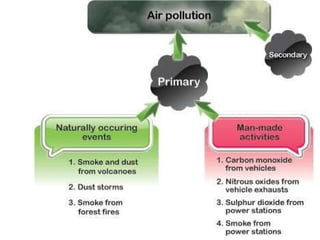
There are twotypes of
pollutants:
Primary pollutants
Secondary pollutants
11.
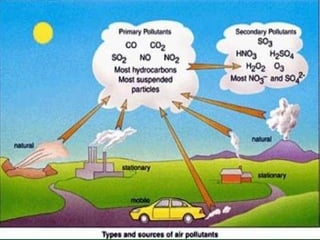
Primary
pollutants:
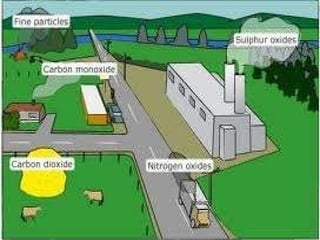
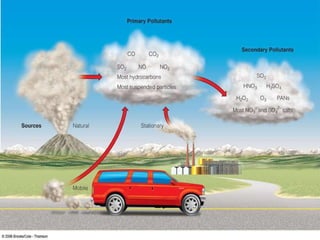
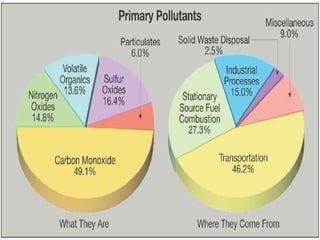
Primary pollutants arethose gases or
particles that are pumped into the air to
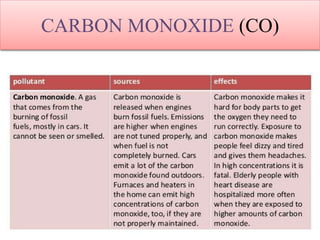
make it unclean. They include carbon
monoxide from automobile (cars) exhausts
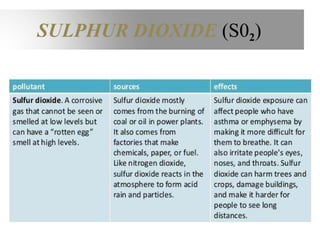
and sulfur dioxide from the combustion of
coal. Primarily air pollutants can be caused
by primary sources or secondary sources.
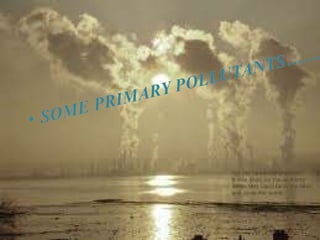
The pollutants that are a direct result of the
process can be called primary pollutants. A
classic example of a primary pollutant would
be the sulfur-dioxide emitted from
factories
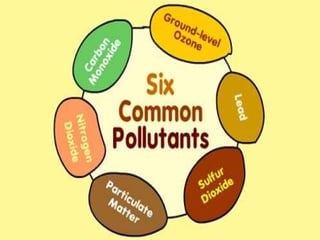
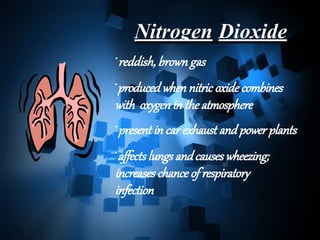
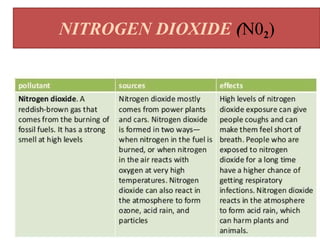
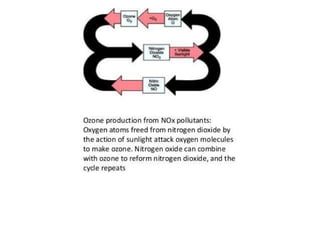
Nitrogen Dioxide
•reddish, browngas
•produced when nitric oxide combines
with oxygen in the atmosphere
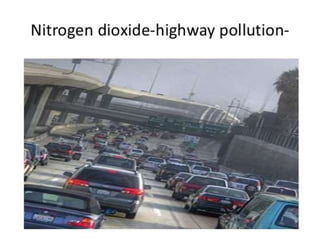
•present in car exhaust and power plants
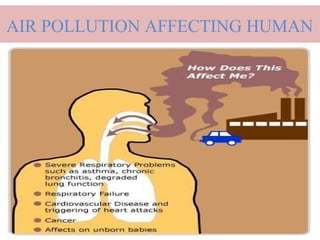
•affects lungs andcauses wheezing;
increases chance of respiratory
infection
Secondary
pollutants:
When pollutants inthe air mix up in a
chemical reaction, they form an even more
dangerous chemical. Photochemical smog
is an example of this, and is a secondary
pollutant. Secondary pollutants are the
ones that are caused by the inter mingling
and reactions of primary pollutants.
Smog created by the interactions of several
primary pollutants is known to be as
secondary pollutant.
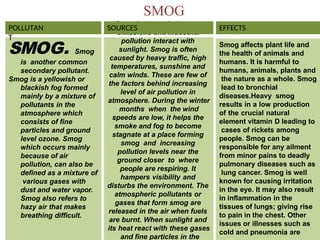
SMOG
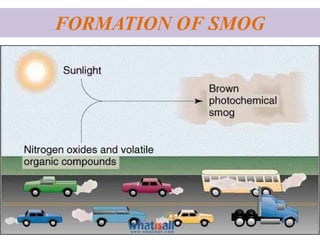
Smog is causedwhen car
emissions and industrial
pollution interact with
sunlight. Smog is often
caused by heavy traffic, high
temperatures, sunshine and
calm winds. These are few of
the factors behind increasing
level of air pollution in
atmosphere. During the winter
months when the wind
speeds are low, it helps the
smoke and fog to become
stagnate at a place forming
smog and increasing
pollution levels near the
ground closer to where
people are respiring. It
hampers visibility and
disturbs the environment. The
atmospheric pollutants or
gases that form smog are
released in the air when fuels
are burnt. When sunlight and
its heat react with these gases
and fine particles in the
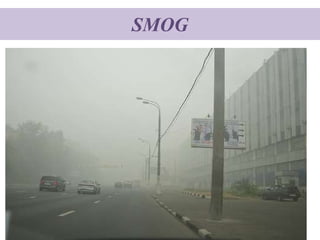
SMOG. Smog
is another common
secondary pollutant.
Smog is a yellowish or
blackish fog formed
mainly by a mixture of
pollutants in the
atmosphere which
consists of fine
particles and ground
level ozone. Smog
which occurs mainly
because of air
pollution, can also be
defined as a mixture of
various gases with
dust and water vapor.
Smog also refers to
hazy air that makes
breathing difficult.
POLLUTAN
T
SOURCES EFFECTS
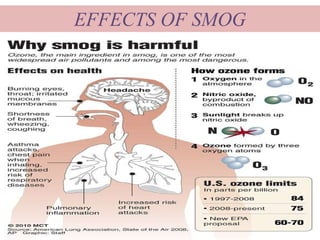
Smog affects plant life and
the health of animals and
humans. It is harmful to
humans, animals, plants and
the nature as a whole. Smog
lead to bronchial
diseases.Heavy smog
results in a low production
of the crucial natural
element vitamin D leading to
cases of rickets among
people. Smog can be
responsible for any ailment
from minor pains to deadly
pulmonary diseases such as
lung cancer. Smog is well
known for causing irritation
in the eye. It may also result
in inflammation in the
tissues of lungs; giving rise
to pain in the chest. Other
issues or illnesses such as
cold and pneumonia are
Any visible orinvisible particle or gas found in the air that
is not part of the original, normal composition.
Air pollution occurs when gases, dust particles, fumes (or
smoke) or odor are introduced into the atmosphere in a way
that makes it harmful to humans, animals and plant. This
is because the air becomes dirty (contaminated or unclean).
38.
The Earth issurrounded by a blanket of air (made up of various gases) called the
atmosphere. The atmosphere helps protect the Earth and allow life to exist. Without it,
we would be burned by the intense heat of the sun during the day or frozen by the
very low temperatures at night
.
Anything additional gas, particles or odors that are introduced into the air (either by
nature or human activity) to destroy this natural balance can be called air pollution.
Things that pollute the air are called pollutants. Examples of pollutants include nitrogen
oxides, carbon monoxides, hydrocarbons, sulphur oxides (usually from factories), sand or
dust particles, and organic compounds that can evaporate and enter the atmosphere.
What causes airpollution?
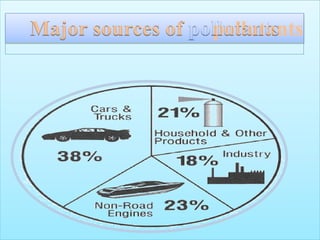
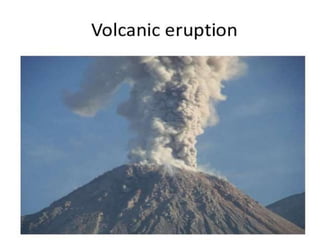
Air pollution can result from both human and natural
actions. Natural events that pollute the air include forest
fires, volcanic eruptions, wind erosion, pollen dispersal,
evaporation of organic compounds and natural radioactivity.
Pollution from natural occurrences are not very often.
42.
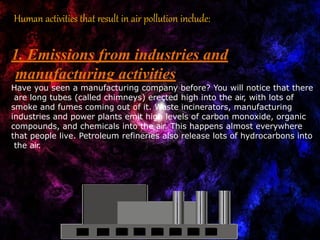
Human activities thatresult in air pollution include:
1. Emissions from industries and
manufacturing activities
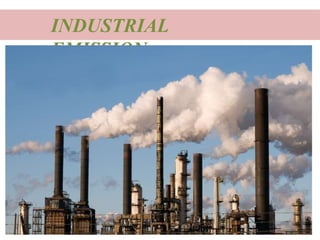
Have you seen a manufacturing company before? You will notice that there
are long tubes (called chimneys) erected high into the air, with lots of
smoke and fumes coming out of it. Waste incinerators, manufacturing
industries and power plants emit high levels of carbon monoxide, organic
compounds, and chemicals into the air. This happens almost everywhere
that people live. Petroleum refineries also release lots of hydrocarbons into
the air.
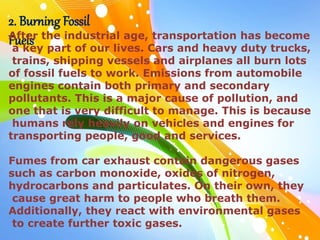
2. Burning Fossil
Fuels
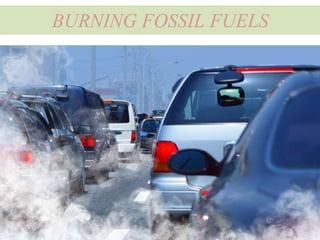
Afterthe industrial age, transportation has become
a key part of our lives. Cars and heavy duty trucks,
trains, shipping vessels and airplanes all burn lots
of fossil fuels to work. Emissions from automobile
engines contain both primary and secondary
pollutants. This is a major cause of pollution, and
one that is very difficult to manage. This is because
humans rely heavily on vehicles and engines for
transporting people, good and services.
Fumes from car exhaust contain dangerous gases
such as carbon monoxide, oxides of nitrogen,
hydrocarbons and particulates. On their own, they
cause great harm to people who breath them.
Additionally, they react with environmental gases
to create further toxic gases.
3.Agricultural activities:
Ammonia isa very common by product
from agriculture related activities and is
one of the most hazardous gases in the
atmosphere. Use of insecticides, pesticides
and fertilizers in agricultural activities
has grown quite a lot. They emit harmful
chemicals into the air and can also cause
water pollution.
4. Mining operations:
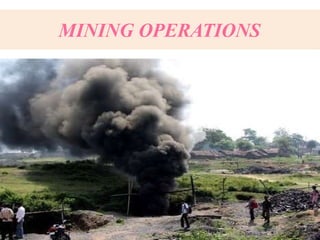
Miningis a process where in minerals
below the earth are extracted using large
equipments. During the process dust and
chemicals are released in the air causing
massive air pollution. This is one of the
reason which is responsible for the
deteriorating health conditions of workers
and nearby residents.
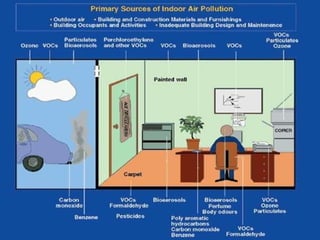
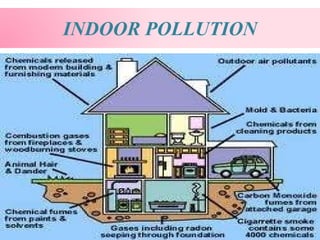
5. Indoor airpollution:
Household cleaning products, painting supplies emit
toxic chemicals in the air and cause air pollution. Have
you ever noticed that once you paint walls of your house,
it creates some sort of smell which makes it literally
impossible for you to breathe?
Suspended particulate matter popular by its acronym
SPM, is another cause of pollution. Referring to the
particles afloat in the air, SPM is usually caused by dust,
combustion etc.
Cooking and heating with solid fuels on open fires or
traditional stoves results in high levels of indoor air
pollution. Indoor smoke contains a range of health-
damaging pollutants, such as small particles and carbon
monoxide.
According to Global Health Risks: Mortality and burden
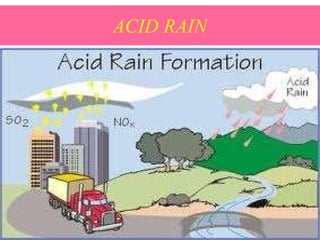
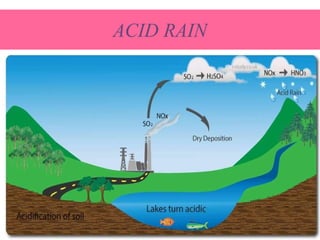
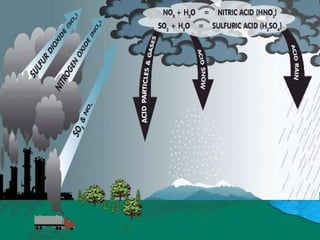
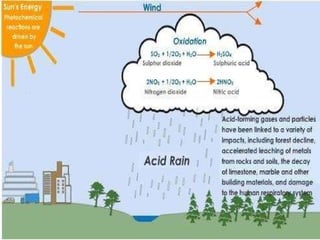
Acidification: Chemical reaction
involvingair pollutants can create acidic compounds
which can cause harm to vegetation and buildings.
Sometimes, when an air pollutant, such as sulfuric
acid combines with the water droplets that make up
clouds, the water droplets become acidic, forming acid
rain. When acid rain falls over an area, it can kill trees
and harm animals, fish, and other wildlife.
Acid rain destroys the leaves of plants.
When acid rain infiltrates into soils, it changes the
chemistry of the soil making it unfit for many living
things that rely on soil as a habitat or for nutrition.
Acid rain also changes the chemistry of the lakes and
streams that the rainwater flows into, harming fish
and other aquatic life.
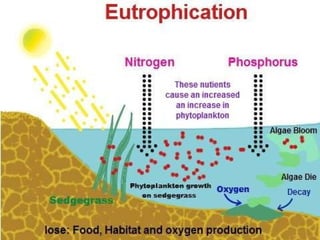
Eutrophication:
Rain can carryand deposit the Nitrogen in
some pollutants on rivers and soils. This
will adversely affect the nutrients in the
soil and water bodies. This can result in
algae growth in lakes and water bodies, and
make conditions for other living organism
harmful.
Eutrophication is a condition where high
amount of nitrogen present in some
pollutants gets developed on sea’s surface
and turns itself into algae and adversely
affects fish, plants and animal species. The
green
60.
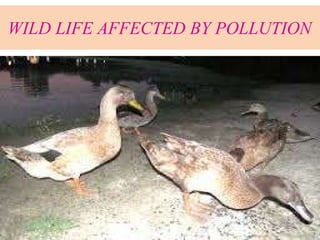
5.Effect on Wildlife:
•Just like humans, animals also
face some devastating effects
of air pollution. Toxic chemicals
present in the air can force
wildlife species to move to new
place and change their habitat.
The toxic pollutants deposit
over the surface of the water
and can also affect sea
animals.
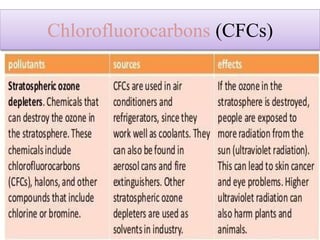
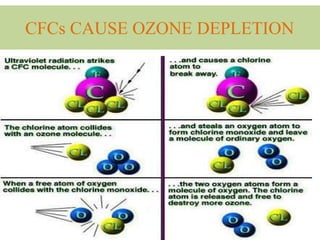
6. Depletion ofOzone
layer:
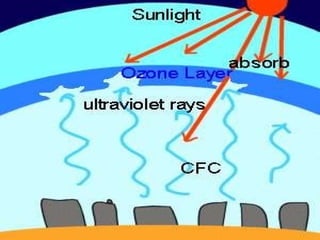
Ozone exists in earth’s stratosphere and is responsible
for protecting humans from harmful ultraviolet (UV)
rays. Earth’s ozone layer is depleting due to the
presence of chlorofluorocarbons, hydro
chlorofluorocarbons in the atmosphere. As ozone layer
will go thin, it will emit harmful rays back on earth
and can cause skin and eye related problems. UV rays
also have the capability to affect crops.
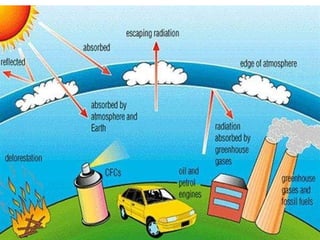
GREEN HOUSE EFFECTIn
the result of air pollution number of green
house gases are increase rapidly. The
man-made (or anthropogenic) component
of the greenhouse effect is caused by
man’s activities that emit greenhouse gases
to the atmosphere.
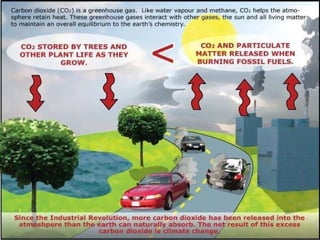
The most important of these is the burning
of fossil fuels. Fossil fuels contain
carbon, and when they are burnt this
carbon combines with oxygen in the
atmosphere to form carbon dioxide.
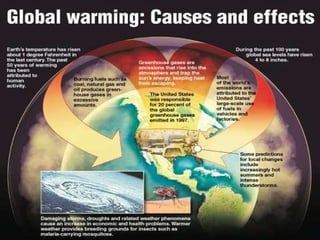
WHAT IS GLOBALWARMING
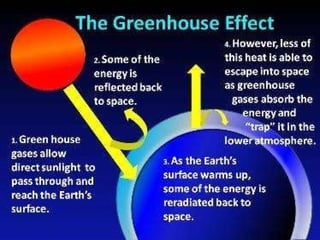
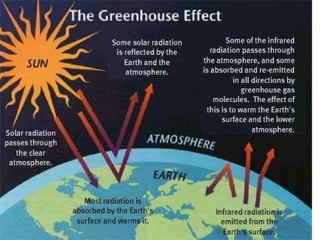
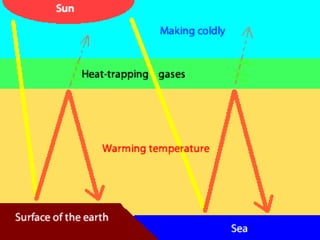
Global warming is an occurrence which results to the rise in the
average temperature of the earth's atmosphere. Due to extreme
pollution from factories and automobiles in the earth's atmosphere,
greenhouse gases like carbon dioxide and nitrous oxide form a thick
layer in the upper atmosphere and traps the sun's rays from being
reflected back to outer space. This eventually leads to a rise in
temperatures as the sun warms the earth. Global warming also called
the greenhouse effect occurs as a result of the gradual increase of
the air temperature in the earth's lower atmosphere. The gases from
the greenhouses escape to the atmosphere to form a blanket' that
prevents the suns radiations from going to the stratosphere thus
keeping the earth an average of 33 degrees centigrade warmer than
it would be if this greenhouse effect did not occur. Some green house
gases are like carbon dioxide, methane, Nitrous oxide and
Chlorofluorocarbons
77.
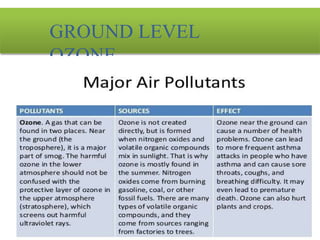
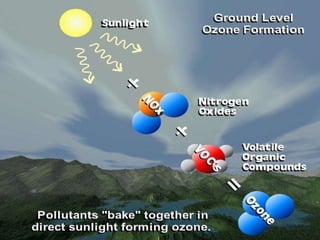
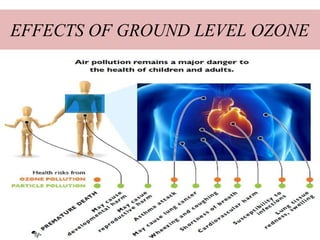
Ground-level ozone:
Chemical reactionsinvolving air
pollutants create a poisonous
gas ozone (O3). Gas Ozone can
affect people’s health and can
damage vegetation types and
some animal life too.
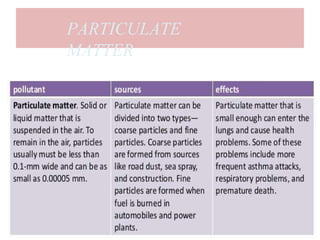
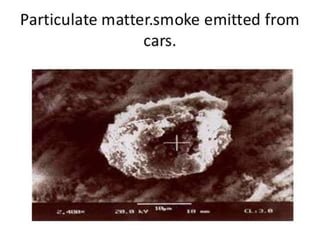
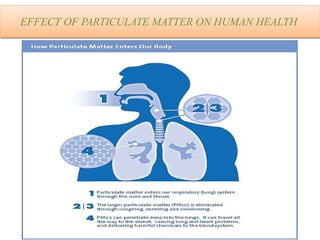
Particulate matter:
Air pollutantscan be in the form of particulate
matter which can be very harmful to our
health. The level of effect usually depends on
the length of time of exposure, as well the kind
and concentration of chemicals and particles
exposed to. Short-term effects include irritation
to the eyes, nose and throat, and upper
respiratory infections such as bronchitis and
pneumonia. Others include headaches, nausea,
and allergic reactions. Short-term air pollution
can aggravate the medical conditions of
individuals with asthma and emphysema. Long-
term health effects can include chronic
respiratory disease, lung cancer, heart disease,
and even damage to the brain, nerves, liver, or
kidneys. Continual exposure to air pollution
Incinerator plants arethe source of
serious toxic pollutants: dioxins;
furans; acid gases; particulates;
heavy metals; and they all need to
be treated very seriously. There
must be absolute prioritization
given to human health
requirements and protection of the
environment. The emissions from
incinerator processes are
extremely toxic.
Some of the emissions are
84.
Many people wouldlike to believe that
waste disappears when it is burnt. In fact
the burnt waste is transformed into ashes
and gas. (A large incinerator produces the
equivalent of 300 wheelie bins of exhaust
gases from its chimneys every second). As
this happens, chemical reactions lead to
the formation of hundreds of new
compounds, some of which are extremely
toxic. The number of substances released
from a waste incinerator may run into
thousands. So far, scientists have identified
a few hundred substances as hazardous.
Numerous studies confirm that a typical
incinerator releases a cocktail of
85.
14.3.4: suggest what
thegovernment
should do more to
control air
pollution resulting
from auto exhaust;
Government (or community)level prevention
Governments throughout the world have
already taken action against air pollution
by introducing green energy.
Some governments are investing in wind
energy and solar
energy, as well as other renewable
energy, to minimize burning of fossil fuels,
which cause heavy air pollution.
Governments are also forcing companies to
be more
responsible with their manufacturing
activities, so that even though they still
cause pollution, they are a lot controlled.
Companies are also building more energy
efficient cars, which pollute less than before.
Government should provide local
88.
Air pollution prevention,monitoring and
solution.
Solution efforts on pollution is always a big
problem. This is why prevention
interventions are always a better way of
controlling air pollution. These prevention
methods can either come from government
(laws) or by individual actions. In many big
cities, monitoring equipment have been
installed at many points in the city.
Authorities read them regularly to check the
quality of air.