The document discusses curriculum development and aims. It states that aims are general statements that provide direction for educational actions using words like learn, know, understand and appreciate. The aims of the curriculum should enable students to become successful learners, confident individuals, and responsible citizens. It then lists characteristics of what successful learners, confident individuals and responsible citizens should demonstrate. The document distinguishes between aims, which are broad statements of intent, and desired learning outcomes, which should be specific and measurable.
Introduces curriculum aims focusing on guiding educational actions. Aims articulate the overall purpose of learning.
Successful learners enjoy learning, progress, and achieve through essential skills, creativity, independence, and motivation.
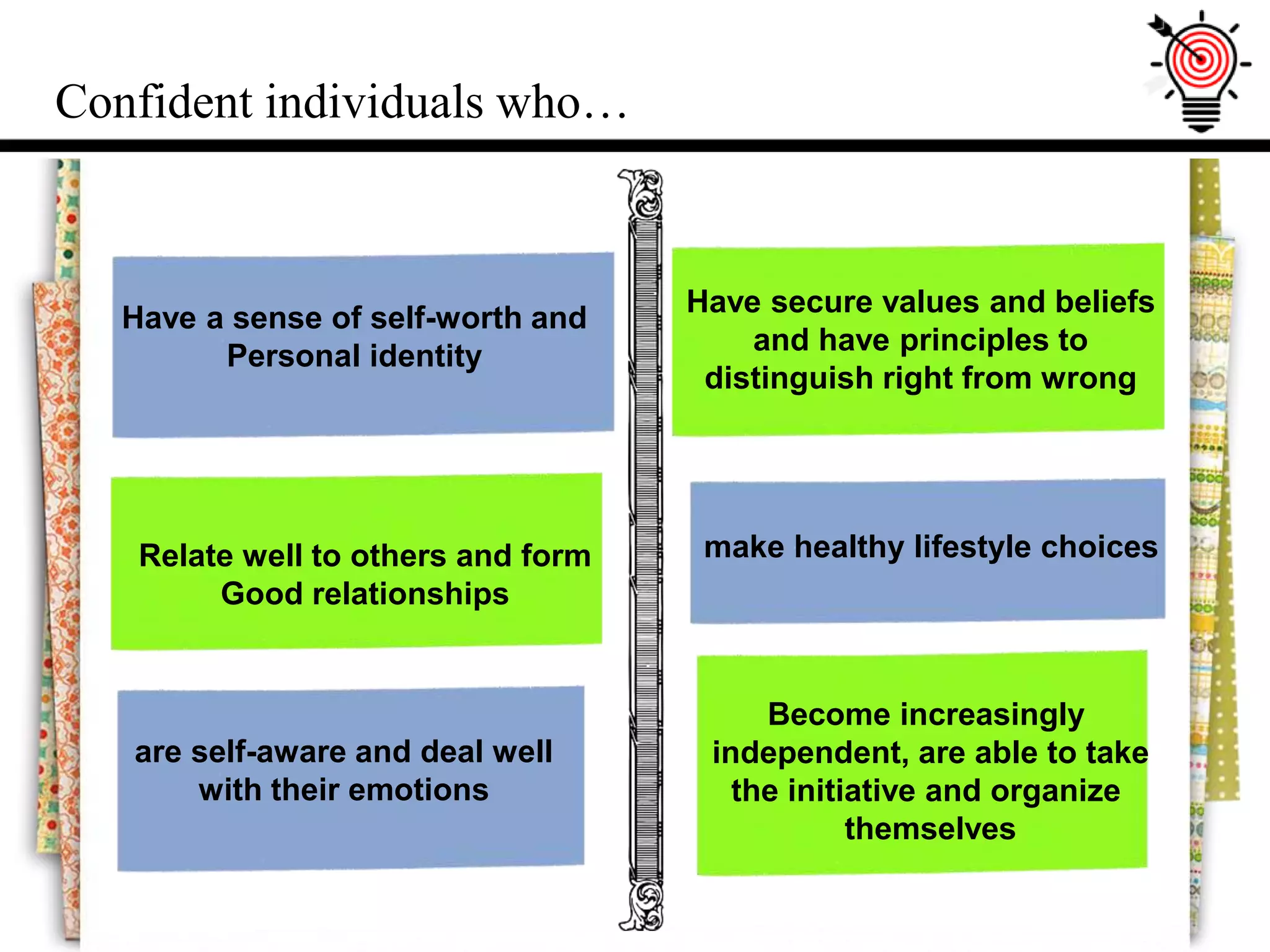
Describes confident individuals possessing self-worth, good relationships, emotional handling, physical competence, and a willingness to embrace risks.
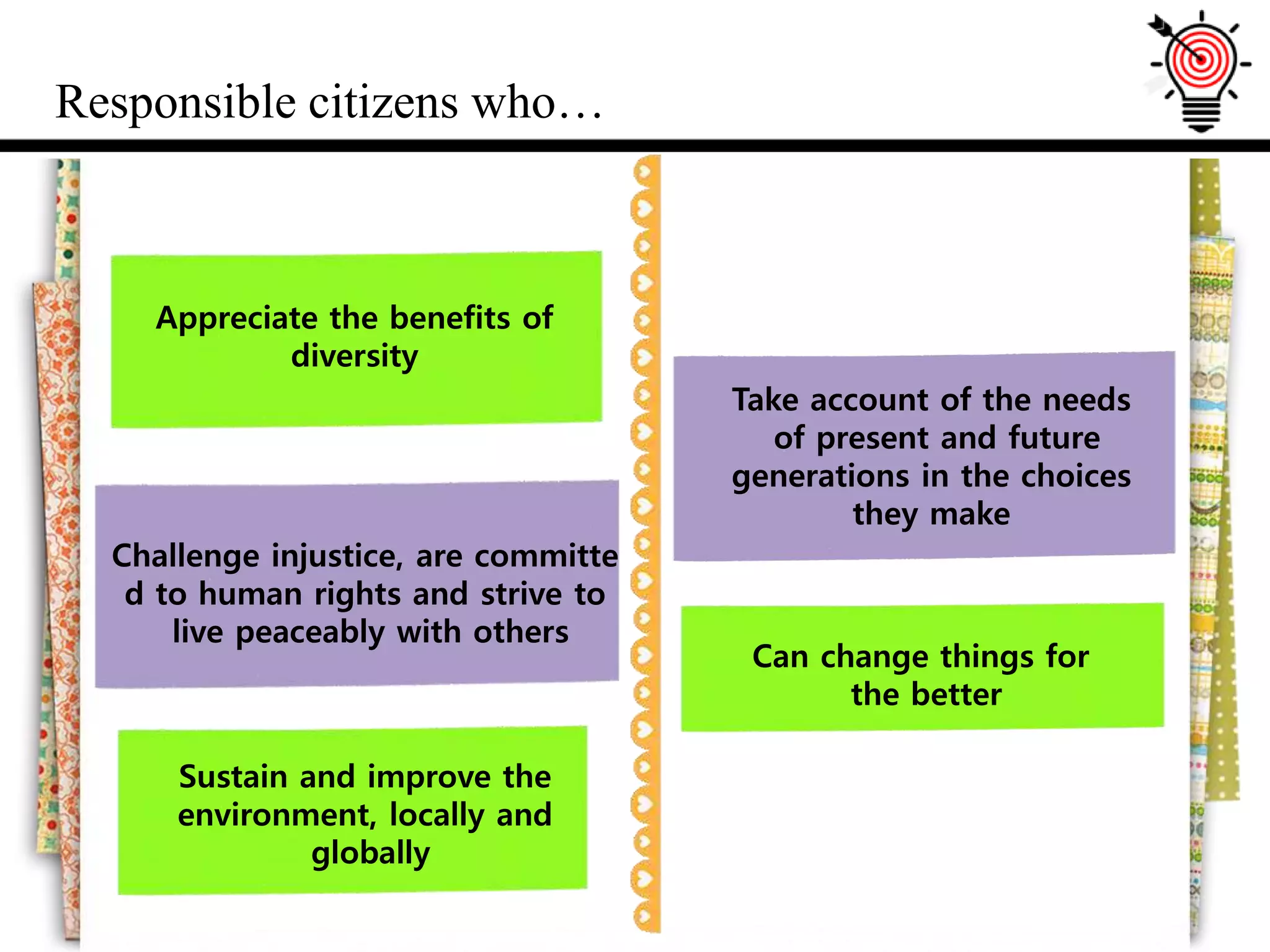
Responsible citizens value diversity, challenge injustice, care for the environment, and respect others while making positive contributions.
Aims for English focus on communication, reading, writing, and developing students into enthusiastic, independent learners.
Distinguishes aims as broad visions from desired learning outcomes that are specific, behavior-focused, and student-oriented.
to plan fora specific purpose intend
Aim V.
learn
know
understand
appreciate
Aims are general statements that provide direction
or intent to educational action. Aims are usually
written in amorphous terms using words like:
And these are not directly measurable
The aims of the curriculum are the reasons for
undertaking the learning 'journey' - its overall
purpose or rationale from the student's point of
view.
3.
The curriculum shouldenable all
young people to become:
The aims of the curriculum
Successful learners who enjoy learning,
make progress and achieve.
Confident individuals who are able to
live safe, healthy and fulfilling lives
Responsible citizens who make a posi-
tive contribution to society
4.
Successful learners who…
Havethe essential learning skills
of literacy, numeracy and informa
-tion and communication
technology
Are creative, resourceful and able
to identify and solve problems
Have enquiring minds and think
for themselves to process inform
ation, reason, question and evalu
ate
Communicate well in a range of
Ways
Understand how they learn and
learn from their mistakes
Are able to learn indepen-
dently and with others
Know about big ideas and
events that shape our world
Enjoy learning and are
motivated to achieve
the best they can now
and in the future.
5.
Have a senseof self-worth and
Personal identity
Relate well to others and form
Good relationships
are self-aware and deal well
with their emotions
Have secure values and beliefs
and have principles to
distinguish right from wrong
Become increasingly
independent, are able to take
the initiative and organize
themselves
make healthy lifestyle choices
Confident individuals who…
6.
Are physically competentand
confident
Take managed risks and stay
safe
Are willing to try new things
and make the most of
opportunities
Are open to the excitement a
nd inspiration offered by the
natural world and human
achievements
Confident individuals who…
7.
Are well preparedfor life and
work
Appreciate the benefits of
diversity
Are enterprising
Are able to work cooperatively
with others
Understand their own and
others’ cultures and traditions,
within the context of Philippine
heritage, and have a strong
sense of their own place in
the world
Respect others and act with
integrity
Responsible citizens who…
8.
Appreciate the benefitsof
diversity
Challenge injustice, are committe
d to human rights and strive to
live peaceably with others
Sustain and improve the
environment, locally and
globally
Take account of the needs
of present and future
generations in the choices
they make
Can change things for
the better
Responsible citizens who…
9.
Sample
THE AIMS OFENGLISH ARE:
to enable children to speak clearly and audibly in ways
which take account of their listeners;
to develop confident, independent readers through an
appropriate focus on word, sentence and text-level
knowledge;
to encourage children to become enthusiastic and
reflective readers through contact with challenging
and lengthy texts;
to help children enjoy writing and recognize its value;
to enable children to write with accuracy and meaning
in narrative and nonfiction;
10.
Aims and DLOs
Aimsare not the same as desired learning outcomes
Aims should relate to the combined impact of the
curriculum, the pedagogy and the assessment of the
various elements .
Desired learning outcomes, need to be student
oriented, and should point to the knowledge, skills,
competencies and attitudes of those students who
successfully complete the course.
DLOs are referred to in the Course
Profile System as ‘Learning Objectives’.
11.
Aims and Objectives
So,aim statements are…
broad and all encompassing.
(The big vision stuff)
While, desired learning outcomes
are specific, behavioral,
student- focused
statements.
12.
Aims are whatyou want to
achieve
Desired learning outcomes are
what your students should
achieve
An alternative angle on aims and
desired learning outcomes/
objectives
Editor's Notes
#3 Some policymakers today insist that there is no need to discuss aims, because we already know what we are trying to accomplish in schooling, and we should simply get on with it. Robert Maynard Hutchins (1999) and other “perennialists” argued years ago that the aims of education are fixed universally for all time, but few of us believe that now when we live in an age of rapid change.