INTRODUCTIONTO
ARTIFICIALNEURALNETWORKS
(ANN)
Definition
Human biological neuron
Artificial Neuron
Outline
Applications of ANN
1
Advantages of ANN
Disadvantages of ANN
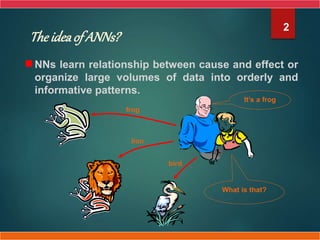
TheideaofANNs?
NNs learn relationship between cause and effect or
organize large volumes of data into orderly and
informative patterns.
frog
lion
bird
What is that?
It’s a frog
2
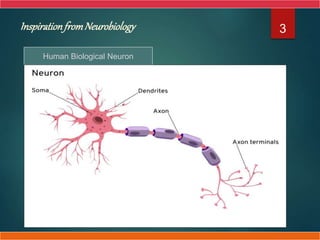
InspirationfromNeurobiology 3
Human Biological Neuron
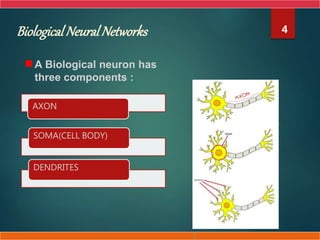
Biological Neural Networks
A Biological neuron has
three components :
AXON
SOMA(CELL BODY)
DENDRITES
T
4
6
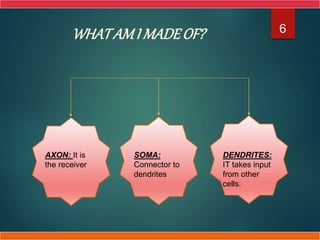
AXON: It is
the receiver
SOMA:
Connector to
dendrites
DENDRITES:
IT takes input
from other
cells.
WHATAMI MADEOF?
FunctionOf Neuron
 Neurons are the building blocks of the nervous
system.
 They receive and transmit signals to different
parts of the body.
 This is carried out in both physical and electrical
forms.
 There are several different types of neurons that
facilitate the transmission of information.
6
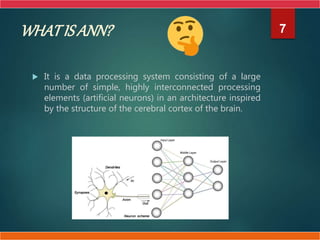
WHATIS ANN?
 It is a data processing system consisting of a large
number of simple, highly interconnected processing
elements (artificial neurons) in an architecture inspired
by the structure of the cerebral cortex of the brain.
7
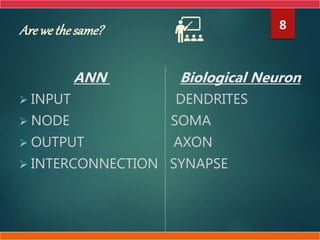
Arewe thesame?
ANN Biological Neuron
 INPUT DENDRITES
 NODE SOMA
 OUTPUT AXON
 INTERCONNECTION SYNAPSE
8
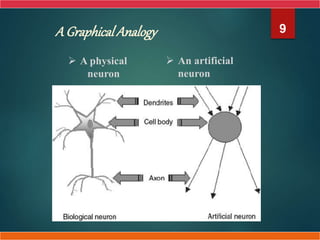
9
 A physical
neuron
 An artificial
neuron
A Graphical Analogy
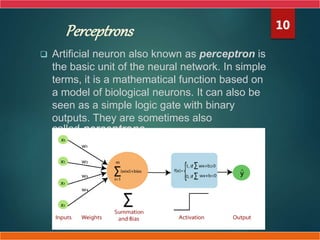
Perceptrons
 Artificial neuron also known as perceptron is
the basic unit of the neural network. In simple
terms, it is a mathematical function based on
a model of biological neurons. It can also be
seen as a simple logic gate with binary
outputs. They are sometimes also
called perceptrons.
10
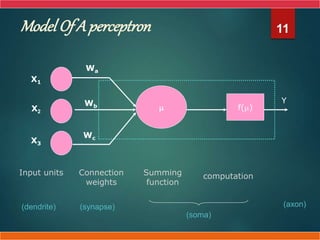
Model Of A perceptron 11
 f()
Y
Wa
Wb
Wc
Connection
weights
Summing
function
computation
X1
X3
X2
Input units
(dendrite) (synapse) (axon)
(soma)
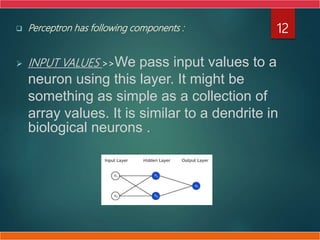
 Perceptron has following components :
 INPUT VALUES >>We pass input values to a
neuron using this layer. It might be
something as simple as a collection of
array values. It is similar to a dendrite in
biological neurons .
12
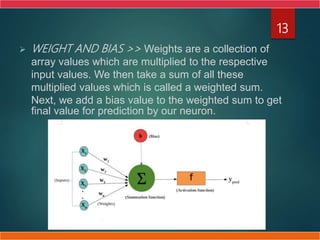
 WEIGHT AND BIAS >> Weights are a collection of
array values which are multiplied to the respective
input values. We then take a sum of all these
multiplied values which is called a weighted sum.
Next, we add a bias value to the weighted sum to get
final value for prediction by our neuron.
13
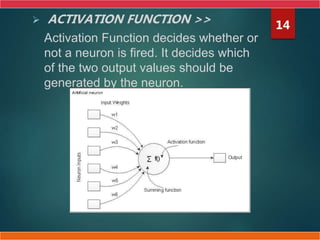
 ACTIVATION FUNCTION >>
Activation Function decides whether or
not a neuron is fired. It decides which
of the two output values should be
generated by the neuron.
14
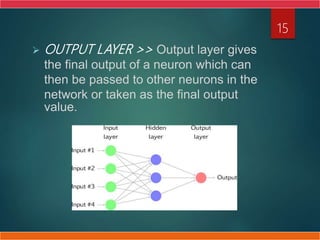
 OUTPUT LAYER >> Output layer gives
the final output of a neuron which can
then be passed to other neurons in the
network or taken as the final output
value.
15
HOWDOESANNWORKS
 Artificial neural networks (ANNs) are comprised of a node layers,
containing an input layer, one or more hidden layers, and an
output layer.
 Each node, or artificial neuron, connects to another and has an
associated weight and threshold.
 Once an input layer is determined, weights are assigned. These
help determine the importance of any given variable, with larger
contributing more significantly to the output compared to other
 Their respective weights and then summed. Afterward, the output
passed through an activation function, which determines the
 If the output of any individual node is above the specified threshold
value, that node is activated, sending data to the next layer of the
network.
16
HowDoes ANNLearns?
 Typically, an ANN is initially trained or fed large
amounts of data. Training consists of providing input
and telling the network what the output should be.
 For example, to build a network that identifies the
faces of actors, the initial training might be a series of
pictures, including actors, non-actors, masks, statuary
and animal faces.
 Each input is accompanied by the matching
identification, such as actors' names or "not actor" or
"not human" information. Providing the answers allows
the model to adjust its internal weightings to learn how
to do its job better.
17
Advantages Of ANN
 Parallel processing abilities mean the network can
perform more than one job at a time.
 Information is stored on an entire network, not just a
database.
 Fault tolerance means the corruption of one or more cells
of the ANN will not stop the generation of output.
 Gradual corruption means the network will slowly
degrade over time, instead of a problem destroying the
network instantly.
 ANN can learn from events and make decisions based on
the observations.
18
Who is interested?...
 Electrical Engineers – signal processing, control theory
 Computer Engineers – robotics
 Computer Scientists – artificial intelligence, pattern
recognition
 Mathematicians – modelling tool when explicit
relationships are unknown
19
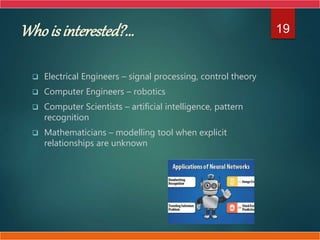
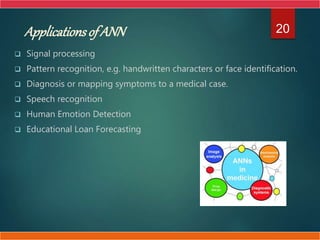
 Signal processing
 Pattern recognition, e.g. handwritten characters or face identification.
 Diagnosis or mapping symptoms to a medical case.
 Speech recognition
 Human Emotion Detection
 Educational Loan Forecasting
20
ApplicationsofANN
Disadvantages Of ANN
 Artificial Neural Networks require processors with parallel
processing power, by their structure.
 When ANN gives a probing solution, it does not give a clue as
to why and how ?
 There is no specific rule for determining the structure of
artificial neural networks.
 The appropriate network structure is achieved through
experience and trial and error.
 The display mechanism to be determined will directly
influence the performance of the network.
 This is dependent on the user's ability
21
FUTUREOF ANN
 Self Driving Cars
 More Advanced Digital ASSISTANTS
 Object Detection
 Powerful CPU’s
 Fake content detector in social media sites
22
Refrence
 https://www.geeksforgeeks.org/difference-between-
ann-and-bnn/
 https://viso.ai/deep-learning/artificial-neural-network/
 https://towardsdatascience.com/whats-the-role-of-
weights-and-bias-in-a-neural-network-4cf7e9888a0f
 https://dzone.com/articles/designing-a-neural-
network-in-java-activation-func
 https://searchenterpriseai.techtarget.com/definition/ne
ural-network
23
THANK YOU

Artificial neural network

  • 1.
  • 2.
    Definition Human biological neuron ArtificialNeuron Outline Applications of ANN 1 Advantages of ANN Disadvantages of ANN
  • 3.
    TheideaofANNs? NNs learn relationshipbetween cause and effect or organize large volumes of data into orderly and informative patterns. frog lion bird What is that? It’s a frog 2
  • 4.
  • 5.
    Biological Neural Networks ABiological neuron has three components : AXON SOMA(CELL BODY) DENDRITES T 4
  • 6.
    6 AXON: It is thereceiver SOMA: Connector to dendrites DENDRITES: IT takes input from other cells. WHATAMI MADEOF?
  • 7.
    FunctionOf Neuron  Neuronsare the building blocks of the nervous system.  They receive and transmit signals to different parts of the body.  This is carried out in both physical and electrical forms.  There are several different types of neurons that facilitate the transmission of information. 6
  • 8.
    WHATIS ANN?  Itis a data processing system consisting of a large number of simple, highly interconnected processing elements (artificial neurons) in an architecture inspired by the structure of the cerebral cortex of the brain. 7
  • 9.
    Arewe thesame? ANN BiologicalNeuron  INPUT DENDRITES  NODE SOMA  OUTPUT AXON  INTERCONNECTION SYNAPSE 8
  • 10.
    9  A physical neuron An artificial neuron A Graphical Analogy
  • 11.
    Perceptrons  Artificial neuronalso known as perceptron is the basic unit of the neural network. In simple terms, it is a mathematical function based on a model of biological neurons. It can also be seen as a simple logic gate with binary outputs. They are sometimes also called perceptrons. 10
  • 12.
    Model Of Aperceptron 11  f() Y Wa Wb Wc Connection weights Summing function computation X1 X3 X2 Input units (dendrite) (synapse) (axon) (soma)
  • 13.
     Perceptron hasfollowing components :  INPUT VALUES >>We pass input values to a neuron using this layer. It might be something as simple as a collection of array values. It is similar to a dendrite in biological neurons . 12
  • 14.
     WEIGHT ANDBIAS >> Weights are a collection of array values which are multiplied to the respective input values. We then take a sum of all these multiplied values which is called a weighted sum. Next, we add a bias value to the weighted sum to get final value for prediction by our neuron. 13
  • 15.
     ACTIVATION FUNCTION>> Activation Function decides whether or not a neuron is fired. It decides which of the two output values should be generated by the neuron. 14
  • 16.
     OUTPUT LAYER>> Output layer gives the final output of a neuron which can then be passed to other neurons in the network or taken as the final output value. 15
  • 17.
    HOWDOESANNWORKS  Artificial neuralnetworks (ANNs) are comprised of a node layers, containing an input layer, one or more hidden layers, and an output layer.  Each node, or artificial neuron, connects to another and has an associated weight and threshold.  Once an input layer is determined, weights are assigned. These help determine the importance of any given variable, with larger contributing more significantly to the output compared to other  Their respective weights and then summed. Afterward, the output passed through an activation function, which determines the  If the output of any individual node is above the specified threshold value, that node is activated, sending data to the next layer of the network. 16
  • 18.
    HowDoes ANNLearns?  Typically,an ANN is initially trained or fed large amounts of data. Training consists of providing input and telling the network what the output should be.  For example, to build a network that identifies the faces of actors, the initial training might be a series of pictures, including actors, non-actors, masks, statuary and animal faces.  Each input is accompanied by the matching identification, such as actors' names or "not actor" or "not human" information. Providing the answers allows the model to adjust its internal weightings to learn how to do its job better. 17
  • 19.
    Advantages Of ANN Parallel processing abilities mean the network can perform more than one job at a time.  Information is stored on an entire network, not just a database.  Fault tolerance means the corruption of one or more cells of the ANN will not stop the generation of output.  Gradual corruption means the network will slowly degrade over time, instead of a problem destroying the network instantly.  ANN can learn from events and make decisions based on the observations. 18
  • 20.
    Who is interested?... Electrical Engineers – signal processing, control theory  Computer Engineers – robotics  Computer Scientists – artificial intelligence, pattern recognition  Mathematicians – modelling tool when explicit relationships are unknown 19
  • 21.
     Signal processing Pattern recognition, e.g. handwritten characters or face identification.  Diagnosis or mapping symptoms to a medical case.  Speech recognition  Human Emotion Detection  Educational Loan Forecasting 20 ApplicationsofANN
  • 22.
    Disadvantages Of ANN Artificial Neural Networks require processors with parallel processing power, by their structure.  When ANN gives a probing solution, it does not give a clue as to why and how ?  There is no specific rule for determining the structure of artificial neural networks.  The appropriate network structure is achieved through experience and trial and error.  The display mechanism to be determined will directly influence the performance of the network.  This is dependent on the user's ability 21
  • 23.
    FUTUREOF ANN  SelfDriving Cars  More Advanced Digital ASSISTANTS  Object Detection  Powerful CPU’s  Fake content detector in social media sites 22
  • 24.
    Refrence  https://www.geeksforgeeks.org/difference-between- ann-and-bnn/  https://viso.ai/deep-learning/artificial-neural-network/ https://towardsdatascience.com/whats-the-role-of- weights-and-bias-in-a-neural-network-4cf7e9888a0f  https://dzone.com/articles/designing-a-neural- network-in-java-activation-func  https://searchenterpriseai.techtarget.com/definition/ne ural-network 23
  • 25.