
Adversarial Search
CSI 341 Mohammad Imam Hossain | Lecturer, Dept. of CSE | UIU
Multi-agent Environment
▸Each agent needs to consider the actions of other agents and how they affect it’s own welfare.
▸The unpredictability of these other agents can introduce contingencies into the agent’s problem-solving process.
▸Two types:
▹Competitive : When agent B is trying to do something that maximizes its performance measure and minimizes
other agent A’s performance measure.
For example, playing chess.
▹Cooperative: When both agents are trying to do something that maximizes both agents performance measures.
For example, taxi-driving agents.
2
Mohammad Imam Hossain | Lecturer, Dept. of CSE | UIU
Adversarial Search
▸Adversarial Search
- In this search problem, agents’ goals are in conflict creating a competitive environment.
- It is a search when there is an enemy or opponent changing the state of the problem every step in a direction you do
not want.
- Examples,
Chess, Tic-tac-toe, 4 in a row, Checkers, Go, Othello etc.
▸AI Game Theory
- Deterministic
- Turn taking
- Two player
- Zero-sum game = It describes a situation in which a participant’s gains or losses is exactly balanced by the losses
or gains of the other.
- Perfect information
- Agents are restricted to a small number of actions described by rules
3
Mohammad Imam Hossain | Lecturer, Dept. of CSE | UIU
Games vs. Search Problems
▸Unpredictable opponent
- Specify a move for every possible opponent reply (contingency strategy)
- Optimal strategy: the one that leads to outcomes at least as good as any other strategy when one is playing against
an infallible opponent.
▸Time limits
- Ability to make some decisions even when calculating the optimal decision is infeasible.
▸Terminology:
- Two players called MAX and MIN
- MAX searches the game tree
- MAX moves first and then they take turns moving until the game is over
- Ply = one turn taken by one of the players.
4
Mohammad Imam Hossain | Lecturer, Dept. of CSE | UIU
Game >> Formal Definition
A game can be formally defined as a kind of search problem with the following elements:
▸S0 : The initial state, which specifies how the game is set up at the start.
▸PLAYER(s) : Defines which player has the move in a state.
▸ACTIONS(s) : Returns the set of legal moves in a state.
▸RESULT(s, a) : The transition model, which defines the result of a move.
▸TERMINAL-TEST(s) : A terminal test which is true when the game is over and false otherwise. States where the game has
ended are called terminal states.
▸UTILITY(s, p) : A utility function that defines the final numeric value for a game that ends in terminal state s for a player p.
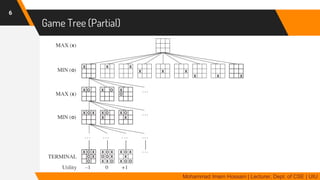
Game Tree >> The initial state, ACTIONS function, and RESULT function define the game tree for the game. It is a tree where
the nodes are game states and the edges are moves.
Our target is to find the Optimal Strategy … …
5
Mohammad Imam Hossain | Lecturer, Dept. of CSE | UIU
Game Tree (Partial)
6
Mohammad Imam Hossain | Lecturer, Dept. of CSE | UIU
Game Complexity
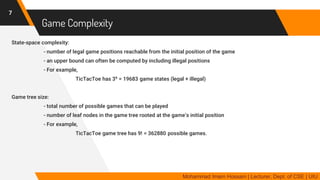
State-space complexity:
- number of legal game positions reachable from the initial position of the game
- an upper bound can often be computed by including illegal positions
- For example,
TicTacToe has 39 = 19683 game states (legal + illegal)
Game tree size:
- total number of possible games that can be played
- number of leaf nodes in the game tree rooted at the game’s initial position
- For example,
TicTacToe game tree has 9! = 362880 possible games.
7
Mohammad Imam Hossain | Lecturer, Dept. of CSE | UIU
Game Complexity
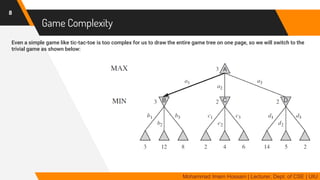
Even a simple game like tic-tac-toe is too complex for us to draw the entire game tree on one page, so we will switch to the
trivial game as shown below:
8
Mohammad Imam Hossain | Lecturer, Dept. of CSE | UIU
MINIMAX Value
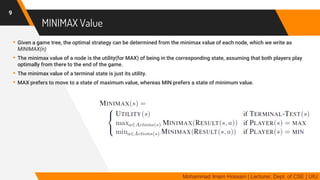
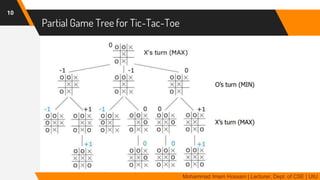
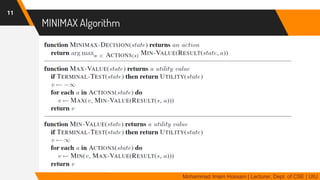
▸Given a game tree, the optimal strategy can be determined from the minimax value of each node, which we write as
MINIMAX(n)
▸The minimax value of a node is the utility(for MAX) of being in the corresponding state, assuming that both players play
optimally from there to the end of the game.
▸The minimax value of a terminal state is just its utility.
▸MAX prefers to move to a state of maximum value, whereas MIN prefers a state of minimum value.
9
Mohammad Imam Hossain | Lecturer, Dept. of CSE | UIU
Partial Game Tree for Tic-Tac-Toe
10
Mohammad Imam Hossain | Lecturer, Dept. of CSE | UIU
MINIMAX Algorithm
11
Mohammad Imam Hossain | Lecturer, Dept. of CSE | UIU
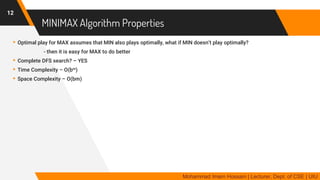
MINIMAX Algorithm Properties
▸Optimal play for MAX assumes that MIN also plays optimally, what if MIN doesn’t play optimally?
- then it is easy for MAX to do better
▸Complete DFS search? – YES
▸Time Complexity – O(bm)
▸Space Complexity – O(bm)
12
Mohammad Imam Hossain | Lecturer, Dept. of CSE | UIU
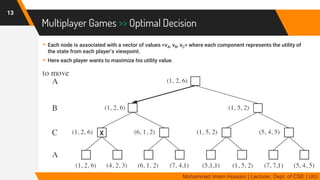
Multiplayer Games >> Optimal Decision
▸Each node is associated with a vector of values <vA, vB, vC> where each component represents the utility of
the state from each player’s viewpoint.
▸Here each player wants to maximize his utility value.
13
Mohammad Imam Hossain | Lecturer, Dept. of CSE | UIU
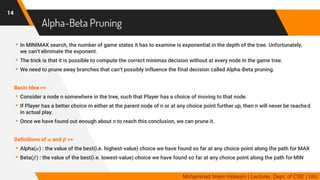
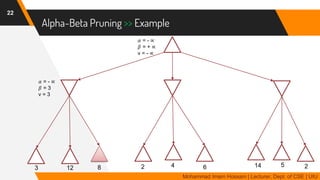
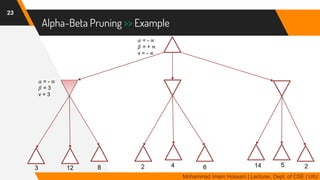
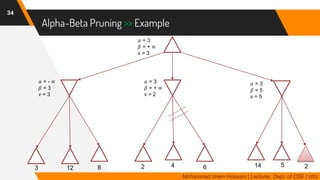
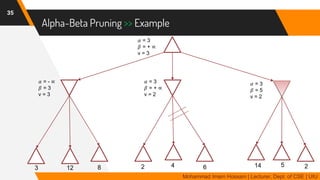
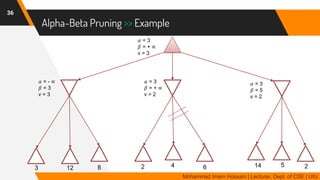
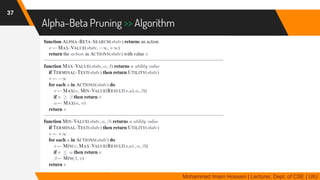
Alpha-Beta Pruning
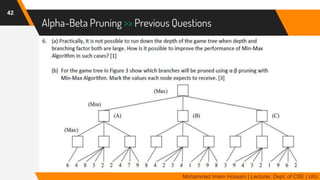
▸In MINIMAX search, the number of game states it has to examine is exponential in the depth of the tree. Unfortunately,
we can’t eliminate the exponent.
▸The trick is that it is possible to compute the correct minimax decision without at every node in the game tree.
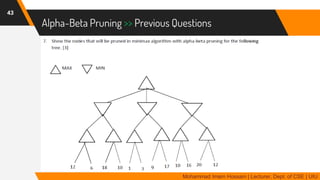
▸We need to prune away branches that can’t possibly influence the final decision called Alpha-Beta pruning.
Basic Idea >>
▸Consider a node n somewhere in the tree, such that Player has a choice of moving to that node.
▸If Player has a better choice m either at the parent node of n or at any choice point further up, then n will never be reached
in actual play.
▸Once we have found out enough about n to reach this conclusion, we can prune it.
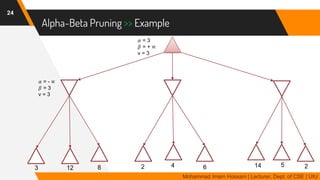
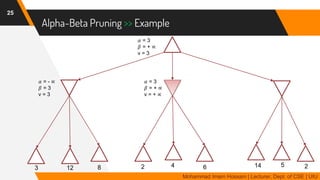
Definitions of 𝜶 and 𝜷 >>
▸Alpha(𝛼) : the value of the best(i.e. highest-value) choice we have found so far at any choice point along the path for MAX
▸Beta(𝛽) : the value of the best(i.e. lowest-value) choice we have found so far at any choice point along the path for MIN
14
Mohammad Imam Hossain | Lecturer, Dept. of CSE | UIU
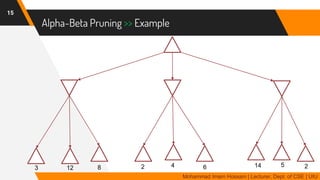
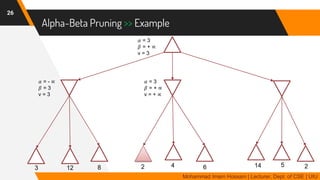
Alpha-Beta Pruning >> Example
15
Mohammad Imam Hossain | Lecturer, Dept. of CSE | UIU
3 12 8 2514642
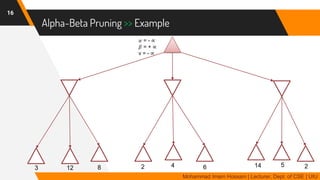
Alpha-Beta Pruning >> Example
16
Mohammad Imam Hossain | Lecturer, Dept. of CSE | UIU
3 12 8 2514642
𝛼 = - ∝
𝛽 = + ∝
v = - ∝
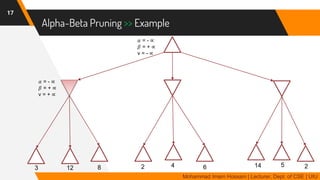
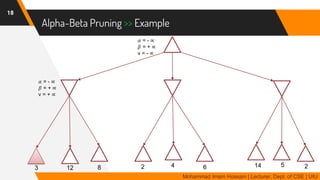
Alpha-Beta Pruning >> Example
17
Mohammad Imam Hossain | Lecturer, Dept. of CSE | UIU
3 12 8 2514642
𝛼 = - ∝
𝛽 = + ∝
v = - ∝
𝛼 = - ∝
𝛽 = + ∝
v = + ∝
Alpha-Beta Pruning >> Example
18
Mohammad Imam Hossain | Lecturer, Dept. of CSE | UIU
3 12 8 2514642
𝛼 = - ∝
𝛽 = + ∝
v = - ∝
𝛼 = - ∝
𝛽 = + ∝
v = + ∝
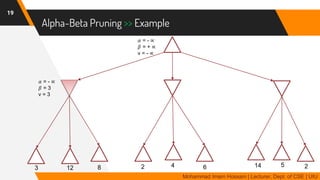
Alpha-Beta Pruning >> Example
19
Mohammad Imam Hossain | Lecturer, Dept. of CSE | UIU
3 12 8 2514642
𝛼 = - ∝
𝛽 = + ∝
v = - ∝
𝛼 = - ∝
𝛽 = 3
v = 3
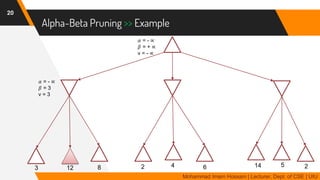
Alpha-Beta Pruning >> Example
20
Mohammad Imam Hossain | Lecturer, Dept. of CSE | UIU
3 12 8 2514642
𝛼 = - ∝
𝛽 = + ∝
v = - ∝
𝛼 = - ∝
𝛽 = 3
v = 3
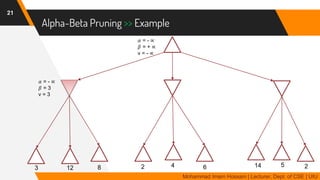
Alpha-Beta Pruning >> Example
21
Mohammad Imam Hossain | Lecturer, Dept. of CSE | UIU
3 12 8 2514642
𝛼 = - ∝
𝛽 = + ∝
v = - ∝
𝛼 = - ∝
𝛽 = 3
v = 3
Alpha-Beta Pruning >> Example
22
Mohammad Imam Hossain | Lecturer, Dept. of CSE | UIU
3 12 8 2514642
𝛼 = - ∝
𝛽 = + ∝
v = - ∝
𝛼 = - ∝
𝛽 = 3
v = 3
Alpha-Beta Pruning >> Example
23
Mohammad Imam Hossain | Lecturer, Dept. of CSE | UIU
3 12 8 2514642
𝛼 = - ∝
𝛽 = + ∝
v = - ∝
𝛼 = - ∝
𝛽 = 3
v = 3
Alpha-Beta Pruning >> Example
24
Mohammad Imam Hossain | Lecturer, Dept. of CSE | UIU
3 12 8 2514642
𝛼 = 3
𝛽 = + ∝
v = 3
𝛼 = - ∝
𝛽 = 3
v = 3
Alpha-Beta Pruning >> Example
25
Mohammad Imam Hossain | Lecturer, Dept. of CSE | UIU
3 12 8 2514642
𝛼 = 3
𝛽 = + ∝
v = 3
𝛼 = - ∝
𝛽 = 3
v = 3
𝛼 = 3
𝛽 = + ∝
v = + ∝
Alpha-Beta Pruning >> Example
26
Mohammad Imam Hossain | Lecturer, Dept. of CSE | UIU
3 12 8 2514642
𝛼 = 3
𝛽 = + ∝
v = 3
𝛼 = - ∝
𝛽 = 3
v = 3
𝛼 = 3
𝛽 = + ∝
v = + ∝
Alpha-Beta Pruning >> Example
27
Mohammad Imam Hossain | Lecturer, Dept. of CSE | UIU
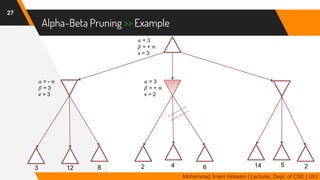
3 12 8 2514642
𝛼 = 3
𝛽 = + ∝
v = 3
𝛼 = - ∝
𝛽 = 3
v = 3
𝛼 = 3
𝛽 = + ∝
v = 2
Alpha-Beta Pruning >> Example
28
Mohammad Imam Hossain | Lecturer, Dept. of CSE | UIU
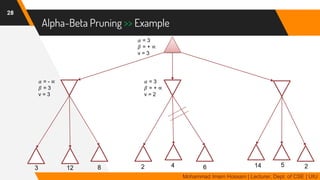
3 12 8 2514642
𝛼 = 3
𝛽 = + ∝
v = 3
𝛼 = - ∝
𝛽 = 3
v = 3
𝛼 = 3
𝛽 = + ∝
v = 2
Alpha-Beta Pruning >> Example
29
Mohammad Imam Hossain | Lecturer, Dept. of CSE | UIU
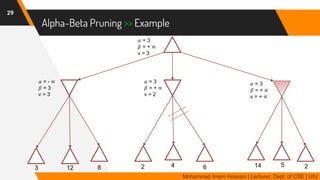
3 12 8 2514642
𝛼 = 3
𝛽 = + ∝
v = 3
𝛼 = - ∝
𝛽 = 3
v = 3
𝛼 = 3
𝛽 = + ∝
v = 2
𝛼 = 3
𝛽 = + ∝
v = + ∝
Alpha-Beta Pruning >> Example
30
Mohammad Imam Hossain | Lecturer, Dept. of CSE | UIU
3 12 8 2514642
𝛼 = 3
𝛽 = + ∝
v = 3
𝛼 = - ∝
𝛽 = 3
v = 3
𝛼 = 3
𝛽 = + ∝
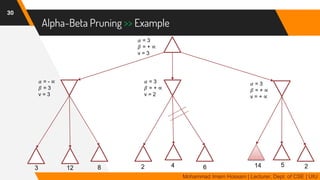
v = 2
𝛼 = 3
𝛽 = + ∝
v = + ∝
Alpha-Beta Pruning >> Example
31
Mohammad Imam Hossain | Lecturer, Dept. of CSE | UIU
3 12 8 2514642
𝛼 = 3
𝛽 = + ∝
v = 3
𝛼 = - ∝
𝛽 = 3
v = 3
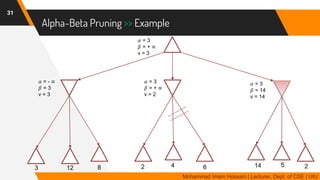
𝛼 = 3
𝛽 = + ∝
v = 2
𝛼 = 3
𝛽 = 14
v = 14
Alpha-Beta Pruning >> Example
32
Mohammad Imam Hossain | Lecturer, Dept. of CSE | UIU
3 12 8 2514642
𝛼 = 3
𝛽 = + ∝
v = 3
𝛼 = - ∝
𝛽 = 3
v = 3
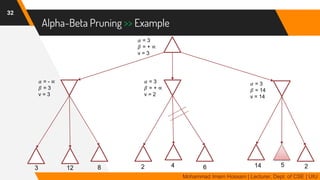
𝛼 = 3
𝛽 = + ∝
v = 2
𝛼 = 3
𝛽 = 14
v = 14
Alpha-Beta Pruning >> Example
33
Mohammad Imam Hossain | Lecturer, Dept. of CSE | UIU
3 12 8 2514642
𝛼 = 3
𝛽 = + ∝
v = 3
𝛼 = - ∝
𝛽 = 3
v = 3
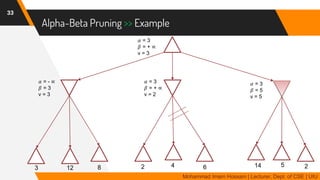
𝛼 = 3
𝛽 = + ∝
v = 2
𝛼 = 3
𝛽 = 5
v = 5
Alpha-Beta Pruning >> Example
34
Mohammad Imam Hossain | Lecturer, Dept. of CSE | UIU
3 12 8 2514642
𝛼 = 3
𝛽 = + ∝
v = 3
𝛼 = - ∝
𝛽 = 3
v = 3
𝛼 = 3
𝛽 = + ∝
v = 2
𝛼 = 3
𝛽 = 5
v = 5
Alpha-Beta Pruning >> Example
35
Mohammad Imam Hossain | Lecturer, Dept. of CSE | UIU
3 12 8 2514642
𝛼 = 3
𝛽 = + ∝
v = 3
𝛼 = - ∝
𝛽 = 3
v = 3
𝛼 = 3
𝛽 = + ∝
v = 2
𝛼 = 3
𝛽 = 5
v = 2
Alpha-Beta Pruning >> Example
36
Mohammad Imam Hossain | Lecturer, Dept. of CSE | UIU
3 12 8 2514642
𝛼 = 3
𝛽 = + ∝
v = 3
𝛼 = - ∝
𝛽 = 3
v = 3
𝛼 = 3
𝛽 = + ∝
v = 2
𝛼 = 3
𝛽 = 5
v = 2
Alpha-Beta Pruning >> Algorithm
37
Mohammad Imam Hossain | Lecturer, Dept. of CSE | UIU
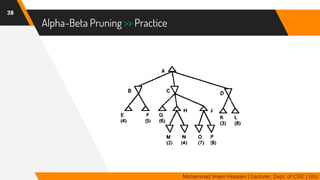
Alpha-Beta Pruning >> Practice
38
Mohammad Imam Hossain | Lecturer, Dept. of CSE | UIU
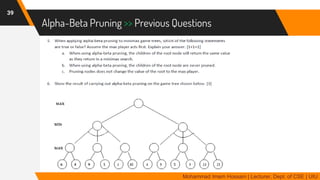
Alpha-Beta Pruning >> Previous Questions
39
Mohammad Imam Hossain | Lecturer, Dept. of CSE | UIU
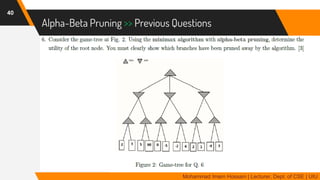
Alpha-Beta Pruning >> Previous Questions
40
Mohammad Imam Hossain | Lecturer, Dept. of CSE | UIU
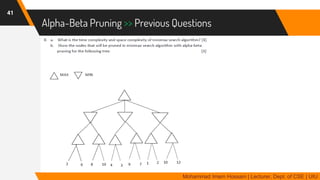
Alpha-Beta Pruning >> Previous Questions
41
Mohammad Imam Hossain | Lecturer, Dept. of CSE | UIU
Alpha-Beta Pruning >> Previous Questions
42
Mohammad Imam Hossain | Lecturer, Dept. of CSE | UIU
Alpha-Beta Pruning >> Previous Questions
43
Mohammad Imam Hossain | Lecturer, Dept. of CSE | UIU
44
THANKS!
Any questions?
You can find me at imam@cse.uiu.ac.bd

AI 6 | Adversarial Search

  • 1.
    Adversarial Search CSI 341Mohammad Imam Hossain | Lecturer, Dept. of CSE | UIU
  • 2.
    Multi-agent Environment ▸Each agentneeds to consider the actions of other agents and how they affect it’s own welfare. ▸The unpredictability of these other agents can introduce contingencies into the agent’s problem-solving process. ▸Two types: ▹Competitive : When agent B is trying to do something that maximizes its performance measure and minimizes other agent A’s performance measure. For example, playing chess. ▹Cooperative: When both agents are trying to do something that maximizes both agents performance measures. For example, taxi-driving agents. 2 Mohammad Imam Hossain | Lecturer, Dept. of CSE | UIU
  • 3.
    Adversarial Search ▸Adversarial Search -In this search problem, agents’ goals are in conflict creating a competitive environment. - It is a search when there is an enemy or opponent changing the state of the problem every step in a direction you do not want. - Examples, Chess, Tic-tac-toe, 4 in a row, Checkers, Go, Othello etc. ▸AI Game Theory - Deterministic - Turn taking - Two player - Zero-sum game = It describes a situation in which a participant’s gains or losses is exactly balanced by the losses or gains of the other. - Perfect information - Agents are restricted to a small number of actions described by rules 3 Mohammad Imam Hossain | Lecturer, Dept. of CSE | UIU
  • 4.
    Games vs. SearchProblems ▸Unpredictable opponent - Specify a move for every possible opponent reply (contingency strategy) - Optimal strategy: the one that leads to outcomes at least as good as any other strategy when one is playing against an infallible opponent. ▸Time limits - Ability to make some decisions even when calculating the optimal decision is infeasible. ▸Terminology: - Two players called MAX and MIN - MAX searches the game tree - MAX moves first and then they take turns moving until the game is over - Ply = one turn taken by one of the players. 4 Mohammad Imam Hossain | Lecturer, Dept. of CSE | UIU
  • 5.
    Game >> FormalDefinition A game can be formally defined as a kind of search problem with the following elements: ▸S0 : The initial state, which specifies how the game is set up at the start. ▸PLAYER(s) : Defines which player has the move in a state. ▸ACTIONS(s) : Returns the set of legal moves in a state. ▸RESULT(s, a) : The transition model, which defines the result of a move. ▸TERMINAL-TEST(s) : A terminal test which is true when the game is over and false otherwise. States where the game has ended are called terminal states. ▸UTILITY(s, p) : A utility function that defines the final numeric value for a game that ends in terminal state s for a player p. Game Tree >> The initial state, ACTIONS function, and RESULT function define the game tree for the game. It is a tree where the nodes are game states and the edges are moves. Our target is to find the Optimal Strategy … … 5 Mohammad Imam Hossain | Lecturer, Dept. of CSE | UIU
  • 6.
    Game Tree (Partial) 6 MohammadImam Hossain | Lecturer, Dept. of CSE | UIU
  • 7.
    Game Complexity State-space complexity: -number of legal game positions reachable from the initial position of the game - an upper bound can often be computed by including illegal positions - For example, TicTacToe has 39 = 19683 game states (legal + illegal) Game tree size: - total number of possible games that can be played - number of leaf nodes in the game tree rooted at the game’s initial position - For example, TicTacToe game tree has 9! = 362880 possible games. 7 Mohammad Imam Hossain | Lecturer, Dept. of CSE | UIU
  • 8.
    Game Complexity Even asimple game like tic-tac-toe is too complex for us to draw the entire game tree on one page, so we will switch to the trivial game as shown below: 8 Mohammad Imam Hossain | Lecturer, Dept. of CSE | UIU
  • 9.
    MINIMAX Value ▸Given agame tree, the optimal strategy can be determined from the minimax value of each node, which we write as MINIMAX(n) ▸The minimax value of a node is the utility(for MAX) of being in the corresponding state, assuming that both players play optimally from there to the end of the game. ▸The minimax value of a terminal state is just its utility. ▸MAX prefers to move to a state of maximum value, whereas MIN prefers a state of minimum value. 9 Mohammad Imam Hossain | Lecturer, Dept. of CSE | UIU
  • 10.
    Partial Game Treefor Tic-Tac-Toe 10 Mohammad Imam Hossain | Lecturer, Dept. of CSE | UIU
  • 11.
    MINIMAX Algorithm 11 Mohammad ImamHossain | Lecturer, Dept. of CSE | UIU
  • 12.
    MINIMAX Algorithm Properties ▸Optimalplay for MAX assumes that MIN also plays optimally, what if MIN doesn’t play optimally? - then it is easy for MAX to do better ▸Complete DFS search? – YES ▸Time Complexity – O(bm) ▸Space Complexity – O(bm) 12 Mohammad Imam Hossain | Lecturer, Dept. of CSE | UIU
  • 13.
    Multiplayer Games >>Optimal Decision ▸Each node is associated with a vector of values <vA, vB, vC> where each component represents the utility of the state from each player’s viewpoint. ▸Here each player wants to maximize his utility value. 13 Mohammad Imam Hossain | Lecturer, Dept. of CSE | UIU
  • 14.
    Alpha-Beta Pruning ▸In MINIMAXsearch, the number of game states it has to examine is exponential in the depth of the tree. Unfortunately, we can’t eliminate the exponent. ▸The trick is that it is possible to compute the correct minimax decision without at every node in the game tree. ▸We need to prune away branches that can’t possibly influence the final decision called Alpha-Beta pruning. Basic Idea >> ▸Consider a node n somewhere in the tree, such that Player has a choice of moving to that node. ▸If Player has a better choice m either at the parent node of n or at any choice point further up, then n will never be reached in actual play. ▸Once we have found out enough about n to reach this conclusion, we can prune it. Definitions of 𝜶 and 𝜷 >> ▸Alpha(𝛼) : the value of the best(i.e. highest-value) choice we have found so far at any choice point along the path for MAX ▸Beta(𝛽) : the value of the best(i.e. lowest-value) choice we have found so far at any choice point along the path for MIN 14 Mohammad Imam Hossain | Lecturer, Dept. of CSE | UIU
  • 15.
    Alpha-Beta Pruning >>Example 15 Mohammad Imam Hossain | Lecturer, Dept. of CSE | UIU 3 12 8 2514642
  • 16.
    Alpha-Beta Pruning >>Example 16 Mohammad Imam Hossain | Lecturer, Dept. of CSE | UIU 3 12 8 2514642 𝛼 = - ∝ 𝛽 = + ∝ v = - ∝
  • 17.
    Alpha-Beta Pruning >>Example 17 Mohammad Imam Hossain | Lecturer, Dept. of CSE | UIU 3 12 8 2514642 𝛼 = - ∝ 𝛽 = + ∝ v = - ∝ 𝛼 = - ∝ 𝛽 = + ∝ v = + ∝
  • 18.
    Alpha-Beta Pruning >>Example 18 Mohammad Imam Hossain | Lecturer, Dept. of CSE | UIU 3 12 8 2514642 𝛼 = - ∝ 𝛽 = + ∝ v = - ∝ 𝛼 = - ∝ 𝛽 = + ∝ v = + ∝
  • 19.
    Alpha-Beta Pruning >>Example 19 Mohammad Imam Hossain | Lecturer, Dept. of CSE | UIU 3 12 8 2514642 𝛼 = - ∝ 𝛽 = + ∝ v = - ∝ 𝛼 = - ∝ 𝛽 = 3 v = 3
  • 20.
    Alpha-Beta Pruning >>Example 20 Mohammad Imam Hossain | Lecturer, Dept. of CSE | UIU 3 12 8 2514642 𝛼 = - ∝ 𝛽 = + ∝ v = - ∝ 𝛼 = - ∝ 𝛽 = 3 v = 3
  • 21.
    Alpha-Beta Pruning >>Example 21 Mohammad Imam Hossain | Lecturer, Dept. of CSE | UIU 3 12 8 2514642 𝛼 = - ∝ 𝛽 = + ∝ v = - ∝ 𝛼 = - ∝ 𝛽 = 3 v = 3
  • 22.
    Alpha-Beta Pruning >>Example 22 Mohammad Imam Hossain | Lecturer, Dept. of CSE | UIU 3 12 8 2514642 𝛼 = - ∝ 𝛽 = + ∝ v = - ∝ 𝛼 = - ∝ 𝛽 = 3 v = 3
  • 23.
    Alpha-Beta Pruning >>Example 23 Mohammad Imam Hossain | Lecturer, Dept. of CSE | UIU 3 12 8 2514642 𝛼 = - ∝ 𝛽 = + ∝ v = - ∝ 𝛼 = - ∝ 𝛽 = 3 v = 3
  • 24.
    Alpha-Beta Pruning >>Example 24 Mohammad Imam Hossain | Lecturer, Dept. of CSE | UIU 3 12 8 2514642 𝛼 = 3 𝛽 = + ∝ v = 3 𝛼 = - ∝ 𝛽 = 3 v = 3
  • 25.
    Alpha-Beta Pruning >>Example 25 Mohammad Imam Hossain | Lecturer, Dept. of CSE | UIU 3 12 8 2514642 𝛼 = 3 𝛽 = + ∝ v = 3 𝛼 = - ∝ 𝛽 = 3 v = 3 𝛼 = 3 𝛽 = + ∝ v = + ∝
  • 26.
    Alpha-Beta Pruning >>Example 26 Mohammad Imam Hossain | Lecturer, Dept. of CSE | UIU 3 12 8 2514642 𝛼 = 3 𝛽 = + ∝ v = 3 𝛼 = - ∝ 𝛽 = 3 v = 3 𝛼 = 3 𝛽 = + ∝ v = + ∝
  • 27.
    Alpha-Beta Pruning >>Example 27 Mohammad Imam Hossain | Lecturer, Dept. of CSE | UIU 3 12 8 2514642 𝛼 = 3 𝛽 = + ∝ v = 3 𝛼 = - ∝ 𝛽 = 3 v = 3 𝛼 = 3 𝛽 = + ∝ v = 2
  • 28.
    Alpha-Beta Pruning >>Example 28 Mohammad Imam Hossain | Lecturer, Dept. of CSE | UIU 3 12 8 2514642 𝛼 = 3 𝛽 = + ∝ v = 3 𝛼 = - ∝ 𝛽 = 3 v = 3 𝛼 = 3 𝛽 = + ∝ v = 2
  • 29.
    Alpha-Beta Pruning >>Example 29 Mohammad Imam Hossain | Lecturer, Dept. of CSE | UIU 3 12 8 2514642 𝛼 = 3 𝛽 = + ∝ v = 3 𝛼 = - ∝ 𝛽 = 3 v = 3 𝛼 = 3 𝛽 = + ∝ v = 2 𝛼 = 3 𝛽 = + ∝ v = + ∝
  • 30.
    Alpha-Beta Pruning >>Example 30 Mohammad Imam Hossain | Lecturer, Dept. of CSE | UIU 3 12 8 2514642 𝛼 = 3 𝛽 = + ∝ v = 3 𝛼 = - ∝ 𝛽 = 3 v = 3 𝛼 = 3 𝛽 = + ∝ v = 2 𝛼 = 3 𝛽 = + ∝ v = + ∝
  • 31.
    Alpha-Beta Pruning >>Example 31 Mohammad Imam Hossain | Lecturer, Dept. of CSE | UIU 3 12 8 2514642 𝛼 = 3 𝛽 = + ∝ v = 3 𝛼 = - ∝ 𝛽 = 3 v = 3 𝛼 = 3 𝛽 = + ∝ v = 2 𝛼 = 3 𝛽 = 14 v = 14
  • 32.
    Alpha-Beta Pruning >>Example 32 Mohammad Imam Hossain | Lecturer, Dept. of CSE | UIU 3 12 8 2514642 𝛼 = 3 𝛽 = + ∝ v = 3 𝛼 = - ∝ 𝛽 = 3 v = 3 𝛼 = 3 𝛽 = + ∝ v = 2 𝛼 = 3 𝛽 = 14 v = 14
  • 33.
    Alpha-Beta Pruning >>Example 33 Mohammad Imam Hossain | Lecturer, Dept. of CSE | UIU 3 12 8 2514642 𝛼 = 3 𝛽 = + ∝ v = 3 𝛼 = - ∝ 𝛽 = 3 v = 3 𝛼 = 3 𝛽 = + ∝ v = 2 𝛼 = 3 𝛽 = 5 v = 5
  • 34.
    Alpha-Beta Pruning >>Example 34 Mohammad Imam Hossain | Lecturer, Dept. of CSE | UIU 3 12 8 2514642 𝛼 = 3 𝛽 = + ∝ v = 3 𝛼 = - ∝ 𝛽 = 3 v = 3 𝛼 = 3 𝛽 = + ∝ v = 2 𝛼 = 3 𝛽 = 5 v = 5
  • 35.
    Alpha-Beta Pruning >>Example 35 Mohammad Imam Hossain | Lecturer, Dept. of CSE | UIU 3 12 8 2514642 𝛼 = 3 𝛽 = + ∝ v = 3 𝛼 = - ∝ 𝛽 = 3 v = 3 𝛼 = 3 𝛽 = + ∝ v = 2 𝛼 = 3 𝛽 = 5 v = 2
  • 36.
    Alpha-Beta Pruning >>Example 36 Mohammad Imam Hossain | Lecturer, Dept. of CSE | UIU 3 12 8 2514642 𝛼 = 3 𝛽 = + ∝ v = 3 𝛼 = - ∝ 𝛽 = 3 v = 3 𝛼 = 3 𝛽 = + ∝ v = 2 𝛼 = 3 𝛽 = 5 v = 2
  • 37.
    Alpha-Beta Pruning >>Algorithm 37 Mohammad Imam Hossain | Lecturer, Dept. of CSE | UIU
  • 38.
    Alpha-Beta Pruning >>Practice 38 Mohammad Imam Hossain | Lecturer, Dept. of CSE | UIU
  • 39.
    Alpha-Beta Pruning >>Previous Questions 39 Mohammad Imam Hossain | Lecturer, Dept. of CSE | UIU
  • 40.
    Alpha-Beta Pruning >>Previous Questions 40 Mohammad Imam Hossain | Lecturer, Dept. of CSE | UIU
  • 41.
    Alpha-Beta Pruning >>Previous Questions 41 Mohammad Imam Hossain | Lecturer, Dept. of CSE | UIU
  • 42.
    Alpha-Beta Pruning >>Previous Questions 42 Mohammad Imam Hossain | Lecturer, Dept. of CSE | UIU
  • 43.
    Alpha-Beta Pruning >>Previous Questions 43 Mohammad Imam Hossain | Lecturer, Dept. of CSE | UIU
  • 44.
    44 THANKS! Any questions? You canfind me at imam@cse.uiu.ac.bd