Download to read offline
![Mohammad Imam Hossain, Lecturer, Dept. of CSE, UIU.
▪ Graph:
A graph 𝐺 = (𝑉, 𝐸) consists of two sets,
𝑉 = set of vertices (nodes)
𝐸 = set of edges = subset of (𝑉 × 𝑉)
▪ Representation
1. Adjacency Matrix:
• Undirected graph
1
2
3
4
5
6 [
0 1 0 0 1 0
1 0 0 0 1 0
0 0 0 0 0 1
0 0 0 0 0 0
1 1 0 0 0 0
0 0 1 0 0 0]
• Weighted undirected graph
1
2
3
4
5
6 [
∞ 5 ∞ ∞ 11 ∞
5 ∞ ∞ ∞ 6 ∞
∞ ∞ ∞ ∞ ∞ 10.5
∞ ∞ ∞ ∞ ∞ ∞
11 6 ∞ ∞ ∞ ∞
∞ ∞ 10.5 ∞ ∞ ∞ ]
• Directed graph
1
2
3
4
5
6 [
0 1 0 0 0 0
0 0 0 1 1 0
0 0 0 0 0 0
1 0 0 0 1 0
0 0 0 1 0 0
0 0 1 0 0 0]
• Weighted directed graph
1
2
3
4
5
6 [
∞ 7.8 ∞ ∞ ∞ ∞
∞ ∞ ∞ 11 8.1 ∞
∞ ∞ ∞ ∞ ∞ ∞
7.6 ∞ ∞ ∞ 9 ∞
∞ ∞ ∞ 8.8 ∞ ∞
∞ ∞ 12 ∞ ∞ ∞]
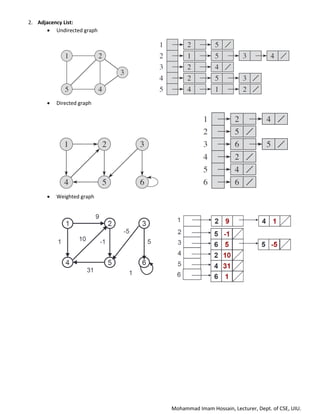
1 2 3 4 5 6
1 2 3 4 5 6
1 2 3 4 5 6
1 2 3 4 5 6](https://image.slidesharecdn.com/graphandshortestpathsearch-231010160556-59a6c916/85/DS-Algo-4-Graph-and-Shortest-Path-Search-1-320.jpg)
![Mohammad Imam Hossain, Lecturer, Dept. of CSE, UIU.
▪ Graph:
A graph 𝐺 = (𝑉, 𝐸) consists of two sets,
𝑉 = set of vertices (nodes)
𝐸 = set of edges = subset of (𝑉 × 𝑉)
▪ Representation
1. Adjacency Matrix:
• Undirected graph
1
2
3
4
5
6 [
0 1 0 0 1 0
1 0 0 0 1 0
0 0 0 0 0 1
0 0 0 0 0 0
1 1 0 0 0 0
0 0 1 0 0 0]
• Weighted undirected graph
1
2
3
4
5
6 [
∞ 5 ∞ ∞ 11 ∞
5 ∞ ∞ ∞ 6 ∞
∞ ∞ ∞ ∞ ∞ 10.5
∞ ∞ ∞ ∞ ∞ ∞
11 6 ∞ ∞ ∞ ∞
∞ ∞ 10.5 ∞ ∞ ∞ ]
• Directed graph
1
2
3
4
5
6 [
0 1 0 0 0 0
0 0 0 1 1 0
0 0 0 0 0 0
1 0 0 0 1 0
0 0 0 1 0 0
0 0 1 0 0 0]
• Weighted directed graph
1
2
3
4
5
6 [
∞ 7.8 ∞ ∞ ∞ ∞
∞ ∞ ∞ 11 8.1 ∞
∞ ∞ ∞ ∞ ∞ ∞
7.6 ∞ ∞ ∞ 9 ∞
∞ ∞ ∞ 8.8 ∞ ∞
∞ ∞ 12 ∞ ∞ ∞]
1 2 3 4 5 6
1 2 3 4 5 6
1 2 3 4 5 6
1 2 3 4 5 6](https://image.slidesharecdn.com/graphandshortestpathsearch-231010160556-59a6c916/75/DS-Algo-4-Graph-and-Shortest-Path-Search-1-2048.jpg)

![Mohammad Imam Hossain, Lecturer, Dept. of CSE, UIU.
Algorithm:
2. Bellman-ford – 𝑂(|𝑉||𝐸|)
BFS(G, s)
1. for each vertex 𝑢 in V[G] – {s}
2. color[u] white
3. d[u]
4. [u] nil
5. color[s] gray
6. d[s] 0
7. [s] nil
8. Q
9. enqueue(Q, s)
10. while Q
11. u dequeue(Q)
12. for each v in Adj[u]
13. if color[v] = white
14. color[v] gray
15. d[v] d[u] + 1
16. [v] u
17. enqueue(Q, v)
18. color[u] black](https://image.slidesharecdn.com/graphandshortestpathsearch-231010160556-59a6c916/85/DS-Algo-4-Graph-and-Shortest-Path-Search-4-320.jpg)
![Mohammad Imam Hossain, Lecturer, Dept. of CSE, UIU.
Algorithm:
3. Dijkstra’s algorithm – min-priority queue: Array 𝑂(|𝑉|2
),
Binary heap 𝑂(|𝐸| lg (|𝑉|)),
Fibonacci heap 𝑂(|𝑉| lg(|𝑉|) + |𝐸|)
BELLMAN-FORD(V, E, w, s)
1. INITIALIZE-SINGLE-SOURCE(V, s)
2. for i ← 1 to |V| - 1
3. do for each edge (u, v) E
4. do RELAX(u, v, w)
5. for each edge (u, v) E
6. do if d[v] > d[u] + w(u, v)
7. then return FALSE
8. return TRUE
INITIALIZE-SINGLE-SOURCE(V, s)
1. for each v V
2. do d[v] ←
3. [v] ← NIL
4. d[s] ← 0
RELAX(u, v, w)
1. if d[v] > d[u] + w(u, v)
2. then d[v] ← d[u] + w(u, v)
3. [v] ← u
Negative Cycle Detection
This section detects negative cycle. If
exists then the algorithm will return False
otherwise True.](https://image.slidesharecdn.com/graphandshortestpathsearch-231010160556-59a6c916/85/DS-Algo-4-Graph-and-Shortest-Path-Search-5-320.jpg)
![Mohammad Imam Hossain, Lecturer, Dept. of CSE, UIU.
Algorithm
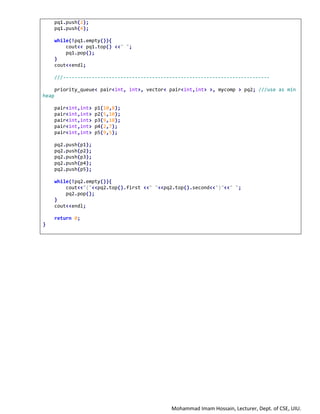
C++ STL – Priority Queue
#include <iostream>
#include <queue>
#include <vector>
#include <functional> ///for greater function
using namespace std;
class mycomp{
public:
bool operator()(const pair<int,int> &elm1, const pair<int,int> &elm2){
return elm1.second>elm2.second;
}
};
int main()
{
priority_queue<int> pq; ///default max heap
pq.push(10);
pq.push(-5);
pq.push(8);
pq.push(2);
pq.push(4);
while(!pq.empty()){
cout<< pq.top() <<" ";
pq.pop();
}
cout<<endl;
///------------------------------------------------------------------------
priority_queue<int, vector<int>, greater<int> > pq1; ///use as min heap
pq1.push(10);
pq1.push(-5);
pq1.push(8);
DIJKSTRA(G, w, s)
1. INITIALIZE-SINGLE-SOURCE(V, s)
2. S ←
3. Q ← V[G]
4. while Q
5. do u ← EXTRACT-MIN(Q)
6. S ← S {u}
7. for each vertex v Adj[u]
8. do RELAX(u, v, w)
INITIALIZE-SINGLE-SOURCE(V, s)
1. for each v V
2. do d[v] ←
3. [v] ← NIL
4. d[s] ← 0
RELAX(u, v, w)
1. if d[v] > d[u] + w(u, v)
2. then d[v] ← d[u] + w(u, v)
3. [v] ← u
4. also update the Priority Queue
value](https://image.slidesharecdn.com/graphandshortestpathsearch-231010160556-59a6c916/85/DS-Algo-4-Graph-and-Shortest-Path-Search-6-320.jpg)

The document discusses graphs and their representations using adjacency matrices and lists. It also describes different algorithms for solving the single-source shortest path problem on graphs, including breadth-first search (BFS), Dijkstra's algorithm, and Bellman-Ford algorithm. BFS runs in O(V+E) time and works when edge weights are equal. Dijkstra's algorithm uses a min-priority queue and runs in O(ElogV) time when implemented with a Fibonacci heap, handling graphs with positive edge weights. Bellman-Ford works for graphs with positive or negative edge weights, running in O(VE) time.


