Local Search
CSI 341 Mohammad Imam Hossain | Lecturer, Dept. of CSE | UIU
Classical Search
The search problems we have considered during the Uninformed/Informed Search have the following properties:
▸Observable
– If an agent’s sensors give it access to the complete state of the environment at each point in time, then we
say that the task environment is fully observable.
▸Deterministic
– If the next state of the environment is completely determined by the current state and action executed by the
agent, then we say the environment is deterministic.
▸Known
– In a known environment, the outcomes for all actions are given and the agent won’t have to learn how it works
in order to make good decisions.
Classical search algorithms explore the search space systematically and the solution of the search problem is a sequence of
actions representing paths from an initial state to the goal state.
2
Mohammad Imam Hossain | Lecturer, Dept. of CSE | UIU
Local Search
▸There exists some problems where the path to the goal is irrelevant.
▸For example,
In the 8-queens problem what matters is the final configuration of queens, not the order in which they are added.
▸If the path to the goal does not matter, we might consider a different class of algorithms(Local Search), ones that do not
worry about paths at all.
▸Local search algorithms evaluate and modify one or more current states rather than systematically exploring paths from an
initial state.
▸Local Search
- Keep track of single current state
- Move only to neighboring states
- Path followed by the search are not retained
▸Advantages
- Use very little memory
- Can often find reasonable solutions in large or infinite state spaces for which systematic algorithms are unsuitable
- Useful for solving pure optimization problems, in which the aim is to find the best state according to an objective
function
3
Mohammad Imam Hossain | Lecturer, Dept. of CSE | UIU
State-space Landscape
Components >>
▸Location – state
▸Elevation – heuristic cost function or,
objective function.
An optimal algorithm always finds a global
maximum(for objective function)/minimum(for
heuristic cost function)
▸Local Maxima – a peak that is higher than each of
its neighboring states but lower than the global
maximum
▸Plateaux – a plateau is a flat area of the state-
space landscape. It can be a flat local maximum
from which no uphill exit exists, or a shoulder from
which progress is possible.
4
Mohammad Imam Hossain | Lecturer, Dept. of CSE | UIU
Hill-climbing Search >> Steepest-ascent Version
▸Hill-climbing search algorithm is simply a loop that continually moves in the direction of increasing value - that is uphill.
▸It terminates when it reaches a peak where no neighbor has a higher value.
▸It doesn’t maintain a search tree, so the data structure for the current node need only record the state and the value of the
objective function/heuristic cost function.
▸Can randomly choose among the set of best successors, if multiple have the best value.
▸It doesn’t look ahead beyond the immediate neighbors of the current state.
▸Also known as Greedy Local Search
5
Mohammad Imam Hossain | Lecturer, Dept. of CSE | UIU
Hill-climbing Search >> Example
▸8-queens problem:
- Local search algorithms use a complete-state formulation, where each state has 8-queens on the board one per
columns.
- Successors of a state are all possible states generated by moving a single queen to another square in the same
column. (8x7=56 successors)
- Heuristic cost function h is the number of pairs of queens that are attacking each other, either directly or indirectly.
- The global minima of this heuristic function i.e. zero occurs only at perfect solution.
6
Mohammad Imam Hossain | Lecturer, Dept. of CSE | UIU
Local minima, h=1Initial State, h=17
Hill-climbing Search >> 8-puzzle
7
Mohammad Imam Hossain | Lecturer, Dept. of CSE | UIU
Hill-climbing Search >> 4-queen
8
Mohammad Imam Hossain | Lecturer, Dept. of CSE | UIU
Hill-climbing Search >> Drawbacks
Hill-climbing search often gets stuck for the following reasons:
▸Local Maxima >>
▹It is a peak that is higher than each of its neighboring states but lower than the global maximum.
▹For 8-queens problem at local minima, each move of a single queen makes the situation worse.
▸Ridges >>
▹Sequence of local maxima difficult for greedy algorithms to navigate
▸Plateaux >>
▹A plateau is a flat area of the state-space landscape. If can be a flat
local maximum or, a shoulder.
9
Mohammad Imam Hossain | Lecturer, Dept. of CSE | UIU
Hill-climbing Search >> Local Maxima
10
Mohammad Imam Hossain | Lecturer, Dept. of CSE | UIU
Hill-climbing Search >> Performance
▸Randomly generated 8-queens starting state…
▸14% the time it solves the problem
▸86% of the time it gets stuck at a local minimum
▸However…
- Takes only 4 steps on average when it succeeds
- And 3 on average when it gets stuck
- Not bad (for a state space with 88~17 million states)
11
Mohammad Imam Hossain | Lecturer, Dept. of CSE | UIU
Hill-climbing Search >> Sideway Move version
▸If no downhill (uphill) moves, allow sideways moves in hope that algorithm can escape
- Need to place a limit on the possible number of sideways moves to avoid infinite loops
▸For 8-queens
- Now allow sideways moves with a limit of 100
- Raises percentage of problem instances solved from 14 to 94%
- However….
- 21 steps for every successful solution
- 64 for each failure
12
Mohammad Imam Hossain | Lecturer, Dept. of CSE | UIU
Hill-climbing Search >> Variations
▸Stochastic hill-climbing
- Random selection among the uphill/downhill moves.
- The selection probability can vary with the steepness of the uphill move.
Sample Algorithm [Uphill version] >>
13
Mohammad Imam Hossain | Lecturer, Dept. of CSE | UIU
eval(vc) = 107, T = const = 10
Hill-climbing Search >> Variations
▸First-choice hill-climbing
- stochastic hill climbing by generating successors randomly until a better one is found
- Useful when there are a very large number of successors
▸Random-restart hill-climbing
- If at first you don’t succeed, try, try again.
- Tries to avoid getting stuck in local maxima.
14
Mohammad Imam Hossain | Lecturer, Dept. of CSE | UIU
Simulated Annealing
15
Mohammad Imam Hossain | Lecturer, Dept. of CSE | UIU
▸A hill-climbing algorithm that never makes downhill moves(for maximization problem) toward states with lower value(or
higher cost) is guaranteed to be incomplete, because it can get stuck on a local maximum.
▸In contrast, a purely random walk-that is moving to successor chosen uniformly at random from the set of successors-is
complete but extremely inefficient.
▸Simulated Annealing is such an algorithm that combines both hill climbing with a random walk in such a way that yields
both efficiency and completeness.
Simulated Annealing
16
Mohammad Imam Hossain | Lecturer, Dept. of CSE | UIU
▸In metallurgy, annealing is the process used to temper or harden metals and glass by heating them to a high temperature
and then gradually cooling them, thus allowing the material to reach a low energy crystalline state.
▸The simulated-annealing solution is to start by shaking hard (i.e. high temperature) and then gradually reduce the
intensity of the shaking (i.e. lower the temperature).
▸Instead of picking the best move, it picks a random move.
- If the move improves the situation, it is always accepted.
- Otherwise, the algorithm accepts the move with some probability less than 1.
▸The probability decreases exponentially with the badness of the move – the amount ∆E by which the evaluation is
worsened.
▸The probability also decreases as the temperature T goes down. As a result bad moves more likely to be allowed at the
start when T is high, and they become more unlikely as T decreases.
▸If the schedule lowers T slowly enough, the algorithm will find a global optimum with probability approaching 1.
Simulated Annealing >> Algorithm
17
Mohammad Imam Hossain | Lecturer, Dept. of CSE | UIU
Simulated Annealing >> Algorithm
18
Mohammad Imam Hossain | Lecturer, Dept. of CSE | UIU
Local Beam Search
19
Mohammad Imam Hossain | Lecturer, Dept. of CSE | UIU
▸Because of memory limitations, we are just maintaining one node in memory in our previous local search algorithms.
▸The local beam search keeps track of k states rather than just one.
▹It begins with k randomly generated states.
▹At each step, all the successors of all k states are generated. If any one is a goal, the algorithm halts. Otherwise it
selects the k best successors from the complete list and repeats.
▸In a random restart search each search process runs independently of the others; while in local beam search useful
information is passed among the parallel search threads.
▸The algorithm quickly abandons unfruitful searches and moves its resources to where the most progress is being made.
▸Problem:
- It can suffer from a lack of diversity among the k states - they can quickly become concentrated in a small region
of the state space, making the search little more than an expensive version of hill-climbing.
▸Solution:
- Stochastic Beam Search : Instead of choosing the best k from the pool of candidate successors, stochastic beam
search chooses k successors at random, with the probability of choosing a given successor being an increasing
function of its value.
Genetic Algorithm (GA)
20
Mohammad Imam Hossain | Lecturer, Dept. of CSE | UIU
▸A Genetic Algorithm is a variant of stochastic beam search in which successor states are generated by combining two
parents rather than by modifying a single state.
▸Population >> GAs begin with a set of k randomly generated states, called population.
▸Individual >> Each state or, individual is represented as a string over finite alphabet.
For example, 8-queens state must specify the positions of 8-queens, each in a column of 8 squares.
- way 1: a bit string requires 8 x log2(8) = 8 x 3 = 24 bits. (problem: cut in the middle of a digit)
- way 2: a string representing a sequence of 8 digits.
▸Genetic algorithms combine an uphill tendency with random exploration and exchange of
information among parallel search threads.
1 6 2 5 7 4 8 3
Genetic Algorithm (GA) >> Fitness Function
21
Mohammad Imam Hossain | Lecturer, Dept. of CSE | UIU
▸Each state/individual is rated by the objective/fitness function. A fitness function should return higher values for better
states.
For 8-queens, fitness function = number of not-attacking pairs of queens, which has a value of 28 for solution.
▸In this variant, we assume that the probability of being chosen for reproducing is directly proportional to the fitness score.
Genetic Algorithm (GA) >> Reproduction & Crossover
22
Mohammad Imam Hossain | Lecturer, Dept. of CSE | UIU
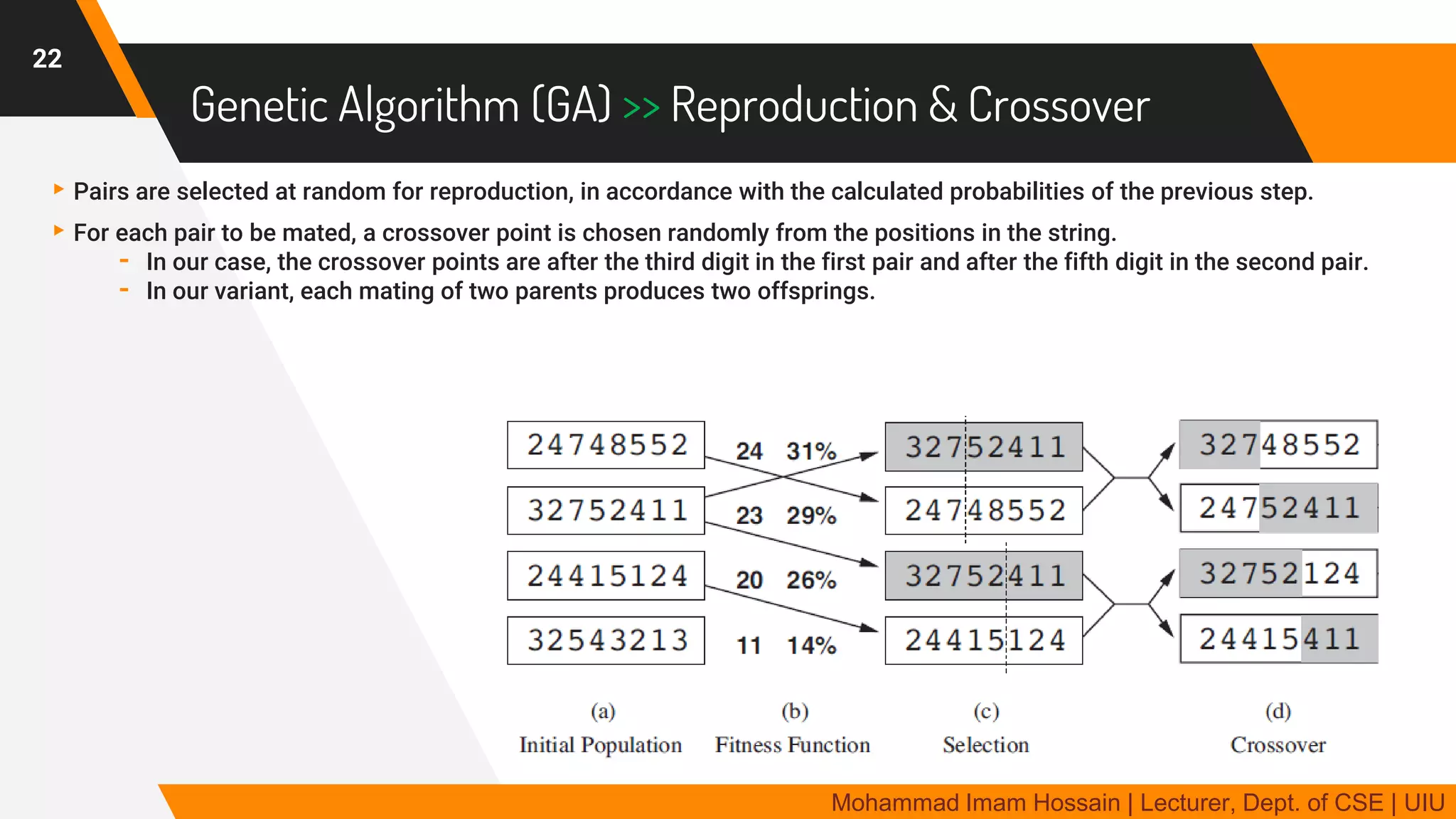
▸Pairs are selected at random for reproduction, in accordance with the calculated probabilities of the previous step.
▸For each pair to be mated, a crossover point is chosen randomly from the positions in the string.
- In our case, the crossover points are after the third digit in the first pair and after the fifth digit in the second pair.
- In our variant, each mating of two parents produces two offsprings.
Genetic Algorithm (GA) >> Reproduction & Crossover
23
Mohammad Imam Hossain | Lecturer, Dept. of CSE | UIU
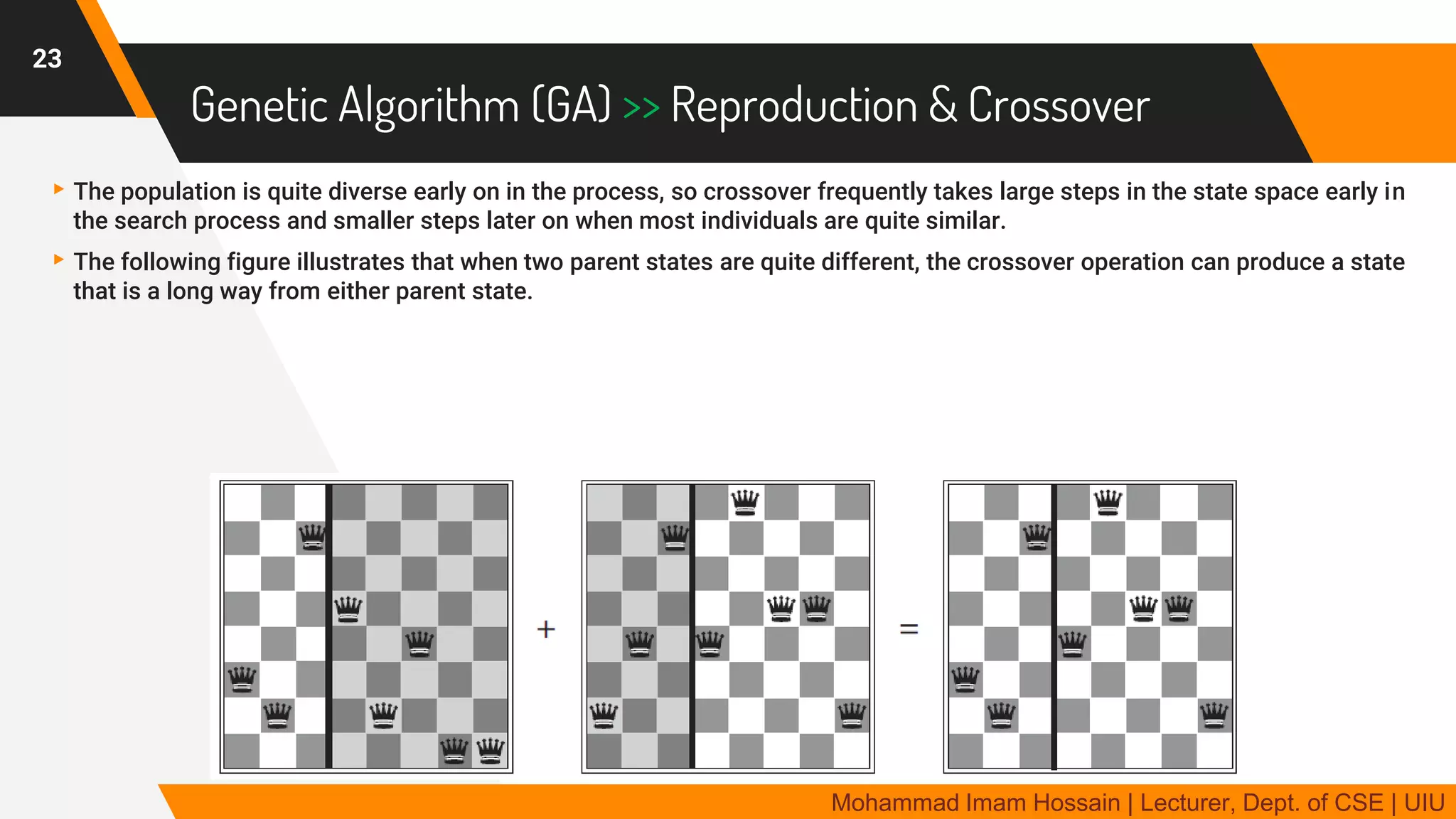
▸The population is quite diverse early on in the process, so crossover frequently takes large steps in the state space early in
the search process and smaller steps later on when most individuals are quite similar.
▸The following figure illustrates that when two parent states are quite different, the crossover operation can produce a state
that is a long way from either parent state.
Genetic Algorithm (GA) >> Mutation
24
Mohammad Imam Hossain | Lecturer, Dept. of CSE | UIU
▸Each location is subject to random mutation with a small independent probability.
▸For 8-queens problem, we need to choose a queen at random and moving it to a random square in its column.
▸In our example, one digit was mutated in the first, third and fourth offspring.
Genetic Algorithm (GA) >> Mutation
25
Mohammad Imam Hossain | Lecturer, Dept. of CSE | UIU
Genetic Algorithm (GA) >> Comments
26
Mohammad Imam Hossain | Lecturer, Dept. of CSE | UIU
▸Positive points
- Random exploration can find solutions that local search can’t
- Appealing connection to human programming
▸Negative points
- Large number of tunable parameters
- Lack of good empirical studies comparing to simpler methods
- Useful on some set of problems but no convincing evidence that GAs are better than hill-climbing w/random restarts
in general.
Genetic Algorithm (GA) >> Max One Problem
27
Mohammad Imam Hossain | Lecturer, Dept. of CSE | UIU
▸The Max-One problem is a very simple problem where evolution is used to find a specific gene.
▸A gene is essentially a piece of text filled with random binary values, binary string.
Start Gene: 1010001010
Target Gene: 1111111111
▸The fitness f of a candidate solution to the Max-One problem is the number of ones in its genetic code.
Genetic Algorithm (GA) >> Max One Problem
28
Mohammad Imam Hossain | Lecturer, Dept. of CSE | UIU
▸We start with a population of n random strings.
▸Suppose that l=10 and n=6
s1= 1111010101 f (s1) = 7
s2= 0111000101 f (s2) = 5
s3= 1110110101 f (s3) = 7
s4= 0100010011 f (s4) = 4
s5= 1110111101 f (s5) = 8
s6= 0100110000 f (s6) = 3
Genetic Algorithm (GA) >> Selection
29
Mohammad Imam Hossain | Lecturer, Dept. of CSE | UIU
▸We randomly select a subset of the individuals based on their fitness:
Individual i will have a probability =
𝑓(𝑖)
𝑓(𝑖)𝑖
to be chosen.
s1’= 1111010101(s1)
s2’ = 1110110101(s3)
s3’ = 1110111101(s5)
s4’ = 0111000101 (s2)
s5’ = 0100010011 (s4)
s6’ = 1110111101 (s5)
Genetic Algorithm (GA) >> Crossover
30
Mohammad Imam Hossain | Lecturer, Dept. of CSE | UIU
▸Next we mate strings for crossover. For each couple we first decide whether to actually perform the crossover or not.
▸If we decide to actually perform crossover, we randomly extract the crossover points.
s1’= 1111010101(s1) s1’’ = 1110110101
s2’ = 1110110101(s3) s2’’ = 1111010101
s3’ = 1110111101(s5) s3’’ = 1110111101
s4’ = 0111000101 (s2) s4’’ = 0111000101
s5’ = 0100010011 (s4) s5’’ = 0100011101
s6’ = 1110111101 (s5) s6’’ = 1110110011
Genetic Algorithm (GA) >> Mutation
31
Mohammad Imam Hossain | Lecturer, Dept. of CSE | UIU
▸For each bit that we are to copy to the new population we allow a small probability of error (for example 0.1)
s1’’ = 1110110101 s1’’’ = 1110100101
s2’’ = 1111010101 s2’’’ = 1111110100
s3’’ = 1110111101 s3’’’ = 1110101111
s4’’ = 0111000101 s4’’’ = 0111000101
s5’’ = 0100011101 s5’’’ = 0100011101
s6’’ = 1110110011 s6’’’ = 1110110001
Go through the same process all over again, until a stopping criterion is met.
Genetic Algorithm (GA) >> Previous Question
32
Mohammad Imam Hossain | Lecturer, Dept. of CSE | UIU
33
THANKS!
Any questions?
You can find me at imam@cse.uiu.ac.bd

AI 5 | Local Search

  • 1.
    Local Search CSI 341Mohammad Imam Hossain | Lecturer, Dept. of CSE | UIU
  • 2.
    Classical Search The searchproblems we have considered during the Uninformed/Informed Search have the following properties: ▸Observable – If an agent’s sensors give it access to the complete state of the environment at each point in time, then we say that the task environment is fully observable. ▸Deterministic – If the next state of the environment is completely determined by the current state and action executed by the agent, then we say the environment is deterministic. ▸Known – In a known environment, the outcomes for all actions are given and the agent won’t have to learn how it works in order to make good decisions. Classical search algorithms explore the search space systematically and the solution of the search problem is a sequence of actions representing paths from an initial state to the goal state. 2 Mohammad Imam Hossain | Lecturer, Dept. of CSE | UIU
  • 3.
    Local Search ▸There existssome problems where the path to the goal is irrelevant. ▸For example, In the 8-queens problem what matters is the final configuration of queens, not the order in which they are added. ▸If the path to the goal does not matter, we might consider a different class of algorithms(Local Search), ones that do not worry about paths at all. ▸Local search algorithms evaluate and modify one or more current states rather than systematically exploring paths from an initial state. ▸Local Search - Keep track of single current state - Move only to neighboring states - Path followed by the search are not retained ▸Advantages - Use very little memory - Can often find reasonable solutions in large or infinite state spaces for which systematic algorithms are unsuitable - Useful for solving pure optimization problems, in which the aim is to find the best state according to an objective function 3 Mohammad Imam Hossain | Lecturer, Dept. of CSE | UIU
  • 4.
    State-space Landscape Components >> ▸Location– state ▸Elevation – heuristic cost function or, objective function. An optimal algorithm always finds a global maximum(for objective function)/minimum(for heuristic cost function) ▸Local Maxima – a peak that is higher than each of its neighboring states but lower than the global maximum ▸Plateaux – a plateau is a flat area of the state- space landscape. It can be a flat local maximum from which no uphill exit exists, or a shoulder from which progress is possible. 4 Mohammad Imam Hossain | Lecturer, Dept. of CSE | UIU
  • 5.
    Hill-climbing Search >>Steepest-ascent Version ▸Hill-climbing search algorithm is simply a loop that continually moves in the direction of increasing value - that is uphill. ▸It terminates when it reaches a peak where no neighbor has a higher value. ▸It doesn’t maintain a search tree, so the data structure for the current node need only record the state and the value of the objective function/heuristic cost function. ▸Can randomly choose among the set of best successors, if multiple have the best value. ▸It doesn’t look ahead beyond the immediate neighbors of the current state. ▸Also known as Greedy Local Search 5 Mohammad Imam Hossain | Lecturer, Dept. of CSE | UIU
  • 6.
    Hill-climbing Search >>Example ▸8-queens problem: - Local search algorithms use a complete-state formulation, where each state has 8-queens on the board one per columns. - Successors of a state are all possible states generated by moving a single queen to another square in the same column. (8x7=56 successors) - Heuristic cost function h is the number of pairs of queens that are attacking each other, either directly or indirectly. - The global minima of this heuristic function i.e. zero occurs only at perfect solution. 6 Mohammad Imam Hossain | Lecturer, Dept. of CSE | UIU Local minima, h=1Initial State, h=17
  • 7.
    Hill-climbing Search >>8-puzzle 7 Mohammad Imam Hossain | Lecturer, Dept. of CSE | UIU
  • 8.
    Hill-climbing Search >>4-queen 8 Mohammad Imam Hossain | Lecturer, Dept. of CSE | UIU
  • 9.
    Hill-climbing Search >>Drawbacks Hill-climbing search often gets stuck for the following reasons: ▸Local Maxima >> ▹It is a peak that is higher than each of its neighboring states but lower than the global maximum. ▹For 8-queens problem at local minima, each move of a single queen makes the situation worse. ▸Ridges >> ▹Sequence of local maxima difficult for greedy algorithms to navigate ▸Plateaux >> ▹A plateau is a flat area of the state-space landscape. If can be a flat local maximum or, a shoulder. 9 Mohammad Imam Hossain | Lecturer, Dept. of CSE | UIU
  • 10.
    Hill-climbing Search >>Local Maxima 10 Mohammad Imam Hossain | Lecturer, Dept. of CSE | UIU
  • 11.
    Hill-climbing Search >>Performance ▸Randomly generated 8-queens starting state… ▸14% the time it solves the problem ▸86% of the time it gets stuck at a local minimum ▸However… - Takes only 4 steps on average when it succeeds - And 3 on average when it gets stuck - Not bad (for a state space with 88~17 million states) 11 Mohammad Imam Hossain | Lecturer, Dept. of CSE | UIU
  • 12.
    Hill-climbing Search >>Sideway Move version ▸If no downhill (uphill) moves, allow sideways moves in hope that algorithm can escape - Need to place a limit on the possible number of sideways moves to avoid infinite loops ▸For 8-queens - Now allow sideways moves with a limit of 100 - Raises percentage of problem instances solved from 14 to 94% - However…. - 21 steps for every successful solution - 64 for each failure 12 Mohammad Imam Hossain | Lecturer, Dept. of CSE | UIU
  • 13.
    Hill-climbing Search >>Variations ▸Stochastic hill-climbing - Random selection among the uphill/downhill moves. - The selection probability can vary with the steepness of the uphill move. Sample Algorithm [Uphill version] >> 13 Mohammad Imam Hossain | Lecturer, Dept. of CSE | UIU eval(vc) = 107, T = const = 10
  • 14.
    Hill-climbing Search >>Variations ▸First-choice hill-climbing - stochastic hill climbing by generating successors randomly until a better one is found - Useful when there are a very large number of successors ▸Random-restart hill-climbing - If at first you don’t succeed, try, try again. - Tries to avoid getting stuck in local maxima. 14 Mohammad Imam Hossain | Lecturer, Dept. of CSE | UIU
  • 15.
    Simulated Annealing 15 Mohammad ImamHossain | Lecturer, Dept. of CSE | UIU ▸A hill-climbing algorithm that never makes downhill moves(for maximization problem) toward states with lower value(or higher cost) is guaranteed to be incomplete, because it can get stuck on a local maximum. ▸In contrast, a purely random walk-that is moving to successor chosen uniformly at random from the set of successors-is complete but extremely inefficient. ▸Simulated Annealing is such an algorithm that combines both hill climbing with a random walk in such a way that yields both efficiency and completeness.
  • 16.
    Simulated Annealing 16 Mohammad ImamHossain | Lecturer, Dept. of CSE | UIU ▸In metallurgy, annealing is the process used to temper or harden metals and glass by heating them to a high temperature and then gradually cooling them, thus allowing the material to reach a low energy crystalline state. ▸The simulated-annealing solution is to start by shaking hard (i.e. high temperature) and then gradually reduce the intensity of the shaking (i.e. lower the temperature). ▸Instead of picking the best move, it picks a random move. - If the move improves the situation, it is always accepted. - Otherwise, the algorithm accepts the move with some probability less than 1. ▸The probability decreases exponentially with the badness of the move – the amount ∆E by which the evaluation is worsened. ▸The probability also decreases as the temperature T goes down. As a result bad moves more likely to be allowed at the start when T is high, and they become more unlikely as T decreases. ▸If the schedule lowers T slowly enough, the algorithm will find a global optimum with probability approaching 1.
  • 17.
    Simulated Annealing >>Algorithm 17 Mohammad Imam Hossain | Lecturer, Dept. of CSE | UIU
  • 18.
    Simulated Annealing >>Algorithm 18 Mohammad Imam Hossain | Lecturer, Dept. of CSE | UIU
  • 19.
    Local Beam Search 19 MohammadImam Hossain | Lecturer, Dept. of CSE | UIU ▸Because of memory limitations, we are just maintaining one node in memory in our previous local search algorithms. ▸The local beam search keeps track of k states rather than just one. ▹It begins with k randomly generated states. ▹At each step, all the successors of all k states are generated. If any one is a goal, the algorithm halts. Otherwise it selects the k best successors from the complete list and repeats. ▸In a random restart search each search process runs independently of the others; while in local beam search useful information is passed among the parallel search threads. ▸The algorithm quickly abandons unfruitful searches and moves its resources to where the most progress is being made. ▸Problem: - It can suffer from a lack of diversity among the k states - they can quickly become concentrated in a small region of the state space, making the search little more than an expensive version of hill-climbing. ▸Solution: - Stochastic Beam Search : Instead of choosing the best k from the pool of candidate successors, stochastic beam search chooses k successors at random, with the probability of choosing a given successor being an increasing function of its value.
  • 20.
    Genetic Algorithm (GA) 20 MohammadImam Hossain | Lecturer, Dept. of CSE | UIU ▸A Genetic Algorithm is a variant of stochastic beam search in which successor states are generated by combining two parents rather than by modifying a single state. ▸Population >> GAs begin with a set of k randomly generated states, called population. ▸Individual >> Each state or, individual is represented as a string over finite alphabet. For example, 8-queens state must specify the positions of 8-queens, each in a column of 8 squares. - way 1: a bit string requires 8 x log2(8) = 8 x 3 = 24 bits. (problem: cut in the middle of a digit) - way 2: a string representing a sequence of 8 digits. ▸Genetic algorithms combine an uphill tendency with random exploration and exchange of information among parallel search threads. 1 6 2 5 7 4 8 3
  • 21.
    Genetic Algorithm (GA)>> Fitness Function 21 Mohammad Imam Hossain | Lecturer, Dept. of CSE | UIU ▸Each state/individual is rated by the objective/fitness function. A fitness function should return higher values for better states. For 8-queens, fitness function = number of not-attacking pairs of queens, which has a value of 28 for solution. ▸In this variant, we assume that the probability of being chosen for reproducing is directly proportional to the fitness score.
  • 22.
    Genetic Algorithm (GA)>> Reproduction & Crossover 22 Mohammad Imam Hossain | Lecturer, Dept. of CSE | UIU ▸Pairs are selected at random for reproduction, in accordance with the calculated probabilities of the previous step. ▸For each pair to be mated, a crossover point is chosen randomly from the positions in the string. - In our case, the crossover points are after the third digit in the first pair and after the fifth digit in the second pair. - In our variant, each mating of two parents produces two offsprings.
  • 23.
    Genetic Algorithm (GA)>> Reproduction & Crossover 23 Mohammad Imam Hossain | Lecturer, Dept. of CSE | UIU ▸The population is quite diverse early on in the process, so crossover frequently takes large steps in the state space early in the search process and smaller steps later on when most individuals are quite similar. ▸The following figure illustrates that when two parent states are quite different, the crossover operation can produce a state that is a long way from either parent state.
  • 24.
    Genetic Algorithm (GA)>> Mutation 24 Mohammad Imam Hossain | Lecturer, Dept. of CSE | UIU ▸Each location is subject to random mutation with a small independent probability. ▸For 8-queens problem, we need to choose a queen at random and moving it to a random square in its column. ▸In our example, one digit was mutated in the first, third and fourth offspring.
  • 25.
    Genetic Algorithm (GA)>> Mutation 25 Mohammad Imam Hossain | Lecturer, Dept. of CSE | UIU
  • 26.
    Genetic Algorithm (GA)>> Comments 26 Mohammad Imam Hossain | Lecturer, Dept. of CSE | UIU ▸Positive points - Random exploration can find solutions that local search can’t - Appealing connection to human programming ▸Negative points - Large number of tunable parameters - Lack of good empirical studies comparing to simpler methods - Useful on some set of problems but no convincing evidence that GAs are better than hill-climbing w/random restarts in general.
  • 27.
    Genetic Algorithm (GA)>> Max One Problem 27 Mohammad Imam Hossain | Lecturer, Dept. of CSE | UIU ▸The Max-One problem is a very simple problem where evolution is used to find a specific gene. ▸A gene is essentially a piece of text filled with random binary values, binary string. Start Gene: 1010001010 Target Gene: 1111111111 ▸The fitness f of a candidate solution to the Max-One problem is the number of ones in its genetic code.
  • 28.
    Genetic Algorithm (GA)>> Max One Problem 28 Mohammad Imam Hossain | Lecturer, Dept. of CSE | UIU ▸We start with a population of n random strings. ▸Suppose that l=10 and n=6 s1= 1111010101 f (s1) = 7 s2= 0111000101 f (s2) = 5 s3= 1110110101 f (s3) = 7 s4= 0100010011 f (s4) = 4 s5= 1110111101 f (s5) = 8 s6= 0100110000 f (s6) = 3
  • 29.
    Genetic Algorithm (GA)>> Selection 29 Mohammad Imam Hossain | Lecturer, Dept. of CSE | UIU ▸We randomly select a subset of the individuals based on their fitness: Individual i will have a probability = 𝑓(𝑖) 𝑓(𝑖)𝑖 to be chosen. s1’= 1111010101(s1) s2’ = 1110110101(s3) s3’ = 1110111101(s5) s4’ = 0111000101 (s2) s5’ = 0100010011 (s4) s6’ = 1110111101 (s5)
  • 30.
    Genetic Algorithm (GA)>> Crossover 30 Mohammad Imam Hossain | Lecturer, Dept. of CSE | UIU ▸Next we mate strings for crossover. For each couple we first decide whether to actually perform the crossover or not. ▸If we decide to actually perform crossover, we randomly extract the crossover points. s1’= 1111010101(s1) s1’’ = 1110110101 s2’ = 1110110101(s3) s2’’ = 1111010101 s3’ = 1110111101(s5) s3’’ = 1110111101 s4’ = 0111000101 (s2) s4’’ = 0111000101 s5’ = 0100010011 (s4) s5’’ = 0100011101 s6’ = 1110111101 (s5) s6’’ = 1110110011
  • 31.
    Genetic Algorithm (GA)>> Mutation 31 Mohammad Imam Hossain | Lecturer, Dept. of CSE | UIU ▸For each bit that we are to copy to the new population we allow a small probability of error (for example 0.1) s1’’ = 1110110101 s1’’’ = 1110100101 s2’’ = 1111010101 s2’’’ = 1111110100 s3’’ = 1110111101 s3’’’ = 1110101111 s4’’ = 0111000101 s4’’’ = 0111000101 s5’’ = 0100011101 s5’’’ = 0100011101 s6’’ = 1110110011 s6’’’ = 1110110001 Go through the same process all over again, until a stopping criterion is met.
  • 32.
    Genetic Algorithm (GA)>> Previous Question 32 Mohammad Imam Hossain | Lecturer, Dept. of CSE | UIU
  • 33.
    33 THANKS! Any questions? You canfind me at imam@cse.uiu.ac.bd