Types of algorithms in Adversarial
search
• Adversarial search is a game-playing technique
where the agents are surrounded by a competitive
environment.
• It is also obvious that the solution for the goal
state will be an optimal solution because the
player will try to win the game with the shortest
path and under limited time.
• There are following types of adversarial search:
– Min-max Algorithm
– Alpha-beta Pruning.
10/30/2023 1
Department of CSE (AI/ML)
Min-Max Algorithm
• In artificial intelligence, minimax is a decision-
making strategy under game theory, which is used to
minimize the losing chances in a game and to
maximize the winning chances.
• This strategy is also known as ‘Min-max,’ ’MM,’ or
‘Saddle point.’
10/30/2023 2
Department of CSE (AI/ML)
Min-Max Algorithm
• Mini-max algorithm is a recursive or backtracking algorithm
which is used in decision-making and game theory. It provides
an optimal move for the player assuming that opponent is also
playing optimally.
• Mini-Max algorithm uses recursion to search through the
game-tree.
• Example : Chess, Checkers, tic-tac-toe
• In this algorithm two players play the game; one is called
MAX and other is called MIN.
10/30/2023 3
Department of CSE (AI/ML)
Mini-Max Algorithm
• Both the players fight it as the opponent player gets the
minimum benefit while they get the maximum benefit.
• MIN: Decrease the chances of MAX to win the game.
• MAX: Increases his chances of winning the game.
• The minimax algorithm performs a depth-first search
algorithm for the exploration of the complete game tree.
• The minimax algorithm proceeds all the way down to the
terminal node of the tree, then backtrack the tree as the
recursion.
10/30/2023 4
Department of CSE (AI/ML)
Working of Min-Max Algorithm
• MINIMAX algorithm is a backtracking algorithm where it
backtracks to pick the best move out of several choices.
• MINIMAX strategy follows the DFS (Depth-first
search) concept.
• Here, we have two players MIN and MAX, and the game is
played alternatively between them, i.e., when MAX made a
move, then the next turn is of MIN.
• It means the move made by MAX is fixed and, he cannot
change it.
• The same concept is followed in DFS strategy, i.e., we
follow the same path and cannot change in the middle.
• That’s why in MINIMAX algorithm, instead of BFS, we
follow DFS.
10/30/2023 5
Department of CSE (AI/ML)
Working of Min-Max Algorithm
• Keep on generating the game tree/ search tree till a
limit d.
• Compute the move using a heuristic function.
• Propagate the values from the leaf node till the
current position following the minimax strategy.
• Make the best move from the choices.
10/30/2023 6
Department of CSE (AI/ML)
Pseudocode for Minimax Algorithm
10/30/2023 Department of CSE (AI/ML) 7
Step 1
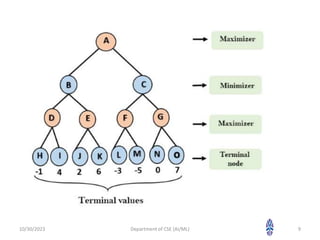
• In the first step, the algorithm generates the
entire game-tree and apply the utility function
to get the utility values for the terminal states.
• In the below tree diagram, let's take A is the
initial state of the tree.
• Suppose maximizer takes first turn which has
worst-case initial value =- infinity, and
minimizer will take next turn which has worst-
case initial value = +infinity.
10/30/2023 Department of CSE (AI/ML) 8
10/30/2023 Department of CSE (AI/ML) 9
Step 2
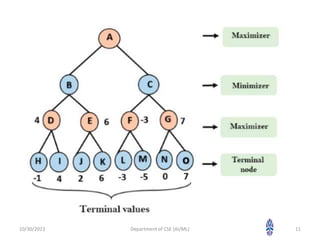
• Now, first we find the utilities value for the
Maximizer, its initial value is -∞, so we will
compare each value in terminal state with initial
value of Maximizer and determines the higher
nodes values. It will find the maximum among the
all.
• For node D max(-1,- -∞) => max(-1,4)= 4
• For Node E max(2, -∞) => max(2, 6)= 6
• For Node F max(-3, -∞) => max(-3,-5) = -3
• For node G max(0, -∞) = max(0, 7) = 7
10/30/2023 Department of CSE (AI/ML) 10
10/30/2023 Department of CSE (AI/ML) 11
Step 3
• In the next step, it's a turn for minimizer, so it
will compare all nodes value with +∞ and will
find the 3rd layer node values.
• For node B= min(4,6) = 4
• For node C= min (-3, 7) = -3
10/30/2023 Department of CSE (AI/ML) 12
10/30/2023 Department of CSE (AI/ML) 13
Step 4
• Now it's a turn for Maximizer, and it will again
choose the maximum of all nodes value and
find the maximum value for the root node.
• In this game tree, there are only 4 layers, hence
we reach immediately to the root node, but in
real games, there will be more than 4 layers.
• For node A max(4, -3)= 4
10/30/2023 Department of CSE (AI/ML) 14
10/30/2023 Department of CSE (AI/ML) 15
Example 2
10/30/2023 Department of CSE (AI/ML) 16
Solution
10/30/2023 Department of CSE (AI/ML) 17
Limitation of the minimax Algorithm
• The main drawback of the minimax algorithm
is that it gets really slow for complex games
such as Chess, go, etc.
• This type of games has a huge branching
factor, and the player has lots of choices to
decide.
• This limitation of the minimax algorithm can
be improved from alpha-beta pruning.
10/30/2023 Department of CSE (AI/ML) 18
Alpha-Beta Pruning
Exploiting the Fact of an Adversary
• If a position is provably bad:
– It is NO USE expending search time to find out exactly how bad
• If the adversary can force a bad position:
– It is NO USE expending search time to find out the good positions
that the adversary won’t let you achieve anyway
• Bad = not better than we already know we can achieve
elsewhere.
• Contrast normal search:
– ANY node might be a winner.
– ALL nodes must be considered.
– (A* avoids this through knowledge, i.e., heuristics)
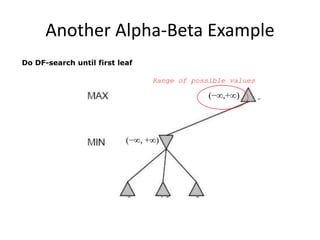
Another Alpha-Beta Example
(−∞, +∞)
(−∞,+∞)
Range of possible values
Do DF-search until first leaf
Alpha-Beta Example (continued)
(−∞,3]
(−∞,+∞)
Alpha-Beta Example (continued)
(−∞,3]
(−∞,+∞)
Alpha-Beta Example (continued)
[3,+∞)
[3,3]
Alpha-Beta Example (continued)
(−∞,2]
[3,+∞)
[3,3]
This node is
worse for MAX
Alpha-Beta Example (continued)
(−∞,2]
[3,14]
[3,3] (−∞,14]
,
Alpha-Beta Example (continued)
(−∞,2]
[3,5]
[3,3] (−∞,5]
,
Alpha-Beta Example (continued)
[2,2]
(−∞,2]
[3,3]
[3,3]
Alpha-Beta Example (continued)
[2,2]
(−∞,2]
[3,3]
[3,3]
General alpha-beta pruning
• Consider a node n in the tree
---
• If player has a better choice
at:
– Parent node of n
– Or any choice point further
up
• Then n will never be reached
in play.
• Hence, when that much is
known about n, it can be
pruned.
Alpha-beta Algorithm
• Depth first search
– only considers nodes along a single path from root at any time
a = highest-value choice found at any choice point of path for MAX
(initially, a = −infinity)
b = lowest-value choice found at any choice point of path for MIN
(initially, b = +infinity)
• Pass current values of a and b down to child nodes during search.
• Update values of a and b during search:
– MAX updates a at MAX nodes
– MIN updates b at MIN nodes
• Prune remaining branches at a node when a ≥ b
When to Prune
• Prune whenever a ≥ b.
– Prune below a Max node whose alpha value becomes
greater than or equal to the beta value of its ancestors.
• Max nodes update alpha based on children’s returned values.
– Prune below a Min node whose beta value becomes less
than or equal to the alpha value of its ancestors.
• Min nodes update beta based on children’s returned values.
Alpha-Beta Example Revisited
a, b, initial values
Do DF-search until first leaf
a=−
b =+
a=−
b =+
a, b, passed to kids
Alpha-Beta Example (continued)
MIN updates b, based on kids
a=−
b =+
a=−
b =3
Alpha-Beta Example (continued)
a=−
b =3
MIN updates b, based on kids.
No change.
a=−
b =+
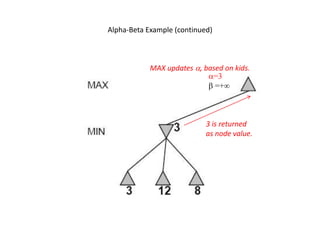
Alpha-Beta Example (continued)
MAX updates a, based on kids.
a=3
b =+
3 is returned
as node value.
Alpha-Beta Example (continued)
a=3
b =+
a=3
b =+
a, b, passed to kids
Alpha-Beta Example (continued)
a=3
b =+
a=3
b =2
MIN updates b,
based on kids.
Alpha-Beta Example (continued)
a=3
b =2
a ≥ b,
so prune.
a=3
b =+
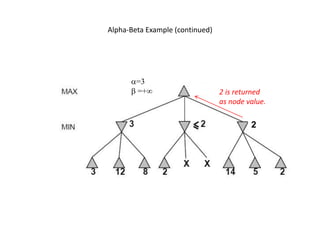
Alpha-Beta Example (continued)
2 is returned
as node value.
MAX updates a, based on kids.
No change. a=3
b =+
Alpha-Beta Example (continued)
,
a=3
b =+
a=3
b =+
a, b, passed to kids
Alpha-Beta Example (continued)
,
a=3
b =14
a=3
b =+
MIN updates b,
based on kids.
Alpha-Beta Example (continued)
,
a=3
b =5
a=3
b =+
MIN updates b,
based on kids.
Alpha-Beta Example (continued)
a=3
b =+ 2 is returned
as node value.
2
Alpha-Beta Example (continued)
Max calculates the same node
value, and makes the same
move!
2
Effectiveness of Alpha-Beta Search
• Worst-Case
– branches are ordered so that no pruning takes place. In this case
alpha-beta gives no improvement over exhaustive search
• Best-Case
– each player’s best move is the left-most child (i.e., evaluated first)
– in practice, performance is closer to best rather than worst-case
– E.g., sort moves by the remembered move values found last time.
– E.g., expand captures first, then threats, then forward moves, etc.
– E.g., run Iterative Deepening search, sort by value last iteration.
• In practice often get O(b(d/2)) rather than O(bd)
– this is the same as having a branching factor of sqrt(b),
• (sqrt(b))d = b(d/2),i.e., we effectively go from b to square root of b
– e.g., in chess go from b ~ 35 to b ~ 6
• this permits much deeper search in the same amount of time
Final Comments about Alpha-Beta Pruning
• Pruning does not affect final results
• Entire subtrees can be pruned.
• Good move ordering improves effectiveness of
pruning
• Repeated states are again possible.
– Store them in memory = transposition table
Example
3 4 1 2 7 8 5 6
-which nodes can be pruned?
Answer to Example
3 4 1 2 7 8 5 6
-which nodes can be pruned?
Answer: NONE! Because the most favorable nodes for both are explored last (i.e., in
the diagram, are on the right-hand side).
Max
Min
Max
Second Example
(the exact mirror image of the first
example)
6 5 8 7 2 1 3 4
-which nodes can be pruned?
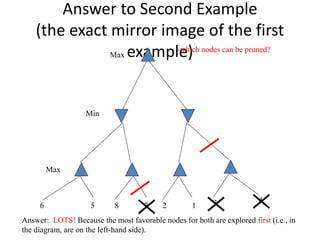
Answer to Second Example
(the exact mirror image of the first
example)
6 5 8 7 2 1 3 4
-which nodes can be pruned?
Min
Max
Max
Answer: LOTS! Because the most favorable nodes for both are explored first (i.e., in
the diagram, are on the left-hand side).

Minmax and alpha beta pruning.pptx

  • 1.
    Types of algorithmsin Adversarial search • Adversarial search is a game-playing technique where the agents are surrounded by a competitive environment. • It is also obvious that the solution for the goal state will be an optimal solution because the player will try to win the game with the shortest path and under limited time. • There are following types of adversarial search: – Min-max Algorithm – Alpha-beta Pruning. 10/30/2023 1 Department of CSE (AI/ML)
  • 2.
    Min-Max Algorithm • Inartificial intelligence, minimax is a decision- making strategy under game theory, which is used to minimize the losing chances in a game and to maximize the winning chances. • This strategy is also known as ‘Min-max,’ ’MM,’ or ‘Saddle point.’ 10/30/2023 2 Department of CSE (AI/ML)
  • 3.
    Min-Max Algorithm • Mini-maxalgorithm is a recursive or backtracking algorithm which is used in decision-making and game theory. It provides an optimal move for the player assuming that opponent is also playing optimally. • Mini-Max algorithm uses recursion to search through the game-tree. • Example : Chess, Checkers, tic-tac-toe • In this algorithm two players play the game; one is called MAX and other is called MIN. 10/30/2023 3 Department of CSE (AI/ML)
  • 4.
    Mini-Max Algorithm • Boththe players fight it as the opponent player gets the minimum benefit while they get the maximum benefit. • MIN: Decrease the chances of MAX to win the game. • MAX: Increases his chances of winning the game. • The minimax algorithm performs a depth-first search algorithm for the exploration of the complete game tree. • The minimax algorithm proceeds all the way down to the terminal node of the tree, then backtrack the tree as the recursion. 10/30/2023 4 Department of CSE (AI/ML)
  • 5.
    Working of Min-MaxAlgorithm • MINIMAX algorithm is a backtracking algorithm where it backtracks to pick the best move out of several choices. • MINIMAX strategy follows the DFS (Depth-first search) concept. • Here, we have two players MIN and MAX, and the game is played alternatively between them, i.e., when MAX made a move, then the next turn is of MIN. • It means the move made by MAX is fixed and, he cannot change it. • The same concept is followed in DFS strategy, i.e., we follow the same path and cannot change in the middle. • That’s why in MINIMAX algorithm, instead of BFS, we follow DFS. 10/30/2023 5 Department of CSE (AI/ML)
  • 6.
    Working of Min-MaxAlgorithm • Keep on generating the game tree/ search tree till a limit d. • Compute the move using a heuristic function. • Propagate the values from the leaf node till the current position following the minimax strategy. • Make the best move from the choices. 10/30/2023 6 Department of CSE (AI/ML)
  • 7.
    Pseudocode for MinimaxAlgorithm 10/30/2023 Department of CSE (AI/ML) 7
  • 8.
    Step 1 • Inthe first step, the algorithm generates the entire game-tree and apply the utility function to get the utility values for the terminal states. • In the below tree diagram, let's take A is the initial state of the tree. • Suppose maximizer takes first turn which has worst-case initial value =- infinity, and minimizer will take next turn which has worst- case initial value = +infinity. 10/30/2023 Department of CSE (AI/ML) 8
  • 9.
  • 10.
    Step 2 • Now,first we find the utilities value for the Maximizer, its initial value is -∞, so we will compare each value in terminal state with initial value of Maximizer and determines the higher nodes values. It will find the maximum among the all. • For node D max(-1,- -∞) => max(-1,4)= 4 • For Node E max(2, -∞) => max(2, 6)= 6 • For Node F max(-3, -∞) => max(-3,-5) = -3 • For node G max(0, -∞) = max(0, 7) = 7 10/30/2023 Department of CSE (AI/ML) 10
  • 11.
  • 12.
    Step 3 • Inthe next step, it's a turn for minimizer, so it will compare all nodes value with +∞ and will find the 3rd layer node values. • For node B= min(4,6) = 4 • For node C= min (-3, 7) = -3 10/30/2023 Department of CSE (AI/ML) 12
  • 13.
  • 14.
    Step 4 • Nowit's a turn for Maximizer, and it will again choose the maximum of all nodes value and find the maximum value for the root node. • In this game tree, there are only 4 layers, hence we reach immediately to the root node, but in real games, there will be more than 4 layers. • For node A max(4, -3)= 4 10/30/2023 Department of CSE (AI/ML) 14
  • 15.
  • 16.
  • 17.
  • 18.
    Limitation of theminimax Algorithm • The main drawback of the minimax algorithm is that it gets really slow for complex games such as Chess, go, etc. • This type of games has a huge branching factor, and the player has lots of choices to decide. • This limitation of the minimax algorithm can be improved from alpha-beta pruning. 10/30/2023 Department of CSE (AI/ML) 18
  • 19.
    Alpha-Beta Pruning Exploiting theFact of an Adversary • If a position is provably bad: – It is NO USE expending search time to find out exactly how bad • If the adversary can force a bad position: – It is NO USE expending search time to find out the good positions that the adversary won’t let you achieve anyway • Bad = not better than we already know we can achieve elsewhere. • Contrast normal search: – ANY node might be a winner. – ALL nodes must be considered. – (A* avoids this through knowledge, i.e., heuristics)
  • 20.
    Another Alpha-Beta Example (−∞,+∞) (−∞,+∞) Range of possible values Do DF-search until first leaf
  • 21.
  • 22.
  • 23.
  • 24.
  • 25.
  • 26.
  • 27.
  • 28.
  • 29.
    General alpha-beta pruning •Consider a node n in the tree --- • If player has a better choice at: – Parent node of n – Or any choice point further up • Then n will never be reached in play. • Hence, when that much is known about n, it can be pruned.
  • 30.
    Alpha-beta Algorithm • Depthfirst search – only considers nodes along a single path from root at any time a = highest-value choice found at any choice point of path for MAX (initially, a = −infinity) b = lowest-value choice found at any choice point of path for MIN (initially, b = +infinity) • Pass current values of a and b down to child nodes during search. • Update values of a and b during search: – MAX updates a at MAX nodes – MIN updates b at MIN nodes • Prune remaining branches at a node when a ≥ b
  • 31.
    When to Prune •Prune whenever a ≥ b. – Prune below a Max node whose alpha value becomes greater than or equal to the beta value of its ancestors. • Max nodes update alpha based on children’s returned values. – Prune below a Min node whose beta value becomes less than or equal to the alpha value of its ancestors. • Min nodes update beta based on children’s returned values.
  • 32.
    Alpha-Beta Example Revisited a,b, initial values Do DF-search until first leaf a=− b =+ a=− b =+ a, b, passed to kids
  • 33.
    Alpha-Beta Example (continued) MINupdates b, based on kids a=− b =+ a=− b =3
  • 34.
    Alpha-Beta Example (continued) a=− b=3 MIN updates b, based on kids. No change. a=− b =+
  • 35.
    Alpha-Beta Example (continued) MAXupdates a, based on kids. a=3 b =+ 3 is returned as node value.
  • 36.
    Alpha-Beta Example (continued) a=3 b=+ a=3 b =+ a, b, passed to kids
  • 37.
    Alpha-Beta Example (continued) a=3 b=+ a=3 b =2 MIN updates b, based on kids.
  • 38.
    Alpha-Beta Example (continued) a=3 b=2 a ≥ b, so prune. a=3 b =+
  • 39.
    Alpha-Beta Example (continued) 2is returned as node value. MAX updates a, based on kids. No change. a=3 b =+
  • 40.
    Alpha-Beta Example (continued) , a=3 b=+ a=3 b =+ a, b, passed to kids
  • 41.
    Alpha-Beta Example (continued) , a=3 b=14 a=3 b =+ MIN updates b, based on kids.
  • 42.
    Alpha-Beta Example (continued) , a=3 b=5 a=3 b =+ MIN updates b, based on kids.
  • 43.
    Alpha-Beta Example (continued) a=3 b=+ 2 is returned as node value. 2
  • 44.
    Alpha-Beta Example (continued) Maxcalculates the same node value, and makes the same move! 2
  • 45.
    Effectiveness of Alpha-BetaSearch • Worst-Case – branches are ordered so that no pruning takes place. In this case alpha-beta gives no improvement over exhaustive search • Best-Case – each player’s best move is the left-most child (i.e., evaluated first) – in practice, performance is closer to best rather than worst-case – E.g., sort moves by the remembered move values found last time. – E.g., expand captures first, then threats, then forward moves, etc. – E.g., run Iterative Deepening search, sort by value last iteration. • In practice often get O(b(d/2)) rather than O(bd) – this is the same as having a branching factor of sqrt(b), • (sqrt(b))d = b(d/2),i.e., we effectively go from b to square root of b – e.g., in chess go from b ~ 35 to b ~ 6 • this permits much deeper search in the same amount of time
  • 46.
    Final Comments aboutAlpha-Beta Pruning • Pruning does not affect final results • Entire subtrees can be pruned. • Good move ordering improves effectiveness of pruning • Repeated states are again possible. – Store them in memory = transposition table
  • 47.
    Example 3 4 12 7 8 5 6 -which nodes can be pruned?
  • 48.
    Answer to Example 34 1 2 7 8 5 6 -which nodes can be pruned? Answer: NONE! Because the most favorable nodes for both are explored last (i.e., in the diagram, are on the right-hand side). Max Min Max
  • 49.
    Second Example (the exactmirror image of the first example) 6 5 8 7 2 1 3 4 -which nodes can be pruned?
  • 50.
    Answer to SecondExample (the exact mirror image of the first example) 6 5 8 7 2 1 3 4 -which nodes can be pruned? Min Max Max Answer: LOTS! Because the most favorable nodes for both are explored first (i.e., in the diagram, are on the left-hand side).