Artificial Intelligence
Adversarial search
Planning ahead in a world that
includes a hostile agent
• Games as search problems
• Idealization and simplification:
– Two players
– Alternate moves
• MAX player
• MIN player
– Available information:
• Perfect: chess, chequers, tic-tac-toe… (no chance,
same knowledge for the two players)
• Imperfect: poker, Stratego, bridge…
Game representation
• In the general case of a game with two
players:
– General state representation
– Initial-state definition
– Winning-state representation as:
• Structure
• Properties
• Utility function
– Definition of a set of operators
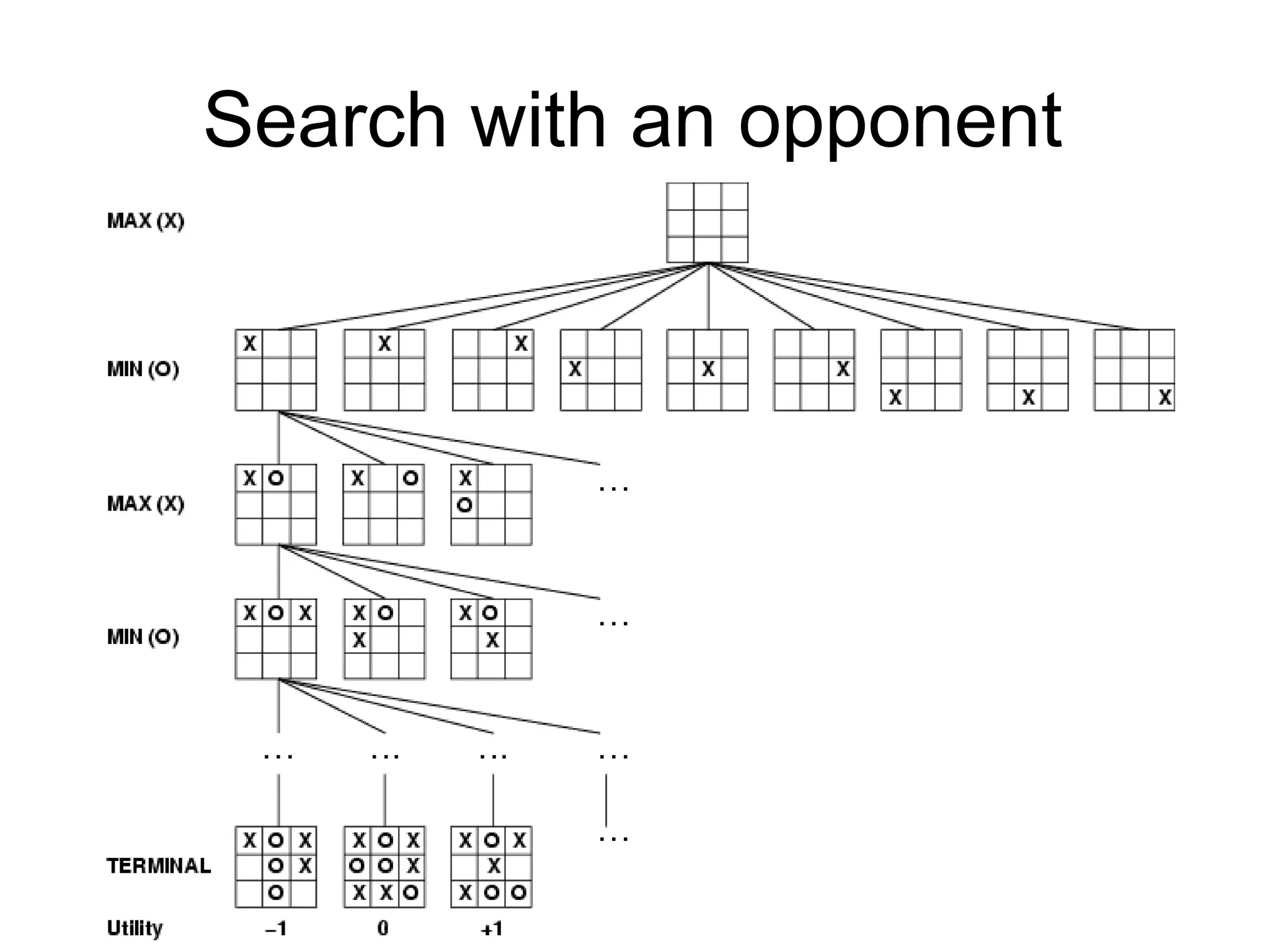
Search with an opponent
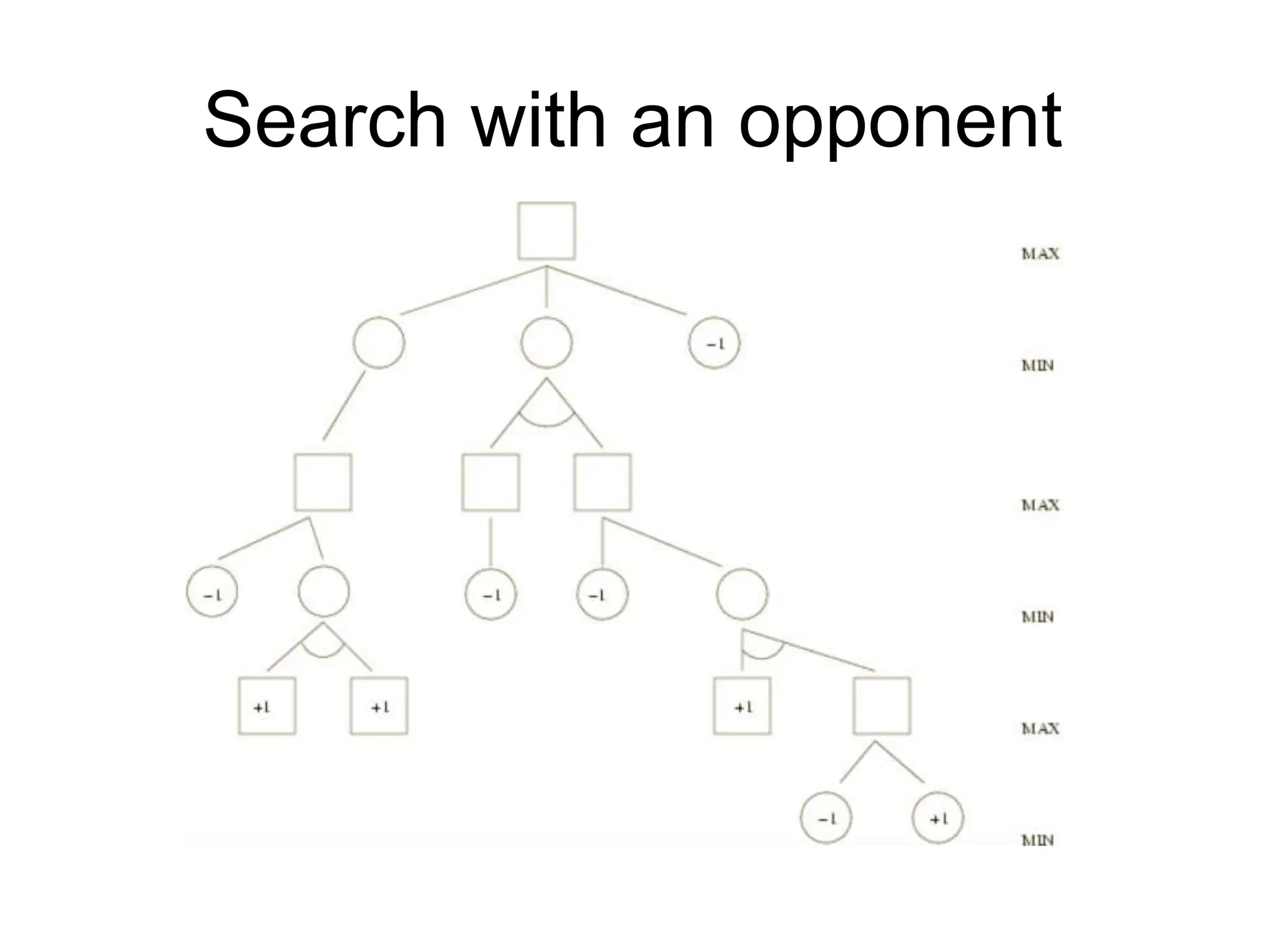
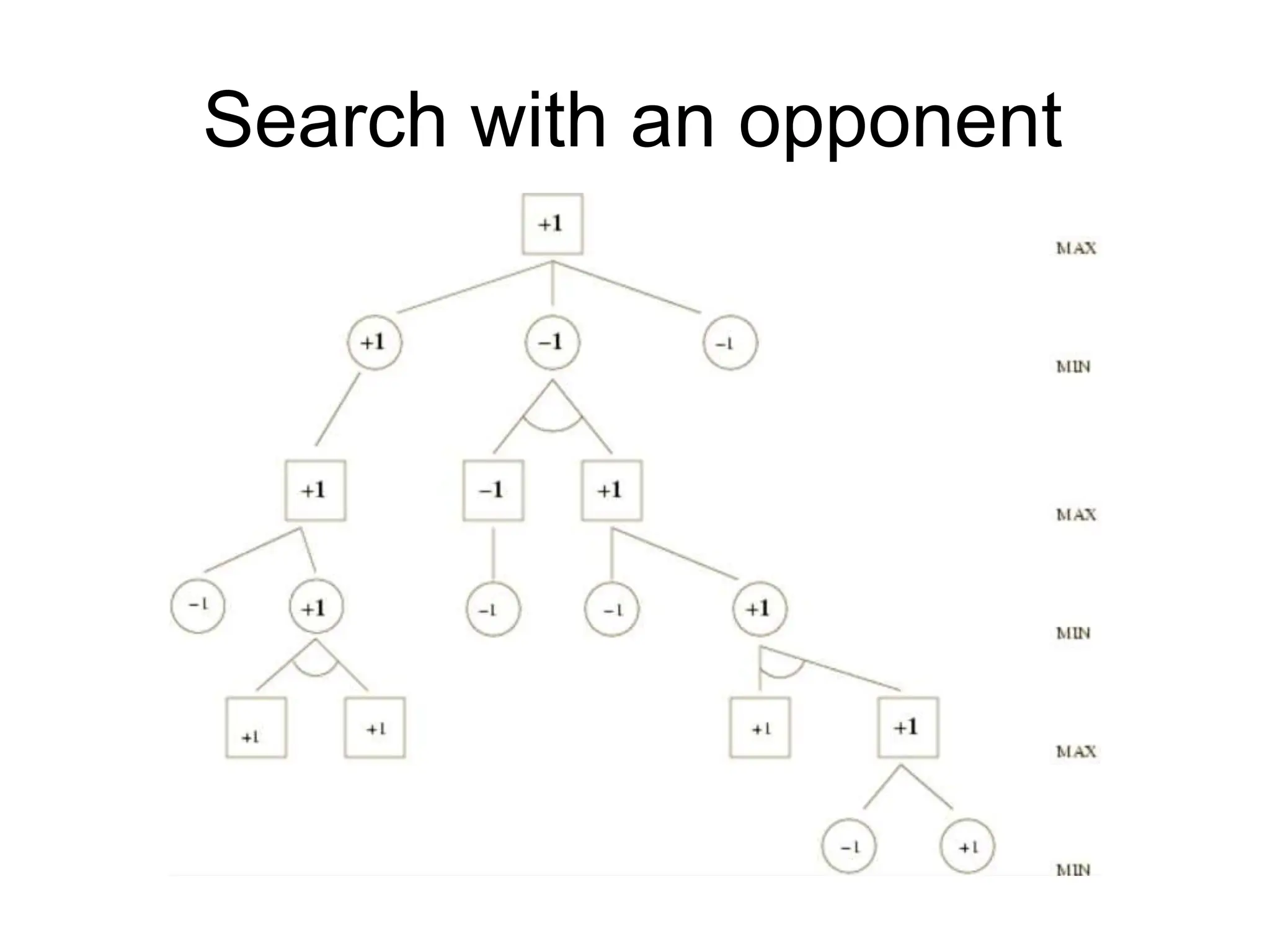
• Trivial approximation: generating the tree for
all moves
• Terminal moves are tagged with a utility value,
for example: “+1” or “-1” depending on if the
winner is MAX or MIN.
• The goal is to find a path to a winning state.
• Even if a depth-first search would minimize
memory space, in complex games this kind of
search cannot be carried out.
• Even a simple game like tic-tac-toe is too
complex to draw the entire game tree.
Search with an opponent
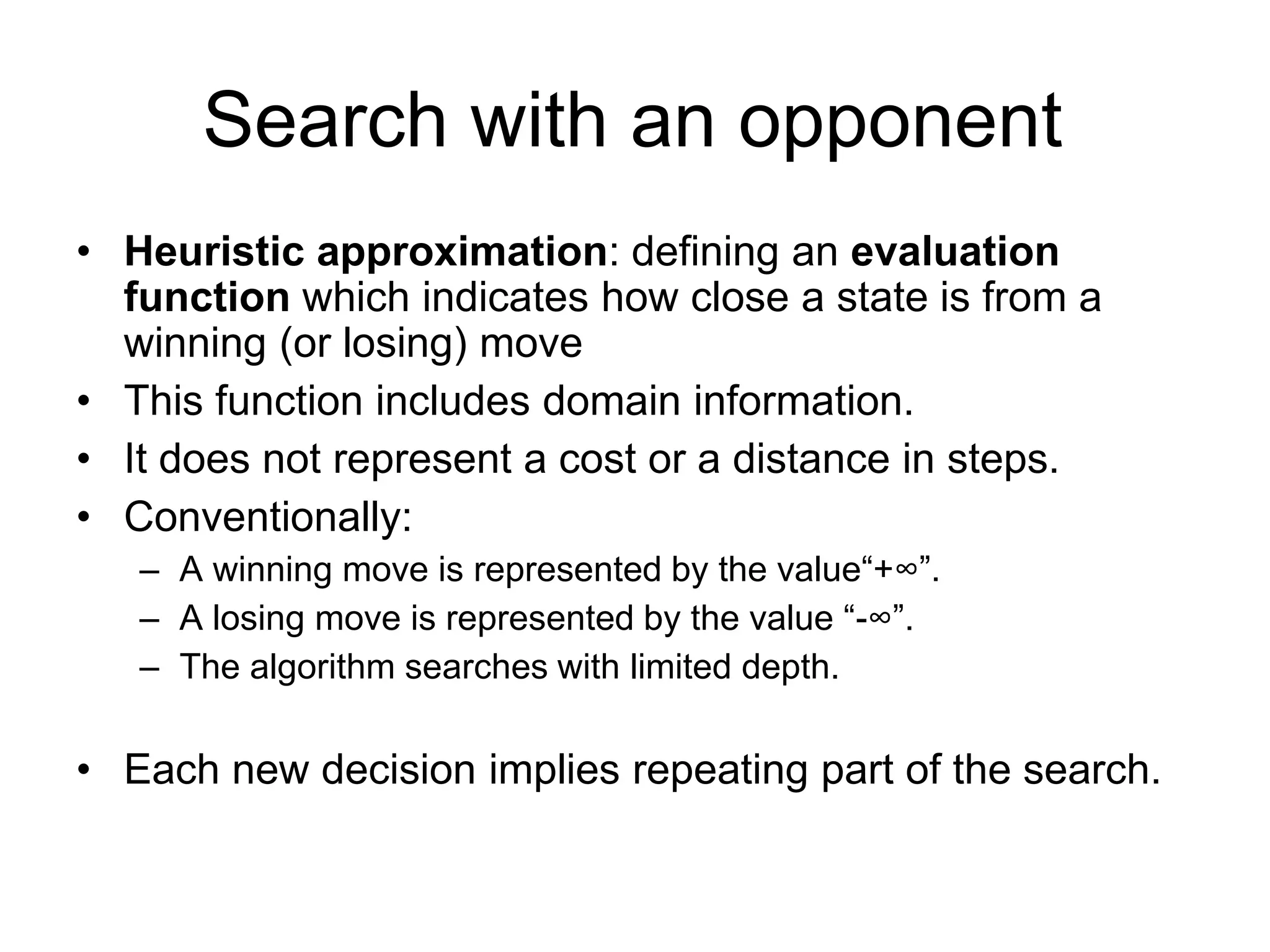
• Heuristic approximation: defining an evaluation
function which indicates how close a state is from a
winning (or losing) move
• This function includes domain information.
• It does not represent a cost or a distance in steps.
• Conventionally:
– A winning move is represented by the value“+∞”.
– A losing move is represented by the value “-∞”.
– The algorithm searches with limited depth.
• Each new decision implies repeating part of the search.
Minimax
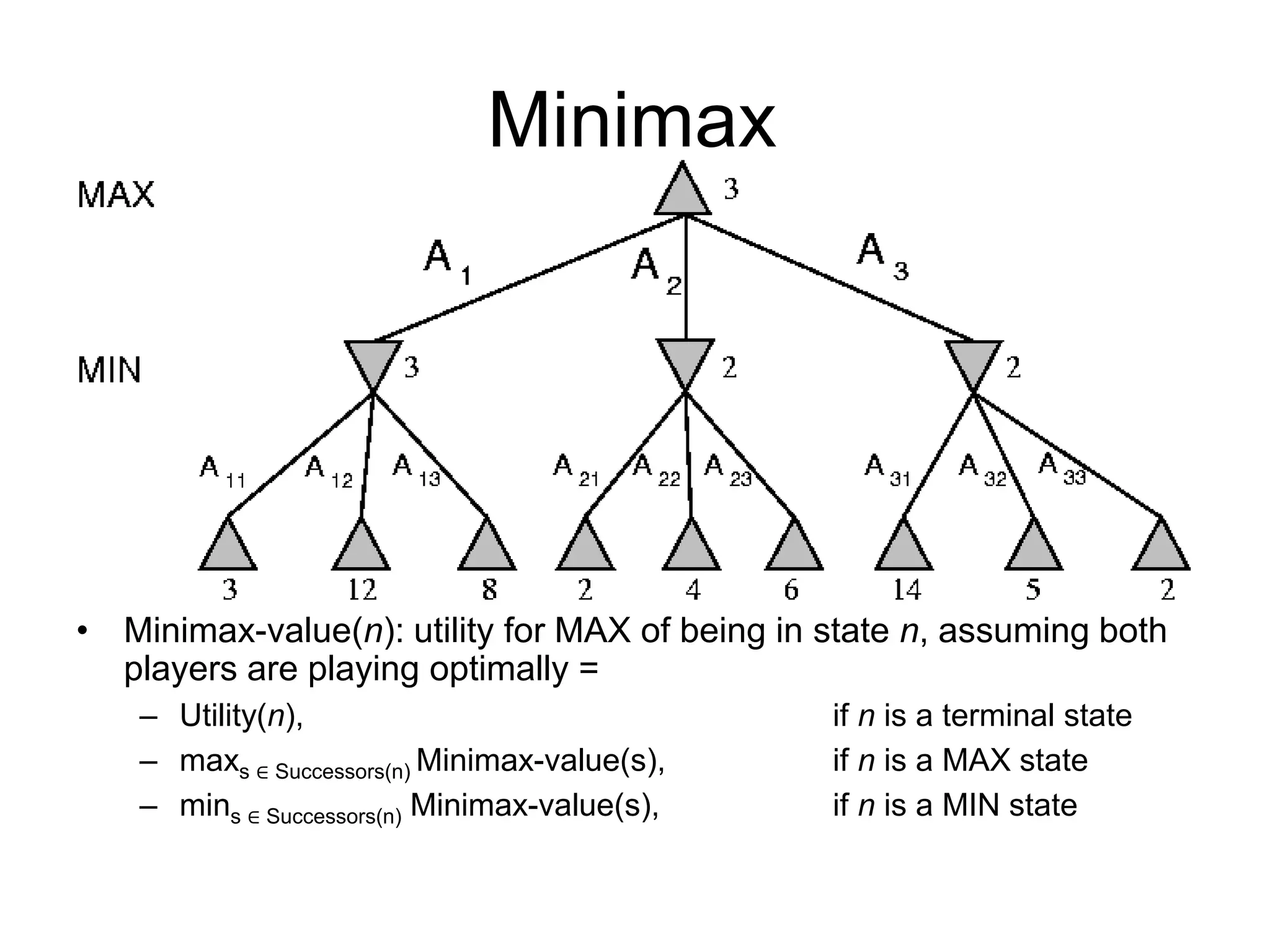
• Minimax-value(n): utility for MAX of being in state n, assuming both
players are playing optimally =
– Utility(n), if n is a terminal state
– maxs ∈ Successors(n) Minimax-value(s), if n is a MAX state
– mins ∈ Successors(n) Minimax-value(s), if n is a MIN state
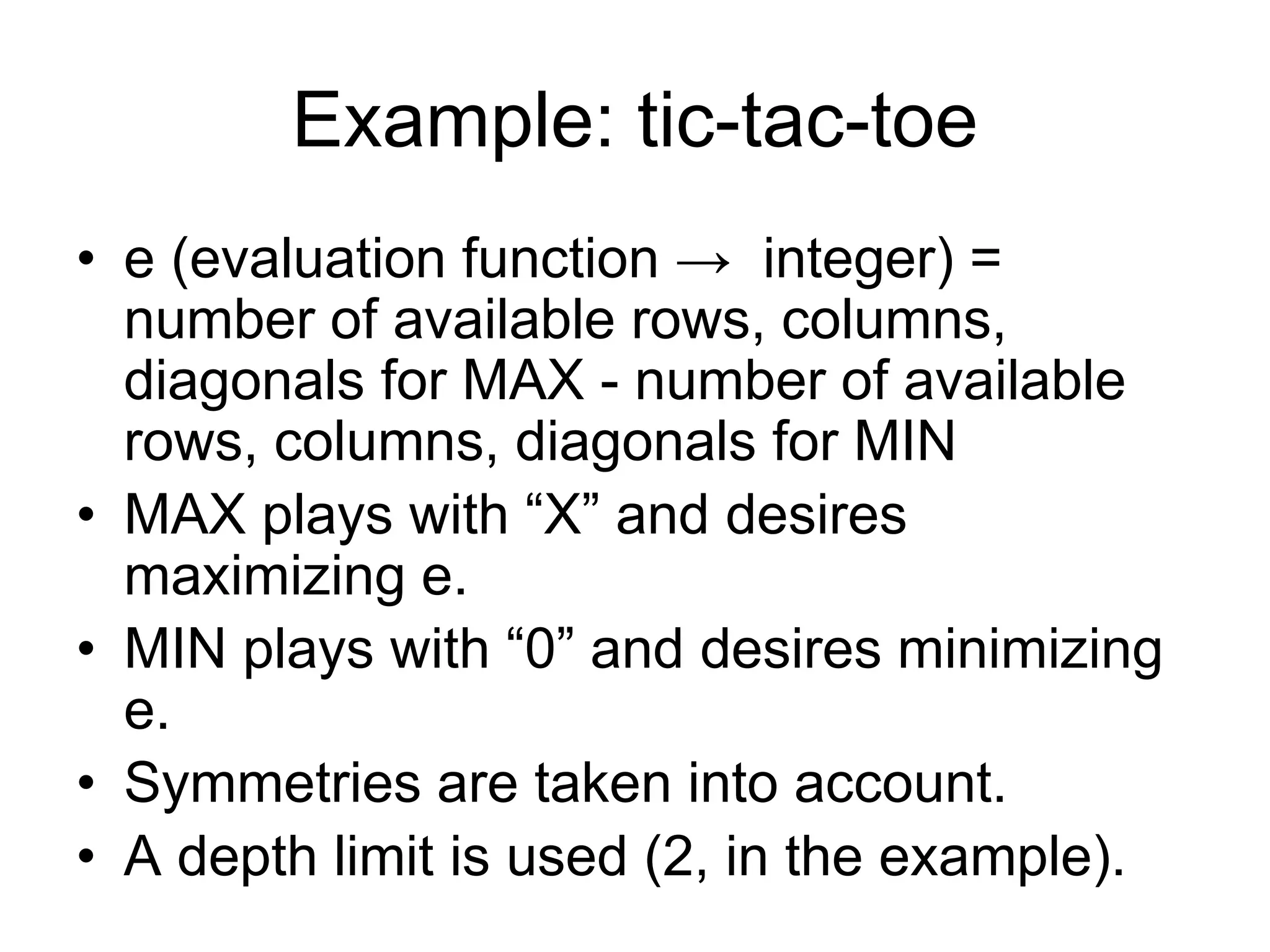
Example: tic-tac-toe
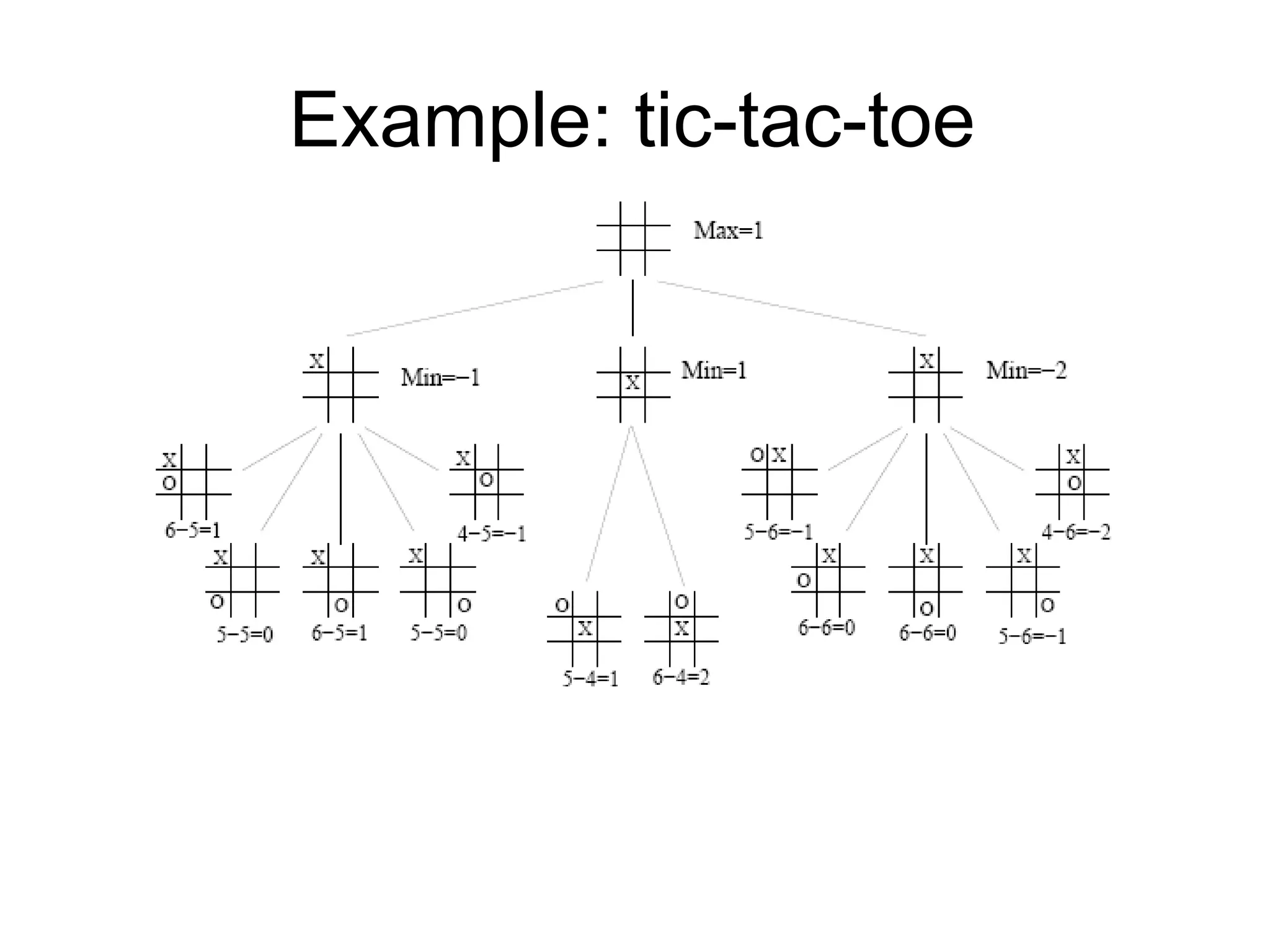
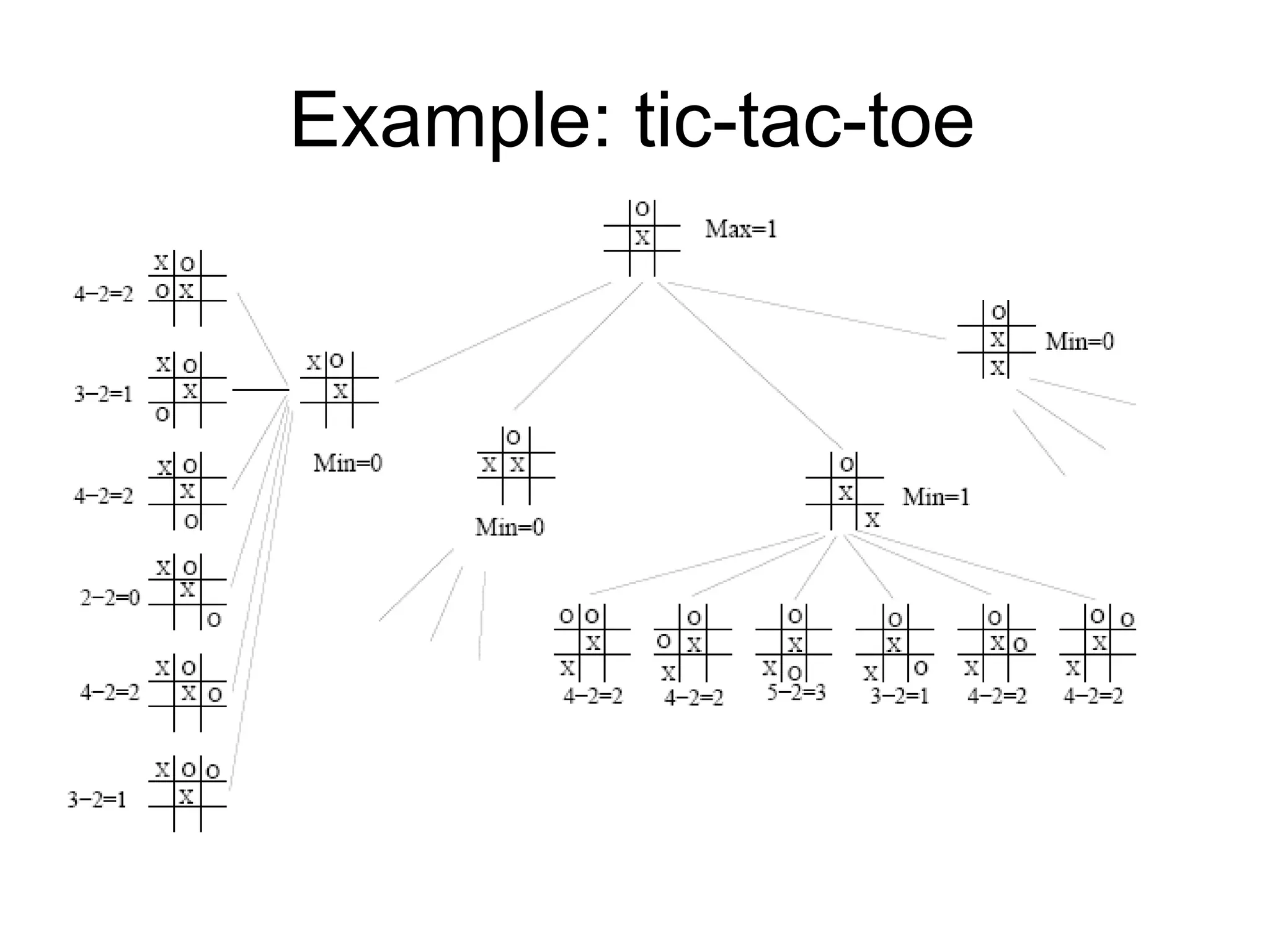
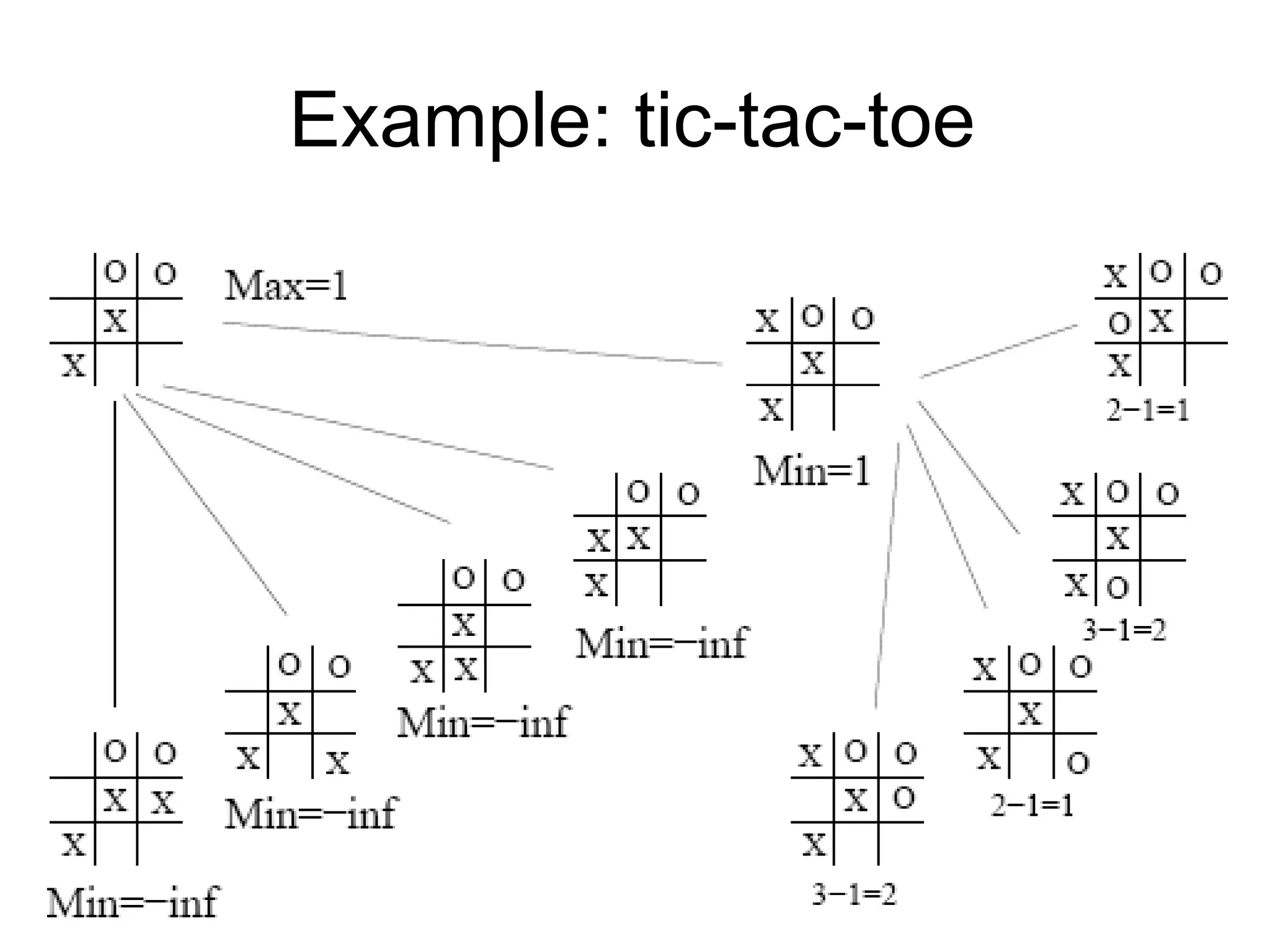
• e (evaluation function → integer) =
number of available rows, columns,
diagonals for MAX - number of available
rows, columns, diagonals for MIN
• MAX plays with “X” and desires
maximizing e.
• MIN plays with “0” and desires minimizing
e.
• Symmetries are taken into account.
• A depth limit is used (2, in the example).
Example: tic-tac-toe
14
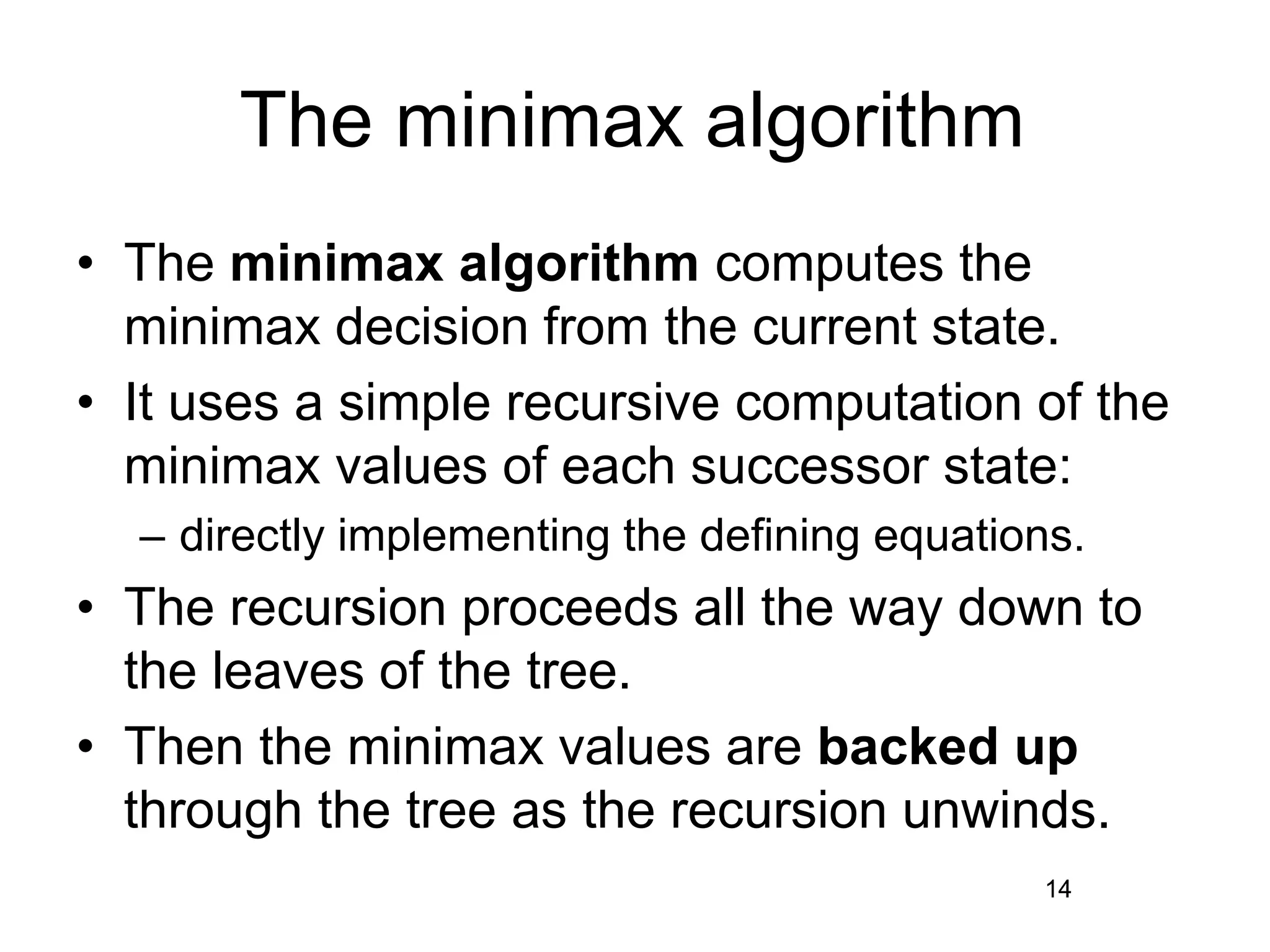
The minimax algorithm
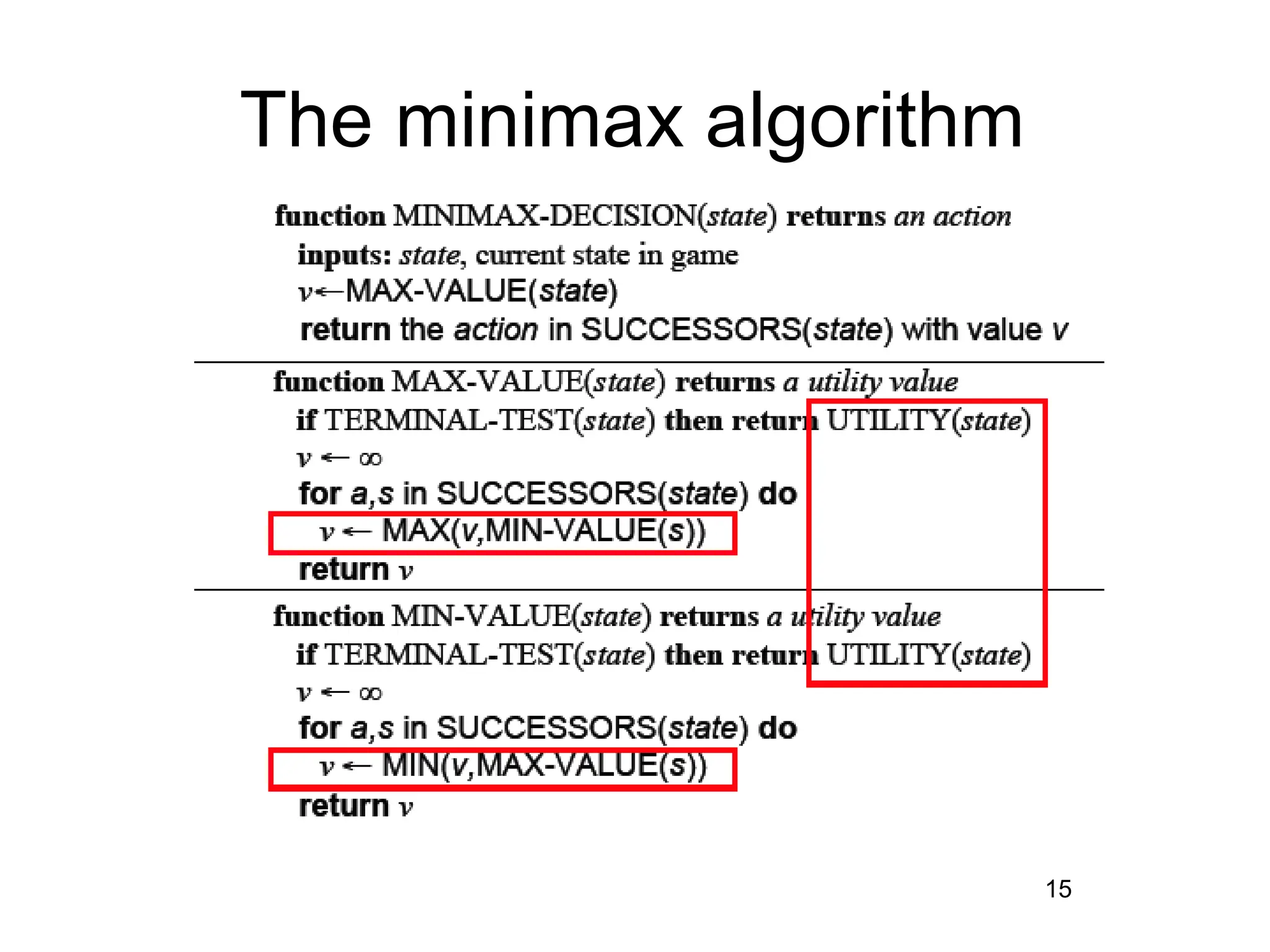
• The minimax algorithm computes the
minimax decision from the current state.
• It uses a simple recursive computation of the
minimax values of each successor state:
– directly implementing the defining equations.
• The recursion proceeds all the way down to
the leaves of the tree.
• Then the minimax values are backed up
through the tree as the recursion unwinds.
14
15
The minimax algorithm
16
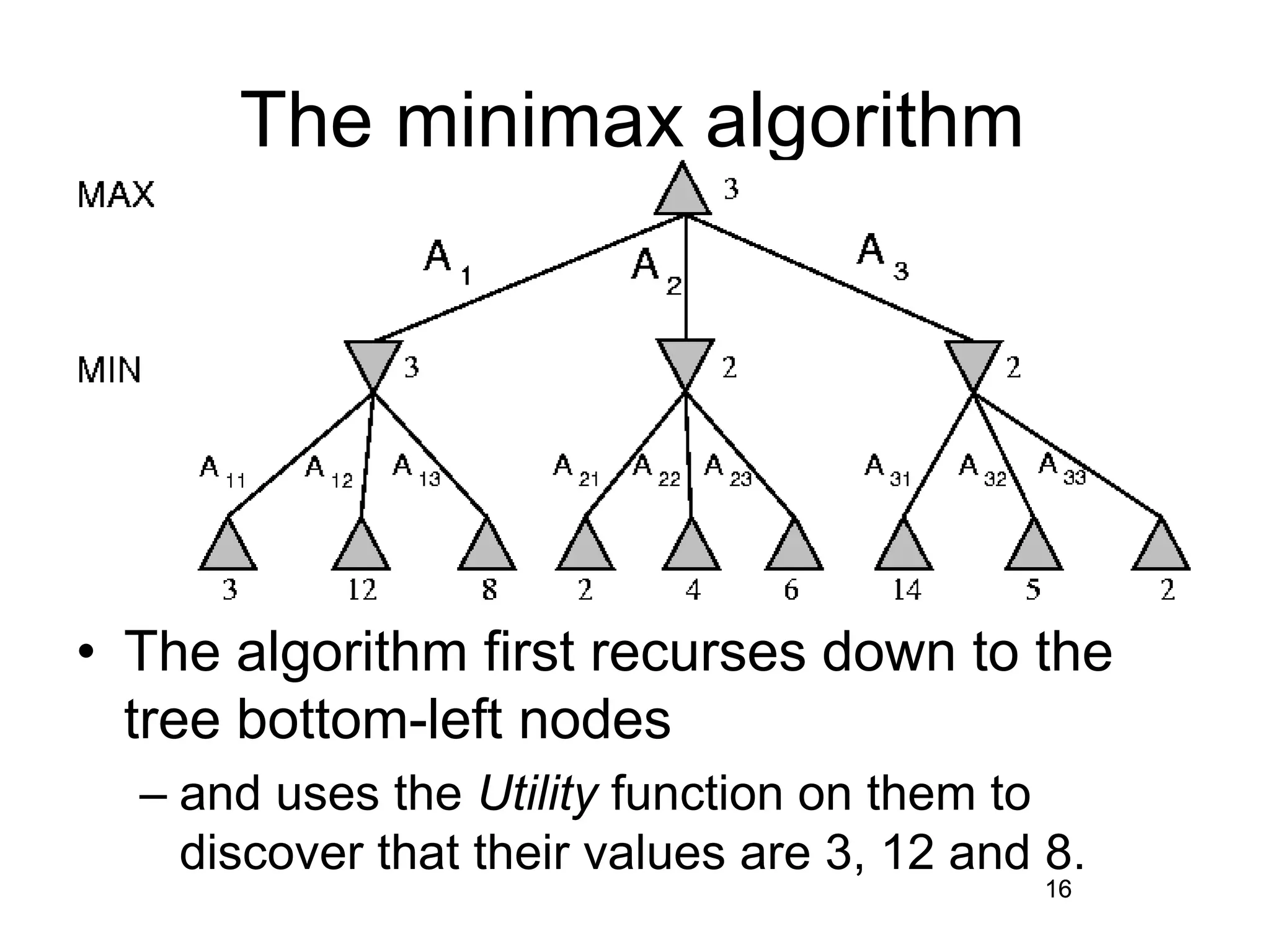
The minimax algorithm
• The algorithm first recurses down to the
tree bottom-left nodes
– and uses the Utility function on them to
discover that their values are 3, 12 and 8.
16
17
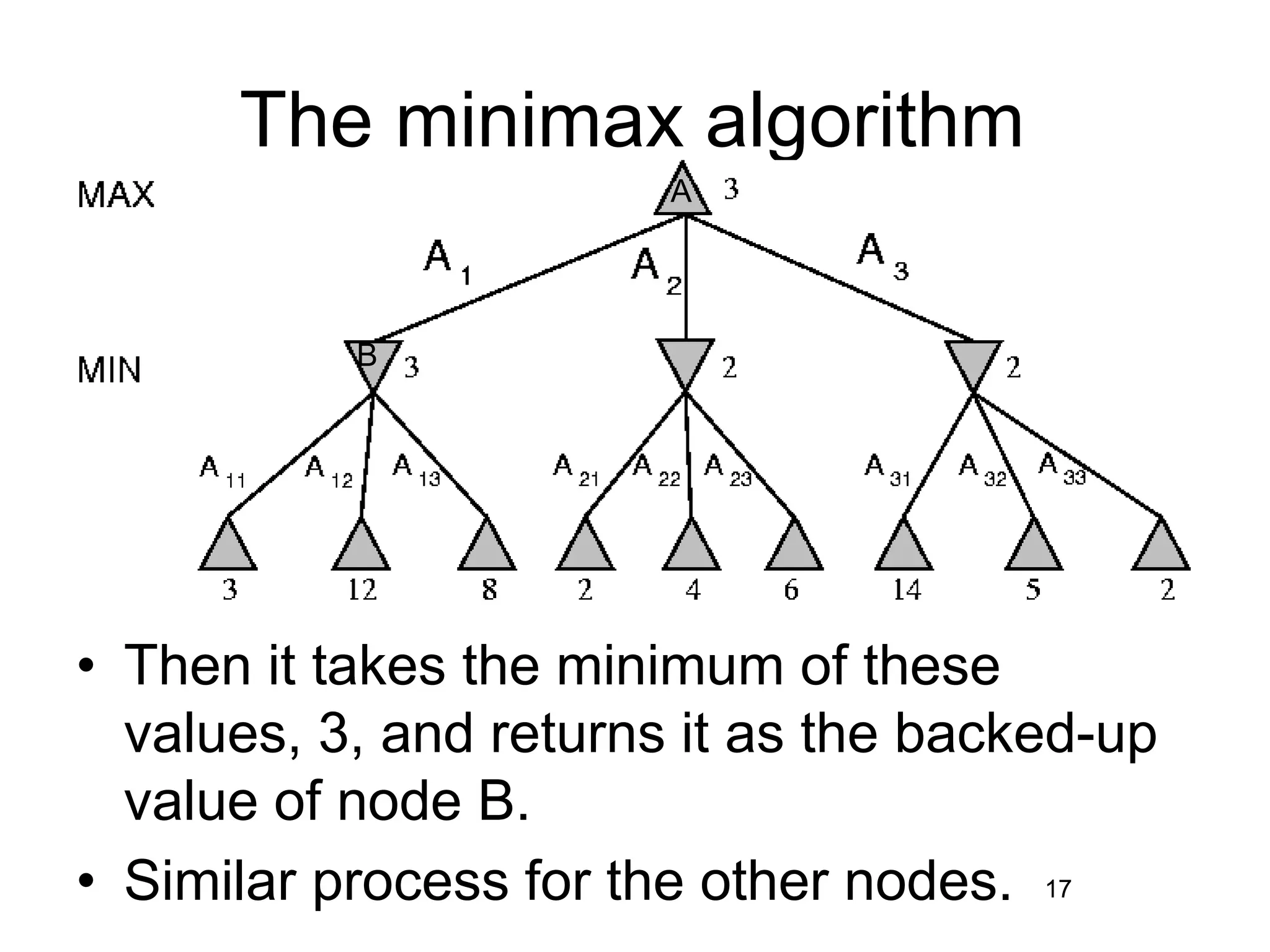
The minimax algorithm
• Then it takes the minimum of these
values, 3, and returns it as the backed-up
value of node B.
• Similar process for the other nodes. 17
B
A
18
The minimax algorithm
• The minimax algorithm performs a
complete depth-first exploration of the
game tree.
• In minimax, at each point in the process,
only the nodes along a path of the tree are
considered and kept in memory.
18
19
The minimax algorithm
• If the maximum depth of the tree is m, and
there are b legal moves at each point,
then the time complexity is O(bm).
• The space complexity is:
– O(bm) for an algorithm that generates all
successors at once
– O(m) if it generates successors one at a time.
19
20
The minimax algorithm:
problems
• For real games the time cost of minimax is
totally impractical, but this algorithm
serves as the basis:
– for the mathematical analysis of games and
– for more practical algorithms
• Problem with minimax search:
– The number of game states it has to examine
is exponential in the number of moves.
• Unfortunately, the exponent can’t be
eliminated, but it can be cut in half. 20
21
Alpha-beta pruning
• It is possible to compute the correct
minimax decision without looking at every
node in the game tree.
• Alpha-beta pruning allows to eliminate
large parts of the tree from consideration,
without influencing the final decision.
21
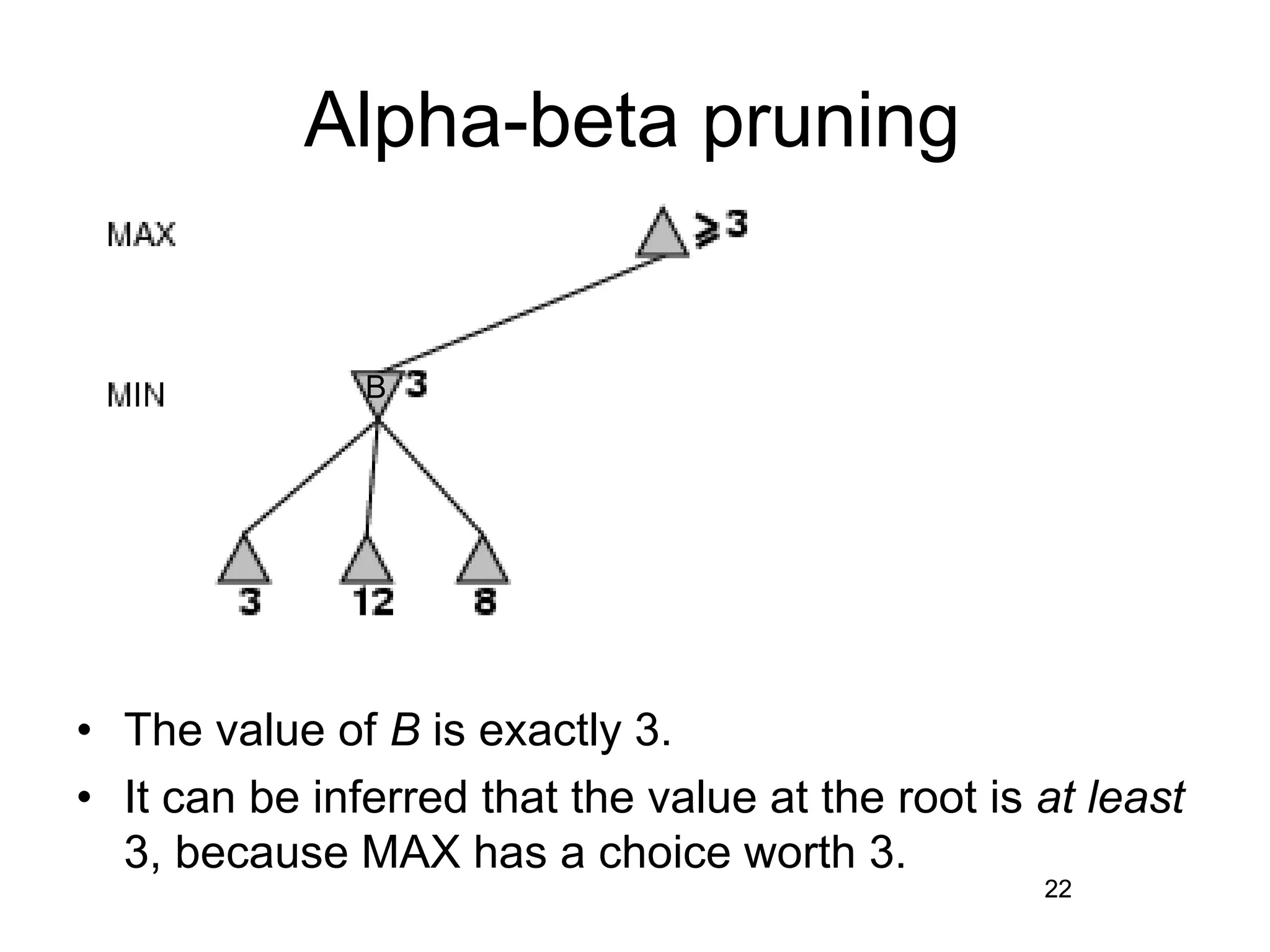
• The leaves below B have the values 3, 12 and 8.
• The value of B is exactly 3.
• It can be inferred that the value at the root is at least
3, because MAX has a choice worth 3.
22
B
Alpha-beta pruning
22
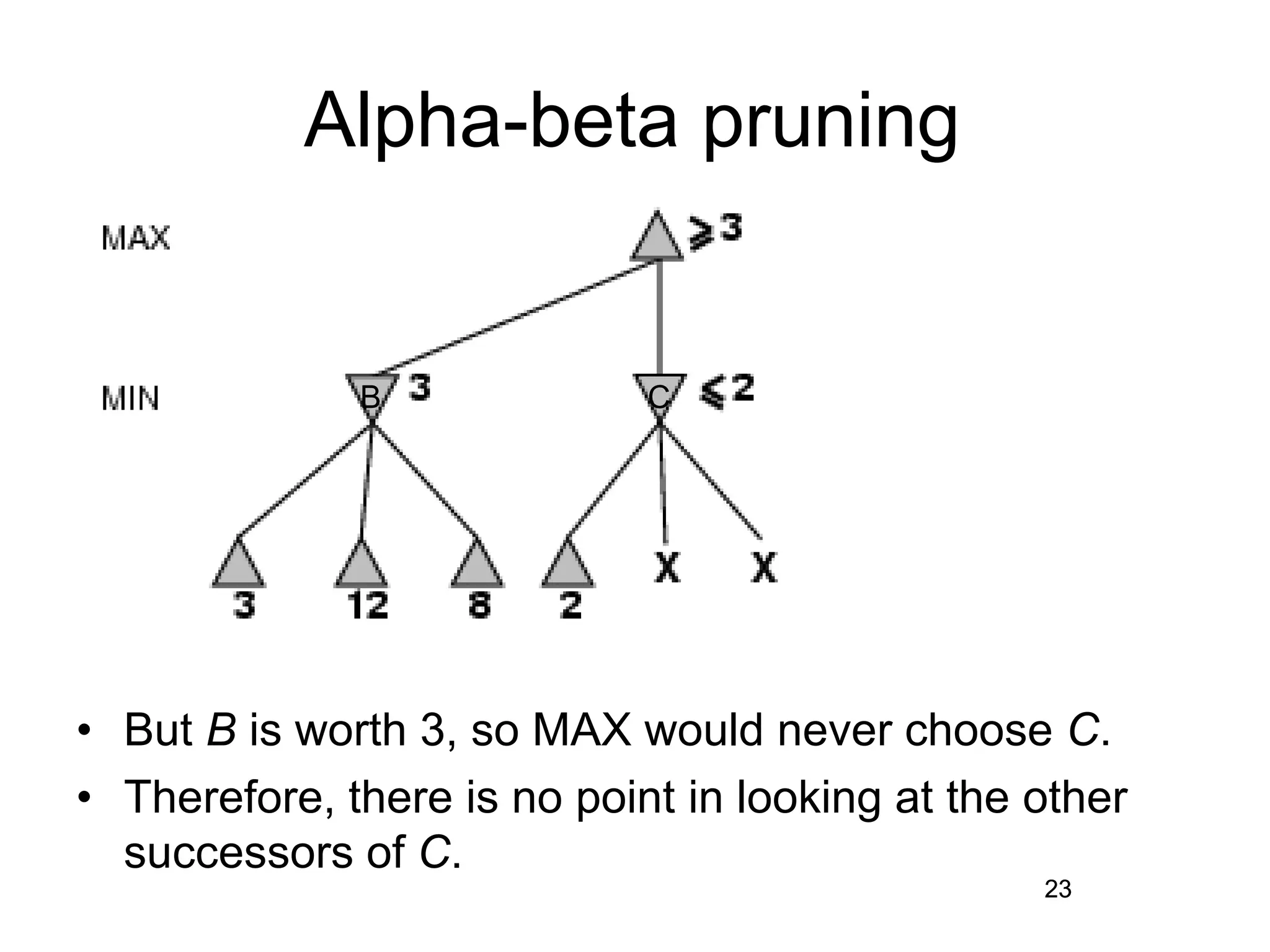
• C, which is a MIN node, has a value of at most 2.
• But B is worth 3, so MAX would never choose C.
• Therefore, there is no point in looking at the other
successors of C.
23
Alpha-beta pruning
23
B C
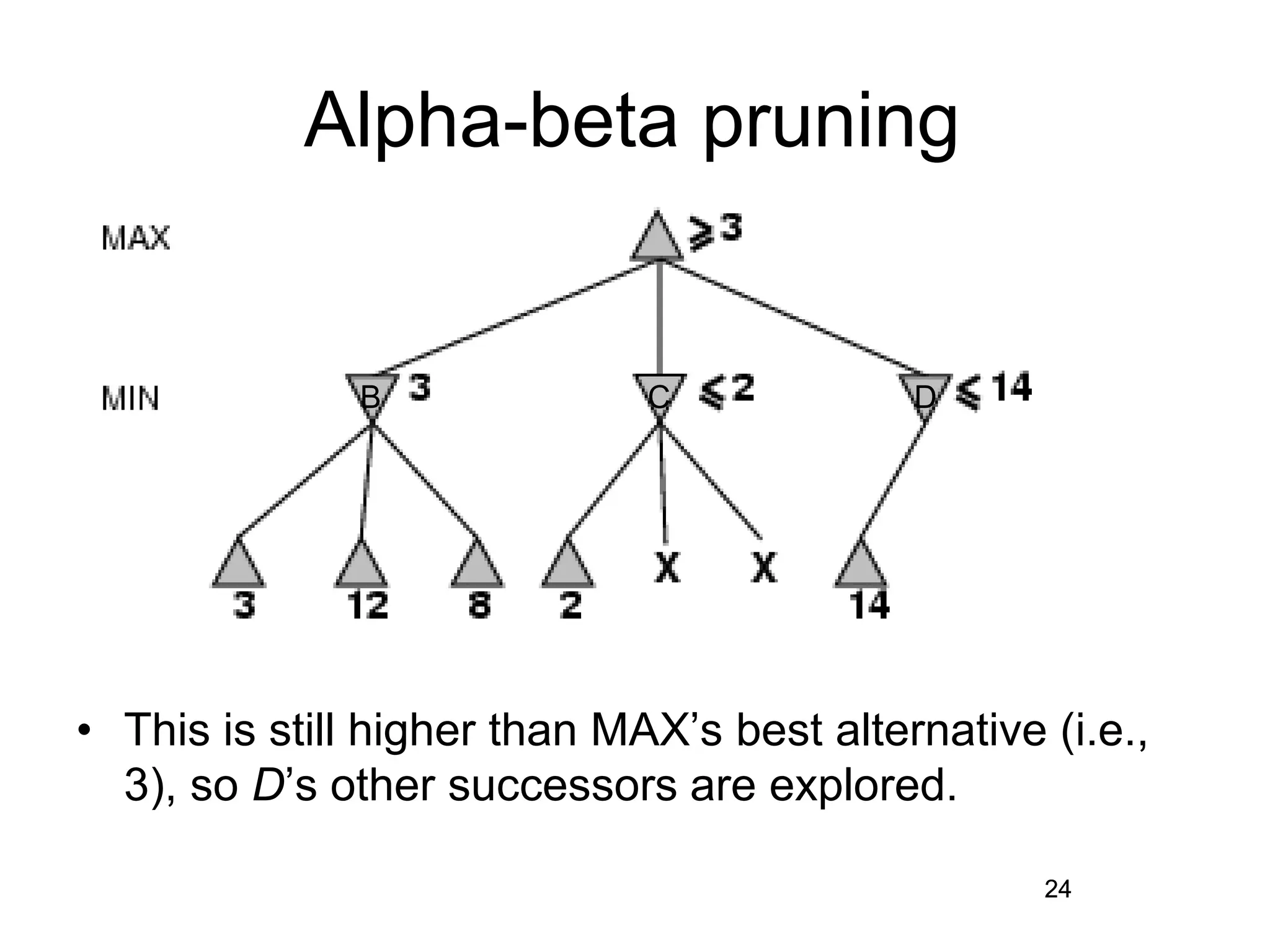
• D, which is a MIN node, is worth at most 14.
• This is still higher than MAX’s best alternative (i.e.,
3), so D’s other successors are explored.
24
Alpha-beta pruning
24
B C D
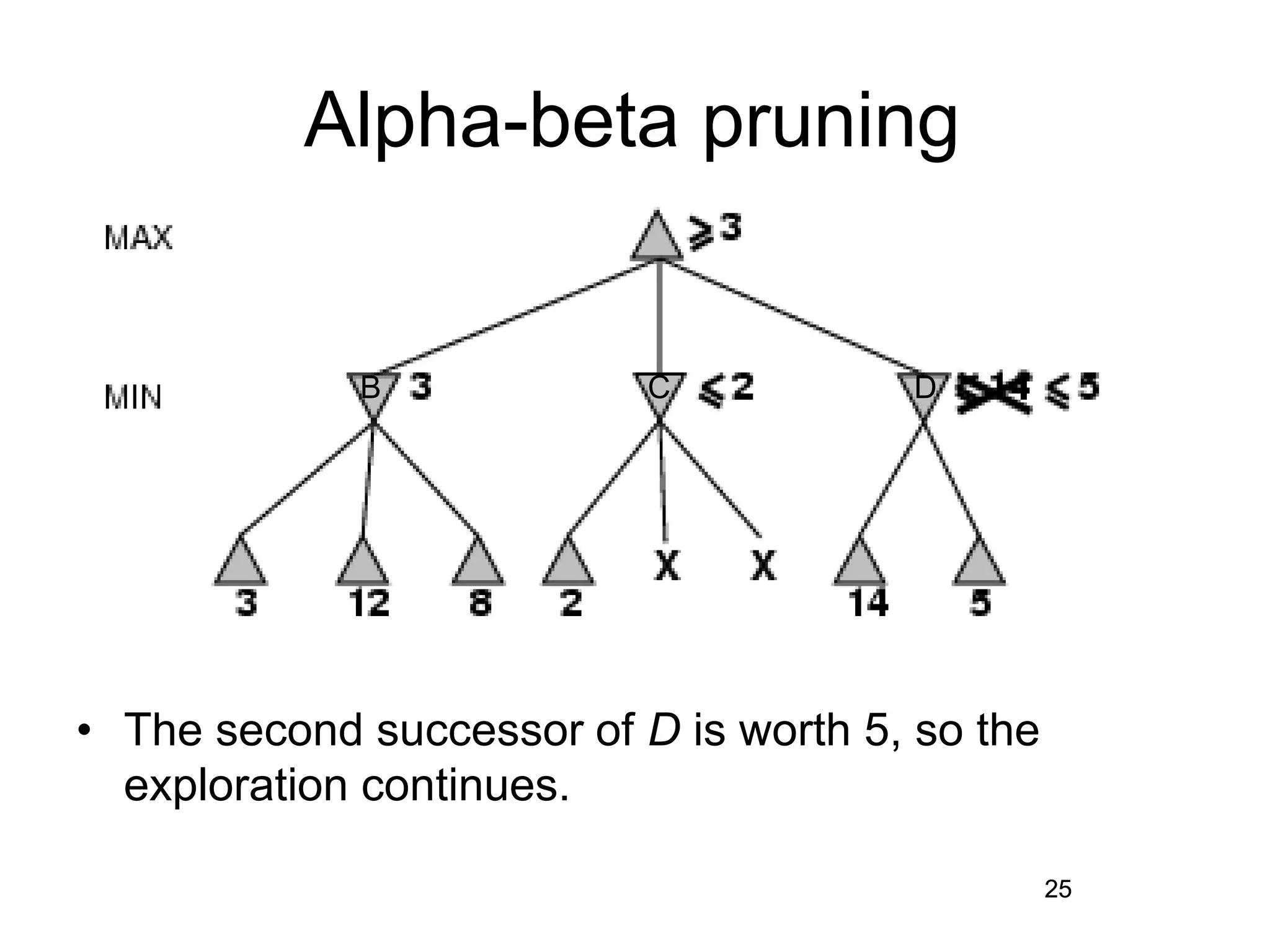
25
• The second successor of D is worth 5, so the
exploration continues.
Alpha-beta pruning
25
B C D
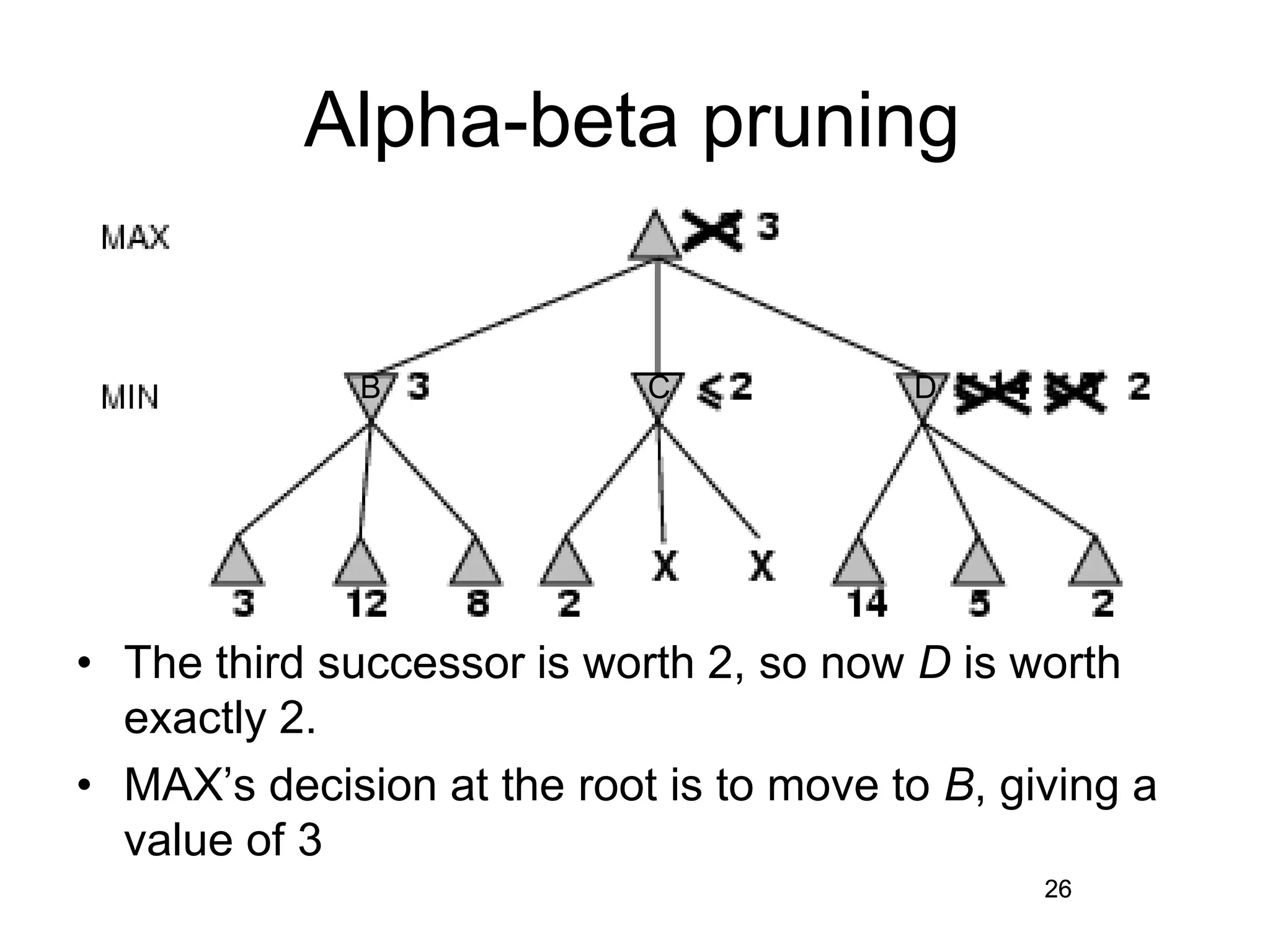
26
• The third successor is worth 2, so now D is worth
exactly 2.
• MAX’s decision at the root is to move to B, giving a
value of 3
Alpha-beta pruning
26
B C D
27
Alpha-beta pruning
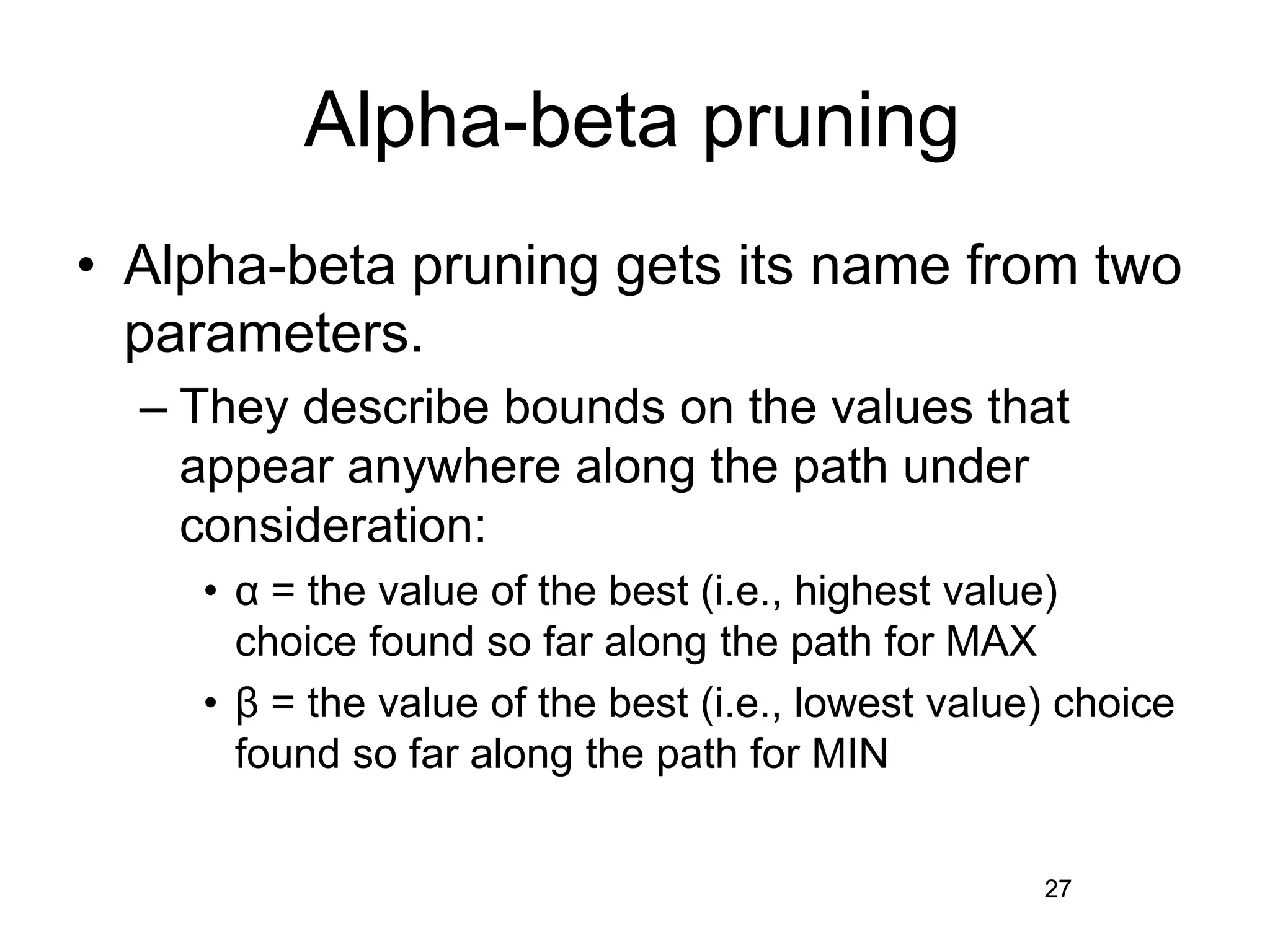
• Alpha-beta pruning gets its name from two
parameters.
– They describe bounds on the values that
appear anywhere along the path under
consideration:
• α = the value of the best (i.e., highest value)
choice found so far along the path for MAX
• β = the value of the best (i.e., lowest value) choice
found so far along the path for MIN
27
28
Alpha-beta pruning
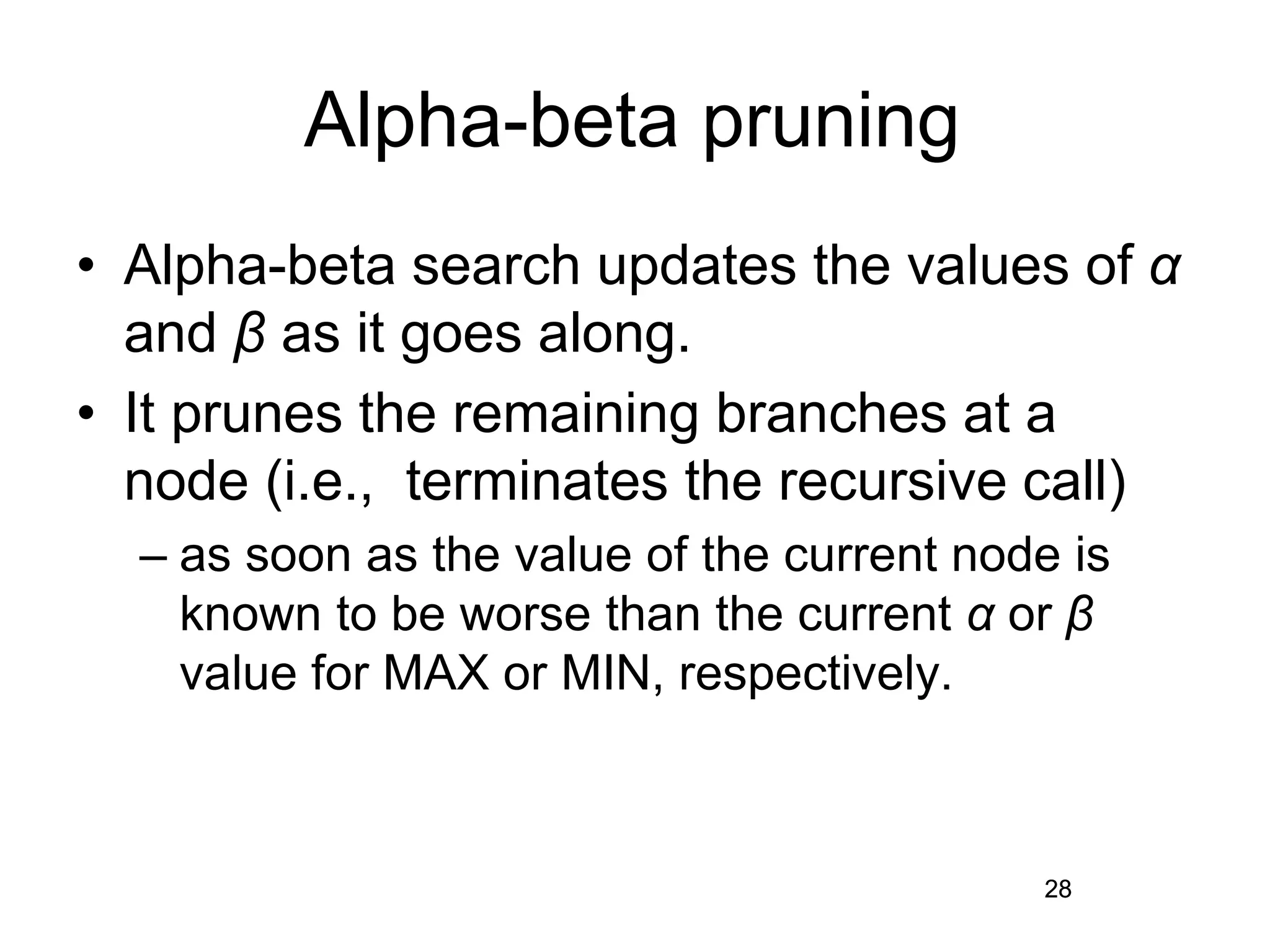
• Alpha-beta search updates the values of α
and β as it goes along.
• It prunes the remaining branches at a
node (i.e., terminates the recursive call)
– as soon as the value of the current node is
known to be worse than the current α or β
value for MAX or MIN, respectively.
28
29
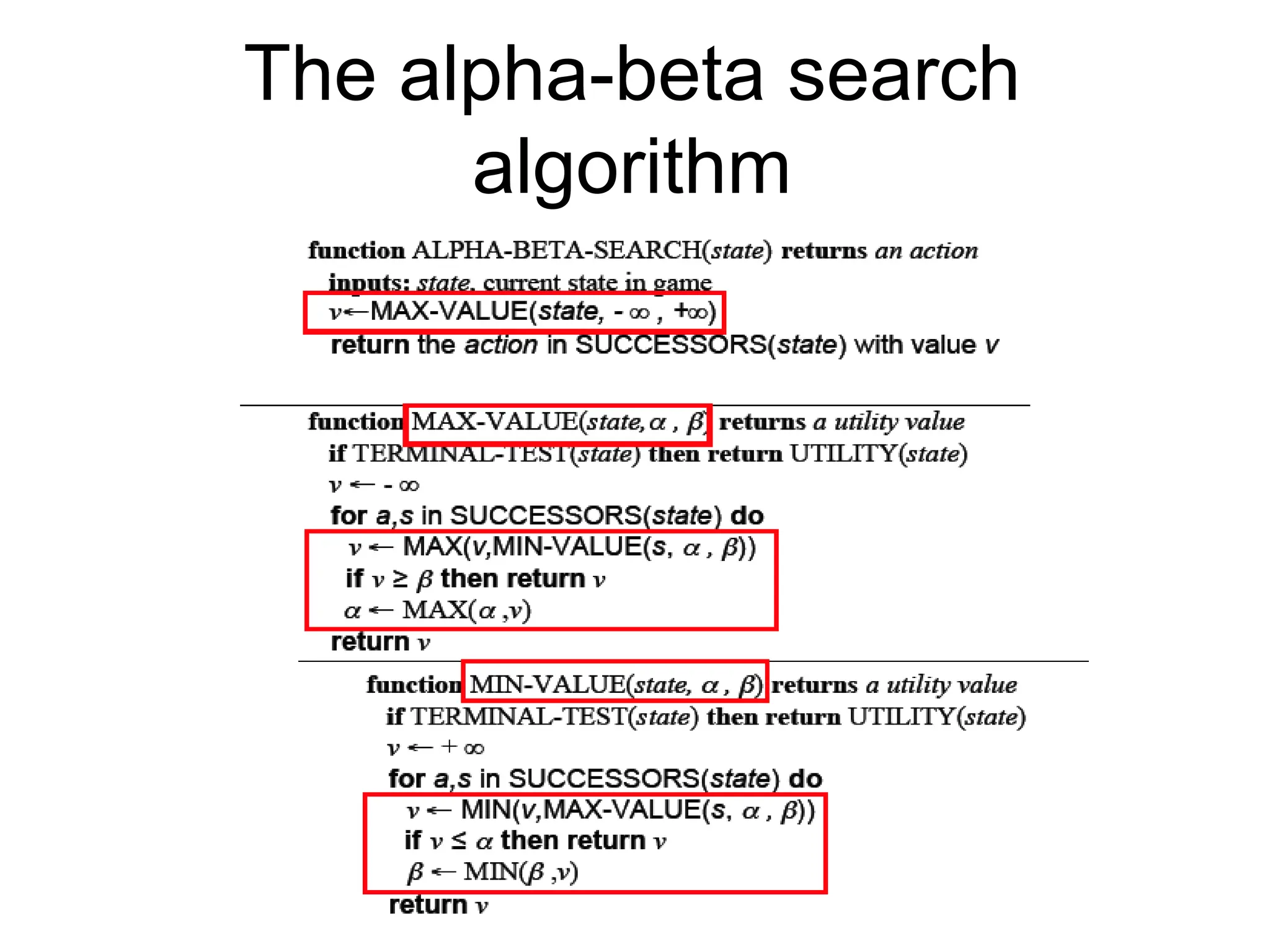
The alpha-beta search
algorithm
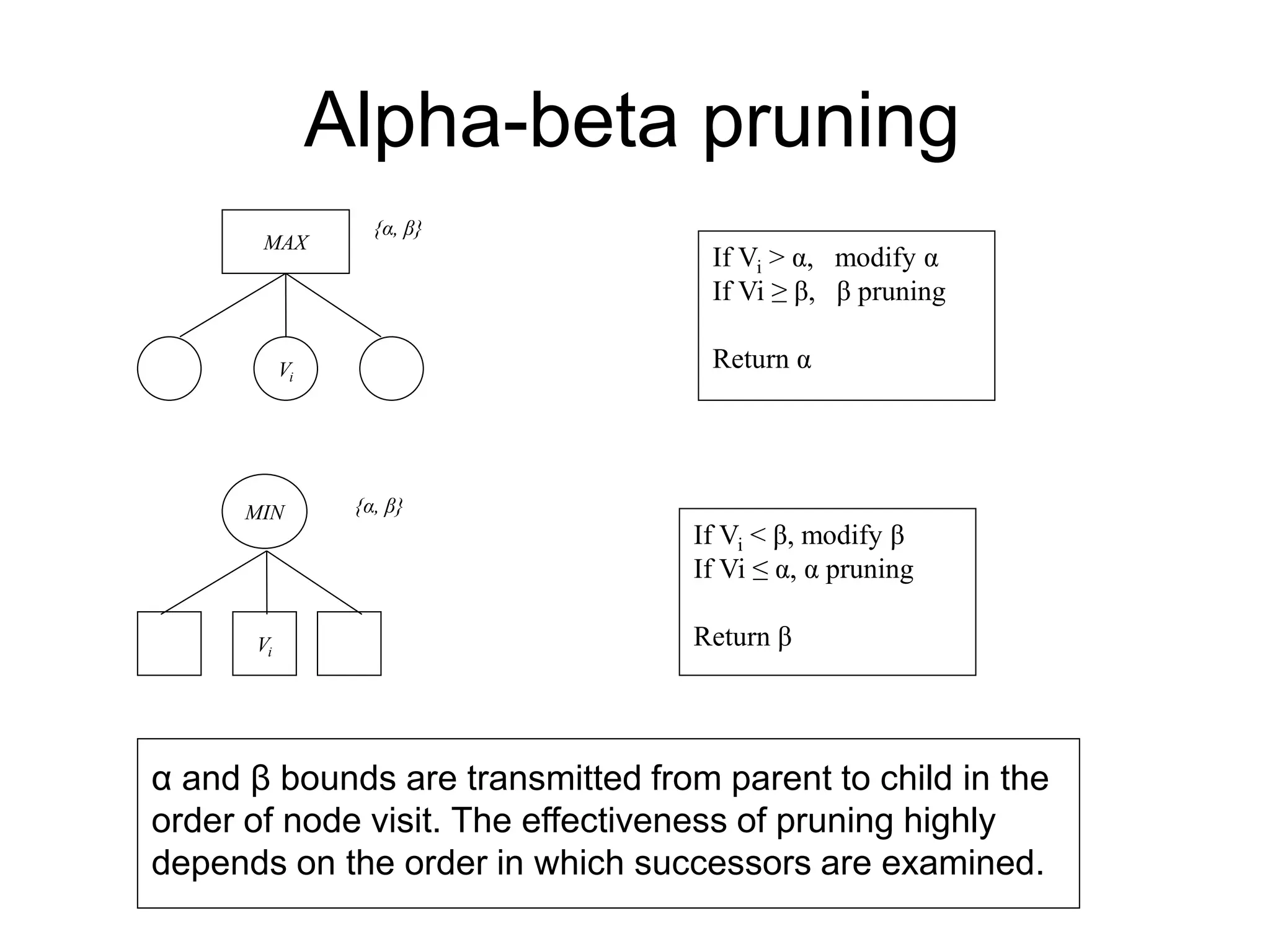
MAX
Vi
{α, β}
If Vi > α, modify α
If Vi ≥ β, β pruning
Return α
{α, β}
If Vi < β, modify β
If Vi ≤ α, α pruning
Return β
MIN
Vi
α and β bounds are transmitted from parent to child in the
order of node visit. The effectiveness of pruning highly
depends on the order in which successors are examined.
Alpha-beta pruning
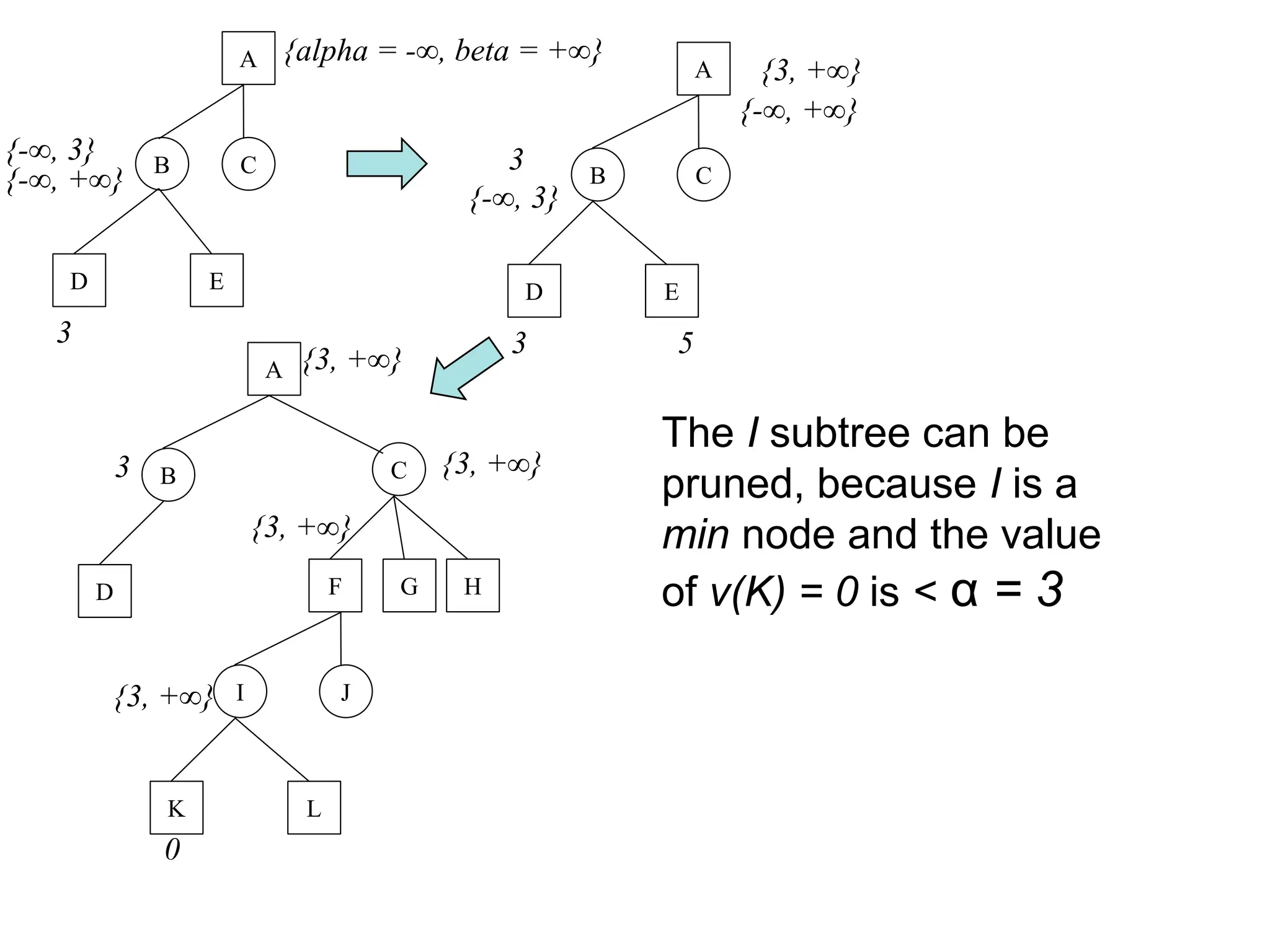
The I subtree can be
pruned, because I is a
min node and the value
of v(K) = 0 is < α = 3
A
C
B
E
D
3
{-∞, +∞}
A
C
B
E
D
3 5
3
{-∞, 3}
A
C
B
D
3
H
F
{3, +∞}
G
J
I
L
K
{3, +∞}
{3, +∞}
{3, +∞}
0
{alpha = -∞, beta = +∞}
{-∞, 3}
{-∞, +∞}
{3, +∞}
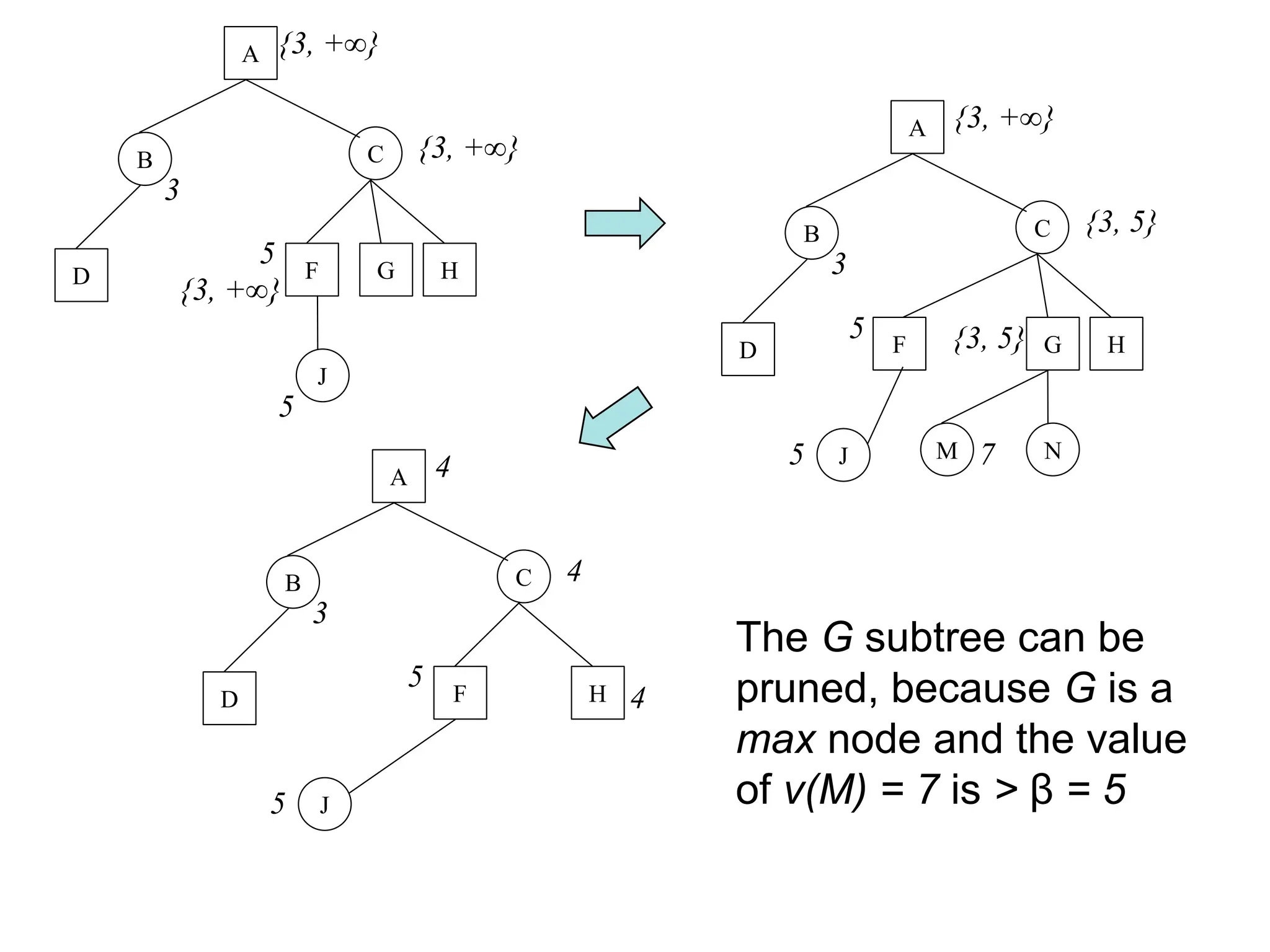
The G subtree can be
pruned, because G is a
max node and the value
of v(M) = 7 is > β = 5
A
C
B
D
3
H
F
{3, +∞}
G
J
{3, +∞}
{3, +∞}
5
5
A
C
B
D
3
H
F
{3, +∞}
G
J
{3, 5}
5
5
N
M 7
A
C
B
D
3
H
F
4
J
4
{3, 5}
5
5
4
33
Final comments about alpha-
beta pruning
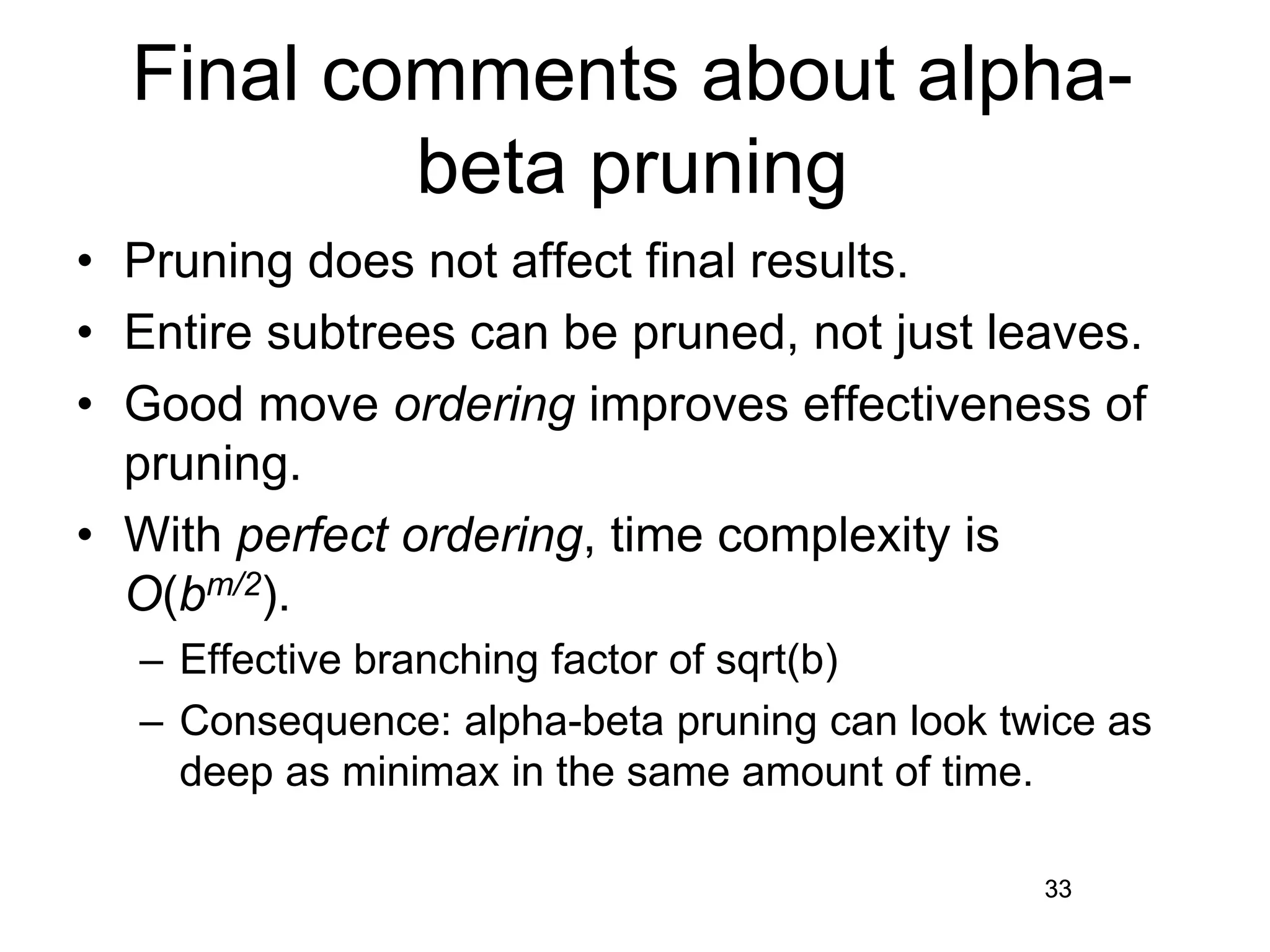
• Pruning does not affect final results.
• Entire subtrees can be pruned, not just leaves.
• Good move ordering improves effectiveness of
pruning.
• With perfect ordering, time complexity is
O(bm/2).
– Effective branching factor of sqrt(b)
– Consequence: alpha-beta pruning can look twice as
deep as minimax in the same amount of time.
33

Artificial Intelligence Adversarial Search.ppt

  • 1.
  • 2.
    Planning ahead ina world that includes a hostile agent • Games as search problems • Idealization and simplification: – Two players – Alternate moves • MAX player • MIN player – Available information: • Perfect: chess, chequers, tic-tac-toe… (no chance, same knowledge for the two players) • Imperfect: poker, Stratego, bridge…
  • 3.
    Game representation • Inthe general case of a game with two players: – General state representation – Initial-state definition – Winning-state representation as: • Structure • Properties • Utility function – Definition of a set of operators
  • 4.
  • 5.
    Search with anopponent • Trivial approximation: generating the tree for all moves • Terminal moves are tagged with a utility value, for example: “+1” or “-1” depending on if the winner is MAX or MIN. • The goal is to find a path to a winning state. • Even if a depth-first search would minimize memory space, in complex games this kind of search cannot be carried out. • Even a simple game like tic-tac-toe is too complex to draw the entire game tree.
  • 6.
  • 7.
  • 8.
    Search with anopponent • Heuristic approximation: defining an evaluation function which indicates how close a state is from a winning (or losing) move • This function includes domain information. • It does not represent a cost or a distance in steps. • Conventionally: – A winning move is represented by the value“+∞”. – A losing move is represented by the value “-∞”. – The algorithm searches with limited depth. • Each new decision implies repeating part of the search.
  • 9.
    Minimax • Minimax-value(n): utilityfor MAX of being in state n, assuming both players are playing optimally = – Utility(n), if n is a terminal state – maxs ∈ Successors(n) Minimax-value(s), if n is a MAX state – mins ∈ Successors(n) Minimax-value(s), if n is a MIN state
  • 10.
    Example: tic-tac-toe • e(evaluation function → integer) = number of available rows, columns, diagonals for MAX - number of available rows, columns, diagonals for MIN • MAX plays with “X” and desires maximizing e. • MIN plays with “0” and desires minimizing e. • Symmetries are taken into account. • A depth limit is used (2, in the example).
  • 11.
  • 12.
  • 13.
  • 14.
    14 The minimax algorithm •The minimax algorithm computes the minimax decision from the current state. • It uses a simple recursive computation of the minimax values of each successor state: – directly implementing the defining equations. • The recursion proceeds all the way down to the leaves of the tree. • Then the minimax values are backed up through the tree as the recursion unwinds. 14
  • 15.
  • 16.
    16 The minimax algorithm •The algorithm first recurses down to the tree bottom-left nodes – and uses the Utility function on them to discover that their values are 3, 12 and 8. 16
  • 17.
    17 The minimax algorithm •Then it takes the minimum of these values, 3, and returns it as the backed-up value of node B. • Similar process for the other nodes. 17 B A
  • 18.
    18 The minimax algorithm •The minimax algorithm performs a complete depth-first exploration of the game tree. • In minimax, at each point in the process, only the nodes along a path of the tree are considered and kept in memory. 18
  • 19.
    19 The minimax algorithm •If the maximum depth of the tree is m, and there are b legal moves at each point, then the time complexity is O(bm). • The space complexity is: – O(bm) for an algorithm that generates all successors at once – O(m) if it generates successors one at a time. 19
  • 20.
    20 The minimax algorithm: problems •For real games the time cost of minimax is totally impractical, but this algorithm serves as the basis: – for the mathematical analysis of games and – for more practical algorithms • Problem with minimax search: – The number of game states it has to examine is exponential in the number of moves. • Unfortunately, the exponent can’t be eliminated, but it can be cut in half. 20
  • 21.
    21 Alpha-beta pruning • Itis possible to compute the correct minimax decision without looking at every node in the game tree. • Alpha-beta pruning allows to eliminate large parts of the tree from consideration, without influencing the final decision. 21
  • 22.
    • The leavesbelow B have the values 3, 12 and 8. • The value of B is exactly 3. • It can be inferred that the value at the root is at least 3, because MAX has a choice worth 3. 22 B Alpha-beta pruning 22
  • 23.
    • C, whichis a MIN node, has a value of at most 2. • But B is worth 3, so MAX would never choose C. • Therefore, there is no point in looking at the other successors of C. 23 Alpha-beta pruning 23 B C
  • 24.
    • D, whichis a MIN node, is worth at most 14. • This is still higher than MAX’s best alternative (i.e., 3), so D’s other successors are explored. 24 Alpha-beta pruning 24 B C D
  • 25.
    25 • The secondsuccessor of D is worth 5, so the exploration continues. Alpha-beta pruning 25 B C D
  • 26.
    26 • The thirdsuccessor is worth 2, so now D is worth exactly 2. • MAX’s decision at the root is to move to B, giving a value of 3 Alpha-beta pruning 26 B C D
  • 27.
    27 Alpha-beta pruning • Alpha-betapruning gets its name from two parameters. – They describe bounds on the values that appear anywhere along the path under consideration: • α = the value of the best (i.e., highest value) choice found so far along the path for MAX • β = the value of the best (i.e., lowest value) choice found so far along the path for MIN 27
  • 28.
    28 Alpha-beta pruning • Alpha-betasearch updates the values of α and β as it goes along. • It prunes the remaining branches at a node (i.e., terminates the recursive call) – as soon as the value of the current node is known to be worse than the current α or β value for MAX or MIN, respectively. 28
  • 29.
  • 30.
    MAX Vi {α, β} If Vi> α, modify α If Vi ≥ β, β pruning Return α {α, β} If Vi < β, modify β If Vi ≤ α, α pruning Return β MIN Vi α and β bounds are transmitted from parent to child in the order of node visit. The effectiveness of pruning highly depends on the order in which successors are examined. Alpha-beta pruning
  • 31.
    The I subtreecan be pruned, because I is a min node and the value of v(K) = 0 is < α = 3 A C B E D 3 {-∞, +∞} A C B E D 3 5 3 {-∞, 3} A C B D 3 H F {3, +∞} G J I L K {3, +∞} {3, +∞} {3, +∞} 0 {alpha = -∞, beta = +∞} {-∞, 3} {-∞, +∞} {3, +∞}
  • 32.
    The G subtreecan be pruned, because G is a max node and the value of v(M) = 7 is > β = 5 A C B D 3 H F {3, +∞} G J {3, +∞} {3, +∞} 5 5 A C B D 3 H F {3, +∞} G J {3, 5} 5 5 N M 7 A C B D 3 H F 4 J 4 {3, 5} 5 5 4
  • 33.
    33 Final comments aboutalpha- beta pruning • Pruning does not affect final results. • Entire subtrees can be pruned, not just leaves. • Good move ordering improves effectiveness of pruning. • With perfect ordering, time complexity is O(bm/2). – Effective branching factor of sqrt(b) – Consequence: alpha-beta pruning can look twice as deep as minimax in the same amount of time. 33