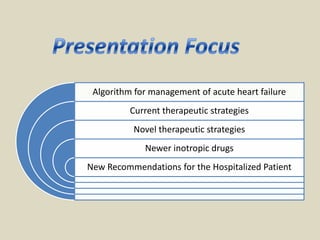
Algorithm for management of acute heart failure

Current therapeutic strategies
Novel therapeutic strategies
Newer inotropic drugs

New Recommendations for the Hospitalized Patient
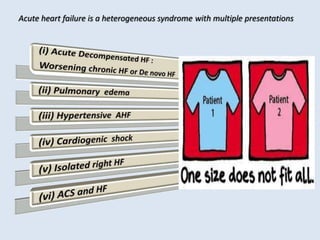
Acute heart failure is a heterogeneous syndrome with multiple presentations
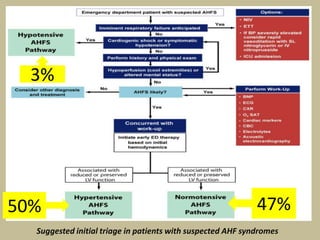
3%

50%

47%

Suggested initial triage in patients with suspected AHF syndromes
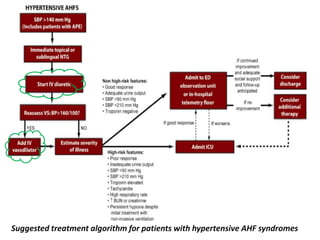
Suggested treatment algorithm for patients with hypertensive AHF syndromes.
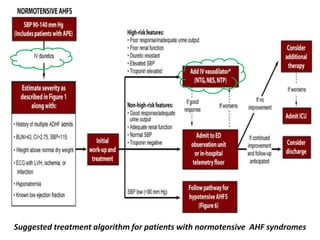
Suggested treatment algorithm for patients with normotensive AHF syndromes.
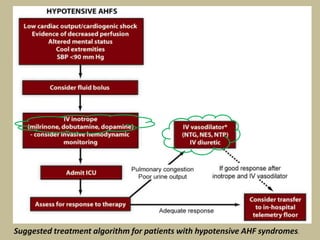
Suggested treatment algorithm for patients with hypotensive AHF syndromes.
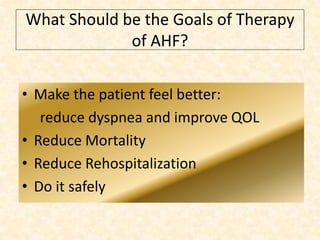
What Should be the Goals of Therapy
of AHF?
• Make the patient feel better:
reduce dyspnea and improve QOL
• Reduce Mortality
• Reduce Rehospitalization
• Do it safely
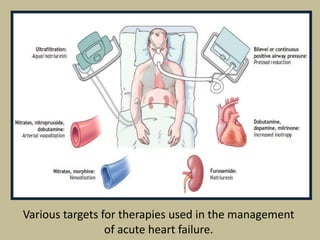
Various targets for therapies used in the management
of acute heart failure.
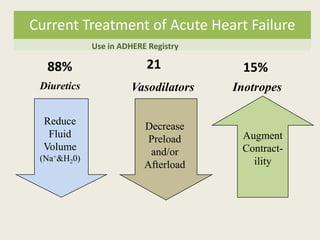
Current Treatment of Acute Heart Failure
Use in ADHERE Registry

88%

21

Diuretics

Vasodilators

Reduce
Fluid
Volume

Decrease
Preload
and/or
Afterload

(Na+&H20)

15%
Inotropes

Augment
Contractility
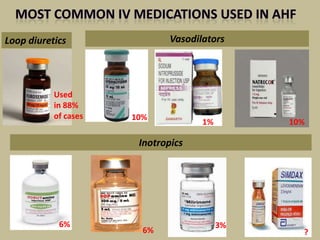
Vasodilators

Loop diuretics

Used
in 88%
of cases

10%

1%

10%

Inotropics

6%

6%

3%

?
Novel therapeutic targets for the
treatment of acute heart failure
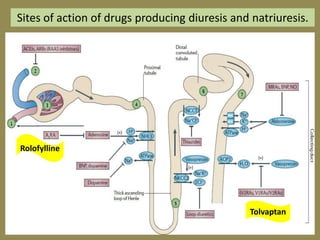
Sites of action of drugs producing diuresis and natriuresis.

Rolofylline

Tolvaptan
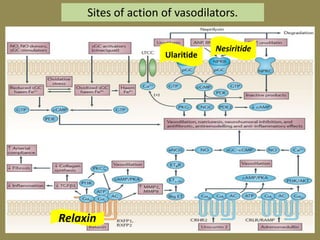
Sites of action of vasodilators.

Ularitide

Relaxin

Nesiritide
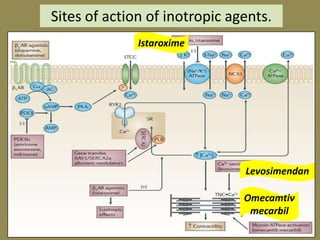
Sites of action of inotropic agents.
Istaroxime

Levosimendan
Omecamtiv
mecarbil
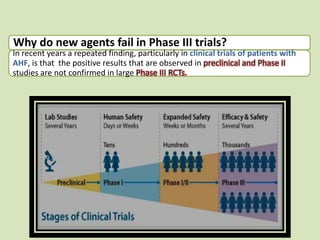
Why do new agents fail in Phase III trials?

In recent years a repeated finding, particularly in clinical trials of patients with
AHF, is that the positive results that are observed in preclinical and Phase II
studies are not confirmed in large Phase III RCTs.
A Word About Inotropes.
In the setting of AHF, inotropic agents are only
recommended in patients with SBP 90 mmHg and
evidence of inadequate organ perfusion despite other
therapeutic interventions.
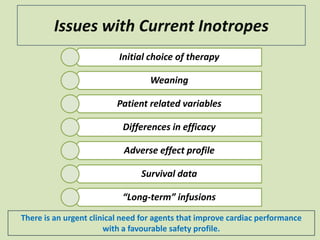
Issues with Current Inotropes
Initial choice of therapy
Weaning
Patient related variables
Differences in efficacy

Adverse effect profile
Survival data
“Long-term” infusions
There is an urgent clinical need for agents that improve cardiac performance
with a favourable safety profile.
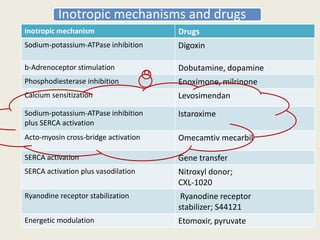
Inotropic mechanisms and drugs
Inotropic mechanism

Drugs

Sodium-potassium-ATPase inhibition

Digoxin

b-Adrenoceptor stimulation

Dobutamine, dopamine

Phosphodiesterase inhibition

Enoximone, milrinone

Calcium sensitization

Levosimendan

Sodium-potassium-ATPase inhibition
plus SERCA activation

Istaroxime

Acto-myosin cross-bridge activation

Omecamtiv mecarbil

SERCA activation

Gene transfer

SERCA activation plus vasodilation

Nitroxyl donor;
CXL-1020

Ryanodine receptor stabilization

Ryanodine receptor
stabilizer; S44121

Energetic modulation

Etomoxir, pyruvate
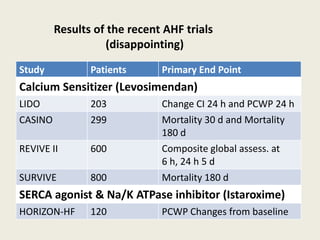
Results of the recent AHF trials
(disappointing)
Study

Patients

Primary End Point

Calcium Sensitizer (Levosimendan)
LIDO
CASINO

203
299

REVIVE II

600

SURVIVE

800

Change CI 24 h and PCWP 24 h
Mortality 30 d and Mortality
180 d
Composite global assess. at
6 h, 24 h 5 d
Mortality 180 d

SERCA agonist & Na/K ATPase inhibitor (Istaroxime)
HORIZON-HF

120

PCWP Changes from baseline
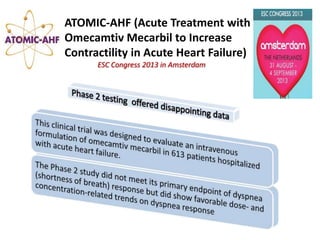
ATOMIC-AHF (Acute Treatment with
Omecamtiv Mecarbil to Increase
Contractility in Acute Heart Failure)
ESC Congress 2013 in Amsterdam
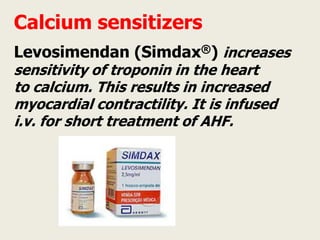
Calcium sensitizers
Levosimendan (Simdax®) increases
sensitivity of troponin in the heart
to calcium. This results in increased
myocardial contractility. It is infused
i.v. for short treatment of AHF.
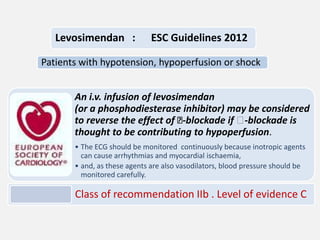
Levosimendan :

ESC Guidelines 2012

Patients with hypotension, hypoperfusion or shock
An i.v. infusion of levosimendan
(or a phosphodiesterase inhibitor) may be considered
to reverse the effect of ẞ
-blockade if ẞ
-blockade is
thought to be contributing to hypoperfusion.
• The ECG should be monitored continuously because inotropic agents
can cause arrhythmias and myocardial ischaemia,
• and, as these agents are also vasodilators, blood pressure should be
monitored carefully.

Class of recommendation IIb . Level of evidence C
New Recommendations for the Hospitalized Patient

2013 ACCF/AHA Guideline for the Management of Heart Failure
A Report of the American College of Cardiology Foundation/American Heart Association Task
Force on Practice Guidelines
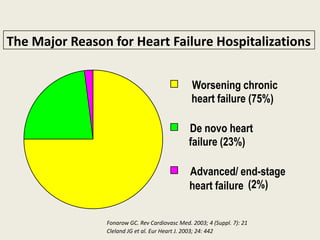
The Major Reason for Heart Failure Hospitalizations
Worsening chronic
heart failure (75%)
De novo heart
failure (23%)
Advanced/ end-stage
heart failure (2%)
Fonarow GC. Rev Cardiovasc Med. 2003; 4 (Suppl. 7): 21
Cleland JG et al. Eur Heart J. 2003; 24: 442
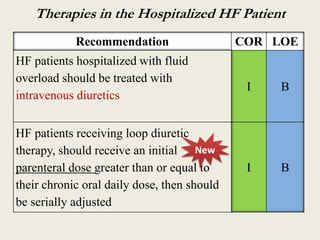
Therapies in the Hospitalized HF Patient
Recommendation
HF patients hospitalized with fluid
overload should be treated with
intravenous diuretics
HF patients receiving loop diuretic
therapy, should receive an initial New
parenteral dose greater than or equal to
their chronic oral daily dose, then should
be serially adjusted

COR LOE

I

B

I

B
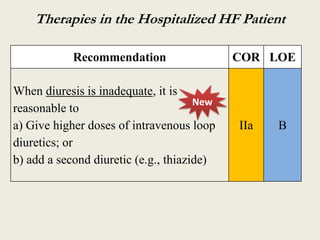
Therapies in the Hospitalized HF Patient
Recommendation
When diuresis is inadequate, it is
New
reasonable to
a) Give higher doses of intravenous loop
diuretics; or
b) add a second diuretic (e.g., thiazide)

COR LOE

IIa

B
Therapies in the Hospitalized HF Patient
Recommendation

COR

LOE

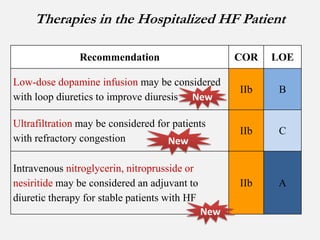
Low-dose dopamine infusion may be considered
with loop diuretics to improve diuresis New

IIb

B

Ultrafiltration may be considered for patients
with refractory congestion
New

IIb

C

Intravenous nitroglycerin, nitroprusside or
nesiritide may be considered an adjuvant to
diuretic therapy for stable patients with HF

IIb

A

New
Therapies in the Hospitalized HF Patient
Recommendation

COR LOE

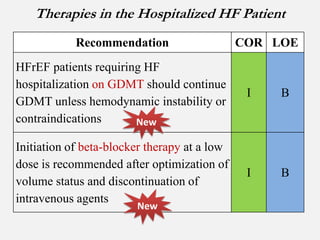
HFrEF patients requiring HF
hospitalization on GDMT should continue
GDMT unless hemodynamic instability or
contraindications
New

I

B

Initiation of beta-blocker therapy at a low
dose is recommended after optimization of
volume status and discontinuation of
intravenous agents

I

B

New
Recommendations for Inotropic Support
Recommendations
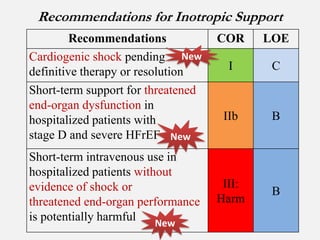
Cardiogenic shock pending New
definitive therapy or resolution
Short-term support for threatened
end-organ dysfunction in
hospitalized patients with
stage D and severe HFrEF New
Short-term intravenous use in
hospitalized patients without
evidence of shock or
threatened end-organ performance
is potentially harmful
New

COR

LOE

I

C

IIb

B

III:
Harm

B
acute heart failure:therapeutic update

acute heart failure:therapeutic update

  • 2.
    Algorithm for managementof acute heart failure Current therapeutic strategies Novel therapeutic strategies Newer inotropic drugs New Recommendations for the Hospitalized Patient
  • 3.
    Acute heart failureis a heterogeneous syndrome with multiple presentations
  • 4.
    3% 50% 47% Suggested initial triagein patients with suspected AHF syndromes
  • 5.
    Suggested treatment algorithmfor patients with hypertensive AHF syndromes.
  • 6.
    Suggested treatment algorithmfor patients with normotensive AHF syndromes.
  • 7.
    Suggested treatment algorithmfor patients with hypotensive AHF syndromes.
  • 8.
    What Should bethe Goals of Therapy of AHF? • Make the patient feel better: reduce dyspnea and improve QOL • Reduce Mortality • Reduce Rehospitalization • Do it safely
  • 9.
    Various targets fortherapies used in the management of acute heart failure.
  • 10.
    Current Treatment ofAcute Heart Failure Use in ADHERE Registry 88% 21 Diuretics Vasodilators Reduce Fluid Volume Decrease Preload and/or Afterload (Na+&H20) 15% Inotropes Augment Contractility
  • 11.
    Vasodilators Loop diuretics Used in 88% ofcases 10% 1% 10% Inotropics 6% 6% 3% ?
  • 12.
    Novel therapeutic targetsfor the treatment of acute heart failure
  • 13.
    Sites of actionof drugs producing diuresis and natriuresis. Rolofylline Tolvaptan
  • 14.
    Sites of actionof vasodilators. Ularitide Relaxin Nesiritide
  • 15.
    Sites of actionof inotropic agents. Istaroxime Levosimendan Omecamtiv mecarbil
  • 16.
    Why do newagents fail in Phase III trials? In recent years a repeated finding, particularly in clinical trials of patients with AHF, is that the positive results that are observed in preclinical and Phase II studies are not confirmed in large Phase III RCTs.
  • 17.
    A Word AboutInotropes. In the setting of AHF, inotropic agents are only recommended in patients with SBP 90 mmHg and evidence of inadequate organ perfusion despite other therapeutic interventions.
  • 19.
    Issues with CurrentInotropes Initial choice of therapy Weaning Patient related variables Differences in efficacy Adverse effect profile Survival data “Long-term” infusions There is an urgent clinical need for agents that improve cardiac performance with a favourable safety profile.
  • 20.
    Inotropic mechanisms anddrugs Inotropic mechanism Drugs Sodium-potassium-ATPase inhibition Digoxin b-Adrenoceptor stimulation Dobutamine, dopamine Phosphodiesterase inhibition Enoximone, milrinone Calcium sensitization Levosimendan Sodium-potassium-ATPase inhibition plus SERCA activation Istaroxime Acto-myosin cross-bridge activation Omecamtiv mecarbil SERCA activation Gene transfer SERCA activation plus vasodilation Nitroxyl donor; CXL-1020 Ryanodine receptor stabilization Ryanodine receptor stabilizer; S44121 Energetic modulation Etomoxir, pyruvate
  • 21.
    Results of therecent AHF trials (disappointing) Study Patients Primary End Point Calcium Sensitizer (Levosimendan) LIDO CASINO 203 299 REVIVE II 600 SURVIVE 800 Change CI 24 h and PCWP 24 h Mortality 30 d and Mortality 180 d Composite global assess. at 6 h, 24 h 5 d Mortality 180 d SERCA agonist & Na/K ATPase inhibitor (Istaroxime) HORIZON-HF 120 PCWP Changes from baseline
  • 22.
    ATOMIC-AHF (Acute Treatmentwith Omecamtiv Mecarbil to Increase Contractility in Acute Heart Failure) ESC Congress 2013 in Amsterdam
  • 23.
    Calcium sensitizers Levosimendan (Simdax®)increases sensitivity of troponin in the heart to calcium. This results in increased myocardial contractility. It is infused i.v. for short treatment of AHF.
  • 24.
    Levosimendan : ESC Guidelines2012 Patients with hypotension, hypoperfusion or shock An i.v. infusion of levosimendan (or a phosphodiesterase inhibitor) may be considered to reverse the effect of ẞ -blockade if ẞ -blockade is thought to be contributing to hypoperfusion. • The ECG should be monitored continuously because inotropic agents can cause arrhythmias and myocardial ischaemia, • and, as these agents are also vasodilators, blood pressure should be monitored carefully. Class of recommendation IIb . Level of evidence C
  • 25.
    New Recommendations forthe Hospitalized Patient 2013 ACCF/AHA Guideline for the Management of Heart Failure A Report of the American College of Cardiology Foundation/American Heart Association Task Force on Practice Guidelines
  • 26.
    The Major Reasonfor Heart Failure Hospitalizations Worsening chronic heart failure (75%) De novo heart failure (23%) Advanced/ end-stage heart failure (2%) Fonarow GC. Rev Cardiovasc Med. 2003; 4 (Suppl. 7): 21 Cleland JG et al. Eur Heart J. 2003; 24: 442
  • 27.
    Therapies in theHospitalized HF Patient Recommendation HF patients hospitalized with fluid overload should be treated with intravenous diuretics HF patients receiving loop diuretic therapy, should receive an initial New parenteral dose greater than or equal to their chronic oral daily dose, then should be serially adjusted COR LOE I B I B
  • 28.
    Therapies in theHospitalized HF Patient Recommendation When diuresis is inadequate, it is New reasonable to a) Give higher doses of intravenous loop diuretics; or b) add a second diuretic (e.g., thiazide) COR LOE IIa B
  • 29.
    Therapies in theHospitalized HF Patient Recommendation COR LOE Low-dose dopamine infusion may be considered with loop diuretics to improve diuresis New IIb B Ultrafiltration may be considered for patients with refractory congestion New IIb C Intravenous nitroglycerin, nitroprusside or nesiritide may be considered an adjuvant to diuretic therapy for stable patients with HF IIb A New
  • 30.
    Therapies in theHospitalized HF Patient Recommendation COR LOE HFrEF patients requiring HF hospitalization on GDMT should continue GDMT unless hemodynamic instability or contraindications New I B Initiation of beta-blocker therapy at a low dose is recommended after optimization of volume status and discontinuation of intravenous agents I B New
  • 31.
    Recommendations for InotropicSupport Recommendations Cardiogenic shock pending New definitive therapy or resolution Short-term support for threatened end-organ dysfunction in hospitalized patients with stage D and severe HFrEF New Short-term intravenous use in hospitalized patients without evidence of shock or threatened end-organ performance is potentially harmful New COR LOE I C IIb B III: Harm B