Heart Failure
DR. MOSTAFIZUR RAHMAN IMROSE
MD(CARDIOLOGY) FINAL PART
DHAKA MEDICAL COLLEGE
Definition
www.escardio.org/guidelines
HF is a clinical syndrome characterized by
typical symptoms (e.g. breathlessness and
fatigue) that may be accompanied by signs
(e.g.ankle swelling, elevated jugular venous
pressure, pulmonary crackles and peripheral
oedema) caused by a structural and/or
functional cardiac abnormality, resulting in a
reduced cardiac output and/or elevated
intracardiac pressures at rest or during stress.
Heart failure is the leading cause of
hospitalization in people older than 65
years…
In developing countries,2-3% of the population
have heart failure,but in those
70-80 years old, it occurs in 20–30%
1 in 4 heart failure patients die within 1yr of
diagnosis. ~50% of pts die within 5yrs of
diagnosis.
Recent study shows that asymptomatic Or
undiagnosed patients are at higher risk than
the diagnosed patients, as they have higher
risk of sudden cardiac death.
Classification of Heart Failure
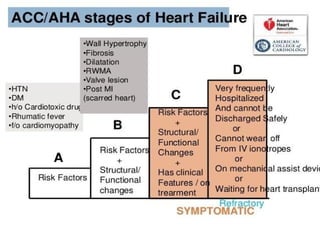
ACCF/AHA Stages of HF NYHA Functional Classification
A At high risk for HF but without structural
heart disease or symptoms of HF.
None
B Structural heart disease but without signs or
symptoms of HF.
I No limitation of physical activity. Ordinary
physical activity does not cause symptoms of
HF.
C Structural heart disease with prior or current
symptoms of HF.
I No limitation of physical activity. Ordinary
physical activity does not cause symptoms of
HF.
II Slight limitation of physical activity.
Comfortable at rest, but ordinary physical
activity results in symptoms of HF.
III Marked limitation of physical activity.
Comfortable at rest, but less than ordinary
activity causes symptoms of HF.
IV Unable to carry on any physical activity
without symptoms of HF, or symptoms of HF
at rest.
D Refractory HF requiring specialized
interventions.
Management of patients with acute heart failure
based on clinical profile during an early phase
www.escardio.org/guidelines
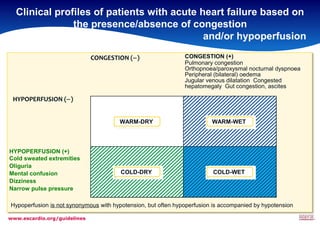
Clinical profiles of patients with acute heart failure based on
the presence/absence of congestion
and/or hypoperfusion
Hypoperfusion is not synonymous with hypotension, but often hypoperfusion is accompanied by hypotension
CONGESTION (+)
Pulmonary congestion
Orthopnoea/paroxysmal nocturnal dyspnoea
Peripheral (bilateral) oedema
Jugular venous dilatation Congested
hepatomegaly Gut congestion, ascites
Hepatojugular reflux
HYPOPERFUSION (+)
Cold sweated extremities
Oliguria
Mental confusion
Dizziness
Narrow pulse pressure
HYPOPERFUSION (‒)
CONGESTION (‒)
WARM-DRY WARM-WET
COLD-DRY COLD-WET
www.escardio.org/guidelines
9
www.escardio.org/guidelines
A New Classification
Heart failure with preserved, mid-range and reduced EF
The only category with evidence based medicine is HF rEF
ESC 2016
•Types of Heart failure:
According to functional
capacity:
a) Systolic dysfunction
b) Diastolic dysfunction
According to the onset of failure:
a) Acute HF
b) Chronic HF
c) Acute on chronic HF
Preload
• Volume of blood in ventricles at end diastole
• Depends on venous return
• Depends on compliance
Afterload
•Force needed to eject blood into circulation
•Arterial B/P, pulmonary artery pressure
•Valvular disease increases afterload
Factors effecting heart
pump effectiveness
Heart Failure Guidelines
ESC2016
What’s New?
MAJOR CHANGES
www.escardio.org/guidelines
1. A new term « HF with mid range ejection fraction »
(HFmrEF).
2. A new algorithm for the diagnosis of HF.
3. Recommendations on prevention of HF.
4. Indications for the use of Sacubitril / Valsartan in
HF with reduced ejection fraction (HFrEF).
5. Indications for cardiac resynchronisation therapy.
6. A new algorithm for the diagnosis and the
management of acute HF.
7. A list of drugs contra-indicated in HFrEF.
WHAT DOES NOT CHANGE ?
First line therapies in chronic heart failure with
reduced ejection fraction (HFrEF).1
Indications for implantable cardiac defibrillator2
Lack of evidence for the treatment of HF with
preserved ejection fraction.3
Gaps in evidence.4
www.escardio.org/guidelines
Acute Heart Failure (ADHF)
(emergency mgt >recall for later!
U Upright Position
N Nitrates
L Lasix
O Oxygen
A ACE, ARBs, Amiodorone
D Dig, Dobutamine
M Morphine Sulfate
E Extremities Down
Immediate Management of acute
LVF:
• Sit the patient up to reduce pulmonary congestion.
• Give Oxygen (high-flow, high-concentrtion).
Non-invasive positive pressure ventilation
continuous positive airways pressure (CPAP) of
5–10 mmHg) by a tight-fitting facemask results
in a more rapid clinical improvement.
• Administer nitrates,such as
IV glyceryl trinitrate (10–200 μg/min) or
buccal glyceryl trinitrate 2–5 mg,titrated
upwards every 10 minutes),until clinical
improvement occurs or
systolic BP falls to less than 110 mmHg.
• Administer a loop diuretic, such as
Furosemide(20–100 mg IV).
•Intravenous opiates must be used sparingly in
distressed patients, as they may cause respiratory
depression and exacerbation of hypoxaemia and
hypercapnia.
If these measures prove ineffective:
•Inotropic agents may be required to augment cardiac
output, particularly in hypotensive patients.
•Insertion of an intra-aortic balloon pump may be
beneficial in patients with acute cardiogenic pulmonary
oedema and shock.
Digoxin: is usefull for rate control in AF.
Treatment of the other identifiable causes
e.g Aspirin and thrombolysis Or PCI for acute MI.
Cardinal features of ALVF:
1.Tachycardia
2.Gallop rhythm,
S3 third heart sound
3.Bilateral basal
crepitation
In lungs,due to
Pulmonary oedema
Fig : chest x ray showing heart failure
features
Acute heart failure
www.escardio.org/guidelines
Causes of acute LVF:
1.Acute MI
2. Acute native valve failure e.g Chordal rupture,
Endocarditis
3. Acute myocarditis
4.Hypertensive crisis (SBP >180mmHg ,
DBP>110mmHg)
5.Cardiac tamponade
6.Profound bradycardia .r tachycardia
7.Myocardial depression due to drug toxicity
-TCA
-Beta blockers
-CCB
Cardinal features of RHF:
1. Raised JVP
2. Tender hepatomegaly
3. Bilateral leg oedema or
Peripheral oedema
Complications of heart failure:
Renal failure
Hypokalaemia
Hyperkalaemia
Hypomagnaesemia
Impaired liver function
Thromboembolism
Atrial and ventricular arrhythmias e.g
AF
VT, SVT
Ventricular ectopics
Based on clinical probability of HF
Based on the assessment of
circulating natriuretic peptides, and
on transthoracic echocardiography.
www.escardio.org/guidelines
A new algorithm for the diagnosis
of chronic HF
9
www.escardio.org/guidelines
A New Classification
Heart failure with preserved, mid-range and reduced EF
The only category with evidence based medicine is HF rEF
∗ Treatment of risk factors (hypertension, diabetes, obesity,
smoking cessation).
∗ Use of statins in patients with or at high risk of coronary
artery disease.
∗ Use of ACE-I in patients with asymptomatic left ventricular
dysfunction /stable CAD.
∗ -Use of beta-blockers in those with asymptomatic left
ventricular dysfunction and a history of myocardial infarction.
www.escardio.org/guidelines
Prevention of heart failure
Stage A (AHA 2013)
Hypertension and lipid disorders should be
controlled in accordance with contemporary
guidelines to lower the risk of HF.
Other conditions that may lead to or
contribute to HF, such as
-obesity
-diabetes mellitus
-tobacco use and
-known cardiotoxic agents should be
controlled or avoided.
Objectives of the treatment of heart
failure with reduced ejection fraction
www.escardio.org/guidelines
 Reduce mortality
 Improve
 clinical status
 functional capacity
 quality of life, prevent hospital admission
Preventing HF hospitalizations and
improving functional capacity.
Initial management of symptomatic HF with
reduced ejection fraction.
www.escardio.org/guidelines
Therapeutic algorithm for a patient with symptomatic HF with
reduced ejection fraction. Next steps
If-channel inhibitor
Ivabradine is indicated in patients with:
 symptomatic HFrEF and LVEF ≤35%
 in sinus rhythm and with a heart rate ≥70 bpm
 who had been hospitalized for HF within the previous 12
months.
The European Medicines Agency (EMA) approved
ivabradine for use in Europe in patients with HFrEF with
LVEF ≤35% and in sinus rhythm with a resting heart rate ≥75
bpm, because in this group ivabradine conferred a survival
benefit.
Main side effects :bradycardia, blurred vision
SHIFT
CV death / HF hospitalization
0 6 12 18 24 30
40
30
20
10
0
-18%
Placebo
Ivabradine
p<0.0001
Months
Swedberg K, et al. Lancet 2010;376: 875-885.
Angiotensin receptor neprilysin inhibitor
(Sacubitril/Valsartan)
 ARNI is indicated in patients with:
 ambulatory, symptomatic HFrEF
 LVEF ≤35%
 elevated plasma NP levels (BNP ≥150 pg/mL or NT-proBNP ≥600
pg/mL)
 estimated GFR (eGFR) ≥30 mL/min/1.73 m2 of body surface area
 who are able to tolerate treatment with enalapril (at least 10 mg b.i.d.)
 Side effects:
 symptomatic hypotension.
 risk of angioedema (ACEI should be withheld for at least 36 h
before initiating LCZ696).
PARADIGM HF
Cardiovascular death / Heart Failure hospitalisation
Patients at Risk
LCZ696 4187 3922 3663 3018 2257 1544 896 249
Enalapril 4212 3883 3579 2922 2123 1488 853 236
0
16
32
40
24
8
Enalapril
(n=4212)
3600 180 1260
1117
914
LCZ696
(n=4187)
HR = 0.80 (0.73-0.87)
P = 0.0000002
Number needed to treat = 21
540 720 900
1080
Days After Randomization
JJV McMurray et al, NEJM 2014 online
Angiotensin II type I receptor blockers
 ARBs are recommended only as an alternative in patients intolerant of
an ACEI.
 The combination of ACEI/ARB should be restricted to symptomatic HFrEF
patients receiving a beta-blocker who are unable to tolerate an MRA, and
must be used under strict supervision.
Combination of hydralazine and isosorbide dinitrate
 There is no clear evidence to suggest the use of this fix-dose
combination therapy in all patients with HFrEF.
 This combination may be considered in patients who can tolerate neither
ACEi nor ARB.
Other pharmacological treatments recommended in
selected patients with symptomatic (NYHA Class II-IV)
HFrEF
Other treatments with less certain benefit in
symptomatic patients
with HFrEF
Digoxin and other digitalis glycosides
Digoxin may be considered in patients in sinus rhythm to reduce the
risk of hospitalisation in symptomatic patients with HFrEF
It is only recommended for the treatment of patients with HFrEF and AF
with rapid ventricular rate when other therapeutic options cannot be
pursued
Digitalis should always be prescribed under specialist supervision.
Caution should be exerted in females, in the elderly and in patients with
reduced renal function.
Treatments not recommended in symptomatic
patients with HFrEF
Statins
Oral anticoagulants and antiplatelet therapy
Except in patients with atrial fibrillation
There is no evidence on the benefits of antiplatelet drugs in patients with HF
without accompanying CAD, whereas there is a substantial risk of GI bleeding.
Renin inhibitors
It is not presently recommended as an alternative to an ACEI or ARB
Treatments (or combinations of treatments) that may cause
harm in patients with symptomatic (NYHA Class II–IV) HFrEF
www.escardio.org/guidelines
Recommendations Classa Levelb
Thiazolidinediones (glitazones) are not recommended in
patients with HF, as they increase the risk of HF worsening and
HF hospitalization.
III A
NSAIDs or COX-2 inhibitors are not recommended in patients
with HF, as they increase the risk of HF worsening and HF
hospitalization.
III B
Diltiazem or verapamil are not recommended in patients with
HFrEF, as they increase the risk of HF worsening and HF
hospitalization.
III C
The addition of an ARB (or renin inhibitor) to the combination of
an ACE-I and an MRA is not recommended in patients with HF,
because of the increased risk of renal dysfunction and
hyperkalaemia.
III C
ESC Heart Failure Guidelines:
devices
www.escardio.org/guidelines
Implantable cardioverter-defibrillator in
patients with heart failure
Recommendations Class Level
Secondary prevention
An ICD is recommended to reduce the risk of sudden death and all-cause mortality in patients who have
recovered from a ventricular arrhythmia causing haemodynamic instability, and who are expected to survive
for >1 year with good functional status.
I A
Primary prevention
An ICD is recommended to reduce the risk of sudden death and all-cause mortality in patients with
symptomatic HF (NYHA Class II–III), and an LVEF ≤35% despite ≥3 months of OMT, provided they are
expected to survive substantially longer than one year with good functional status, and they have:
• IHD (unless they have had an MI in the prior 40 days – see below). I A
• DCM. I B
ICD implantation is not recommended within 40 days of an MI as implantation at this time does not
improve prognosis.
III A
ICD therapy is not recommended in patients in NYHA Class IV with severe symptoms refractory to
pharmacological therapy unless they are candidates for CRT, a ventricular assist device, or cardiac
transplantation.
III C
Patients should be carefully evaluated by an experienced cardiologist before generator replacement, because
management goals and the patient’s needs and clinical status may have changed. IIa B
A wearable ICD may be considered for patients with HF who are at risk of sudden cardiac death for a limited
period or as a bridge to an implanted device. IIb C
www.escardio.org/guidelines
Recommendations Classa Levelb
CRT is recommended for symptomatic patients with HF in sinus rhythm with a QRS
duration ≥ 150 msec and LBBB QRS morphology and with LVEF ≤ 35% despite OMT
in order to improve symptoms and reduce morbidity and mortality.
I A
CRT should be considered for symptomatic patients with HF in sinus rhythm with a QRS
duration ≥ 150 msec and non-LBBB QRS morphology and with LVEF ≤ 35% despite
OMT in order to improve symptoms and reduce morbidity and mortality.
IIa B
CRT is recommended for symptomatic patients with HF in sinus rhythm with a QRS
duration of 130-149 msec and LBBB QRS morphology and with LVEF ≤ 35% despite
OMT in order to improve symptoms and reduce morbidity and mortality.
I B
CRT may be considered for symptomatic patients with HF in sinus rhythm with a
QRS duration of 130-149 msec and non-LBBB QRS morphology and with LVEF
≤ 35% despite OMT in order to improve symptoms and reduce morbidity and mortality. IIb B
CRT should be considered for patients with LVEF ≤ 35% in NYHA Class III-Ivc despite
OMT in order to improve symptoms and reduce morbidity and mortality, if they are in AF
and have a QRS duration ≥ 130 msec provided a strategy to ensure bi-ventricular
capture is in place or the patient is expected to return to sinus rhythm.
IIa B
www.escardio.org/guidelines
Recommendations for cardiac resynchronization
therapy implantation in patients with heart failure
Gaps in evidence
www.escardio.org/guidelines
Clinicians responsible for managing patients with HF must frequently make treatment
decisions without adequate evidence or a consensus of expert opinion. The following is a
short list of selected, common issues that deserve to be addressed in future clinical
research:
Indications for ICDs in specific subgroups (e.g. ARVC and HFmrEF / HFpEF) and optimal
selection of ICD candidates.
QRS morphology or duration as a predictor of response to CRT.
CRT in patients with AF.
Efficacy of PV ablation as a rhythm-control strategy in patients with AF.
Interventional approach to recurrent, live-threatening ventricular tachyarrhythmias.
The role of remote monitoring strategies in HF.
Non-surgical (percutaneous) correction of functional mitral and tricuspid regurgitations.
Identification of indications for coronary angiography/revascularization in patients
with HF and chronic stable CAD;
Effects of novel LVADs as destination therapy and bridge to transplantation.
Take home message:
•Heart failure is a clinical diagnosis based on the results of the
lab tests and echocardiography
•Cardiac transplantatoin is the end stage of treatment.
•Diuretics are for acute relief and also prevents
fluid retention in future.
•ACEI/ARB/ beta blockers/spironolactones are much responsive
to HF in Reduced EF.
•Digoxin should only be used in pts with AF.
•Patient should be advised : Salt and water restriction.
•Sodium in diet 2-3g
• Fluid restriction 1-1.5 L/day
•If any deterioration of the condition ,pt must consult to
the cardiologist.
Thank You

Heart failure imrose

  • 1.
    Heart Failure DR. MOSTAFIZURRAHMAN IMROSE MD(CARDIOLOGY) FINAL PART DHAKA MEDICAL COLLEGE
  • 2.
    Definition www.escardio.org/guidelines HF is aclinical syndrome characterized by typical symptoms (e.g. breathlessness and fatigue) that may be accompanied by signs (e.g.ankle swelling, elevated jugular venous pressure, pulmonary crackles and peripheral oedema) caused by a structural and/or functional cardiac abnormality, resulting in a reduced cardiac output and/or elevated intracardiac pressures at rest or during stress.
  • 3.
    Heart failure isthe leading cause of hospitalization in people older than 65 years… In developing countries,2-3% of the population have heart failure,but in those 70-80 years old, it occurs in 20–30% 1 in 4 heart failure patients die within 1yr of diagnosis. ~50% of pts die within 5yrs of diagnosis. Recent study shows that asymptomatic Or undiagnosed patients are at higher risk than the diagnosed patients, as they have higher risk of sudden cardiac death.
  • 4.
    Classification of HeartFailure ACCF/AHA Stages of HF NYHA Functional Classification A At high risk for HF but without structural heart disease or symptoms of HF. None B Structural heart disease but without signs or symptoms of HF. I No limitation of physical activity. Ordinary physical activity does not cause symptoms of HF. C Structural heart disease with prior or current symptoms of HF. I No limitation of physical activity. Ordinary physical activity does not cause symptoms of HF. II Slight limitation of physical activity. Comfortable at rest, but ordinary physical activity results in symptoms of HF. III Marked limitation of physical activity. Comfortable at rest, but less than ordinary activity causes symptoms of HF. IV Unable to carry on any physical activity without symptoms of HF, or symptoms of HF at rest. D Refractory HF requiring specialized interventions.
  • 9.
    Management of patientswith acute heart failure based on clinical profile during an early phase www.escardio.org/guidelines
  • 10.
    Clinical profiles ofpatients with acute heart failure based on the presence/absence of congestion and/or hypoperfusion Hypoperfusion is not synonymous with hypotension, but often hypoperfusion is accompanied by hypotension CONGESTION (+) Pulmonary congestion Orthopnoea/paroxysmal nocturnal dyspnoea Peripheral (bilateral) oedema Jugular venous dilatation Congested hepatomegaly Gut congestion, ascites Hepatojugular reflux HYPOPERFUSION (+) Cold sweated extremities Oliguria Mental confusion Dizziness Narrow pulse pressure HYPOPERFUSION (‒) CONGESTION (‒) WARM-DRY WARM-WET COLD-DRY COLD-WET www.escardio.org/guidelines
  • 11.
    9 www.escardio.org/guidelines A New Classification Heartfailure with preserved, mid-range and reduced EF The only category with evidence based medicine is HF rEF
  • 12.
  • 15.
  • 16.
    According to functional capacity: a)Systolic dysfunction b) Diastolic dysfunction According to the onset of failure: a) Acute HF b) Chronic HF c) Acute on chronic HF
  • 17.
    Preload • Volume ofblood in ventricles at end diastole • Depends on venous return • Depends on compliance Afterload •Force needed to eject blood into circulation •Arterial B/P, pulmonary artery pressure •Valvular disease increases afterload Factors effecting heart pump effectiveness
  • 18.
  • 19.
    MAJOR CHANGES www.escardio.org/guidelines 1. Anew term « HF with mid range ejection fraction » (HFmrEF). 2. A new algorithm for the diagnosis of HF. 3. Recommendations on prevention of HF. 4. Indications for the use of Sacubitril / Valsartan in HF with reduced ejection fraction (HFrEF). 5. Indications for cardiac resynchronisation therapy. 6. A new algorithm for the diagnosis and the management of acute HF. 7. A list of drugs contra-indicated in HFrEF.
  • 20.
    WHAT DOES NOTCHANGE ? First line therapies in chronic heart failure with reduced ejection fraction (HFrEF).1 Indications for implantable cardiac defibrillator2 Lack of evidence for the treatment of HF with preserved ejection fraction.3 Gaps in evidence.4 www.escardio.org/guidelines
  • 21.
    Acute Heart Failure(ADHF) (emergency mgt >recall for later! U Upright Position N Nitrates L Lasix O Oxygen A ACE, ARBs, Amiodorone D Dig, Dobutamine M Morphine Sulfate E Extremities Down
  • 22.
    Immediate Management ofacute LVF: • Sit the patient up to reduce pulmonary congestion. • Give Oxygen (high-flow, high-concentrtion). Non-invasive positive pressure ventilation continuous positive airways pressure (CPAP) of 5–10 mmHg) by a tight-fitting facemask results in a more rapid clinical improvement. • Administer nitrates,such as IV glyceryl trinitrate (10–200 μg/min) or buccal glyceryl trinitrate 2–5 mg,titrated upwards every 10 minutes),until clinical improvement occurs or systolic BP falls to less than 110 mmHg. • Administer a loop diuretic, such as Furosemide(20–100 mg IV).
  • 23.
    •Intravenous opiates mustbe used sparingly in distressed patients, as they may cause respiratory depression and exacerbation of hypoxaemia and hypercapnia. If these measures prove ineffective: •Inotropic agents may be required to augment cardiac output, particularly in hypotensive patients. •Insertion of an intra-aortic balloon pump may be beneficial in patients with acute cardiogenic pulmonary oedema and shock. Digoxin: is usefull for rate control in AF. Treatment of the other identifiable causes e.g Aspirin and thrombolysis Or PCI for acute MI.
  • 24.
    Cardinal features ofALVF: 1.Tachycardia 2.Gallop rhythm, S3 third heart sound 3.Bilateral basal crepitation In lungs,due to Pulmonary oedema
  • 25.
    Fig : chestx ray showing heart failure features
  • 28.
  • 29.
    Causes of acuteLVF: 1.Acute MI 2. Acute native valve failure e.g Chordal rupture, Endocarditis 3. Acute myocarditis 4.Hypertensive crisis (SBP >180mmHg , DBP>110mmHg) 5.Cardiac tamponade 6.Profound bradycardia .r tachycardia 7.Myocardial depression due to drug toxicity -TCA -Beta blockers -CCB
  • 30.
    Cardinal features ofRHF: 1. Raised JVP 2. Tender hepatomegaly 3. Bilateral leg oedema or Peripheral oedema
  • 31.
    Complications of heartfailure: Renal failure Hypokalaemia Hyperkalaemia Hypomagnaesemia Impaired liver function Thromboembolism Atrial and ventricular arrhythmias e.g AF VT, SVT Ventricular ectopics
  • 32.
    Based on clinicalprobability of HF Based on the assessment of circulating natriuretic peptides, and on transthoracic echocardiography. www.escardio.org/guidelines A new algorithm for the diagnosis of chronic HF
  • 34.
    9 www.escardio.org/guidelines A New Classification Heartfailure with preserved, mid-range and reduced EF The only category with evidence based medicine is HF rEF
  • 35.
    ∗ Treatment ofrisk factors (hypertension, diabetes, obesity, smoking cessation). ∗ Use of statins in patients with or at high risk of coronary artery disease. ∗ Use of ACE-I in patients with asymptomatic left ventricular dysfunction /stable CAD. ∗ -Use of beta-blockers in those with asymptomatic left ventricular dysfunction and a history of myocardial infarction. www.escardio.org/guidelines Prevention of heart failure
  • 36.
    Stage A (AHA2013) Hypertension and lipid disorders should be controlled in accordance with contemporary guidelines to lower the risk of HF. Other conditions that may lead to or contribute to HF, such as -obesity -diabetes mellitus -tobacco use and -known cardiotoxic agents should be controlled or avoided.
  • 37.
    Objectives of thetreatment of heart failure with reduced ejection fraction www.escardio.org/guidelines  Reduce mortality  Improve  clinical status  functional capacity  quality of life, prevent hospital admission Preventing HF hospitalizations and improving functional capacity.
  • 39.
    Initial management ofsymptomatic HF with reduced ejection fraction. www.escardio.org/guidelines
  • 40.
    www.escardio.org/guidelines Therapeutic algorithm fora patient with symptomatic HF with reduced ejection fraction. Next steps
  • 42.
    If-channel inhibitor Ivabradine isindicated in patients with:  symptomatic HFrEF and LVEF ≤35%  in sinus rhythm and with a heart rate ≥70 bpm  who had been hospitalized for HF within the previous 12 months. The European Medicines Agency (EMA) approved ivabradine for use in Europe in patients with HFrEF with LVEF ≤35% and in sinus rhythm with a resting heart rate ≥75 bpm, because in this group ivabradine conferred a survival benefit. Main side effects :bradycardia, blurred vision
  • 43.
    SHIFT CV death /HF hospitalization 0 6 12 18 24 30 40 30 20 10 0 -18% Placebo Ivabradine p<0.0001 Months Swedberg K, et al. Lancet 2010;376: 875-885.
  • 44.
    Angiotensin receptor neprilysininhibitor (Sacubitril/Valsartan)  ARNI is indicated in patients with:  ambulatory, symptomatic HFrEF  LVEF ≤35%  elevated plasma NP levels (BNP ≥150 pg/mL or NT-proBNP ≥600 pg/mL)  estimated GFR (eGFR) ≥30 mL/min/1.73 m2 of body surface area  who are able to tolerate treatment with enalapril (at least 10 mg b.i.d.)  Side effects:  symptomatic hypotension.  risk of angioedema (ACEI should be withheld for at least 36 h before initiating LCZ696).
  • 47.
    PARADIGM HF Cardiovascular death/ Heart Failure hospitalisation Patients at Risk LCZ696 4187 3922 3663 3018 2257 1544 896 249 Enalapril 4212 3883 3579 2922 2123 1488 853 236 0 16 32 40 24 8 Enalapril (n=4212) 3600 180 1260 1117 914 LCZ696 (n=4187) HR = 0.80 (0.73-0.87) P = 0.0000002 Number needed to treat = 21 540 720 900 1080 Days After Randomization JJV McMurray et al, NEJM 2014 online
  • 48.
    Angiotensin II typeI receptor blockers  ARBs are recommended only as an alternative in patients intolerant of an ACEI.  The combination of ACEI/ARB should be restricted to symptomatic HFrEF patients receiving a beta-blocker who are unable to tolerate an MRA, and must be used under strict supervision. Combination of hydralazine and isosorbide dinitrate  There is no clear evidence to suggest the use of this fix-dose combination therapy in all patients with HFrEF.  This combination may be considered in patients who can tolerate neither ACEi nor ARB. Other pharmacological treatments recommended in selected patients with symptomatic (NYHA Class II-IV) HFrEF
  • 49.
    Other treatments withless certain benefit in symptomatic patients with HFrEF Digoxin and other digitalis glycosides Digoxin may be considered in patients in sinus rhythm to reduce the risk of hospitalisation in symptomatic patients with HFrEF It is only recommended for the treatment of patients with HFrEF and AF with rapid ventricular rate when other therapeutic options cannot be pursued Digitalis should always be prescribed under specialist supervision. Caution should be exerted in females, in the elderly and in patients with reduced renal function.
  • 50.
    Treatments not recommendedin symptomatic patients with HFrEF Statins Oral anticoagulants and antiplatelet therapy Except in patients with atrial fibrillation There is no evidence on the benefits of antiplatelet drugs in patients with HF without accompanying CAD, whereas there is a substantial risk of GI bleeding. Renin inhibitors It is not presently recommended as an alternative to an ACEI or ARB
  • 52.
    Treatments (or combinationsof treatments) that may cause harm in patients with symptomatic (NYHA Class II–IV) HFrEF www.escardio.org/guidelines Recommendations Classa Levelb Thiazolidinediones (glitazones) are not recommended in patients with HF, as they increase the risk of HF worsening and HF hospitalization. III A NSAIDs or COX-2 inhibitors are not recommended in patients with HF, as they increase the risk of HF worsening and HF hospitalization. III B Diltiazem or verapamil are not recommended in patients with HFrEF, as they increase the risk of HF worsening and HF hospitalization. III C The addition of an ARB (or renin inhibitor) to the combination of an ACE-I and an MRA is not recommended in patients with HF, because of the increased risk of renal dysfunction and hyperkalaemia. III C
  • 53.
    ESC Heart FailureGuidelines: devices www.escardio.org/guidelines
  • 54.
    Implantable cardioverter-defibrillator in patientswith heart failure Recommendations Class Level Secondary prevention An ICD is recommended to reduce the risk of sudden death and all-cause mortality in patients who have recovered from a ventricular arrhythmia causing haemodynamic instability, and who are expected to survive for >1 year with good functional status. I A Primary prevention An ICD is recommended to reduce the risk of sudden death and all-cause mortality in patients with symptomatic HF (NYHA Class II–III), and an LVEF ≤35% despite ≥3 months of OMT, provided they are expected to survive substantially longer than one year with good functional status, and they have: • IHD (unless they have had an MI in the prior 40 days – see below). I A • DCM. I B ICD implantation is not recommended within 40 days of an MI as implantation at this time does not improve prognosis. III A ICD therapy is not recommended in patients in NYHA Class IV with severe symptoms refractory to pharmacological therapy unless they are candidates for CRT, a ventricular assist device, or cardiac transplantation. III C Patients should be carefully evaluated by an experienced cardiologist before generator replacement, because management goals and the patient’s needs and clinical status may have changed. IIa B A wearable ICD may be considered for patients with HF who are at risk of sudden cardiac death for a limited period or as a bridge to an implanted device. IIb C www.escardio.org/guidelines
  • 55.
    Recommendations Classa Levelb CRTis recommended for symptomatic patients with HF in sinus rhythm with a QRS duration ≥ 150 msec and LBBB QRS morphology and with LVEF ≤ 35% despite OMT in order to improve symptoms and reduce morbidity and mortality. I A CRT should be considered for symptomatic patients with HF in sinus rhythm with a QRS duration ≥ 150 msec and non-LBBB QRS morphology and with LVEF ≤ 35% despite OMT in order to improve symptoms and reduce morbidity and mortality. IIa B CRT is recommended for symptomatic patients with HF in sinus rhythm with a QRS duration of 130-149 msec and LBBB QRS morphology and with LVEF ≤ 35% despite OMT in order to improve symptoms and reduce morbidity and mortality. I B CRT may be considered for symptomatic patients with HF in sinus rhythm with a QRS duration of 130-149 msec and non-LBBB QRS morphology and with LVEF ≤ 35% despite OMT in order to improve symptoms and reduce morbidity and mortality. IIb B CRT should be considered for patients with LVEF ≤ 35% in NYHA Class III-Ivc despite OMT in order to improve symptoms and reduce morbidity and mortality, if they are in AF and have a QRS duration ≥ 130 msec provided a strategy to ensure bi-ventricular capture is in place or the patient is expected to return to sinus rhythm. IIa B www.escardio.org/guidelines Recommendations for cardiac resynchronization therapy implantation in patients with heart failure
  • 58.
    Gaps in evidence www.escardio.org/guidelines Cliniciansresponsible for managing patients with HF must frequently make treatment decisions without adequate evidence or a consensus of expert opinion. The following is a short list of selected, common issues that deserve to be addressed in future clinical research: Indications for ICDs in specific subgroups (e.g. ARVC and HFmrEF / HFpEF) and optimal selection of ICD candidates. QRS morphology or duration as a predictor of response to CRT. CRT in patients with AF. Efficacy of PV ablation as a rhythm-control strategy in patients with AF. Interventional approach to recurrent, live-threatening ventricular tachyarrhythmias. The role of remote monitoring strategies in HF. Non-surgical (percutaneous) correction of functional mitral and tricuspid regurgitations. Identification of indications for coronary angiography/revascularization in patients with HF and chronic stable CAD; Effects of novel LVADs as destination therapy and bridge to transplantation.
  • 59.
    Take home message: •Heartfailure is a clinical diagnosis based on the results of the lab tests and echocardiography •Cardiac transplantatoin is the end stage of treatment. •Diuretics are for acute relief and also prevents fluid retention in future. •ACEI/ARB/ beta blockers/spironolactones are much responsive to HF in Reduced EF. •Digoxin should only be used in pts with AF. •Patient should be advised : Salt and water restriction. •Sodium in diet 2-3g • Fluid restriction 1-1.5 L/day •If any deterioration of the condition ,pt must consult to the cardiologist.
  • 60.