The Compassion of Hospitality

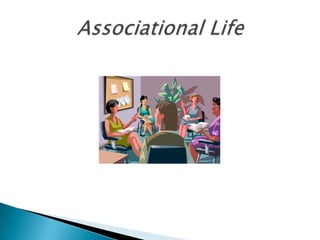
 The Presence of Association

     The Giving of Gifts
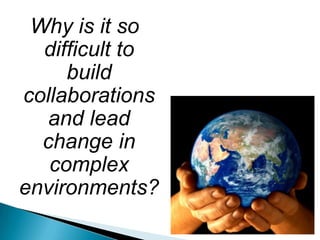
Why is it so
  difficult to
     build
collaborations
   and lead
  change in
   complex
environments?
Through   our mental models, in
other words, we use our past to
make sense of our present in an
effort to predict and control the
future…..
◦ Bounded Rationality:
   The Penchant to find Best-Fit vs. Optimal
    Solution

◦ Sense-Making:
   The maps we construct to make sense

◦ Social Construction:
   Collective effort to reduce to level of
    manageable understanding
Moments of Magnified
Meaning Making:
Our Mental Models at Work
   Creating a shift in our mental models:

    ◦ To People are unfinished works of
      progress, not problems to be fixed
    ◦ To a belief in the social fabric
    ◦ To associational life as central
    ◦ To a focus on citizens

    ◦ To a focus on   Gifts and Possibility
   Think about when you’re at your best, what
    are the unique skills and knowledge you
    have?

   What is the gift you’re here to bring in to the
    world? (Clue: It surprises you when others
    tell you about it).
The Action of Change:
New Possibilities
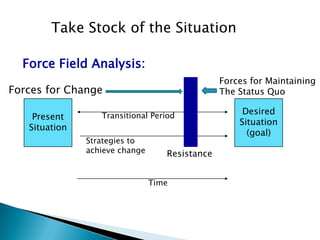
Take Stock of the Situation

  Force Field Analysis:
                                                Forces for Maintaining
Forces for Change                               The Status Quo

                  Transitional Period
                                                     Desired
    Present
                                                    Situation
   Situation
                                                      (goal)
               Strategies to
               achieve change      Resistance


                                Time
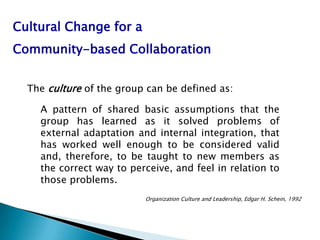
Cultural Change for a
Community-based Collaboration


  The culture of the group can be defined as:

    A pattern of shared basic assumptions that the
    group has learned as it solved problems of
    external adaptation and internal integration, that
    has worked well enough to be considered valid
    and, therefore, to be taught to new members as
    the correct way to perceive, and feel in relation to
    those problems.
                          Organization Culture and Leadership, Edgar H. Schein, 1992
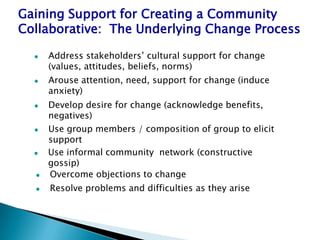
Gaining Support for Creating a Community
Collaborative: The Underlying Change Process

     Address stakeholders’ cultural support for change
      (values, attitudes, beliefs, norms)
     Arouse attention, need, support for change (induce
      anxiety)
     Develop desire for change (acknowledge benefits,
      negatives)
     Use group members / composition of group to elicit
      support
     Use informal community network (constructive
      gossip)
     Overcome objections to change
     Resolve problems and difficulties as they arise
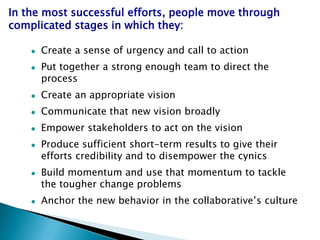
In the most successful efforts, people move through
complicated stages in which they:

       Create a sense of urgency and call to action
       Put together a strong enough team to direct the
        process
       Create an appropriate vision
       Communicate that new vision broadly
       Empower stakeholders to act on the vision
       Produce sufficient short-term results to give their
        efforts credibility and to disempower the cynics
       Build momentum and use that momentum to tackle
        the tougher change problems
       Anchor the new behavior in the collaborative’s culture
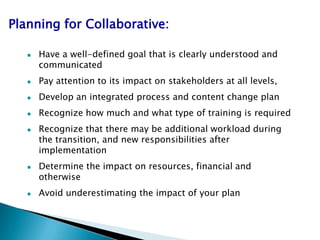
Planning for Collaborative:

      Have a well-defined goal that is clearly understood and
       communicated
      Pay attention to its impact on stakeholders at all levels,
      Develop an integrated process and content change plan
      Recognize how much and what type of training is required
      Recognize that there may be additional workload during
       the transition, and new responsibilities after
       implementation
      Determine the impact on resources, financial and
       otherwise
      Avoid underestimating the impact of your plan
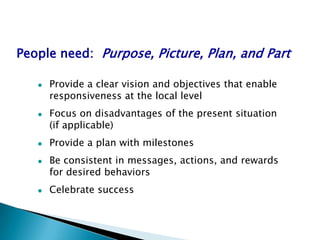
People need: Purpose, Picture, Plan, and Part

      Provide a clear vision and objectives that enable
       responsiveness at the local level
      Focus on disadvantages of the present situation
       (if applicable)
      Provide a plan with milestones
      Be consistent in messages, actions, and rewards
       for desired behaviors
      Celebrate success
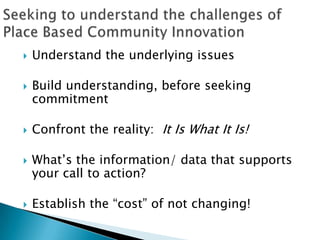
   Understand the underlying issues

   Build understanding, before seeking
    commitment

   Confront the reality: It Is What It Is!

   What’s the information/ data that supports
    your call to action?

   Establish the “cost” of not changing!
   Define “Dialogues/Conversations” as the
            Plans of Action
   Initiate and convene conversations that shift
    people’s experience, which occurs through
    the way people are brought together and the
    nature of the questions/conversations that
    engage them.

    The Conversations will build The Plan
What can this group create
together, that you cannot
create alone?
   What are the possibilities that exist for you
     and your agency by your being here?

    What declaration of Possibility can you make
     that has the power of to transform and
     inspire you?


I am the possibility of         _________________!
The Action of Change
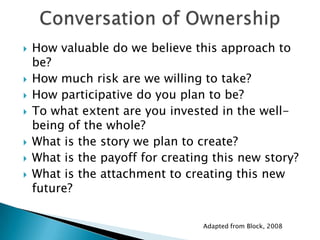
   How valuable do we believe this approach to
    be?
   How much risk are we willing to take?
   How participative do you plan to be?
   To what extent are you invested in the well-
    being of the whole?
   What is the story we plan to create?
   What is the payoff for creating this new story?
   What is the attachment to creating this new
    future?


                                  Adapted from Block, 2008
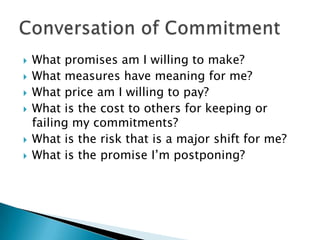
   What promises am I willing to make?
   What measures have meaning for me?
   What price am I willing to pay?
   What is the cost to others for keeping or
    failing my commitments?
   What is the risk that is a major shift for me?
   What is the promise I’m postponing?
 Whatis your commitment in
being here, what is it you
will commit to while you’re
here?
   What kind of sense are we making together?

   What are we coming to talk about as we
    converse?

   How are we shifting our understanding of
    what we are engaged in?

   What kind of enterprise are we shaping?
   What haven’t you discussed that if it were to
    happen would be a game changer?

   What probabilities occur around this?

   What is the capacity for flexibility and
    adaptability for emergent phenomenon?

   What is/are the commitments people are
    willing to act upon?
Change Management activities of respondents with
very good or excellent results

     Educated others on the need for change and
      how the new project will operate

     Built executive/ political support and
      sponsorship by giving presentations/holding
      conversations and encouraging involvement
     Developed and implemented a communication
      plan to create awareness and commitment to
      the new narrative/project

     Performed pilot tests and simulations
Change Management Activities of Respondents With
    Very Good or Excellent Results
    Involved others and end users in project
     planning and design
                  Reviewed the process periodically and
                   reinforced use of the new process
    Implemented a formal change process
                Clearly defined the process and process
                 boundaries
    Addressed resistance to change


                          Communicated and Held
                          Ongoing Conversations!
The future is not a result of choices
 among alternative paths offered
 by the present, but a place that is
 created--created first in the mind
 and will, created next in activity.
The future is not some place we
 are going to, but one we are
 creating.”
                                unknown
   Bridge the best of “what is” and “what might be”

   Challenge the “status quo”

   It should be desirable

   State it in affirmative and bold terms

   Fit within the architecture of possibility

   Participative process

   Balance the management of continuity, novelty and
    transition
There are only two ways to live
 your life. One is though
 nothing is a miracle. The other
 is as though everything is a
 miracle.

                Albert Einstein
What’s the next step
 you need to take
 that will empower
 you to achieve your
 collective dream?
1.   Create and ensure a shared vision and
     philosophy which encompasses the
     collective dreams, goals, and
     expectations.

2.   Create, ensure and maintain a
     commitment to the “best” of what is
     possible.
3.   Create and implement a comprehensive
     strategy to achieve the collective dream,
     incorporating accountability for all.

4.   Continue to pursue self-reflection and
     growth developing insights and the
     requisite attitudes to achieve the
     envisioned collective dream.
 Do you see opportunity; a
 future of possibilities?

 Do   you see a mystery?

 Doyou see adventure in the
 journey ahead?
Ah, but one’s reach should
 exceed one’s grasp,

        Or what’s a heaven for?

                    Robert Browning
   Know your own mission and part in
    achieving the dream
   Make more informed decisions, go after the
    information you need…don’t make your
    knowing based on waiting for someone else
    to get around to telling you
   Prepare and act to make a difference every
    day
   Achieve your own highest level of
    effectiveness and performance
   Get others involved in a conversation to start
    doing what is necessary to achieve the dream

   Build toward long-term improvement, even
    while doing short-term work

   Lead your own individual and the
    organization’s change; don’t wait for
    someone else to do it

   Communicate powerfully, especially your
    commitment to the journey and the dream
   Make the transition in to new ways of doing
    your role

   Get the most out of your own personal
    commitment to growth

   Always remember why you started this
    collaborative and cue yourself each day

   Know that ingenuity, plus courage, plus
    work equals miracles!
Act as though everything you do
 makes a difference….

If you worry that one person
  cannot make that big a
  difference, remember what
  Margaret Mead said,

   “It is surely the only thing
           that ever has!”
   Support a cause, don’t just do your job.
   Trumpet an exhilarating story.
   Be a generator of enthusiasm.
   Embrace and promote optimism.


When you say,    “I Will”,    with conviction,
    magic begins to happen.
                                        Willy Amos
“Some people look at things the
  way they are, and ask Why?
I dream of things that never
  were, and ask,
           “Why Not?”
                    Robert Kennedy
So, I would offer this:


Keep you feet on the ground…

    And, keep reaching for the stars!
And now the journey
 continues….

Being a Catalyst for Community-Based Collaboration

  • 2.
    The Compassion ofHospitality The Presence of Association The Giving of Gifts
  • 3.
    Why is itso difficult to build collaborations and lead change in complex environments?
  • 6.
    Through our mental models, in other words, we use our past to make sense of our present in an effort to predict and control the future…..
  • 7.
    ◦ Bounded Rationality:  The Penchant to find Best-Fit vs. Optimal Solution ◦ Sense-Making:  The maps we construct to make sense ◦ Social Construction:  Collective effort to reduce to level of manageable understanding
  • 8.
    Moments of Magnified MeaningMaking: Our Mental Models at Work
  • 9.
    Creating a shift in our mental models: ◦ To People are unfinished works of progress, not problems to be fixed ◦ To a belief in the social fabric ◦ To associational life as central ◦ To a focus on citizens ◦ To a focus on Gifts and Possibility
  • 11.
    Think about when you’re at your best, what are the unique skills and knowledge you have?  What is the gift you’re here to bring in to the world? (Clue: It surprises you when others tell you about it).
  • 12.
    The Action ofChange: New Possibilities
  • 13.
    Take Stock ofthe Situation Force Field Analysis: Forces for Maintaining Forces for Change The Status Quo Transitional Period Desired Present Situation Situation (goal) Strategies to achieve change Resistance Time
  • 14.
    Cultural Change fora Community-based Collaboration The culture of the group can be defined as: A pattern of shared basic assumptions that the group has learned as it solved problems of external adaptation and internal integration, that has worked well enough to be considered valid and, therefore, to be taught to new members as the correct way to perceive, and feel in relation to those problems. Organization Culture and Leadership, Edgar H. Schein, 1992
  • 15.
    Gaining Support forCreating a Community Collaborative: The Underlying Change Process  Address stakeholders’ cultural support for change (values, attitudes, beliefs, norms)  Arouse attention, need, support for change (induce anxiety)  Develop desire for change (acknowledge benefits, negatives)  Use group members / composition of group to elicit support  Use informal community network (constructive gossip)  Overcome objections to change  Resolve problems and difficulties as they arise
  • 16.
    In the mostsuccessful efforts, people move through complicated stages in which they:  Create a sense of urgency and call to action  Put together a strong enough team to direct the process  Create an appropriate vision  Communicate that new vision broadly  Empower stakeholders to act on the vision  Produce sufficient short-term results to give their efforts credibility and to disempower the cynics  Build momentum and use that momentum to tackle the tougher change problems  Anchor the new behavior in the collaborative’s culture
  • 17.
    Planning for Collaborative:  Have a well-defined goal that is clearly understood and communicated  Pay attention to its impact on stakeholders at all levels,  Develop an integrated process and content change plan  Recognize how much and what type of training is required  Recognize that there may be additional workload during the transition, and new responsibilities after implementation  Determine the impact on resources, financial and otherwise  Avoid underestimating the impact of your plan
  • 18.
    People need: Purpose,Picture, Plan, and Part  Provide a clear vision and objectives that enable responsiveness at the local level  Focus on disadvantages of the present situation (if applicable)  Provide a plan with milestones  Be consistent in messages, actions, and rewards for desired behaviors  Celebrate success
  • 19.
    Understand the underlying issues  Build understanding, before seeking commitment  Confront the reality: It Is What It Is!  What’s the information/ data that supports your call to action?  Establish the “cost” of not changing!
  • 20.
    Define “Dialogues/Conversations” as the Plans of Action  Initiate and convene conversations that shift people’s experience, which occurs through the way people are brought together and the nature of the questions/conversations that engage them. The Conversations will build The Plan
  • 22.
    What can thisgroup create together, that you cannot create alone?
  • 23.
    What are the possibilities that exist for you and your agency by your being here?  What declaration of Possibility can you make that has the power of to transform and inspire you? I am the possibility of _________________!
  • 24.
  • 25.
    How valuable do we believe this approach to be?  How much risk are we willing to take?  How participative do you plan to be?  To what extent are you invested in the well- being of the whole?  What is the story we plan to create?  What is the payoff for creating this new story?  What is the attachment to creating this new future? Adapted from Block, 2008
  • 26.
    What promises am I willing to make?  What measures have meaning for me?  What price am I willing to pay?  What is the cost to others for keeping or failing my commitments?  What is the risk that is a major shift for me?  What is the promise I’m postponing?
  • 27.
     Whatis yourcommitment in being here, what is it you will commit to while you’re here?
  • 28.
    What kind of sense are we making together?  What are we coming to talk about as we converse?  How are we shifting our understanding of what we are engaged in?  What kind of enterprise are we shaping?
  • 29.
    What haven’t you discussed that if it were to happen would be a game changer?  What probabilities occur around this?  What is the capacity for flexibility and adaptability for emergent phenomenon?  What is/are the commitments people are willing to act upon?
  • 30.
    Change Management activitiesof respondents with very good or excellent results  Educated others on the need for change and how the new project will operate  Built executive/ political support and sponsorship by giving presentations/holding conversations and encouraging involvement  Developed and implemented a communication plan to create awareness and commitment to the new narrative/project  Performed pilot tests and simulations
  • 31.
    Change Management Activitiesof Respondents With Very Good or Excellent Results  Involved others and end users in project planning and design  Reviewed the process periodically and reinforced use of the new process  Implemented a formal change process  Clearly defined the process and process boundaries  Addressed resistance to change Communicated and Held Ongoing Conversations!
  • 32.
    The future isnot a result of choices among alternative paths offered by the present, but a place that is created--created first in the mind and will, created next in activity. The future is not some place we are going to, but one we are creating.” unknown
  • 33.
    Bridge the best of “what is” and “what might be”  Challenge the “status quo”  It should be desirable  State it in affirmative and bold terms  Fit within the architecture of possibility  Participative process  Balance the management of continuity, novelty and transition
  • 34.
    There are onlytwo ways to live your life. One is though nothing is a miracle. The other is as though everything is a miracle. Albert Einstein
  • 35.
    What’s the nextstep you need to take that will empower you to achieve your collective dream?
  • 36.
    1. Create and ensure a shared vision and philosophy which encompasses the collective dreams, goals, and expectations. 2. Create, ensure and maintain a commitment to the “best” of what is possible.
  • 37.
    3. Create and implement a comprehensive strategy to achieve the collective dream, incorporating accountability for all. 4. Continue to pursue self-reflection and growth developing insights and the requisite attitudes to achieve the envisioned collective dream.
  • 38.
     Do yousee opportunity; a future of possibilities?  Do you see a mystery?  Doyou see adventure in the journey ahead?
  • 39.
    Ah, but one’sreach should exceed one’s grasp, Or what’s a heaven for? Robert Browning
  • 40.
    Know your own mission and part in achieving the dream  Make more informed decisions, go after the information you need…don’t make your knowing based on waiting for someone else to get around to telling you  Prepare and act to make a difference every day  Achieve your own highest level of effectiveness and performance
  • 41.
    Get others involved in a conversation to start doing what is necessary to achieve the dream  Build toward long-term improvement, even while doing short-term work  Lead your own individual and the organization’s change; don’t wait for someone else to do it  Communicate powerfully, especially your commitment to the journey and the dream
  • 42.
    Make the transition in to new ways of doing your role  Get the most out of your own personal commitment to growth  Always remember why you started this collaborative and cue yourself each day  Know that ingenuity, plus courage, plus work equals miracles!
  • 43.
    Act as thougheverything you do makes a difference…. If you worry that one person cannot make that big a difference, remember what Margaret Mead said, “It is surely the only thing that ever has!”
  • 44.
    Support a cause, don’t just do your job.  Trumpet an exhilarating story.  Be a generator of enthusiasm.  Embrace and promote optimism. When you say, “I Will”, with conviction, magic begins to happen. Willy Amos
  • 45.
    “Some people lookat things the way they are, and ask Why? I dream of things that never were, and ask, “Why Not?” Robert Kennedy
  • 46.
    So, I wouldoffer this: Keep you feet on the ground… And, keep reaching for the stars!
  • 47.
    And now thejourney continues….

Editor's Notes

  • #5 In complex organizations and environment we recognize that Interactive non-linear processes and relationships are difficult to define and defy meta-narrative understanding, since each of us potentially sees something different when we see organization(Mangiofico, 2003 based on adaptations of Clegg & Hardy, 1996)Thus, Sense making helps us to understand this…We are challenged then to reconcile meaning of what it is we’re addressing…ergo, what we are speaking of today is a difference in metaphors of how we frame our perception of organization and what that implies in terms of what we pay attention to as OD professionals and the possibilities we facilitate organizations being able to see.The future is recognizable when it arrives, but not predictable before it does. However, this paradoxical nature of organizational life is unacceptable to business that perceives it should be able to resolve any paradox in its efforts to find solutions for business planning. Systems theory tools, e.g. SWOT, environmental scanning, and so forth presume a predictability that complexity theory would challenge is possible in a context of complex dynamics. How do we reconcile divergent views?
  • #7 And, this is our dominant business model…it’s based on the Systems Theory Model. And it works in slow environments, manufacturing environments, but begins to breakdown the more complex our environment or value proposition and the more complex the potential influences are….
  • #20 Possible Layers of the issue:Top Layer: The presenting issue.Middle Layer: Other’s (beside the client) contributions to the problem/ issue.Ask: How others are contributing to the problem/ issue.Core Layer: The client’s contributions to the problem/ issue.Ask: How he/she is contributing to the problem/ issue.Resist the urge for complete data at this point;Avoid seeing this as the intervention.
  • #34 Six Principles of Affirmative ChangeConstructionist Principle: The way we know is fateful.Principle of Simultaneity: Change begins at the moment you ask the question.Poetic Principle: Organizations are an open book.Anticipatory Principle: Deep change = change in active images of the future.Positive Principle: The more positive the question, the greater and longer-lasting the change.Principle of Wholeness: The whole system can have a voice in the future.