Afshan N. Baig, M.D., F.A.A.P.
Chief Medical Officer
Clinicas De Salud Del Pueblo, Inc.
ACA from the Clinical Perspective
Introduction
For more than 45 years, health centers have
delivered comprehensive, high-quality preventive
and primary health care to patients regardless of
their ability to pay. During the at time, health
centers have become the essential primary care
medical home for millions for Americans including
some of the nation’s most vulnerable populations.
With a proven track record of success, health
centers will play a key role in implementation of the
Affordable Care Act.
The Essential Role
 Health Centers  Will play an essential
Role in implementation
of ACA
 Those who emphasize
coordinated primary and
preventive services or a
“medical home” that
promotes reductions in
health disparities for
low-income
individuals, racial and
ethic minorities, rural
communities and other
underserved
populations.
The Affordable Care Act and Health
Centers
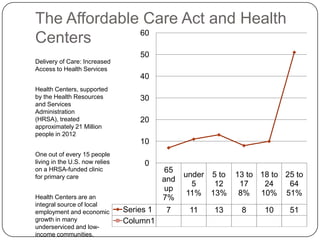
Delivery of Care: Increased
Access to Health Services
Health Centers, supported
by the Health Resources
and Services
Administration
(HRSA), treated
approximately 21 Million
people in 2012
One out of every 15 people
living in the U.S. now relies
on a HRSA-funded clinic
for primary care
Health Centers are an
integral source of local
employment and economic
growth in many
underserviced and low-
income communities.
65
and
up
7%
under
5
11%
5 to
12
13%
13 to
17
8%
18 to
24
10%
25 to
64
51%
Series 1 7 11 13 8 10 51
Column1
0
10
20
30
40
50
60
The ACA: Essential Role of
Community Health Centers
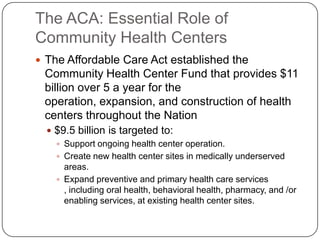
 The Affordable Care Act established the
Community Health Center Fund that provides $11
billion over 5 a year for the
operation, expansion, and construction of health
centers throughout the Nation
 $9.5 billion is targeted to:
 Support ongoing health center operation.
 Create new health center sites in medically underserved
areas.
 Expand preventive and primary health care services
, including oral health, behavioral health, pharmacy, and /or
enabling services, at existing health center sites.
The ACA: Essential Role of
Community Health Centers
 $1.5 billion will support major construction and
renovation projects at community health centers
nationwide.
ACA and Health Centers
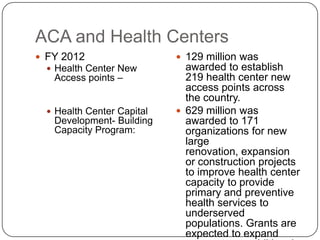
 FY 2012
 Health Center New
Access points –
 Health Center Capital
Development- Building
Capacity Program:
 129 million was
awarded to establish
219 health center new
access points across
the country.
 629 million was
awarded to 171
organizations for new
large
renovation, expansion
or construction projects
to improve health center
capacity to provide
primary and preventive
health services to
underserved
populations. Grants are
expected to expand
ACA and Health Centers
 Health Center Capital
Development –
Immediate Facility
Improvement
Program:
 99 million was
awarded to 227
organizations for new
construction and
renovation projects to
help support health
center efforts to
address immediate
facility needs within
existing sites that are
providing primary and
preventive health
services.
ACA and Health Centers
FY 2013, through the ACA, the Health Center
Program will award the following new funding
Health Center Controlled
Networks:
 18 million was awarded
in December 2012 to 37
network organizations
to support the adoption
and meaningful use of
EHR’s, and the other
HIT to improve quality in
health centers. These
networks must include
at least 10 Health
Center Program
grantees and overall will
provide support to more
than 600 health centers
nationwide.
ACA and Health Centers
FY 2013, through the ACA, the Health Center
Program will award the following new funding
 Health Center Outreach
and Enrollment
Assistance
supplemental funding
opportunity:
 HRSA awarded 150
million in early July to
1,159 health centers in
support of outreach and
enrollment activities
nationwide. The
outreach efforts are to
be in line through
Insurance
Marketplaces, Medicaid
or the Children’s Health
Insurance Program, as
well as other federal
efforts such as the
Navigator program, as
well as state consumer
assistance efforts.
ACA and Health Centers
FY 2013, through the ACA, the Health Center
Program will award the following new funding
 Health Center New
Access Points:
 19 Million will be
awarded to help
establish 25 new
health center access
points. Grants will
support new full-time
service delivery sites
for provision of
comprehensive
primary and
preventive health care
services. HRSA
anticipates
ACA and Health Centers
FY 2013, through the ACA, the Health Center
Program will award the following new funding
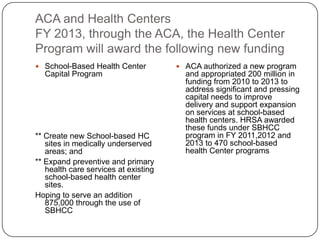
 School-Based Health Center
Capital Program
** Create new School-based HC
sites in medically underserved
areas; and
** Expand preventive and primary
health care services at existing
school-based health center
sites.
Hoping to serve an addition
875,000 through the use of
SBHCC
 ACA authorized a new program
and appropriated 200 million in
funding from 2010 to 2013 to
address significant and pressing
capital needs to improve
delivery and support expansion
on services at school-based
health centers. HRSA awarded
these funds under SBHCC
program in FY 2011,2012 and
2013 to 470 school-based
health Center programs
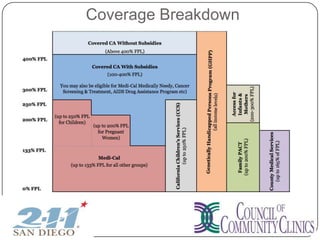
Coverage Breakdown
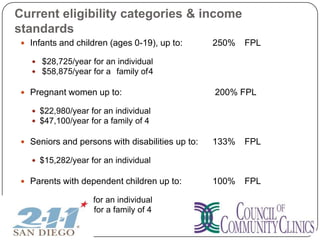
Current eligibility categories & income
standards
 Infants and children (ages 0-19), up to: 250% FPL
 $28,725/year for an individual
 $58,875/year for a family of4
 Pregnant women up to: 200% FPL
 $22,980/year for an individual
 $47,100/year for a family of 4
 Seniors and persons with disabilities up to: 133% FPL
 $15,282/year for an individual
 Parents with dependent children up to: 100% FPL
 $11,170/year for an individual
 $23,550/year for a family of 4
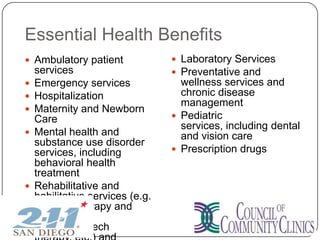
Essential Health Benefits
 Ambulatory patient
services
 Emergency services
 Hospitalization
 Maternity and Newborn
Care
 Mental health and
substance use disorder
services, including
behavioral health
treatment
 Rehabilitative and
habilitative services (e.g.
physical therapy and
occupational
therapy, speech
 Laboratory Services
 Preventative and
wellness services and
chronic disease
management
 Pediatric
services, including dental
and vision care
 Prescription drugs
 Transitions of care – hospital to ED to primary care
medical home
 Prevention of chronic disease - promoting effective
prevention strategies and evidence-based treatment
of chronic disease
 Patient centered care and engaging patient and
families in care
 Improved patient experience
 Reduced hospital readmissions and ED utilization
 Improved care coordination across the continuity of
care - promoting effective communication and
coordination of care across providers
 Increased focus on measurement and improvement
of clinical outcomes
 Meaningful use of health information technology –
for example, use of technology to identify high
utilizers of care to target cost effective interventions
Effect on our population
The Law will help the issue of disparities in access
to care.
 Increase access to quality affordable health
coverage.
 Invest in prevention and wellness and give
individuals more control over their care.
 Latinos suffer from certain illnesses at higher
levels than other groups.
 E.g. Obesity, Diabetes heart disease, Cervical
cancer screening.
 Only 46.5 of Latinos received Colorectal cancer
screening compared to 59.9 non Latinos.
Resources
 Council of Community Clinics
 HRSA – www.hrsa.com

AHF ACA Workshop: Dr. Haig, Clinicas de Salud del Pueblo

  • 1.
    Afshan N. Baig,M.D., F.A.A.P. Chief Medical Officer Clinicas De Salud Del Pueblo, Inc. ACA from the Clinical Perspective
  • 2.
    Introduction For more than45 years, health centers have delivered comprehensive, high-quality preventive and primary health care to patients regardless of their ability to pay. During the at time, health centers have become the essential primary care medical home for millions for Americans including some of the nation’s most vulnerable populations. With a proven track record of success, health centers will play a key role in implementation of the Affordable Care Act.
  • 3.
    The Essential Role Health Centers  Will play an essential Role in implementation of ACA  Those who emphasize coordinated primary and preventive services or a “medical home” that promotes reductions in health disparities for low-income individuals, racial and ethic minorities, rural communities and other underserved populations.
  • 4.
    The Affordable CareAct and Health Centers Delivery of Care: Increased Access to Health Services Health Centers, supported by the Health Resources and Services Administration (HRSA), treated approximately 21 Million people in 2012 One out of every 15 people living in the U.S. now relies on a HRSA-funded clinic for primary care Health Centers are an integral source of local employment and economic growth in many underserviced and low- income communities. 65 and up 7% under 5 11% 5 to 12 13% 13 to 17 8% 18 to 24 10% 25 to 64 51% Series 1 7 11 13 8 10 51 Column1 0 10 20 30 40 50 60
  • 5.
    The ACA: EssentialRole of Community Health Centers  The Affordable Care Act established the Community Health Center Fund that provides $11 billion over 5 a year for the operation, expansion, and construction of health centers throughout the Nation  $9.5 billion is targeted to:  Support ongoing health center operation.  Create new health center sites in medically underserved areas.  Expand preventive and primary health care services , including oral health, behavioral health, pharmacy, and /or enabling services, at existing health center sites.
  • 6.
    The ACA: EssentialRole of Community Health Centers  $1.5 billion will support major construction and renovation projects at community health centers nationwide.
  • 7.
    ACA and HealthCenters  FY 2012  Health Center New Access points –  Health Center Capital Development- Building Capacity Program:  129 million was awarded to establish 219 health center new access points across the country.  629 million was awarded to 171 organizations for new large renovation, expansion or construction projects to improve health center capacity to provide primary and preventive health services to underserved populations. Grants are expected to expand
  • 8.
    ACA and HealthCenters  Health Center Capital Development – Immediate Facility Improvement Program:  99 million was awarded to 227 organizations for new construction and renovation projects to help support health center efforts to address immediate facility needs within existing sites that are providing primary and preventive health services.
  • 9.
    ACA and HealthCenters FY 2013, through the ACA, the Health Center Program will award the following new funding Health Center Controlled Networks:  18 million was awarded in December 2012 to 37 network organizations to support the adoption and meaningful use of EHR’s, and the other HIT to improve quality in health centers. These networks must include at least 10 Health Center Program grantees and overall will provide support to more than 600 health centers nationwide.
  • 10.
    ACA and HealthCenters FY 2013, through the ACA, the Health Center Program will award the following new funding  Health Center Outreach and Enrollment Assistance supplemental funding opportunity:  HRSA awarded 150 million in early July to 1,159 health centers in support of outreach and enrollment activities nationwide. The outreach efforts are to be in line through Insurance Marketplaces, Medicaid or the Children’s Health Insurance Program, as well as other federal efforts such as the Navigator program, as well as state consumer assistance efforts.
  • 11.
    ACA and HealthCenters FY 2013, through the ACA, the Health Center Program will award the following new funding  Health Center New Access Points:  19 Million will be awarded to help establish 25 new health center access points. Grants will support new full-time service delivery sites for provision of comprehensive primary and preventive health care services. HRSA anticipates
  • 12.
    ACA and HealthCenters FY 2013, through the ACA, the Health Center Program will award the following new funding  School-Based Health Center Capital Program ** Create new School-based HC sites in medically underserved areas; and ** Expand preventive and primary health care services at existing school-based health center sites. Hoping to serve an addition 875,000 through the use of SBHCC  ACA authorized a new program and appropriated 200 million in funding from 2010 to 2013 to address significant and pressing capital needs to improve delivery and support expansion on services at school-based health centers. HRSA awarded these funds under SBHCC program in FY 2011,2012 and 2013 to 470 school-based health Center programs
  • 13.
  • 14.
    Current eligibility categories& income standards  Infants and children (ages 0-19), up to: 250% FPL  $28,725/year for an individual  $58,875/year for a family of4  Pregnant women up to: 200% FPL  $22,980/year for an individual  $47,100/year for a family of 4  Seniors and persons with disabilities up to: 133% FPL  $15,282/year for an individual  Parents with dependent children up to: 100% FPL  $11,170/year for an individual  $23,550/year for a family of 4
  • 15.
    Essential Health Benefits Ambulatory patient services  Emergency services  Hospitalization  Maternity and Newborn Care  Mental health and substance use disorder services, including behavioral health treatment  Rehabilitative and habilitative services (e.g. physical therapy and occupational therapy, speech  Laboratory Services  Preventative and wellness services and chronic disease management  Pediatric services, including dental and vision care  Prescription drugs
  • 16.
     Transitions ofcare – hospital to ED to primary care medical home  Prevention of chronic disease - promoting effective prevention strategies and evidence-based treatment of chronic disease  Patient centered care and engaging patient and families in care  Improved patient experience  Reduced hospital readmissions and ED utilization  Improved care coordination across the continuity of care - promoting effective communication and coordination of care across providers  Increased focus on measurement and improvement of clinical outcomes  Meaningful use of health information technology – for example, use of technology to identify high utilizers of care to target cost effective interventions
  • 17.
    Effect on ourpopulation The Law will help the issue of disparities in access to care.  Increase access to quality affordable health coverage.  Invest in prevention and wellness and give individuals more control over their care.  Latinos suffer from certain illnesses at higher levels than other groups.  E.g. Obesity, Diabetes heart disease, Cervical cancer screening.  Only 46.5 of Latinos received Colorectal cancer screening compared to 59.9 non Latinos.
  • 18.
    Resources  Council ofCommunity Clinics  HRSA – www.hrsa.com