        
UNIV 393, Tyler Hough
“Once   social change begins, it cannot
 be reversed. You cannot uneducate
 the person who has learned to read.
 You cannot humiliate the person who
 feels pride. You cannot oppress the
 people who are not afraid anymore.
 We have seen the future, and the
 future is ours.”
   Why it was created
    o For college students who wanted to learn of work effectively with
       other to create their own social change.
   A leader is not necessarily a person who holds some formal
    position of leadership or who is perceived as a leader by
    others. Rather, we regard a leader as one who is able to
    effect positive change for the betterment of others, the
    community, and society.”
    ~ The authors on the social change
   In USGA, we all have formal roles, but many times on the
    committee level we adopt informal roles to achieve the task at
    hand.
   Plays a prominent role in shaping the curriculum and formats
    of undergraduate leadership.
   The Group identified refers to themselves as an ensemble.
   The individuals make up the group.
   The individuals wants, needs, and thoughts are different than
    the over all group, even though their opinions make up that of
    the group.
   The many voices contribute to the varying needs of the goal
    of the group.
   The USGA is comprised of an eclectic group of students. This
    gives us the opportunity to grow and learn from each other to
    better the students.
   The Social Change Model of Leadership Development
    approaches leadership as a purposeful, collaborative, values-
    based process that results in positive social change
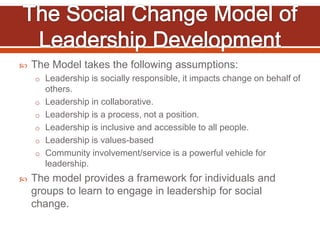
   The Model takes the following assumptions:
    o Leadership is socially responsible, it impacts change on behalf of
        others.
    o   Leadership in collaborative.
    o   Leadership is a process, not a position.
    o   Leadership is inclusive and accessible to all people.
    o   Leadership is values-based
    o   Community involvement/service is a powerful vehicle for
        leadership.
   The model provides a framework for individuals and
    groups to learn to engage in leadership for social
    change.
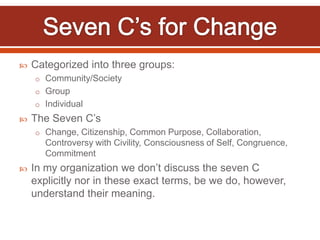
   Categorized into three groups:
    o Community/Society
    o Group
    o Individual
   The Seven C’s
    o Change, Citizenship, Common Purpose, Collaboration,
       Controversy with Civility, Consciousness of Self, Congruence,
       Commitment
   In my organization we don’t discuss the seven C
    explicitly nor in these exact terms, be we do, however,
    understand their meaning.
   Citizenship
    o Requires all individuals to see themselves as part of the larger
      whole
   “Even if I knew that tomorrow would go to pieces, I would
    still plant my apple tree.” ~ MLK Jr.
   Leadership for the greater, over one’s own interests
   Encompasses all communities: the campus, the
    country, the state, or the world.
   Crucial that leadership be connected to a larger social
    purpose.
   As student leaders, we put the interests of our
    constituencies above our own.
   While the size of a community varies, individuals often
    times find themselves members of multiple community
    groups.
   Leadership for social change happens at the group level:
    student organization, a group of colleagues or friends, or
    a sports team.
   Three areas that affect leadership ability:
    o Come to Common Purpose
    o Engage in Collaboration with others
    o Embrace Controversy with Civility
   “No journey carries one far unless, as it extends into the
    world around us, it goes an equal distance into the world
    within.” ~ Lillian Smith
   Consciousness of Self
   Congruence
   Commitment
   In order to help and benefit the groups and societies, the
    leadership transformation needs to happen on an
    individual level.
   One needs to look inside and reflect upon their what they
    value as a leader and
   The values at this level include developing a
    consciousness of self, being congruent with one’s
    beliefs, and making commitments that follow those
    beliefs
   This is very applicable to my organization because we
    need to learn what type of leader and what we stand for
    before we try to help others.
   The Social Change Model approaches leadership in a
    way that appreciates dynamic, collaborative, and values-
    based learning. This model was designed with the
    college student in mind. It was to help the college leader
    be better and allow he/she to create change and further
    personal development. The ethics and values associated
    in this model (the 7 C’s) play a critical role in college
    based leadership. Each “C” allows the individual to grow
    both personally and professionally. It helps them help
    both themselves, and the community at large. This gives
    my organization the tools to succeed and greater benefit
    the student body.

The Social Change Model

  • 1.
     UNIV 393, Tyler Hough
  • 2.
    “Once social change begins, it cannot be reversed. You cannot uneducate the person who has learned to read. You cannot humiliate the person who feels pride. You cannot oppress the people who are not afraid anymore. We have seen the future, and the future is ours.”
  • 3.
    Why it was created o For college students who wanted to learn of work effectively with other to create their own social change.  A leader is not necessarily a person who holds some formal position of leadership or who is perceived as a leader by others. Rather, we regard a leader as one who is able to effect positive change for the betterment of others, the community, and society.” ~ The authors on the social change  In USGA, we all have formal roles, but many times on the committee level we adopt informal roles to achieve the task at hand.  Plays a prominent role in shaping the curriculum and formats of undergraduate leadership.
  • 4.
    The Group identified refers to themselves as an ensemble.  The individuals make up the group.  The individuals wants, needs, and thoughts are different than the over all group, even though their opinions make up that of the group.  The many voices contribute to the varying needs of the goal of the group.  The USGA is comprised of an eclectic group of students. This gives us the opportunity to grow and learn from each other to better the students.  The Social Change Model of Leadership Development approaches leadership as a purposeful, collaborative, values- based process that results in positive social change
  • 5.
    The Model takes the following assumptions: o Leadership is socially responsible, it impacts change on behalf of others. o Leadership in collaborative. o Leadership is a process, not a position. o Leadership is inclusive and accessible to all people. o Leadership is values-based o Community involvement/service is a powerful vehicle for leadership.  The model provides a framework for individuals and groups to learn to engage in leadership for social change.
  • 6.
    Categorized into three groups: o Community/Society o Group o Individual  The Seven C’s o Change, Citizenship, Common Purpose, Collaboration, Controversy with Civility, Consciousness of Self, Congruence, Commitment  In my organization we don’t discuss the seven C explicitly nor in these exact terms, be we do, however, understand their meaning.
  • 7.
    Citizenship o Requires all individuals to see themselves as part of the larger whole
  • 8.
    “Even if I knew that tomorrow would go to pieces, I would still plant my apple tree.” ~ MLK Jr.  Leadership for the greater, over one’s own interests  Encompasses all communities: the campus, the country, the state, or the world.  Crucial that leadership be connected to a larger social purpose.  As student leaders, we put the interests of our constituencies above our own.
  • 9.
    While the size of a community varies, individuals often times find themselves members of multiple community groups.  Leadership for social change happens at the group level: student organization, a group of colleagues or friends, or a sports team.  Three areas that affect leadership ability: o Come to Common Purpose o Engage in Collaboration with others o Embrace Controversy with Civility
  • 10.
    “No journey carries one far unless, as it extends into the world around us, it goes an equal distance into the world within.” ~ Lillian Smith  Consciousness of Self  Congruence  Commitment
  • 11.
    In order to help and benefit the groups and societies, the leadership transformation needs to happen on an individual level.  One needs to look inside and reflect upon their what they value as a leader and  The values at this level include developing a consciousness of self, being congruent with one’s beliefs, and making commitments that follow those beliefs  This is very applicable to my organization because we need to learn what type of leader and what we stand for before we try to help others.
  • 12.
    The Social Change Model approaches leadership in a way that appreciates dynamic, collaborative, and values- based learning. This model was designed with the college student in mind. It was to help the college leader be better and allow he/she to create change and further personal development. The ethics and values associated in this model (the 7 C’s) play a critical role in college based leadership. Each “C” allows the individual to grow both personally and professionally. It helps them help both themselves, and the community at large. This gives my organization the tools to succeed and greater benefit the student body.