Food Production Sarah Marshall Honors Capstone
2005 United Nations Millennium Ecosystem Assessment “ Agriculture may be the largest threat to biodiversity and ecosystem function of any single human activity.”
World Hunger 12 preschool children  in developing countries  die every minute  from hunger and malnutrition  5 million children under 5 years of age die each year The cost of childhood diseases in developing countries account for  20-25% of their economic budgets
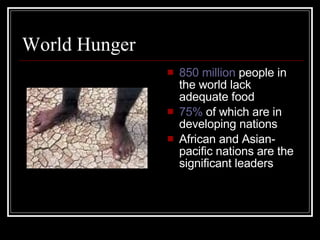
World Hunger 850 million  people in the world lack adequate food 75%  of which are in developing nations African and Asian-pacific nations are the significant leaders
Food Security  Is the ability of individuals to obtain sufficient food on a day-to-day basis More than  6 million people  rely on food grown on 11% of the earth  Out of this 11% only  3% is fertile soil
Our Agriculture A gallon of oil = one pound of beef 2500 gallons of water = one pound of beef Cows defecate 65 pounds per day 10 pounds of grain yields one pound of cow
Our Agriculture  16%  of greenhouse gasses come from our agriculture 1 billion pounds  of pesticides are used  each   year $14 billion a year are given to industrial farmers Farm run-off had poisoned ground water in 17 states and polluted  35,000 miles  of rivers
Soil 25 billion  tons of soil are lost annually in the US alone This is the area size of the US and Canada Renewable, develops from underlying parent material but takes  500 years  in order to be useable
Soil Solutions Minimum Tillage Leaves crop residues on land Greatly reduces soil erosion Only used on 38% of US cropland Cover Crops Sustainable tools to manage soil fertility, soil quality, water, weeds, pests, diseases, and increasing diversity and wildlife “ Green manures” Leguminous
Agriculture Pollution Heating animal homes Fertilizers Fuel and emissions from tractors Fuel to make tractors Fuel used in grain production Fuel used to dry grain Transportation / distribution to supermarkets Driving to supermarkets and driving home Using energy to prepare food for consumption
Possible Solutions Organic Farming On the rise Green Revolution Used successfully in Mexico and India Genetically Modified Golden rice
Organic Less than 1% of the US is organic farming Can support local demands; buy local Labor intensive: can create jobs Must have special certification  Since the early 1900s organic food production has growth rates of 20% a year in developed and developing nations April 2008 organic food accounts of 1-2% food sales worldwide
Green Revolution  Started after WWII and was funded by the Rockefeller Foundation  Worldwide effort to improve the productivity of wheat and rice by selecting the high yield varieties First used in Mexico then India adopted the same strategies Numerous attempts to implement in Africa but unsuccessful due to: Widespread corruption Insecurity Lack of infrastructure Lack of governmental concern Availability of water for irrigation Diversity of soil types Inability to place rice in the farmer’s hands
Continuing the Green Revolution by Borlaug in 2007  The Wall Street Journal Tools of biotechnology to meet demands for food, feed, fiber, and biofuels Plant breeders have problems with: Saline conditions Resisting diseases and insects Droughts and water logging Distressed climates
Bittersweet Harvest by Hsin in 2002  Harvard International Review Genetically modified (GM) crops Recently FDA reconsidered policies; in the past allergenicity safety tests were not mandated For almost a decade the US government made no distinction between GM crops and organically grown crops Could wipeout hunger; especially in countries such as India where the population grows by 20 million every year Most potent risk of GM crops: uncontrolled breeding and introduction of foreign genes into the natural ecosystem
Deflating the World’s Bubble Economy by Brown in 2003  USA Today Magazine   Food is the most vulnerable sector National security threats Terrorists treats Worldwide  More than 100 countries import wheat and 40 import rice Only 6 countries supply 90% of grain: US, Canada, France, Australia, Argentina, and Thailand World’s poor spends 70% of income on food
World’s Bubble Economy Climate change The highest temperatures in 11,000 years Exhausted soils Widespread aquifer depletion Loss of irrigation water unknown to previous generations Natural disasters Destructive storms Deadly heat waves Collapsing fisheries Melting of polar ice caps
Will the World Be Able to Feed Itself in the Foreseeable Future? 2006 FAO reported food demand growth will rise 1.5% each year for the next 30 years Future problems include: Producing enough food for 67% of population Ridding of chronic malnutrition to world’s poor
Will the World Be Able to Feed Itself in the Foreseeable Future? YES Global food production can keep pace with hunger via policies set in place by governments and organizations NO Decreasing grain harvests, growing populations, dwindling fisheries and the continuing problem of poverty
The Great Debate Topic: Universal Standards of Living and Global Sustainability
The Great Debate Basic  human entitlements  should be: Food Water Health  Energy
The Great Debate Question 1: The effects and influences of technology on  human entitlements . Will it save or kill us?
The Great Debate Question 1 Pro Is technology the solution? Water Desalination Reverse osmosis Distilment Alternative energy GM food Con  Is technology the problem? Pollution Climate change Rain forests  Dirty drinking water Garbage in the oceans World hunger
The Great Debate Question 2: The incentives for improving  human entitlements . Capitalism or intrinsic motivators?
The Great Debate Question 2 Pro Better incentives to work toward solutions. Little money now compared to lots of money later War is bad Problems grow and spread Disease to plagues Hunger to starvation Con Are profits the only motivators that will last and truly work? Government and organizational programs come and go Mankind is greedy
References Borlaug, Norman, E (2008). Continuing the green revolution.  Global Issues ,  24 , 39-40. Brown, Lester, R (2008). Deflating the world’s bubble economy.  Global Issues, 24,  46-48.  Gulnick, Jeanne (2008). Ecology class.  Saint Joseph’s College of Maine. Standish, ME.  Hart, J. E. & Lombardi, M. O (2009).  Will the world be able to feed itself in the foreseeable future?  Taking Sides, 5,  112-127. Hsin, Honor (2008). Bittersweet harvest.  Global Issues, 24,  41-43.

Food Production

  • 1.
    Food Production SarahMarshall Honors Capstone
  • 2.
    2005 United NationsMillennium Ecosystem Assessment “ Agriculture may be the largest threat to biodiversity and ecosystem function of any single human activity.”
  • 3.
    World Hunger 12preschool children in developing countries die every minute from hunger and malnutrition 5 million children under 5 years of age die each year The cost of childhood diseases in developing countries account for 20-25% of their economic budgets
  • 4.
    World Hunger 850million people in the world lack adequate food 75% of which are in developing nations African and Asian-pacific nations are the significant leaders
  • 5.
    Food Security Is the ability of individuals to obtain sufficient food on a day-to-day basis More than 6 million people rely on food grown on 11% of the earth Out of this 11% only 3% is fertile soil
  • 6.
    Our Agriculture Agallon of oil = one pound of beef 2500 gallons of water = one pound of beef Cows defecate 65 pounds per day 10 pounds of grain yields one pound of cow
  • 7.
    Our Agriculture 16% of greenhouse gasses come from our agriculture 1 billion pounds of pesticides are used each year $14 billion a year are given to industrial farmers Farm run-off had poisoned ground water in 17 states and polluted 35,000 miles of rivers
  • 8.
    Soil 25 billion tons of soil are lost annually in the US alone This is the area size of the US and Canada Renewable, develops from underlying parent material but takes 500 years in order to be useable
  • 9.
    Soil Solutions MinimumTillage Leaves crop residues on land Greatly reduces soil erosion Only used on 38% of US cropland Cover Crops Sustainable tools to manage soil fertility, soil quality, water, weeds, pests, diseases, and increasing diversity and wildlife “ Green manures” Leguminous
  • 10.
    Agriculture Pollution Heatinganimal homes Fertilizers Fuel and emissions from tractors Fuel to make tractors Fuel used in grain production Fuel used to dry grain Transportation / distribution to supermarkets Driving to supermarkets and driving home Using energy to prepare food for consumption
  • 11.
    Possible Solutions OrganicFarming On the rise Green Revolution Used successfully in Mexico and India Genetically Modified Golden rice
  • 12.
    Organic Less than1% of the US is organic farming Can support local demands; buy local Labor intensive: can create jobs Must have special certification Since the early 1900s organic food production has growth rates of 20% a year in developed and developing nations April 2008 organic food accounts of 1-2% food sales worldwide
  • 13.
    Green Revolution Started after WWII and was funded by the Rockefeller Foundation Worldwide effort to improve the productivity of wheat and rice by selecting the high yield varieties First used in Mexico then India adopted the same strategies Numerous attempts to implement in Africa but unsuccessful due to: Widespread corruption Insecurity Lack of infrastructure Lack of governmental concern Availability of water for irrigation Diversity of soil types Inability to place rice in the farmer’s hands
  • 14.
    Continuing the GreenRevolution by Borlaug in 2007 The Wall Street Journal Tools of biotechnology to meet demands for food, feed, fiber, and biofuels Plant breeders have problems with: Saline conditions Resisting diseases and insects Droughts and water logging Distressed climates
  • 15.
    Bittersweet Harvest byHsin in 2002 Harvard International Review Genetically modified (GM) crops Recently FDA reconsidered policies; in the past allergenicity safety tests were not mandated For almost a decade the US government made no distinction between GM crops and organically grown crops Could wipeout hunger; especially in countries such as India where the population grows by 20 million every year Most potent risk of GM crops: uncontrolled breeding and introduction of foreign genes into the natural ecosystem
  • 16.
    Deflating the World’sBubble Economy by Brown in 2003 USA Today Magazine Food is the most vulnerable sector National security threats Terrorists treats Worldwide More than 100 countries import wheat and 40 import rice Only 6 countries supply 90% of grain: US, Canada, France, Australia, Argentina, and Thailand World’s poor spends 70% of income on food
  • 17.
    World’s Bubble EconomyClimate change The highest temperatures in 11,000 years Exhausted soils Widespread aquifer depletion Loss of irrigation water unknown to previous generations Natural disasters Destructive storms Deadly heat waves Collapsing fisheries Melting of polar ice caps
  • 18.
    Will the WorldBe Able to Feed Itself in the Foreseeable Future? 2006 FAO reported food demand growth will rise 1.5% each year for the next 30 years Future problems include: Producing enough food for 67% of population Ridding of chronic malnutrition to world’s poor
  • 19.
    Will the WorldBe Able to Feed Itself in the Foreseeable Future? YES Global food production can keep pace with hunger via policies set in place by governments and organizations NO Decreasing grain harvests, growing populations, dwindling fisheries and the continuing problem of poverty
  • 20.
    The Great DebateTopic: Universal Standards of Living and Global Sustainability
  • 21.
    The Great DebateBasic human entitlements should be: Food Water Health Energy
  • 22.
    The Great DebateQuestion 1: The effects and influences of technology on human entitlements . Will it save or kill us?
  • 23.
    The Great DebateQuestion 1 Pro Is technology the solution? Water Desalination Reverse osmosis Distilment Alternative energy GM food Con Is technology the problem? Pollution Climate change Rain forests Dirty drinking water Garbage in the oceans World hunger
  • 24.
    The Great DebateQuestion 2: The incentives for improving human entitlements . Capitalism or intrinsic motivators?
  • 25.
    The Great DebateQuestion 2 Pro Better incentives to work toward solutions. Little money now compared to lots of money later War is bad Problems grow and spread Disease to plagues Hunger to starvation Con Are profits the only motivators that will last and truly work? Government and organizational programs come and go Mankind is greedy
  • 26.
    References Borlaug, Norman,E (2008). Continuing the green revolution. Global Issues , 24 , 39-40. Brown, Lester, R (2008). Deflating the world’s bubble economy. Global Issues, 24, 46-48. Gulnick, Jeanne (2008). Ecology class. Saint Joseph’s College of Maine. Standish, ME. Hart, J. E. & Lombardi, M. O (2009). Will the world be able to feed itself in the foreseeable future? Taking Sides, 5, 112-127. Hsin, Honor (2008). Bittersweet harvest. Global Issues, 24, 41-43.