Agribusiness: A Perspective 
Wilfred E. Jamandre 
Department of Agribusiness Management 
Central Luzon State University 
Science City of Muñoz, Nueva Ecija 
Agribusiness: A Definition 
In 1957, John Davis and Ray Goldberg, two Harvard Economists, coined 
the term "Agribusiness"1. They believed that the concept of agriculture as 
industry had, in 1957, already existed for over 150 years --when a typical 
family would not only grow and raise food but also produce and use the means 
necessary for this production i.e., draft animals, tools, fertilizers, processing 
and retailing. In other words, agribusiness encompasses all enterprises that 
take place inside and outside the farm gate, bringing products from the field to 
the consumers. Agribusiness consisted not only of food production by itself, 
but included other processes such as generation or acquisition of production 
inputs, use of farm produce in different forms through processing and trading 
of farm products. Hence, there begun a “specialization” into different aspects 
of the agricultural industry process. However, each of these parts relies on the 
entire process, such that, one can not function without the rest. 
And thus in 1957 Goldberg and Davis defined agribusiness as "the sum 
total of all operations involved in the manufacture and distribution of farm 
supplies; production operations on the farm; and the storage, processing and 
distribution of farm commodities and items made from them." 
Agribusiness, therefore, literally includes all enterprises derived FROM 
and AROUND agricultural production2. The emphasis on the phrase “from and 
1 Heather Ruhsam & Jason Hutchins. Definition of Agribusiness. 
www.ils.unc.edu/~hutcr/definition.html 
2 In this sense, agriculture includes crop production, livestock production, forestry and 
fisheries. 
Page 1 of 12
around” connotes a whole range of possibilities from the production of farm 
inputs (including farm equipment and machineries) until commodities, in their 
various forms, reach the end consumers. Agribusiness encompasses many 
aspects of the economy, including agricultural producers (farmers and livestock 
raisers); businesses that provide supplies and services to the producers, 
businesses that add value to agricultural products (processors), and those that 
facilitate the marketing of agricultural products. 
Agribusiness: The Concept 
In essence, agribusiness consists of all industries surrounding food 
production, ultimate end-user is the consumer, with marketing as the driving 
force behind all profitable activities. With this in mind, there are basically 
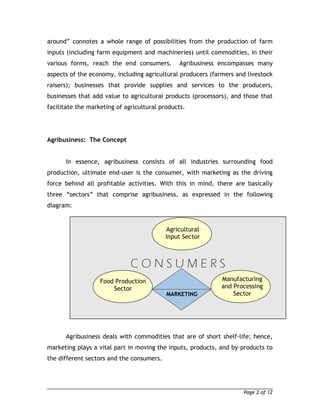
three “sectors” that comprise agribusiness, as expressed in the following 
diagram: 
Agribusiness deals with commodities that are of short shelf-life; hence, 
marketing plays a vital part in moving the inputs, products, and by-products to 
the different sectors and the consumers. 
Page 2 of 12 
C O N S U M E R S 
Food Production 
Sector 
Agricultural 
Input Sector 
Manufacturing 
and Processing 
MARKETING Sector
Agribusiness: A System of systems 
Agribusiness is a system of interrelated and closely knit stages in the life 
cycle of an agricultural consumer product. As stated by Custodio3 agribusiness 
encompasses all operations involved in the production of farm inputs, the use 
of these farm inputs in the cultivation of crops or raising of livestock, the 
various handling and processing of agricultural commodities, and the transfer 
of these commodities to the end-users. Interspersed among these operations 
are the various support services that provide “logistics, coordination, financing, 
manpower, technology, information, policies and programs, incentives and 
other services” that lead to the achievement of a successful agricultural 
business enterprise. 
Cited earlier are the five major areas that are also subsystems making 
up the whole agribusiness System. 
The input subsystem: This is the first subsystem from which all other 
agribusiness subsystems emanate. Here, all inputs (e.g. 
fertilizers, seeds, machineries, etc) are manufactured, 
imported or distributed. 
The production subsystem: Inputs are directly used for the production of an 
agricultural commodity as end-product in itself or as a 
raw material for the production of other products. 
The processing subsystem: The commodities from the production subsystem 
are transformed into various products. The levels of 
transformation depend upon the level of processing4, 
3 Custodio, HC Jr. Agribusiness Concepts and Dimension: Some Applications. 
4 Dy, Rolando T. A Concept of Agribusiness 
Page 3 of 12
which can be as simple as washing and grading to as 
complex as chemical alteration. 
The marketing subsystem: This subsystem is concerned with the transfer of 
goods from source to end-user. It includes all handling 
procedures and infrastructures that move the 
commodities from one point to another. The marketing 
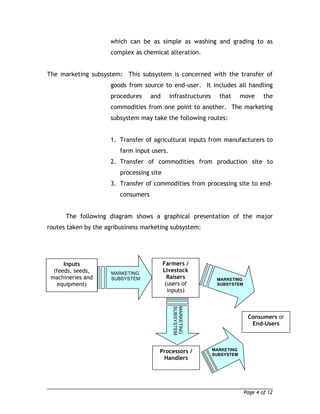
subsystem may take the following routes: 
1. Transfer of agricultural inputs from manufacturers to 
farm input users. 
2. Transfer of commodities from production site to 
processing site 
3. Transfer of commodities from processing site to end-consumers 
The following diagram shows a graphical presentation of the major 
routes taken by the agribusiness marketing subsystem: 
Page 4 of 12 
MARKETING 
SUBSYSTEM MARKETING 
SUBSYSTEM 
MARKETING 
SUBSYSTEM 
Inputs 
(feeds, seeds, 
machineries and 
equipment) 
Farmers / 
Livestock 
Raisers 
(users of 
inputs) 
Consumers or 
End-Users 
MARKETING 
SUBSYSTEM 
Processors / 
Handlers
The Support Subsystem: consists of all the key players that provide services, 
however, optional, but crucial to the success of an 
agribusiness venture. These services are provided by 
institutions such as government agencies, commercial 
associations, credit and financing, research organizations 
and cooperatives. 
The government plays an important role in providing a policy 
environment that is favorable to agribusiness enterprises such as policies on 
prices, imports, exports and general trading. 
As cited by Gallegos5, these subsystems are very much interrelated in 
such a way that one subsystem can not be taken independently from the other. 
The success of any agribusiness venture depends on how well coordinated and 
complementary these are. 
For example, an individual contemplating on establishing an agribusiness 
venture such as the establishment of a wholesale and retail distribution of 
agricultural supplies should consider the existing agricultural production 
enterprises in the area. This implies a careful consideration of the users of 
farm inputs (the farmers), the extent of farming activities (agricultural 
production), existing marketing services and practices (cooperatives, credit 
and financing) and the movement of inputs from sources to users. 
5 Gallegos, Jesus G. The Concept of Agribusiness. 
Page 5 of 12
Agriculture vs Agribusiness: As fields of study 
Agriculture 
Agriculture is essentially concerned with food production. 
As broad a field as it is, agriculture is split up in to diverse interests such 
as study on the life processes of plants, animals and microorganisms in order 
produce food for humans and animals. It includes specific studies and 
specializations on soil science (including soil nutrients and conservation), plant 
and animal protection from diseases, irrigation and water management, dairy 
and meat production, and related fields of study such as horticulture, 
agronomy and farming systems. However, not everything is biology. 
Agriculture includes an understanding of interrelationships of infrastructures, 
machines, new technology and systems that facilitate food production. 
At present, there is great emphasis placed on sustainable agriculture and 
environment friendly methods of production. This is due to the realization that 
natural resources are limited and finite. A great concern is being placed on 
conservation and wise utilization of resources so that human needs could be 
supported for all future generations, without sacrificing quality and food 
safety. 
Agribusiness 
As a field of study, agribusiness is both an art and a science of managing 
an agricultural business enterprise. The programs for the study of agribusiness 
provide an in-depth understanding of the industries that produce, process, and 
distribute agricultural products. It studies the different sectors starting from 
the production unit (e.g. farms) to the ultimate consumer. Interrelationships 
Page 6 of 12
of the different sectors involved in the production of agricultural commodities 
are studied; including regional, national, and international interdependencies 
of the agricultural sector. 
Agribusiness, integrates business management principles with the 
technical knowledge of the managerial challenges of the agricultural sector 
from actual production to consumer acceptances. 
An art: . Agribusiness puts together the various skills of an individual or 
organization, in running a profitable venture. It is a creative 
undertaking that plays along with the rapid changing economic 
environment putting to test the risk-taking ability of an 
individual or an organization that engages in an agribusiness 
enterprise 
A science: Risk-taking is backed up by an objective gathering and 
analysis of data and information. Current trends, production 
and marketing issues, human resources management and 
financing and accounting are logically converted into strategic 
business plans. 
Students in the field of agribusiness are exposed to various situations 
(both real and hypothetical), through “case studies”, which allow them to gain 
knowledge and skills that set them apart from the basic sciences of agriculture 
and the broad scope of management. 
At the Central Luzon State University, the Agribusiness Program includes 
coursework on different fields, that sufficiently prepare students for an 
agribusiness undertaking. The following are the major areas of emphasis in the 
Agribusiness field of study: 
Page 7 of 12
a. agricultural economics and marketing 
b. analysis of agribusiness enterprises/agribusiness management/project 
development and management 
c. agricultural finance and quantitative methods in business 
d. agribusiness laws and policies 
e. agricultural business organizations (e.g. cooperatives) 
Management aspect of Agribusiness 
Agribusiness is a commercial activity engaged in as a means of livelihood 
or profit. As such, like any commercial enterprise, agribusiness is expected to 
make money, or create desired impact; otherwise, there is no sense in getting 
into the business. 
Management is a built-in function of agribusiness. Management is 
essentially a decision-making process based on information and experience, in 
order to achieve desired goals and objectives. Agribusiness management 
therefore is a dynamic decision-making process revolving around an agricultural 
business enterprise. 
Whether the business is a farm family operation or an enterprise with 
hundreds of employees, agribusiness takes into consideration an individual’s or 
organization’s ability to receive and process information in order to devise 
competitive strategies that lead to a profitable and sustainable undertaking, 
amidst the rapid changes in the economic environment. 
The many considerations of agribusiness management includes 
technology know-how, sources of inputs and raw materials, financing, local and 
international awareness of trends in agricultural market and marketing, 
Page 8 of 12
agricultural products and by-products trends and innovations, and a degree of 
knowledge of policy climate that affect the agricultural sector. 
With the current developments and trends in agribusiness (please refer 
to the next section), agribusiness employs sophisticated management 
techniques to survive a tightly competitive business world. These techniques 
includes, but not limited to, the following: 
1. Off-shore sourcing of raw materials, products, and by-products 
2. Improvements in packaging, postharvest handling and distribution 
systems 
3. Horizontal and vertical market integration6 
4. Tightly integrated agribusiness sub-systems, where agribusiness 
enterprises are consumer-driven; strategic involvement of customers 
from the initial steps of product development to the final utilization of 
the consumer product. 
5. Use of E-commerce format (e.g. use of the world wide web in input 
procurement, establishment of supply chains, commodity marketing, 
communication, and information gathering ) 
Agribusiness: New Developments and Trends 
The new millennium can be described as a communications technology 
age. As such, agriculture is faced with a climate of unprecedented change, 
both in communication needs and in the technology within which this 
communication takes place (hardware and applications, biotechnology, global 
information and business network). 
6 Items 3 and 4 from Jamandre, W.E lectures. AB 740 – Advanced Marketing. SY 2003-2004. 
Page 9 of 12
Each sector in agriculture (producers, agribusiness, environmental 
organizations/public institutions), is a developer, a communicator and a user of 
information, which creates a new, open, multi-directional information 
environment.7 
As such, agribusiness keeps abreast with the new modalities in carrying 
out a business venture. An example is a computer-based agribusiness, where 
products and ideas are exchanged through interactive electronic transactions. 
One innovative agribusiness company has come up with a trendy name, 
patterned after e-commerce. This is known as “e-Agribiz” (short for e- 
Agribusiness), where transactions can be undertaken through its word wide web 
at http://www.agribusiness.org/eagribiz.htm.8 
With these developments in the communications technology, the world 
is fast becoming a one big marketplace where agribusiness plays a major role in 
the economies of third world agricultural countries. 
The important developments in agribusiness include the following9: 
1. trade barriers 
2. food safety specifications 
3. good agricultural practices (social and environmental sustainability) 
4. Genetically Modified Organisms (biotechnology) 
5. organic products 
6. evolution of imports and exports for agricultural and food products 
7. productivity evolution 
8. comparative costs 
7 Francis, Charles, James King, Jerry DeWitt, James Bushnell, and Leo Lucas. "Participatory 
Strategies for Information Exchange" American Journal of Alternative Agriculture Vol. 5, No. 
4, 1990: 153-160. 
8 -Agribusiness. 5700 Ralston, Suite 310, Ventura, CA 93003. webmaster@agribusiness.org 
9 Farina, Elizabeth and de Azebedo, PauloF. Competitiveness and Coordination Under 
Institutional Change Environment: Public and Private Implications. Congress Forum Posters 
and Proposals. http://www.ifama.org/conferences/9/1999/1999. 
Page 10 of 12
9. changing demographics and population growth10 
10.changing demands in diet, wardrobes, etc. 
11.changing technological and regulatory settings 
12.increasing international competition 
13.trade barriers 
10 Items 7 to 10 are taken from: Peterson, Christopher and Scott Swinton. "Agribusiness 
Opportunities in the 21st Century" Choices , 1992, Third Quarter: 38-41. 
Page 11 of 12
References: 
Heather Ruhsam & Jason Hutchins. Definition of Agribusiness. 
www.ils.unc.edu/~hutcr/definition.html 
Custodio, HC Jr. Agribusiness Concepts and Dimension: Some Applications. 
From C.V.Velasco. 2003. Agribusiness Management Course Module. 
AB 710. Central Luzon State University. 
Dy, Rolando T. A Concept of Agribusiness. From C.V.Velasco. 2003. 
Agribusiness Management Course Module. AB 710. Central Luzon 
State University. 
e-Agribusiness. 5700 Ralston, Suite 310, Ventura, CA 93003. 
http://www.agribusiness.org/eagribiz.htm, 
webmaster@agribusiness.org 
Gallegos, Jesus G. The Concept of Agribusiness. From C.V.Velasco. 2003. 
Agribusiness Management Course Module. AB 710. Central Luzon 
State University. 
Francis, Charles, James King, Jerry DeWitt, James Bushnell, and Leo Lucas. 
"Participatory Strategies for Information Exchange" American Journal 
of Alternative Agriculture Vol. 5, No. 4, 1990: 153-160 
Farina, Elizabeth and de Azebedo, Paulo F. Competitiveness and Coordination 
Under Institutional Change Environment: Public and Private Implications. 
Congress Forum Posters and Proposals. 
http://www.ifama.org/conferences/9/1999/1999. 
Page 12 of 12

Agricultural business

  • 1.
    Agribusiness: A Perspective Wilfred E. Jamandre Department of Agribusiness Management Central Luzon State University Science City of Muñoz, Nueva Ecija Agribusiness: A Definition In 1957, John Davis and Ray Goldberg, two Harvard Economists, coined the term "Agribusiness"1. They believed that the concept of agriculture as industry had, in 1957, already existed for over 150 years --when a typical family would not only grow and raise food but also produce and use the means necessary for this production i.e., draft animals, tools, fertilizers, processing and retailing. In other words, agribusiness encompasses all enterprises that take place inside and outside the farm gate, bringing products from the field to the consumers. Agribusiness consisted not only of food production by itself, but included other processes such as generation or acquisition of production inputs, use of farm produce in different forms through processing and trading of farm products. Hence, there begun a “specialization” into different aspects of the agricultural industry process. However, each of these parts relies on the entire process, such that, one can not function without the rest. And thus in 1957 Goldberg and Davis defined agribusiness as "the sum total of all operations involved in the manufacture and distribution of farm supplies; production operations on the farm; and the storage, processing and distribution of farm commodities and items made from them." Agribusiness, therefore, literally includes all enterprises derived FROM and AROUND agricultural production2. The emphasis on the phrase “from and 1 Heather Ruhsam & Jason Hutchins. Definition of Agribusiness. www.ils.unc.edu/~hutcr/definition.html 2 In this sense, agriculture includes crop production, livestock production, forestry and fisheries. Page 1 of 12
  • 2.
    around” connotes awhole range of possibilities from the production of farm inputs (including farm equipment and machineries) until commodities, in their various forms, reach the end consumers. Agribusiness encompasses many aspects of the economy, including agricultural producers (farmers and livestock raisers); businesses that provide supplies and services to the producers, businesses that add value to agricultural products (processors), and those that facilitate the marketing of agricultural products. Agribusiness: The Concept In essence, agribusiness consists of all industries surrounding food production, ultimate end-user is the consumer, with marketing as the driving force behind all profitable activities. With this in mind, there are basically three “sectors” that comprise agribusiness, as expressed in the following diagram: Agribusiness deals with commodities that are of short shelf-life; hence, marketing plays a vital part in moving the inputs, products, and by-products to the different sectors and the consumers. Page 2 of 12 C O N S U M E R S Food Production Sector Agricultural Input Sector Manufacturing and Processing MARKETING Sector
  • 3.
    Agribusiness: A Systemof systems Agribusiness is a system of interrelated and closely knit stages in the life cycle of an agricultural consumer product. As stated by Custodio3 agribusiness encompasses all operations involved in the production of farm inputs, the use of these farm inputs in the cultivation of crops or raising of livestock, the various handling and processing of agricultural commodities, and the transfer of these commodities to the end-users. Interspersed among these operations are the various support services that provide “logistics, coordination, financing, manpower, technology, information, policies and programs, incentives and other services” that lead to the achievement of a successful agricultural business enterprise. Cited earlier are the five major areas that are also subsystems making up the whole agribusiness System. The input subsystem: This is the first subsystem from which all other agribusiness subsystems emanate. Here, all inputs (e.g. fertilizers, seeds, machineries, etc) are manufactured, imported or distributed. The production subsystem: Inputs are directly used for the production of an agricultural commodity as end-product in itself or as a raw material for the production of other products. The processing subsystem: The commodities from the production subsystem are transformed into various products. The levels of transformation depend upon the level of processing4, 3 Custodio, HC Jr. Agribusiness Concepts and Dimension: Some Applications. 4 Dy, Rolando T. A Concept of Agribusiness Page 3 of 12
  • 4.
    which can beas simple as washing and grading to as complex as chemical alteration. The marketing subsystem: This subsystem is concerned with the transfer of goods from source to end-user. It includes all handling procedures and infrastructures that move the commodities from one point to another. The marketing subsystem may take the following routes: 1. Transfer of agricultural inputs from manufacturers to farm input users. 2. Transfer of commodities from production site to processing site 3. Transfer of commodities from processing site to end-consumers The following diagram shows a graphical presentation of the major routes taken by the agribusiness marketing subsystem: Page 4 of 12 MARKETING SUBSYSTEM MARKETING SUBSYSTEM MARKETING SUBSYSTEM Inputs (feeds, seeds, machineries and equipment) Farmers / Livestock Raisers (users of inputs) Consumers or End-Users MARKETING SUBSYSTEM Processors / Handlers
  • 5.
    The Support Subsystem:consists of all the key players that provide services, however, optional, but crucial to the success of an agribusiness venture. These services are provided by institutions such as government agencies, commercial associations, credit and financing, research organizations and cooperatives. The government plays an important role in providing a policy environment that is favorable to agribusiness enterprises such as policies on prices, imports, exports and general trading. As cited by Gallegos5, these subsystems are very much interrelated in such a way that one subsystem can not be taken independently from the other. The success of any agribusiness venture depends on how well coordinated and complementary these are. For example, an individual contemplating on establishing an agribusiness venture such as the establishment of a wholesale and retail distribution of agricultural supplies should consider the existing agricultural production enterprises in the area. This implies a careful consideration of the users of farm inputs (the farmers), the extent of farming activities (agricultural production), existing marketing services and practices (cooperatives, credit and financing) and the movement of inputs from sources to users. 5 Gallegos, Jesus G. The Concept of Agribusiness. Page 5 of 12
  • 6.
    Agriculture vs Agribusiness:As fields of study Agriculture Agriculture is essentially concerned with food production. As broad a field as it is, agriculture is split up in to diverse interests such as study on the life processes of plants, animals and microorganisms in order produce food for humans and animals. It includes specific studies and specializations on soil science (including soil nutrients and conservation), plant and animal protection from diseases, irrigation and water management, dairy and meat production, and related fields of study such as horticulture, agronomy and farming systems. However, not everything is biology. Agriculture includes an understanding of interrelationships of infrastructures, machines, new technology and systems that facilitate food production. At present, there is great emphasis placed on sustainable agriculture and environment friendly methods of production. This is due to the realization that natural resources are limited and finite. A great concern is being placed on conservation and wise utilization of resources so that human needs could be supported for all future generations, without sacrificing quality and food safety. Agribusiness As a field of study, agribusiness is both an art and a science of managing an agricultural business enterprise. The programs for the study of agribusiness provide an in-depth understanding of the industries that produce, process, and distribute agricultural products. It studies the different sectors starting from the production unit (e.g. farms) to the ultimate consumer. Interrelationships Page 6 of 12
  • 7.
    of the differentsectors involved in the production of agricultural commodities are studied; including regional, national, and international interdependencies of the agricultural sector. Agribusiness, integrates business management principles with the technical knowledge of the managerial challenges of the agricultural sector from actual production to consumer acceptances. An art: . Agribusiness puts together the various skills of an individual or organization, in running a profitable venture. It is a creative undertaking that plays along with the rapid changing economic environment putting to test the risk-taking ability of an individual or an organization that engages in an agribusiness enterprise A science: Risk-taking is backed up by an objective gathering and analysis of data and information. Current trends, production and marketing issues, human resources management and financing and accounting are logically converted into strategic business plans. Students in the field of agribusiness are exposed to various situations (both real and hypothetical), through “case studies”, which allow them to gain knowledge and skills that set them apart from the basic sciences of agriculture and the broad scope of management. At the Central Luzon State University, the Agribusiness Program includes coursework on different fields, that sufficiently prepare students for an agribusiness undertaking. The following are the major areas of emphasis in the Agribusiness field of study: Page 7 of 12
  • 8.
    a. agricultural economicsand marketing b. analysis of agribusiness enterprises/agribusiness management/project development and management c. agricultural finance and quantitative methods in business d. agribusiness laws and policies e. agricultural business organizations (e.g. cooperatives) Management aspect of Agribusiness Agribusiness is a commercial activity engaged in as a means of livelihood or profit. As such, like any commercial enterprise, agribusiness is expected to make money, or create desired impact; otherwise, there is no sense in getting into the business. Management is a built-in function of agribusiness. Management is essentially a decision-making process based on information and experience, in order to achieve desired goals and objectives. Agribusiness management therefore is a dynamic decision-making process revolving around an agricultural business enterprise. Whether the business is a farm family operation or an enterprise with hundreds of employees, agribusiness takes into consideration an individual’s or organization’s ability to receive and process information in order to devise competitive strategies that lead to a profitable and sustainable undertaking, amidst the rapid changes in the economic environment. The many considerations of agribusiness management includes technology know-how, sources of inputs and raw materials, financing, local and international awareness of trends in agricultural market and marketing, Page 8 of 12
  • 9.
    agricultural products andby-products trends and innovations, and a degree of knowledge of policy climate that affect the agricultural sector. With the current developments and trends in agribusiness (please refer to the next section), agribusiness employs sophisticated management techniques to survive a tightly competitive business world. These techniques includes, but not limited to, the following: 1. Off-shore sourcing of raw materials, products, and by-products 2. Improvements in packaging, postharvest handling and distribution systems 3. Horizontal and vertical market integration6 4. Tightly integrated agribusiness sub-systems, where agribusiness enterprises are consumer-driven; strategic involvement of customers from the initial steps of product development to the final utilization of the consumer product. 5. Use of E-commerce format (e.g. use of the world wide web in input procurement, establishment of supply chains, commodity marketing, communication, and information gathering ) Agribusiness: New Developments and Trends The new millennium can be described as a communications technology age. As such, agriculture is faced with a climate of unprecedented change, both in communication needs and in the technology within which this communication takes place (hardware and applications, biotechnology, global information and business network). 6 Items 3 and 4 from Jamandre, W.E lectures. AB 740 – Advanced Marketing. SY 2003-2004. Page 9 of 12
  • 10.
    Each sector inagriculture (producers, agribusiness, environmental organizations/public institutions), is a developer, a communicator and a user of information, which creates a new, open, multi-directional information environment.7 As such, agribusiness keeps abreast with the new modalities in carrying out a business venture. An example is a computer-based agribusiness, where products and ideas are exchanged through interactive electronic transactions. One innovative agribusiness company has come up with a trendy name, patterned after e-commerce. This is known as “e-Agribiz” (short for e- Agribusiness), where transactions can be undertaken through its word wide web at http://www.agribusiness.org/eagribiz.htm.8 With these developments in the communications technology, the world is fast becoming a one big marketplace where agribusiness plays a major role in the economies of third world agricultural countries. The important developments in agribusiness include the following9: 1. trade barriers 2. food safety specifications 3. good agricultural practices (social and environmental sustainability) 4. Genetically Modified Organisms (biotechnology) 5. organic products 6. evolution of imports and exports for agricultural and food products 7. productivity evolution 8. comparative costs 7 Francis, Charles, James King, Jerry DeWitt, James Bushnell, and Leo Lucas. "Participatory Strategies for Information Exchange" American Journal of Alternative Agriculture Vol. 5, No. 4, 1990: 153-160. 8 -Agribusiness. 5700 Ralston, Suite 310, Ventura, CA 93003. webmaster@agribusiness.org 9 Farina, Elizabeth and de Azebedo, PauloF. Competitiveness and Coordination Under Institutional Change Environment: Public and Private Implications. Congress Forum Posters and Proposals. http://www.ifama.org/conferences/9/1999/1999. Page 10 of 12
  • 11.
    9. changing demographicsand population growth10 10.changing demands in diet, wardrobes, etc. 11.changing technological and regulatory settings 12.increasing international competition 13.trade barriers 10 Items 7 to 10 are taken from: Peterson, Christopher and Scott Swinton. "Agribusiness Opportunities in the 21st Century" Choices , 1992, Third Quarter: 38-41. Page 11 of 12
  • 12.
    References: Heather Ruhsam& Jason Hutchins. Definition of Agribusiness. www.ils.unc.edu/~hutcr/definition.html Custodio, HC Jr. Agribusiness Concepts and Dimension: Some Applications. From C.V.Velasco. 2003. Agribusiness Management Course Module. AB 710. Central Luzon State University. Dy, Rolando T. A Concept of Agribusiness. From C.V.Velasco. 2003. Agribusiness Management Course Module. AB 710. Central Luzon State University. e-Agribusiness. 5700 Ralston, Suite 310, Ventura, CA 93003. http://www.agribusiness.org/eagribiz.htm, webmaster@agribusiness.org Gallegos, Jesus G. The Concept of Agribusiness. From C.V.Velasco. 2003. Agribusiness Management Course Module. AB 710. Central Luzon State University. Francis, Charles, James King, Jerry DeWitt, James Bushnell, and Leo Lucas. "Participatory Strategies for Information Exchange" American Journal of Alternative Agriculture Vol. 5, No. 4, 1990: 153-160 Farina, Elizabeth and de Azebedo, Paulo F. Competitiveness and Coordination Under Institutional Change Environment: Public and Private Implications. Congress Forum Posters and Proposals. http://www.ifama.org/conferences/9/1999/1999. Page 12 of 12