CIARD Coherence in Information for Agricultural Research for developmentDr. Johannes KeizerOffice ofKnowledge Exchange, Research and ExtensionFood andAgricultureOrganizationofthe UNTalk atthe AGNIC meeting,          2011, May 18
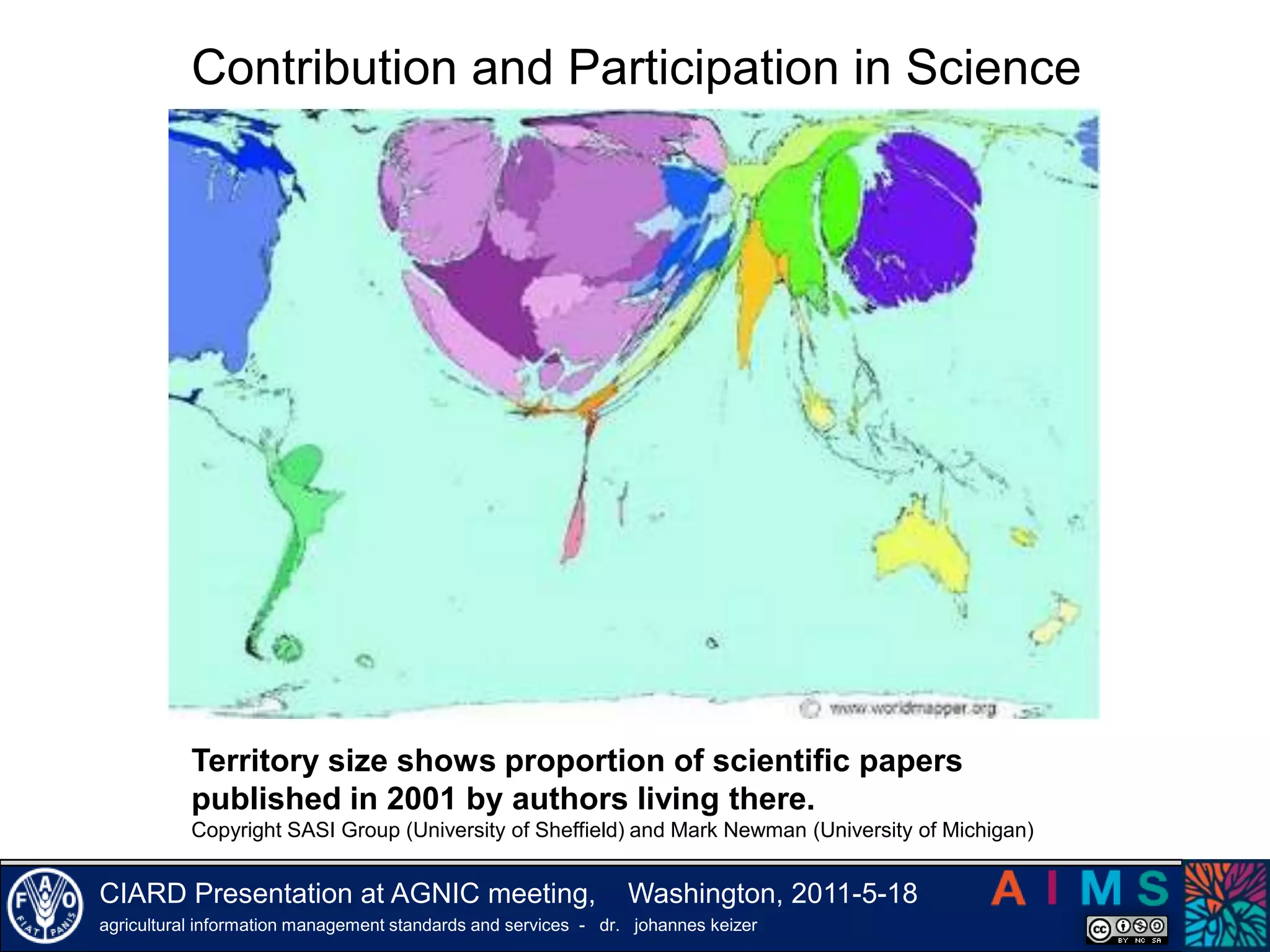
Contribution and Participation in ScienceTerritory size shows proportion of scientific papers published in 2001 by authors living there.  Copyright SASI Group (University of Sheffield) and Mark Newman (University of Michigan)
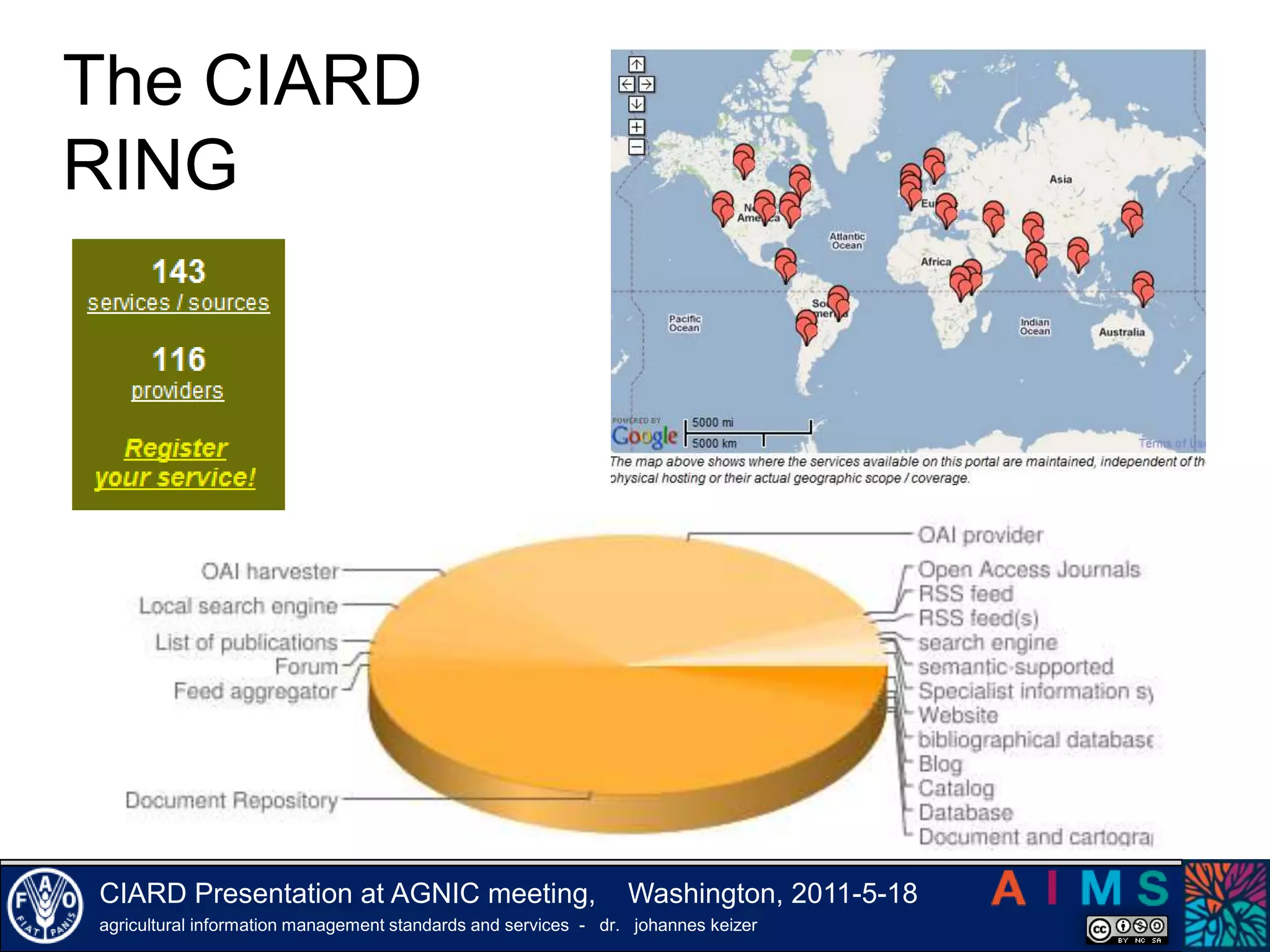
RING - Charts and numbersThe CIARD RING
The CommunityFounding Partnersand growing…..
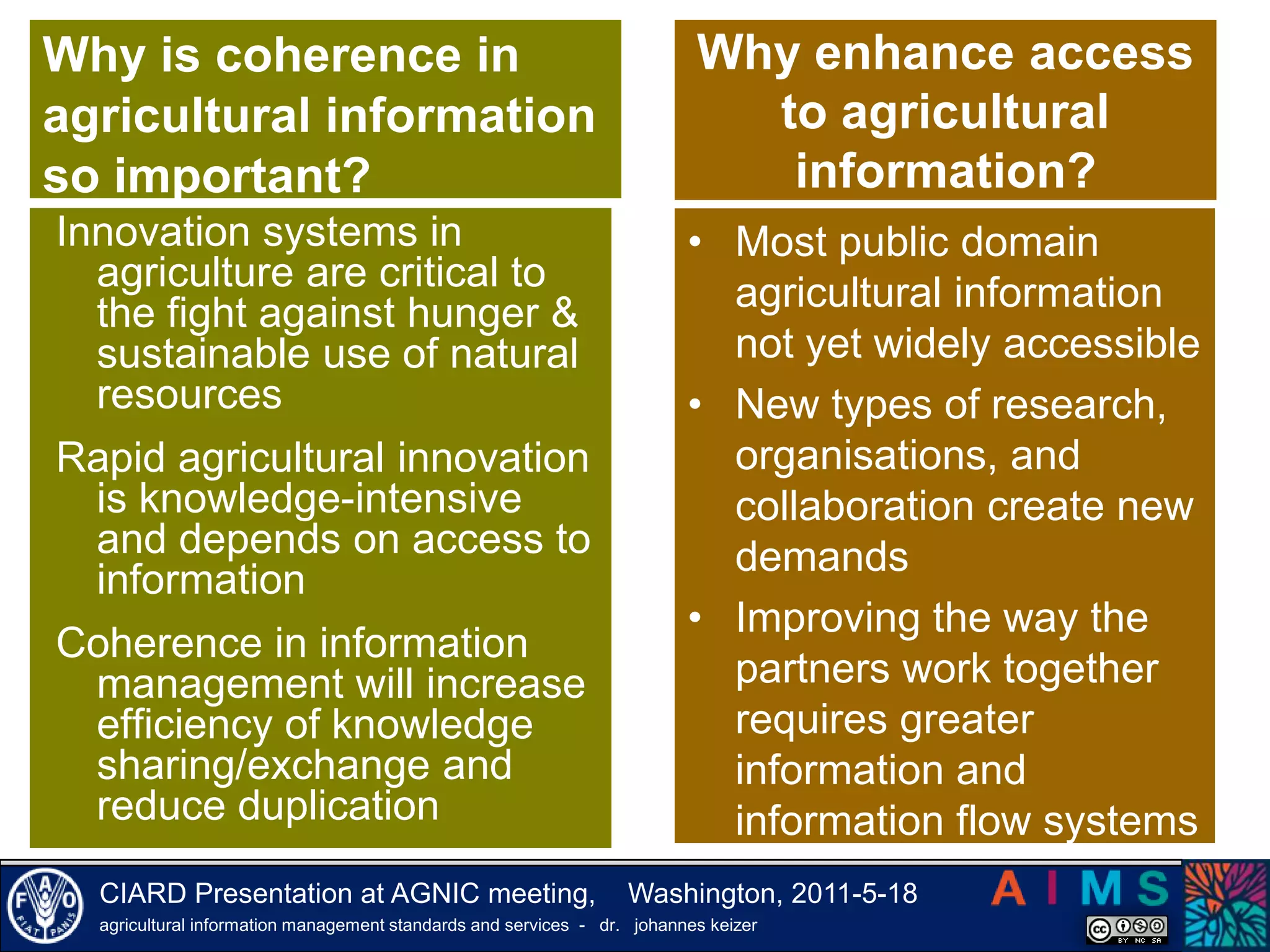
Why is coherence in agricultural information so important?Why enhance access to agricultural information?Innovation systems in   agriculture are critical to the fight against hunger & sustainable use of natural resourcesRapid agricultural innovation is knowledge-intensive and depends on access to informationCoherence in information management will increase efficiency of knowledge sharing/exchange and reduce duplication Most public domain agricultural information not yet widely accessible
New types of research, organisations, and collaboration create new demands
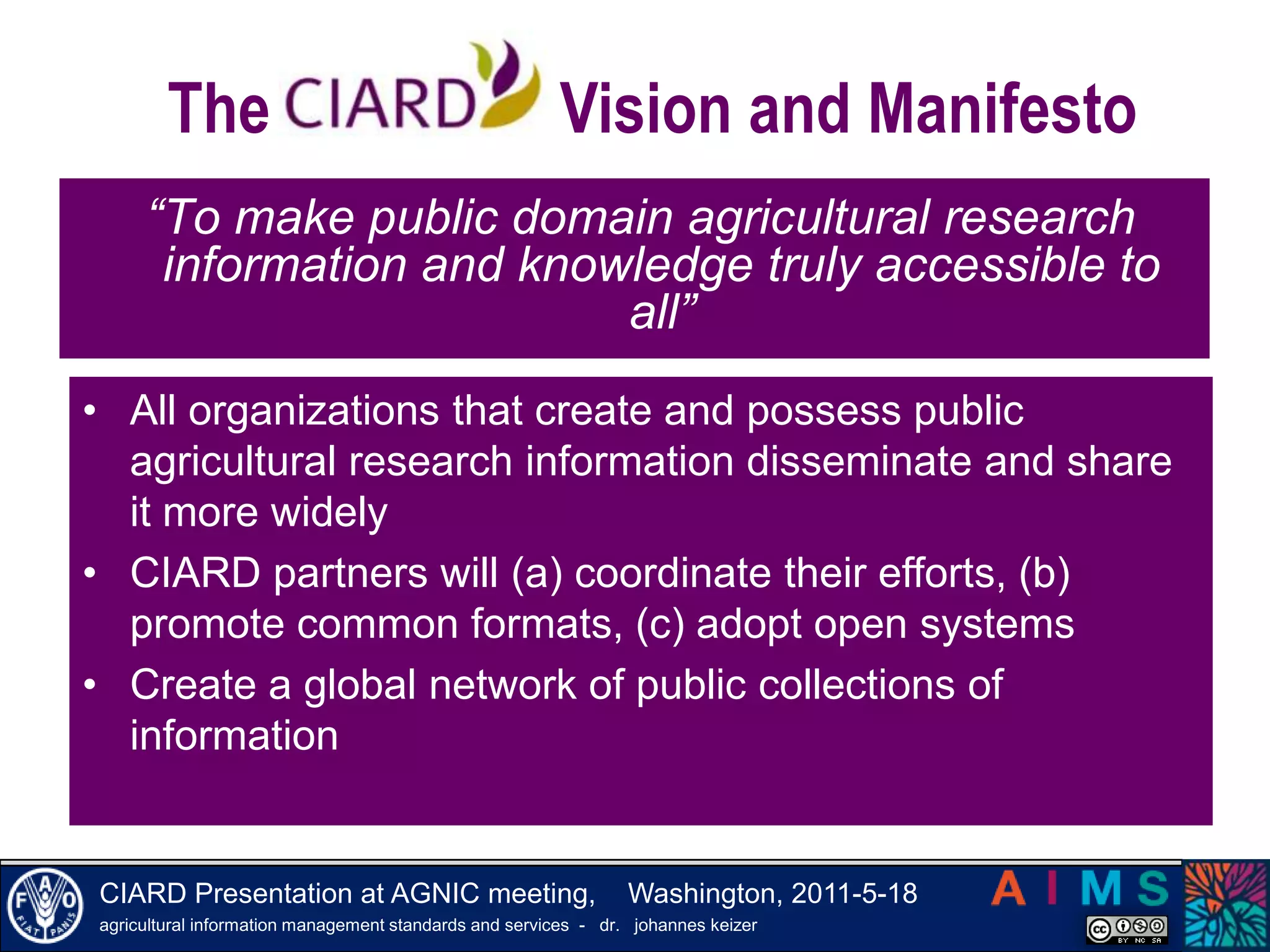
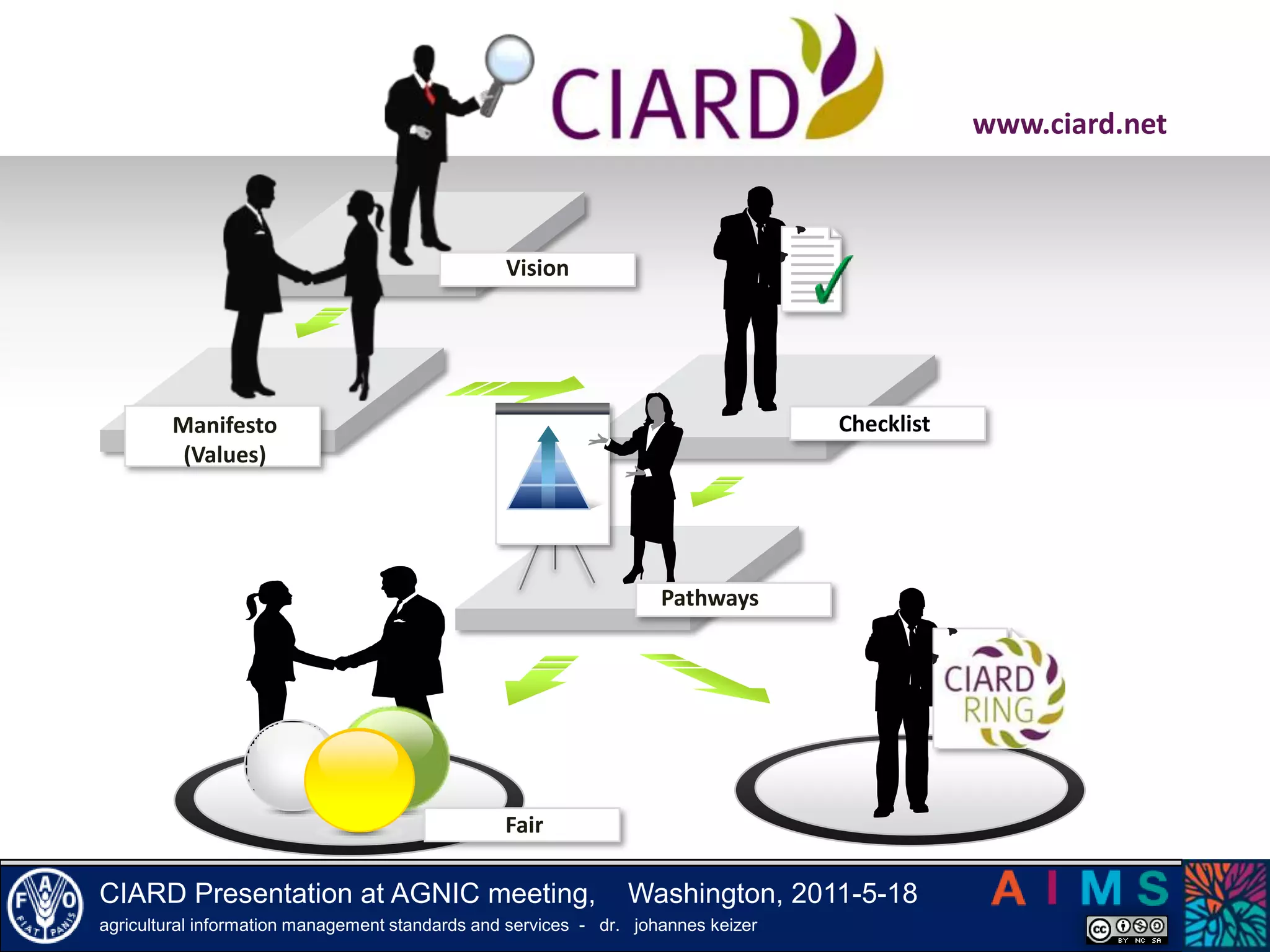
Improving the way the partners work together requires greater information and information flow systems The                  Vision and Manifesto“To make public domain agricultural research information and knowledge truly accessible to all”All organizations that create and possess public agricultural research information disseminate and share it more widely
CIARD partners will (a) coordinate their efforts, (b) promote common formats, (c) adopt open systems
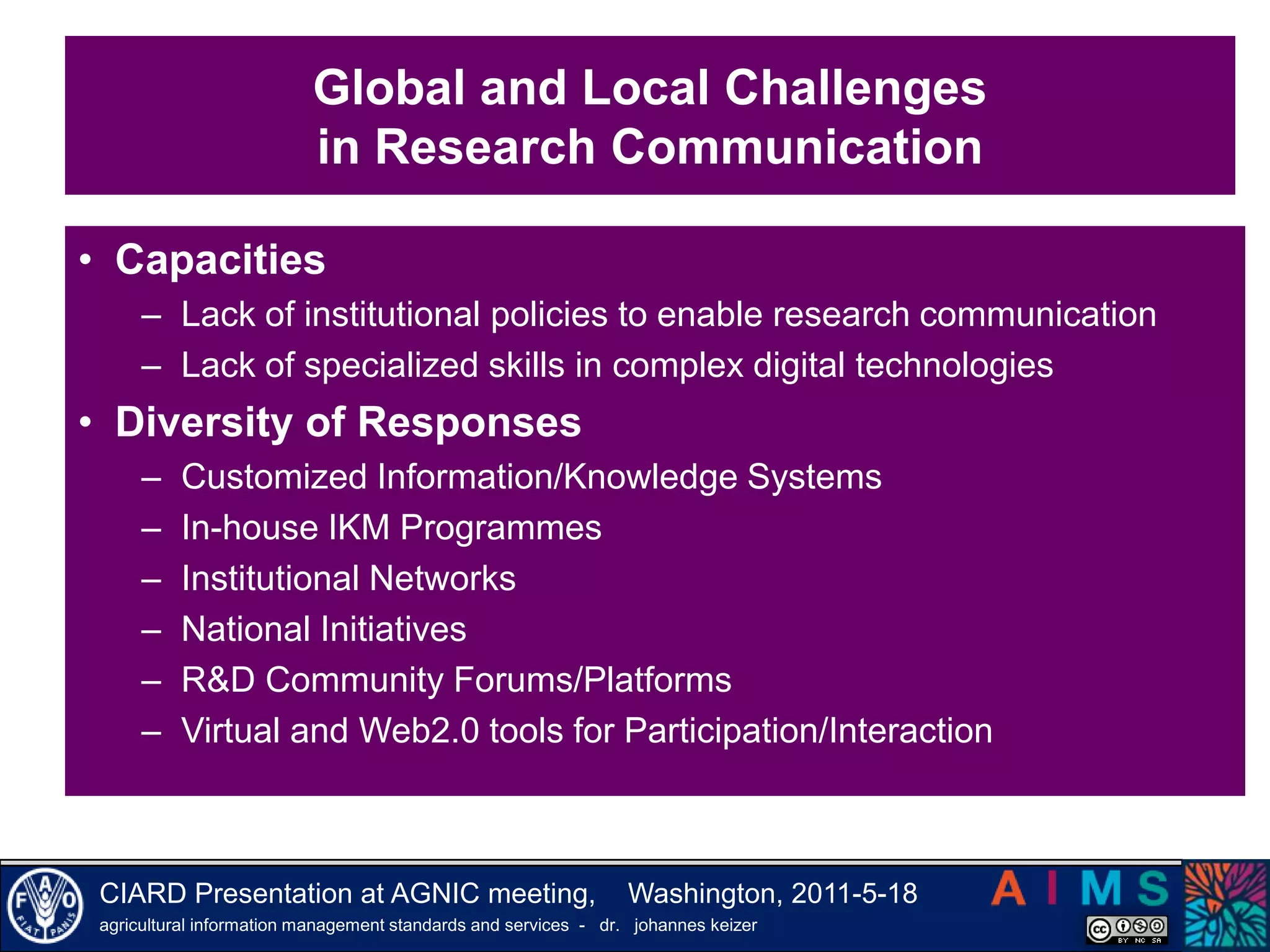
Create a global network of public collections of informationGlobal and Local Challenges in Research CommunicationCapacities
Lack of institutional policies to enable research communication
Lack of specialized skills in complex digital technologies
Diversity of Responses
Customized Information/Knowledge Systems
In-house IKM Programmes
Institutional Networks
National Initiatives

Agnic 2011 5

  • 1.
    CIARD Coherence inInformation for Agricultural Research for developmentDr. Johannes KeizerOffice ofKnowledge Exchange, Research and ExtensionFood andAgricultureOrganizationofthe UNTalk atthe AGNIC meeting, 2011, May 18
  • 2.
    Contribution and Participationin ScienceTerritory size shows proportion of scientific papers published in 2001 by authors living there. Copyright SASI Group (University of Sheffield) and Mark Newman (University of Michigan)
  • 3.
    RING - Chartsand numbersThe CIARD RING
  • 4.
  • 5.
    Why is coherencein agricultural information so important?Why enhance access to agricultural information?Innovation systems in agriculture are critical to the fight against hunger & sustainable use of natural resourcesRapid agricultural innovation is knowledge-intensive and depends on access to informationCoherence in information management will increase efficiency of knowledge sharing/exchange and reduce duplication Most public domain agricultural information not yet widely accessible
  • 6.
    New types ofresearch, organisations, and collaboration create new demands
  • 7.
    Improving the waythe partners work together requires greater information and information flow systems The Vision and Manifesto“To make public domain agricultural research information and knowledge truly accessible to all”All organizations that create and possess public agricultural research information disseminate and share it more widely
  • 8.
    CIARD partners will(a) coordinate their efforts, (b) promote common formats, (c) adopt open systems
  • 9.
    Create a globalnetwork of public collections of informationGlobal and Local Challenges in Research CommunicationCapacities
  • 10.
    Lack of institutionalpolicies to enable research communication
  • 11.
    Lack of specializedskills in complex digital technologies
  • 12.
  • 13.
  • 14.
  • 15.
  • 16.
  • 17.
  • 18.
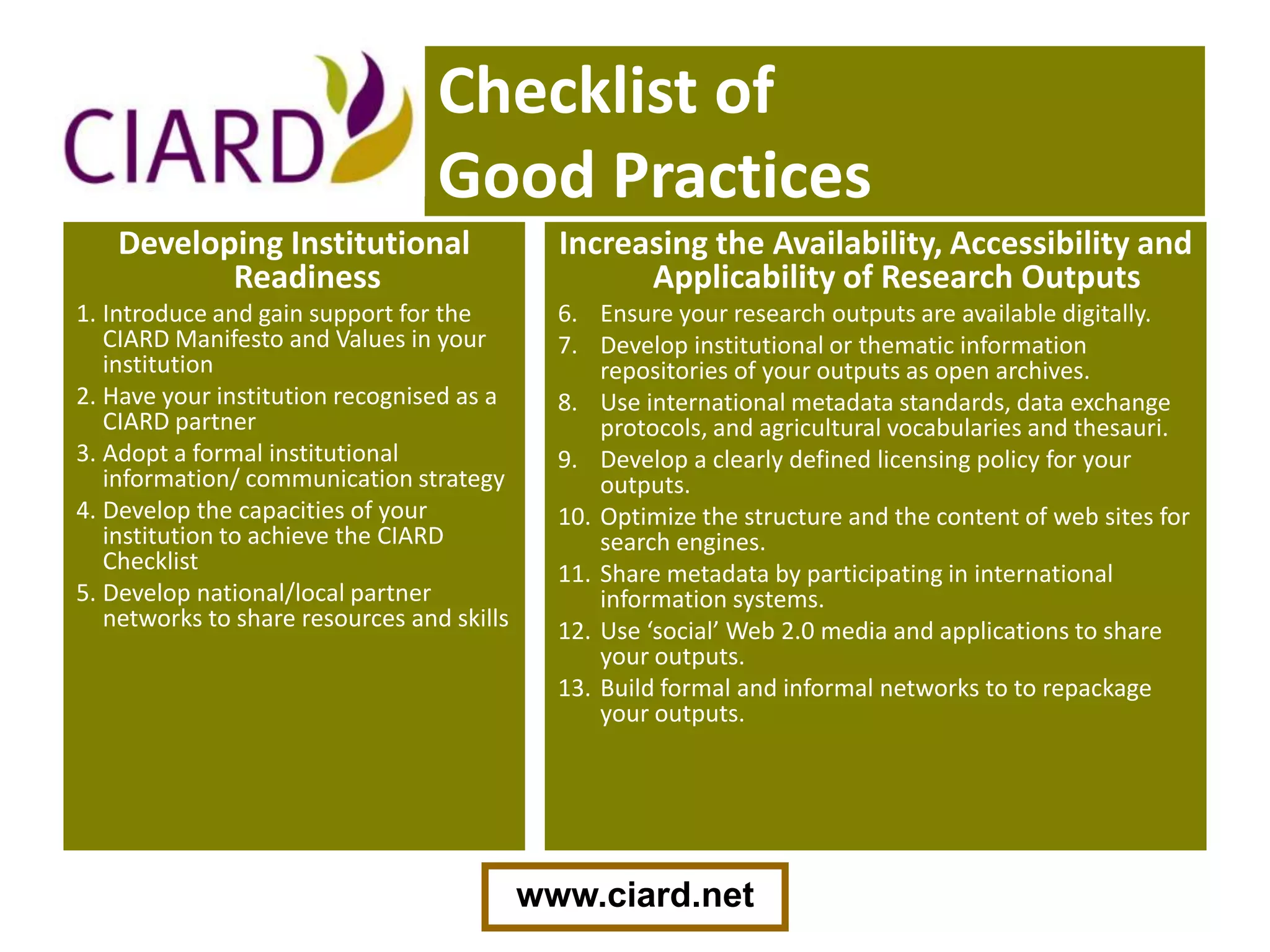
    Virtual and Web2.0tools for Participation/InteractionChecklist of Good PracticesDeveloping Institutional ReadinessIntroduce and gain support for the CIARD Manifesto and Values in your institutionHave your institution recognised as a CIARD partnerAdopt a formal institutional information/ communication strategy Develop the capacities of your institution to achieve the CIARD ChecklistDevelop national/local partner networks to share resources and skillsIncreasing the Availability, Accessibility and Applicability of Research OutputsEnsure your research outputs are available digitally. Develop institutional or thematic information repositories of your outputs as open archives.Use international metadata standards, data exchange protocols, and agricultural vocabularies and thesauri. Develop a clearly defined licensing policy for your outputs. Optimize the structure and the content of web sites for search engines.Share metadata by participating in international information systems.Use ‘social’ Web 2.0 media and applications to share your outputs.Build formal and informal networks to to repackage your outputs.www.ciard.net
  • 19.
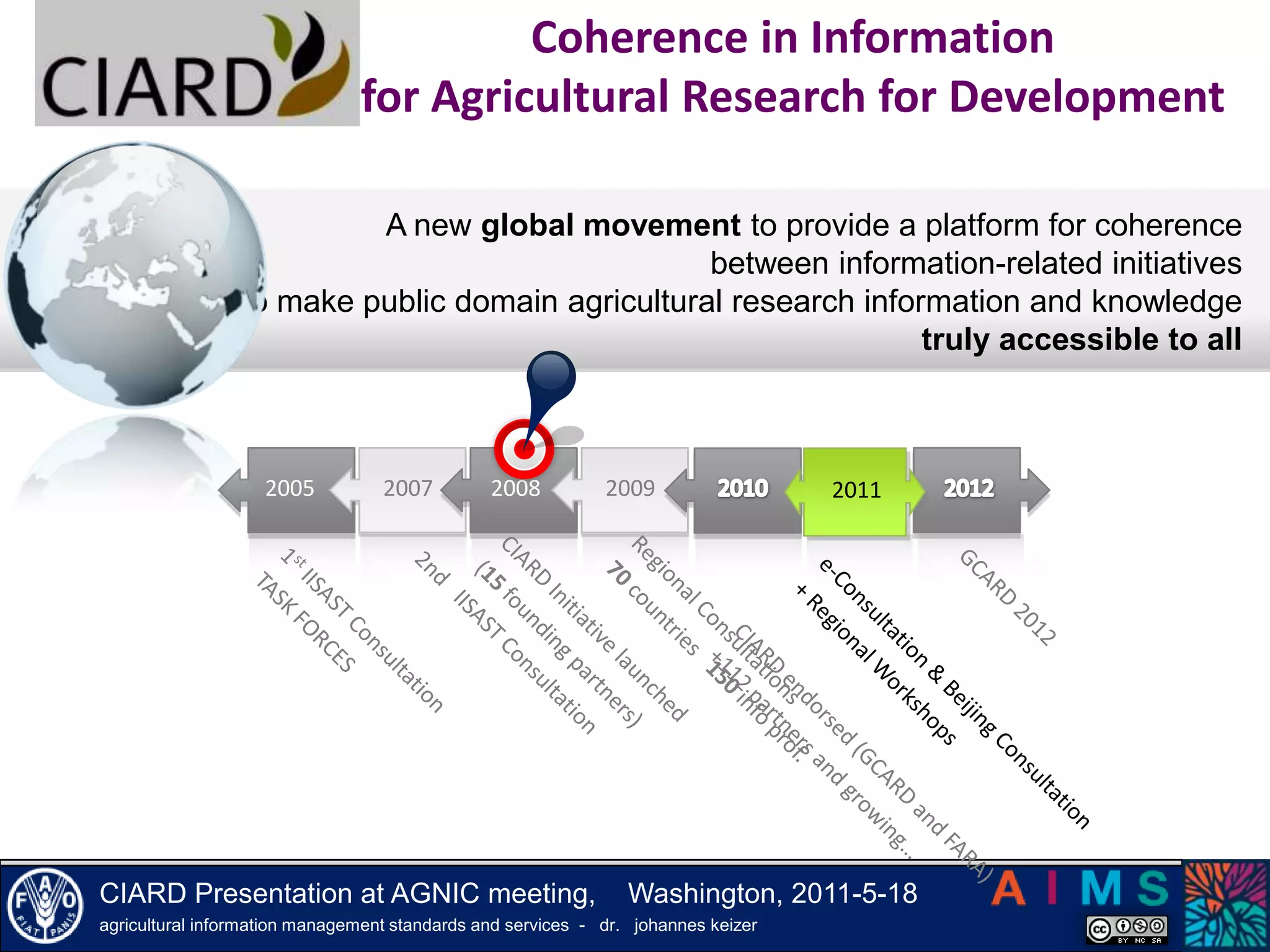
    Coherence in Informationfor Agricultural Research for DevelopmentA new global movement to provide a platform for coherence between information-related initiatives to make public domain agricultural research information and knowledge truly accessible to all 20092007200820052010201220111st IISAST Consultation TASK FORCESCIARD Initiative launched (15 founding partners)Regional Consultations70 countries 150 info prof.GCARD 20122nd IISAST Consultatione-Consultation & Beijing Consultation+ Regional WorkshopsCIARD endorsed (GCARD and FARA)+112 partners and growing…
  • 20.
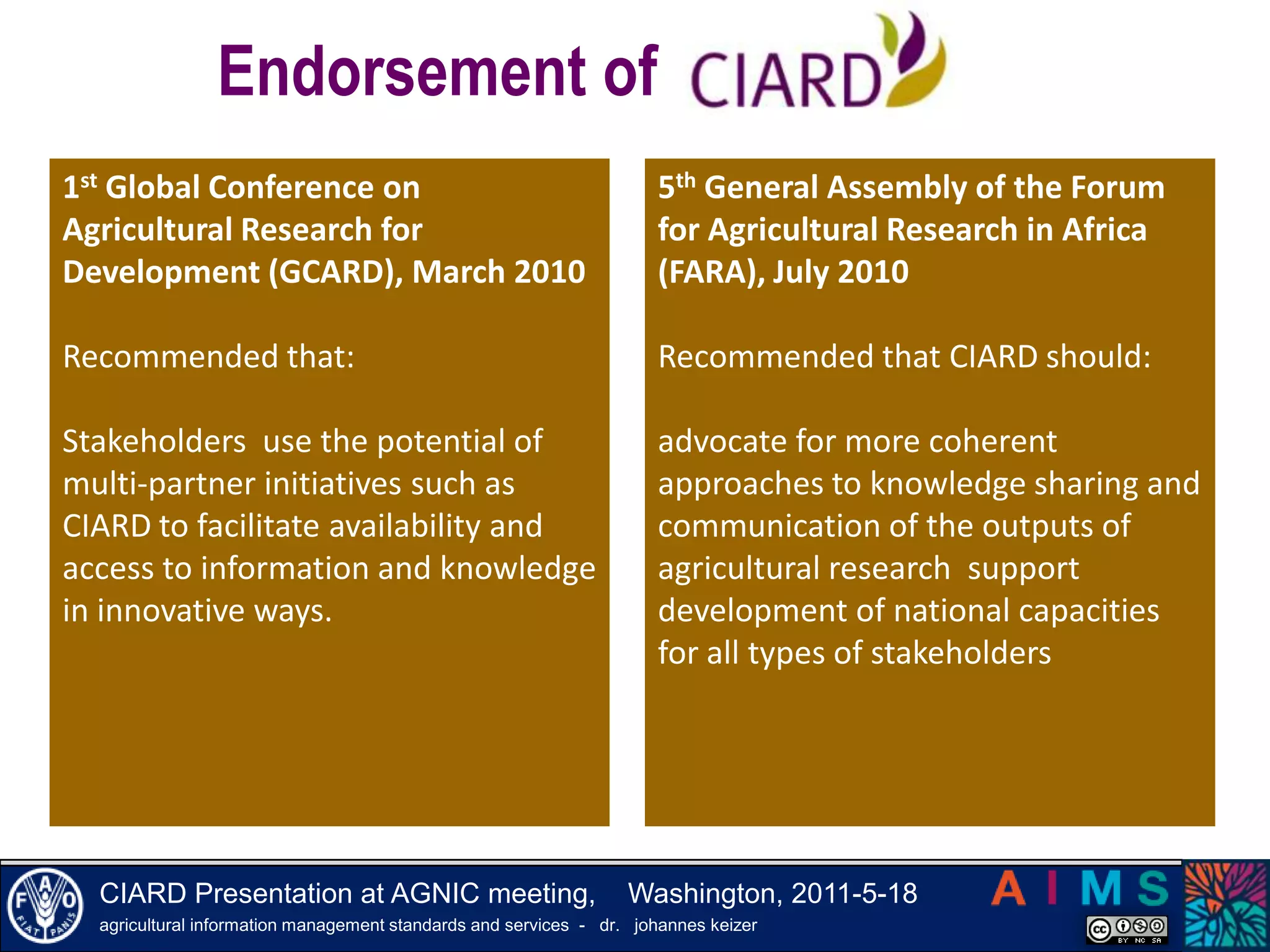
    Endorsement of1st Global Conference on Agricultural Research for Development (GCARD), March 2010 Recommended that: Stakeholders use the potential of multi-partner initiatives such as CIARD to facilitate availability and access to information and knowledge in innovative ways.5th General Assembly of the Forum for Agricultural Research in Africa (FARA), July 2010Recommended that CIARD should: advocate for more coherent approaches to knowledge sharing and communication of the outputs of agricultural research support development of national capacities for all types of stakeholders
  • 21.
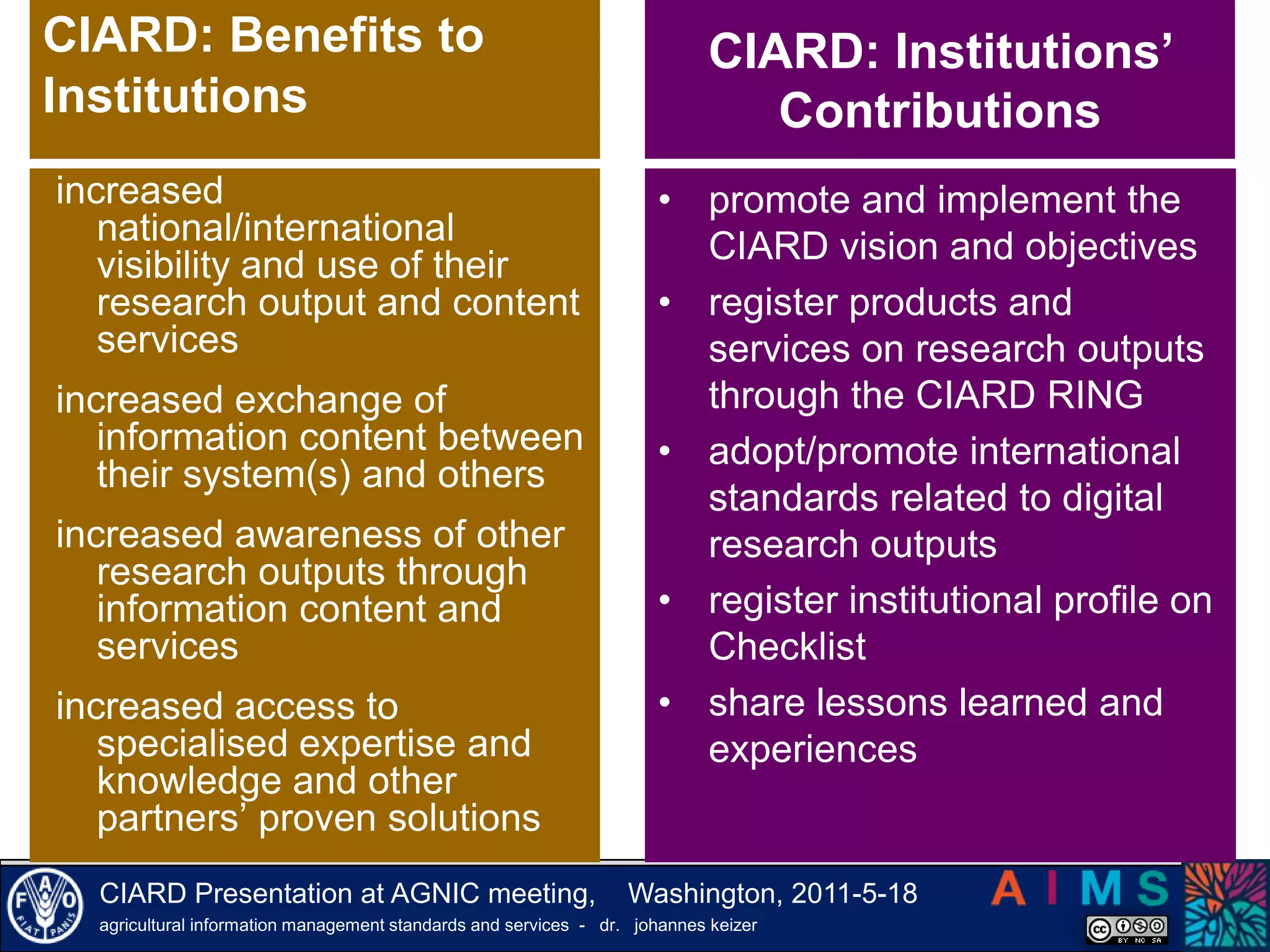
    CIARD: Benefits toInstitutionsCIARD: Institutions’ Contributionsincreased national/international visibility and use of their research output and content services increased exchange of information content between their system(s) and others increased awareness of other research outputs through information content and services increased access to specialised expertise and knowledge and other partners’ proven solutionspromote and implement the CIARD vision and objectives
  • 22.
    register products andservices on research outputs through the CIARD RING
  • 23.
    adopt/promote international standardsrelated to digital research outputs
  • 24.
  • 25.
    share lessons learnedand experienceshttp://www.ciard.net
  • 26.
  • 27.
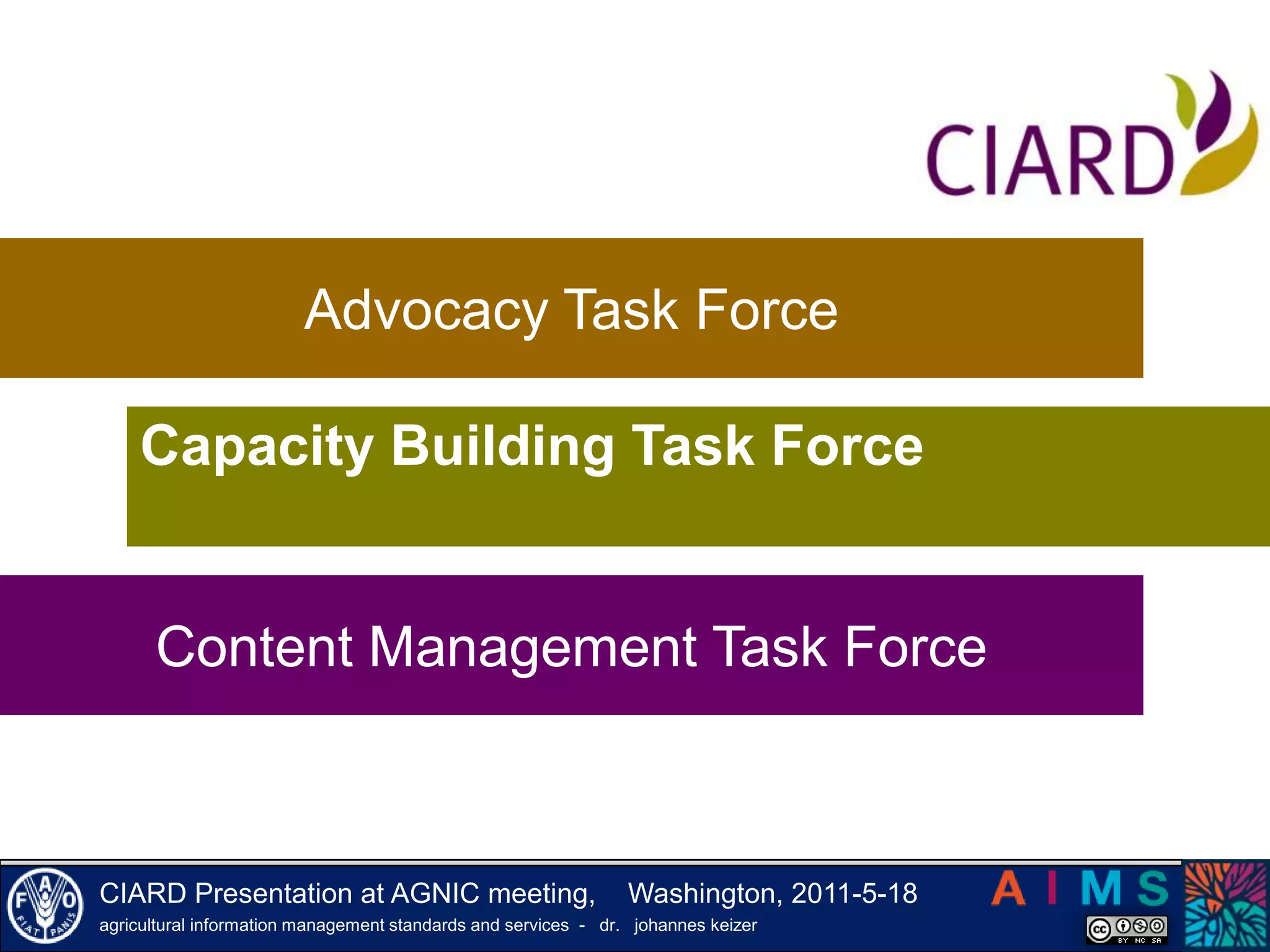
    Advocacy Task ForceCapacityBuilding Task ForceContent Management Task Force
  • 28.
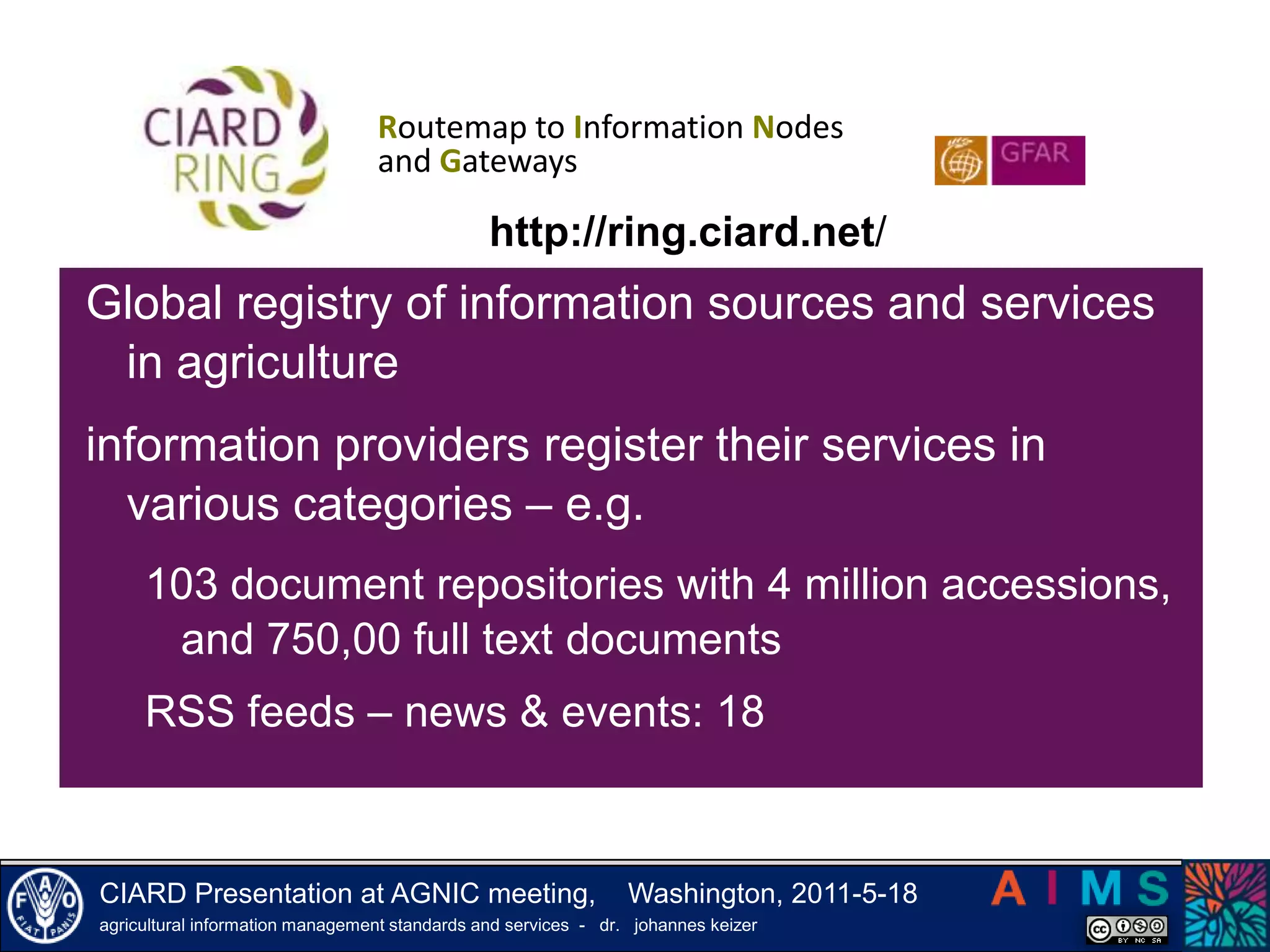
    Routemap to InformationNodes and Gatewayshttp://ring.ciard.net/Global registry of information sources and services in agricultureinformation providers register their services in various categories – e.g.103 document repositories with 4 million accessions, and 750,00 full text documentsRSS feeds – news & events: 18
  • 29.
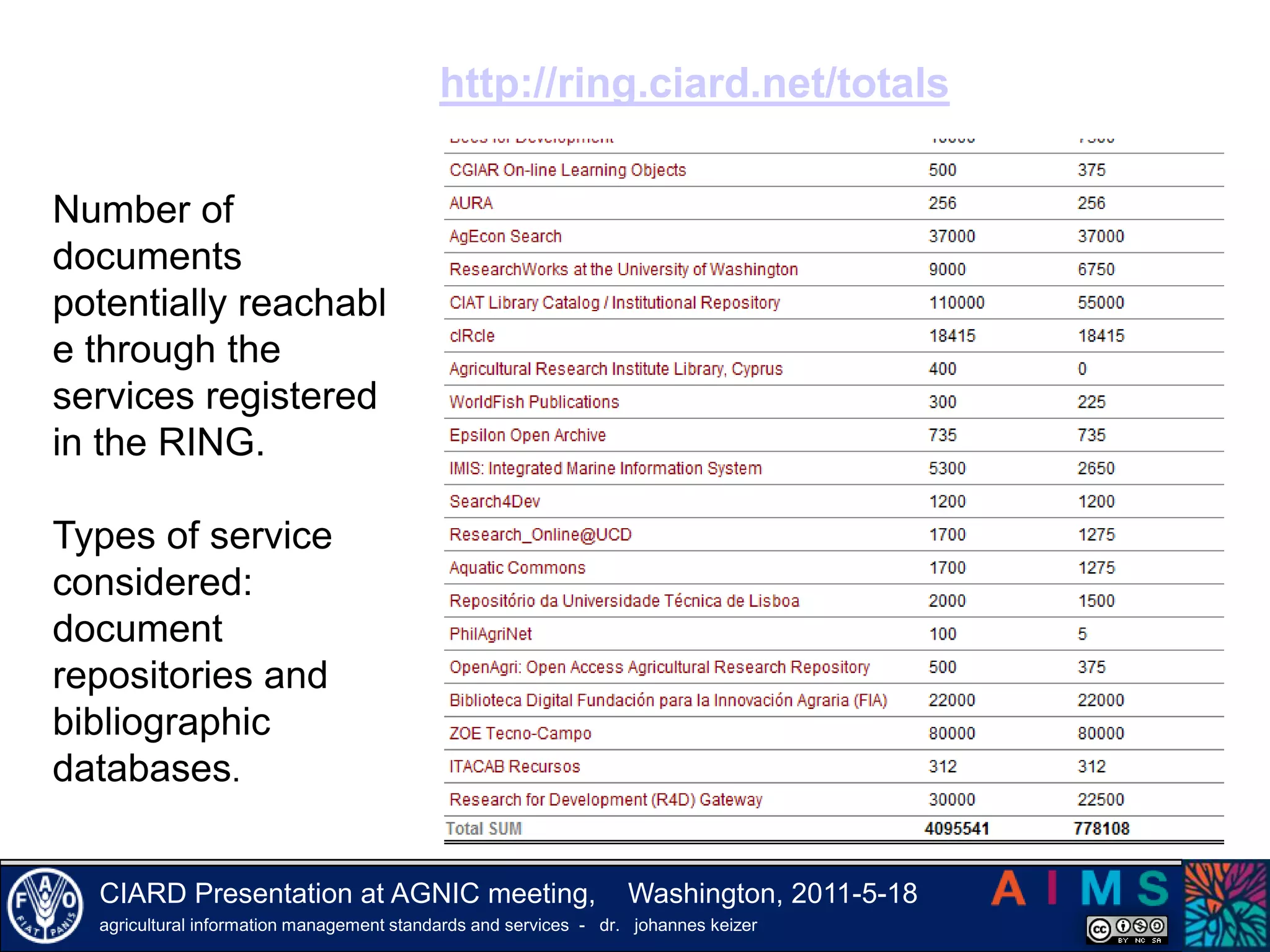
    RING – Numbershttp://ring.ciard.net/totalsNumberof documents potentially reachable through the services registered in the RING.Types of service considered: document repositories and bibliographic databases.

Editor's Notes

  • #4 the chart on the homepage representing the distribution of services across "service types" (http://ring.ciard.net) (implemented with support from John Fereira); the geographic map on the homepage representing the geographic distribution of services;
  • #17 a first attempt to provide some aggregated data on the number of contents / resources potentially reachable through the services registered in the RING: http://ring.ciard.net/totals