eROSA has received funding from the European
Union’s Horizon 2020 research and innovation
programme under grant agreement No 730988
VISION 2030 and Roadmap
Presentation to CAAS, AII, Beijing 2018, September 5
Johannes Keizer, for the eROSA team
Horizon 2020 research and innovation programme - grant agreement No 730988
EOSC Stakeholder Meeting Brussels– 2017-11-28
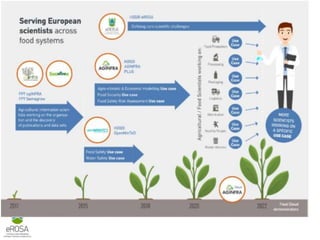
eROSA in brief
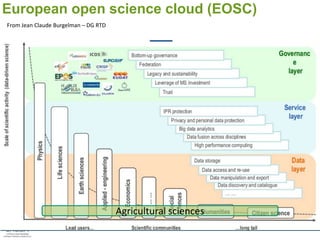
European open science cloud (EOSC)
From Jean Claude Burgelman – DG RTD
Agricultural sciences
Agriculture – back into the
center of interest
• healthy and delicious food for all (feeding 9
billion!)
• based on environmentally (climate change)
• and socially sustainable agriculture (fighting
rural poverty!)
• and food production (healthy nutrition)
it cannot be about
agriculture and food
it needs to be about Food
Systems
Efficiency needs to be
accounted for in terms of
Quality and sustainability,
efficiency in mass
production has still its
role, though
The vision cannot be
European - it has to be
global
Radical Transparency!
science is not limited to
Universities and Research
Institutes, but includes
farmers, industry, supply
chain and citizens
• Big data in Omics
• Artificial intelligence
• Robotics
• Precision agriculture for
sustainability
Internet of Things
Communities
Trust
And again: radical transparency
Main vision for roadmaps:
• Fairization of back ends, but no technology
dictate
• Improvements of front ends, but no
homogenization and limitations
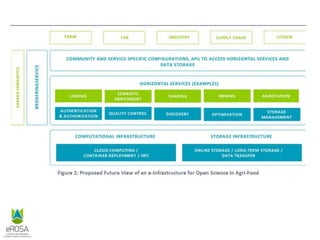
• Working in the middle for interoperability
• Common semantics of prime importance
Learning from China
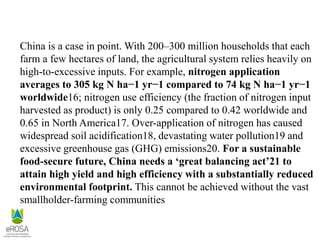
China is a case in point. With 200–300 million households that each
farm a few hectares of land, the agricultural system relies heavily on
high-to-excessive inputs. For example, nitrogen application
averages to 305 kg N ha−1 yr−1 compared to 74 kg N ha−1 yr−1
worldwide16; nitrogen use efficiency (the fraction of nitrogen input
harvested as product) is only 0.25 compared to 0.42 worldwide and
0.65 in North America17. Over-application of nitrogen has caused
widespread soil acidification18, devastating water pollution19 and
excessive greenhouse gas (GHG) emissions20. For a sustainable
food-secure future, China needs a ‘great balancing act’21 to
attain high yield and high efficiency with a substantially reduced
environmental footprint. This cannot be achieved without the vast
smallholder-farming communities
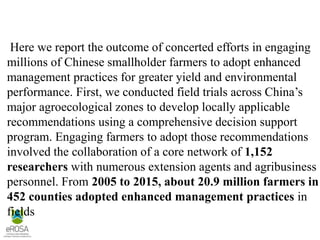
Here we report the outcome of concerted efforts in engaging
millions of Chinese smallholder farmers to adopt enhanced
management practices for greater yield and environmental
performance. First, we conducted field trials across China’s
major agroecological zones to develop locally applicable
recommendations using a comprehensive decision support
program. Engaging farmers to adopt those recommendations
involved the collaboration of a core network of 1,152
researchers with numerous extension agents and agribusiness
personnel. From 2005 to 2015, about 20.9 million farmers in
452 counties adopted enhanced management practices in
fields
eROSA has received funding from the European
Union’s Horizon 2020 research and innovation
programme under grant agreement No 730988
Big and open Data
…is the basis of the research which is described in the Nature letter.
We need to serve the scientists with better data storage, access and
management
CONSORTIUM
WWW.EROSA.AGINFRA.EU
eROSA will develop further to serve the
international community and seeks for
collaboration

eROSA presentation at CAAS, September 2018

  • 1.
    eROSA has receivedfunding from the European Union’s Horizon 2020 research and innovation programme under grant agreement No 730988 VISION 2030 and Roadmap Presentation to CAAS, AII, Beijing 2018, September 5 Johannes Keizer, for the eROSA team
  • 2.
    Horizon 2020 researchand innovation programme - grant agreement No 730988 EOSC Stakeholder Meeting Brussels– 2017-11-28 eROSA in brief
  • 6.
    European open sciencecloud (EOSC) From Jean Claude Burgelman – DG RTD Agricultural sciences
  • 7.
    Agriculture – backinto the center of interest
  • 8.
    • healthy anddelicious food for all (feeding 9 billion!) • based on environmentally (climate change) • and socially sustainable agriculture (fighting rural poverty!) • and food production (healthy nutrition)
  • 9.
    it cannot beabout agriculture and food it needs to be about Food Systems
  • 10.
    Efficiency needs tobe accounted for in terms of Quality and sustainability, efficiency in mass production has still its role, though
  • 11.
    The vision cannotbe European - it has to be global
  • 12.
    Radical Transparency! science isnot limited to Universities and Research Institutes, but includes farmers, industry, supply chain and citizens
  • 13.
    • Big datain Omics • Artificial intelligence • Robotics • Precision agriculture for sustainability
  • 14.
    Internet of Things Communities Trust Andagain: radical transparency
  • 15.
    Main vision forroadmaps: • Fairization of back ends, but no technology dictate • Improvements of front ends, but no homogenization and limitations • Working in the middle for interoperability • Common semantics of prime importance
  • 18.
  • 19.
    China is acase in point. With 200–300 million households that each farm a few hectares of land, the agricultural system relies heavily on high-to-excessive inputs. For example, nitrogen application averages to 305 kg N ha−1 yr−1 compared to 74 kg N ha−1 yr−1 worldwide16; nitrogen use efficiency (the fraction of nitrogen input harvested as product) is only 0.25 compared to 0.42 worldwide and 0.65 in North America17. Over-application of nitrogen has caused widespread soil acidification18, devastating water pollution19 and excessive greenhouse gas (GHG) emissions20. For a sustainable food-secure future, China needs a ‘great balancing act’21 to attain high yield and high efficiency with a substantially reduced environmental footprint. This cannot be achieved without the vast smallholder-farming communities
  • 20.
    Here we reportthe outcome of concerted efforts in engaging millions of Chinese smallholder farmers to adopt enhanced management practices for greater yield and environmental performance. First, we conducted field trials across China’s major agroecological zones to develop locally applicable recommendations using a comprehensive decision support program. Engaging farmers to adopt those recommendations involved the collaboration of a core network of 1,152 researchers with numerous extension agents and agribusiness personnel. From 2005 to 2015, about 20.9 million farmers in 452 counties adopted enhanced management practices in fields
  • 21.
    eROSA has receivedfunding from the European Union’s Horizon 2020 research and innovation programme under grant agreement No 730988 Big and open Data …is the basis of the research which is described in the Nature letter. We need to serve the scientists with better data storage, access and management
  • 22.
    CONSORTIUM WWW.EROSA.AGINFRA.EU eROSA will developfurther to serve the international community and seeks for collaboration

Editor's Notes

  • #8 AlwAYS in th ece nter of poor countries.. Marginalization, of Agriculture in Industrialization Process, Back through quality of food in live, Agriculture back in a holistic view
  • #11 Possibility of dual systems, healthiness, quality, environmental sustainability