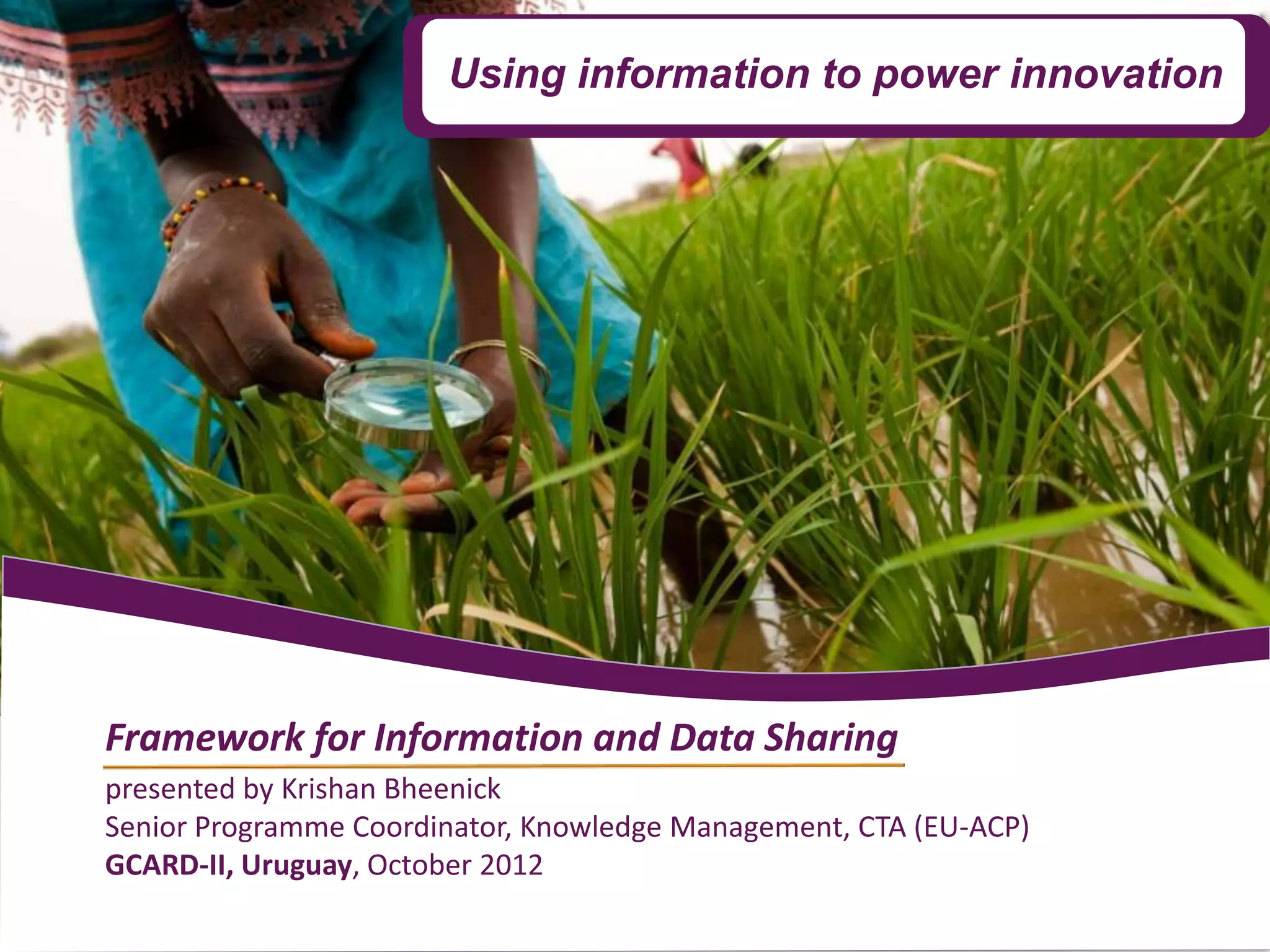
Using information to power innovation


Framework for Information and Data Sharing
presented by Krishan Bheenick
Senior Programme Coordinator, Knowledge Management, CTA (EU-ACP)
GCARD-II, Uruguay, October 2012
Knowledge Sharing in Agricultural Innovation


     Innovation is knowledge-intensive and requires
     greater information sharing/exchange
     Access to research outputs is essential to
     address problems
     Effective access enhances information use, and
     enhances innovation within and among
     communities
     Greater use of information will accelerate rural
     development
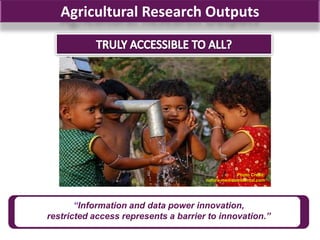
Agricultural Research Outputs


                                                   Photo Credit:
                                      natura-medioambiental.com


       “Information and data power innovation,
restricted access represents a barrier to innovation.”
Communicating Agricultural Research
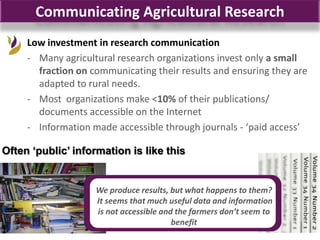
     Low investment in research communication
     - Many agricultural research organizations invest only a small
       fraction on communicating their results and ensuring they are
       adapted to rural needs.
     - Most organizations make <10% of their publications/
       documents accessible on the Internet
     - Information made accessible through journals - ‘paid access’

Often „public‟ information is like this


                    We produce results, but what happens to them?
                    It seems that much useful data and information
                    is not accessible and the farmers don’t seem to
                                         benefit
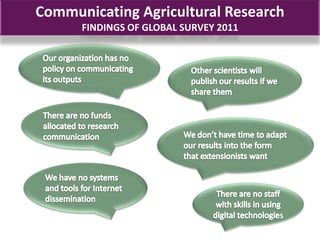
Communicating Agricultural Research
      FINDINGS OF GLOBAL SURVEY 2011


                                       s
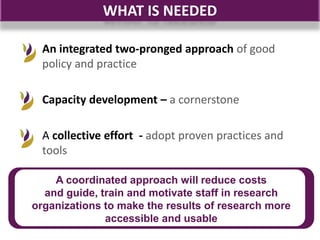
WHAT IS NEEDED

  An integrated two-pronged approach of good
  policy and practice

  Capacity development – a cornerstone

  A collective effort - adopt proven practices and
  tools

    A coordinated approach will reduce costs
  and guide, train and motivate staff in research
organizations to make the results of research more
              accessible and usable
COHERENCE IN PARTNERSHIP & ACTION


Coherence in Information for Agricultural
      Research for Development

         A Global Movement
A GLOBAL MOVEMENT

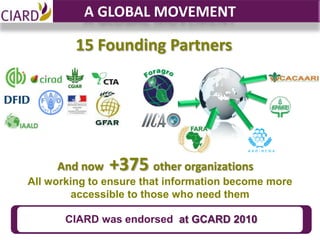
         15 Founding Partners


     And now   +375 other organizations
All working to ensure that information become more
        accessible to those who need them

       CIARD was endorsed at GCARD 2010
A CONSULTATIVE PROCESS

    2008 onwards: Meetings/events for partners, electronic
   discussions, development of CIARD products & initiatives
                Advocacy, Advocacy, Advocacy !

    Shared, distributed coordination – subsidiarity


  2009: CIARD consultation in Africa at FARA – “…CIARD gives us a
 global framework for what we have been trying to do at individual
and institutional level; now I feel empowered to tell my Director …”

  2011: A CIARD global consultation process on “Developing a
          framework for data and information sharing”
PRIORITY AREAS IDENTIFIED

To improve investment through introduction of
sound policies and coordinated approaches

To develop institutional capacity through
encouraging self-sufficiency and empowerment

To make data and information accessible by
promoting open content and common standards
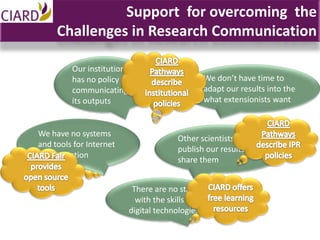
Support for overcoming the
     Challenges in Research Communication

         Our institution
         has no policy on                       We don’t have time to
         communicating                          adapt our results into the
         its outputs                            what extensionists want


We have no systems
                                      Other scientists will
and tools for Internet
                                      publish our results if we
dissemination
                                      share them


                          There are no staff
                           with the skills in
                         digital technologies
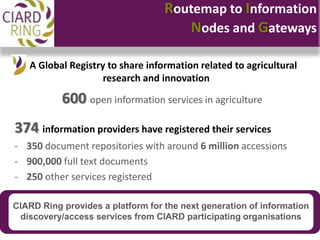
Routemap to Information
                                      Nodes and Gateways

   A Global Registry to share information related to agricultural
                    research and innovation

           600 open information services in agriculture
374 information providers have registered their services
- 350 document repositories with around 6 million accessions
- 900,000 full text documents
- 250 other services registered

CIARD Ring provides a platform for the next generation of information
 discovery/access services from CIARD participating organisations
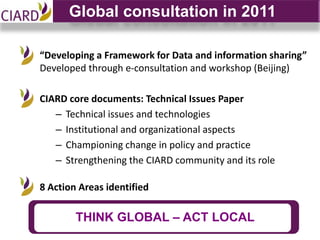
Global consultation in 2011

“Developing a Framework for Data and information sharing”
Developed through e-consultation and workshop (Beijing)

CIARD core documents: Technical Issues Paper
   – Technical issues and technologies
   – Institutional and organizational aspects
   – Championing change in policy and practice
   – Strengthening the CIARD community and its role

8 Action Areas identified

        THINK GLOBAL – ACT LOCAL
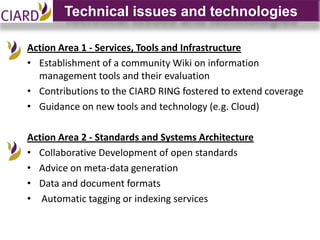
Technical issues and technologies

Action Area 1 - Services, Tools and Infrastructure
• Establishment of a community Wiki on information
  management tools and their evaluation
• Contributions to the CIARD RING fostered to extend coverage
• Guidance on new tools and technology (e.g. Cloud)

Action Area 2 - Standards and Systems Architecture
• Collaborative Development of open standards
• Advice on meta-data generation
• Data and document formats
• Automatic tagging or indexing services
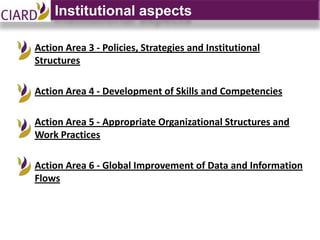
Institutional aspects

Action Area 3 - Policies, Strategies and Institutional
Structures

Action Area 4 - Development of Skills and Competencies

Action Area 5 - Appropriate Organizational Structures and
Work Practices

Action Area 6 - Global Improvement of Data and Information
Flows
Championing change in
      policy and practice


Action Area 7 - Advocacy and Evidence
• Convince Policy makers and research managers, information
  specialists, users and generators of ARD information
• Document initiatives and cost benefit analysis, and impact in
  case studies
• Develop and implement an advocacy programme, using
  champions [see recently launched Advocacy Toolkit]
• CIARD partners lead by example
Strengthening the CIARD
            Community and its role

Action Area 8 - Partnerships and Information Managers
• CIARD as a multi-dimensional learning initiative
• Sharing and discussing experiences and ideas among the CIARD
  partners: from technologies and policies to case studies and
  success stories
• Establish a virtual platform for the community to promote peer
  learning
Resources to support action

Championing change in policy and practice:
  CIARD Advocacy Toolkit
  Collection of evidence, benefits and good practices (i.e.
  CIARD Checklist)

Institutions/organizations:
   Guidelines (CIARD Pathways) ; E-learning programmes

Information Technologies: Open information standards ,tools
   and services; CIARD RING

Strengthening the CIARD Community: Physical and electronic
   interactions

  We can build further on these achievements
The Way Forward

National organizations:
- implement policies and practices on opening access to and
  enhancing use of agricultural research information
- create/strengthen research communication activities
- register their open services in the CIARD.RING
Regional and International organizations:
- achieve even stronger consensus and support for CIARD
- develop regional partnerships and networks to leverage
  resources and capacities in support of opening access
Donors providing research funds:
- Support grantees in communicating their findings effectively
Using information to power innovation


Framework for Information and Data Sharing
GCARD-II, Uruguay, October 2012            www.ciard.net

C3.1. Framework for Information and Data Sharing

  • 1.
    Using information topower innovation Framework for Information and Data Sharing presented by Krishan Bheenick Senior Programme Coordinator, Knowledge Management, CTA (EU-ACP) GCARD-II, Uruguay, October 2012
  • 2.
    Knowledge Sharing inAgricultural Innovation Innovation is knowledge-intensive and requires greater information sharing/exchange Access to research outputs is essential to address problems Effective access enhances information use, and enhances innovation within and among communities Greater use of information will accelerate rural development
  • 3.
    Agricultural Research Outputs Photo Credit: natura-medioambiental.com “Information and data power innovation, restricted access represents a barrier to innovation.”
  • 4.
    Communicating Agricultural Research Low investment in research communication - Many agricultural research organizations invest only a small fraction on communicating their results and ensuring they are adapted to rural needs. - Most organizations make <10% of their publications/ documents accessible on the Internet - Information made accessible through journals - ‘paid access’ Often „public‟ information is like this We produce results, but what happens to them? It seems that much useful data and information is not accessible and the farmers don’t seem to benefit
  • 5.
    Communicating Agricultural Research FINDINGS OF GLOBAL SURVEY 2011 s
  • 6.
    WHAT IS NEEDED An integrated two-pronged approach of good policy and practice Capacity development – a cornerstone A collective effort - adopt proven practices and tools A coordinated approach will reduce costs and guide, train and motivate staff in research organizations to make the results of research more accessible and usable
  • 7.
    COHERENCE IN PARTNERSHIP& ACTION Coherence in Information for Agricultural Research for Development A Global Movement
  • 8.
    A GLOBAL MOVEMENT 15 Founding Partners And now +375 other organizations All working to ensure that information become more accessible to those who need them CIARD was endorsed at GCARD 2010
  • 9.
    A CONSULTATIVE PROCESS 2008 onwards: Meetings/events for partners, electronic discussions, development of CIARD products & initiatives Advocacy, Advocacy, Advocacy ! Shared, distributed coordination – subsidiarity 2009: CIARD consultation in Africa at FARA – “…CIARD gives us a global framework for what we have been trying to do at individual and institutional level; now I feel empowered to tell my Director …” 2011: A CIARD global consultation process on “Developing a framework for data and information sharing”
  • 10.
    PRIORITY AREAS IDENTIFIED Toimprove investment through introduction of sound policies and coordinated approaches To develop institutional capacity through encouraging self-sufficiency and empowerment To make data and information accessible by promoting open content and common standards
  • 11.
    Support for overcomingthe Challenges in Research Communication Our institution has no policy on We don’t have time to communicating adapt our results into the its outputs what extensionists want We have no systems Other scientists will and tools for Internet publish our results if we dissemination share them There are no staff with the skills in digital technologies
  • 12.
    Routemap to Information Nodes and Gateways A Global Registry to share information related to agricultural research and innovation 600 open information services in agriculture 374 information providers have registered their services - 350 document repositories with around 6 million accessions - 900,000 full text documents - 250 other services registered CIARD Ring provides a platform for the next generation of information discovery/access services from CIARD participating organisations
  • 13.
    Global consultation in2011 “Developing a Framework for Data and information sharing” Developed through e-consultation and workshop (Beijing) CIARD core documents: Technical Issues Paper – Technical issues and technologies – Institutional and organizational aspects – Championing change in policy and practice – Strengthening the CIARD community and its role 8 Action Areas identified THINK GLOBAL – ACT LOCAL
  • 14.
    Technical issues andtechnologies Action Area 1 - Services, Tools and Infrastructure • Establishment of a community Wiki on information management tools and their evaluation • Contributions to the CIARD RING fostered to extend coverage • Guidance on new tools and technology (e.g. Cloud) Action Area 2 - Standards and Systems Architecture • Collaborative Development of open standards • Advice on meta-data generation • Data and document formats • Automatic tagging or indexing services
  • 15.
    Institutional aspects Action Area3 - Policies, Strategies and Institutional Structures Action Area 4 - Development of Skills and Competencies Action Area 5 - Appropriate Organizational Structures and Work Practices Action Area 6 - Global Improvement of Data and Information Flows
  • 16.
    Championing change in policy and practice Action Area 7 - Advocacy and Evidence • Convince Policy makers and research managers, information specialists, users and generators of ARD information • Document initiatives and cost benefit analysis, and impact in case studies • Develop and implement an advocacy programme, using champions [see recently launched Advocacy Toolkit] • CIARD partners lead by example
  • 17.
    Strengthening the CIARD Community and its role Action Area 8 - Partnerships and Information Managers • CIARD as a multi-dimensional learning initiative • Sharing and discussing experiences and ideas among the CIARD partners: from technologies and policies to case studies and success stories • Establish a virtual platform for the community to promote peer learning
  • 18.
    Resources to supportaction Championing change in policy and practice: CIARD Advocacy Toolkit Collection of evidence, benefits and good practices (i.e. CIARD Checklist) Institutions/organizations: Guidelines (CIARD Pathways) ; E-learning programmes Information Technologies: Open information standards ,tools and services; CIARD RING Strengthening the CIARD Community: Physical and electronic interactions We can build further on these achievements
  • 19.
    The Way Forward Nationalorganizations: - implement policies and practices on opening access to and enhancing use of agricultural research information - create/strengthen research communication activities - register their open services in the CIARD.RING Regional and International organizations: - achieve even stronger consensus and support for CIARD - develop regional partnerships and networks to leverage resources and capacities in support of opening access Donors providing research funds: - Support grantees in communicating their findings effectively
  • 20.
    Using information topower innovation Framework for Information and Data Sharing GCARD-II, Uruguay, October 2012 www.ciard.net

Editor's Notes

  • #7 In order to address these barriers to opening access to data and information and to their effective transformation and use.  An integrated two-pronged approach of good policy and practice is needed so that organizations can develop incentives build up their skills base for greater cooperation and sharing.  In addition, capacity development has to be a cornerstone of the approach that will help in applying data and information to solving real problems.  A collective effort will really help many smaller institutions to make information truly accessible and contribute to its effective use as they can immediately adopt proven practices and tools without having to develop their own.BENEFITS:  By supporting a more coordinated approach to opening up data and information and enabling their effective use, research organizations can reduce costs and guide, train, and motivate their staff.
  • #11 PRIORITIES AREAS IDENTIFIED:1. To improve investment through introduction of sound policies and coordinated approaches; 2. To develop institutional capacity through encouraging self-sufficiency and empowerment; 3. To make data and information accessible by promoting open content and common standards.
  • #18 Technical issues and technologies. A set of open services -such as the CIARD.RING- and tools are available to promote information and data sharing, and open standards are continuously being developed and applied.