Biochemistry of aging
Dr. Priya Patil
Objectives of the seminar
• Define Aging
• Components of Aging
• Theories and Cellular processes of Aging
• Aging changes in specific tissues
• Genetic influences on Aging
• Gene studies in long lived centenarians
• Molecular repair mechanisms to combat wear
and tear
• Strategies to increase health span and delay
Aging
Define Aging
• Aging is easy to recognise but difficult to define.
• Most definitions of aging indicate that it is a
progressive process associated with declines in
structure and function, impaired maintenance and
repair systems, increased susceptibility to disease
and death and reduced reproductive capacity.
• Components of Aging
Statistical component Phenotypic component
• Theories of Aging
Evolutionary theories -
Biological/physiological theories-
Evolutionary theories
• Programmed death
• Mutation accumulation
• Antagonistic pleiotrophy
• Life history theory
• Disposable soma theory
Biological/Physiological theories
• Wear and tear theory
-hydrolytic reactions can damage proteins and
nucleotides.
- Generation of reactive oxygen species.
• Free radical and mitochondrial theory of aging
• UV induced free radical generation
• Protein glycation- AGE’s
• Hydrolytic reactions
•Reactive oxygen species
Free radical and mitochondrial theory
of aging-
“Free radical theory of aging”- Denham Harmon
Life span α 1
metabolic rate
Mitochondria are key participitants in apoptosis
Telomere shortening and replicative
senescence
• Secondary to hayflick limit
• Cellular clock
• Neurons also age
Altered gene expression, Epigentics,
miRNA
• Eg: histone acetylation is regulated by many
enzymes including SIRT 1, a protein that has
marked effect on aging.
• Specific miRNA are linked to aging pathways
like miR-21 (asso with target of rapamycin
pathway) and miR-1 (asso with insulin/IGF
pathway)
Impaired autophagy
Lysosomal system,
Ubiquitin proteosomal system
Lipofuscin,
Aggregated proetins
UV rays can be extremely damaging
UV Rays
Protein glycation
• Protein glycation often links to the formation of covalent cross
links between two proteins or other biological
macromolecule.
• These cross linked aggregates are sometime called as AGE’s.
• Eg: the progressive crosslinking of collagen network in
vascular endothelial cells leads to the progressive loss of
elasticity and thickening of basement in blood vessels
promoting plague formation.
Aging changes in specific tissue that
predispose to disease
• Immune system- decreased T- cells and overproduction of
autoantibodies by B-cells
• Liver- impaired detoxification, decreased hepatic clearance
• Vascular changes- atherosclerosis, myocardial interstitial fibrosis
• Sensory- lacrimal gland atrophy, corneal degenerations, cataract etc
• Endocrine –hypogonadism and bone diseases.
Molecular repair mechanisms- combat
wear and tear
• Enzymatic and chemical mechanism intercept
damaging ROS.
• The integrity of DNA is maintained by proof
reading and repair mechanism
• Routine turnover
• Aggregated proteins
Genetic influences on Aging
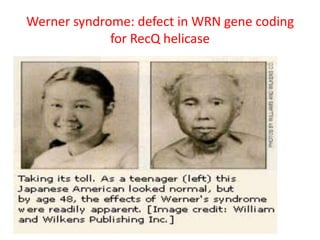
Werner syndrome: defect in WRN gene coding
for RecQ helicase
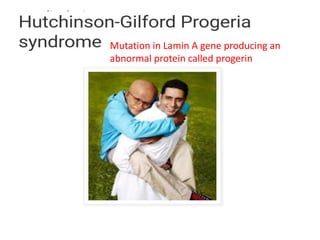
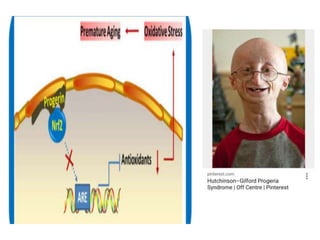
Mutation in Lamin A gene producing an
abnormal protein called progerin
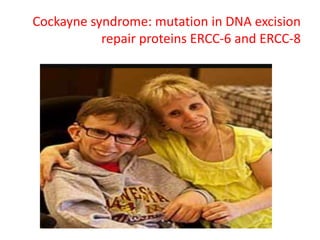
Cockayne syndrome: mutation in DNA excision
repair proteins ERCC-6 and ERCC-8
Gene studies in long lived centenarians
• APO E
• FOXO 3A
• Certain SNP’s
Strategies to increase health span and
delay Aging
Diet restriction
Exercise
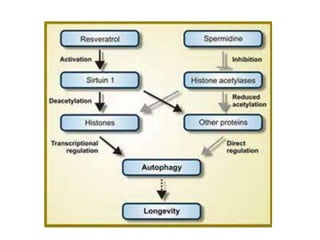
Drugs –
revereratol,
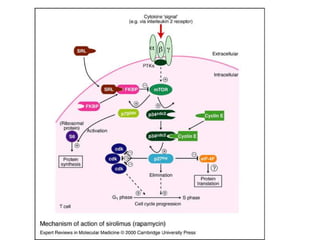
rapamycin,
spermidine,
metformin
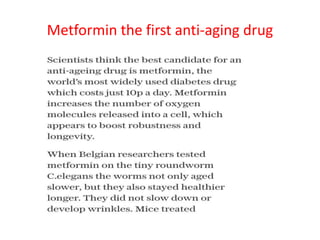
Metformin the first anti-aging drug
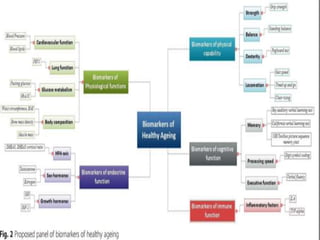
Biomarkers of aging
Everolimus
Trade off between cells
GDF 11- promotes fast healing
Nanog: stem cell gene
Aging
Aging

Aging

  • 1.
  • 3.
    Objectives of theseminar • Define Aging • Components of Aging • Theories and Cellular processes of Aging • Aging changes in specific tissues • Genetic influences on Aging • Gene studies in long lived centenarians • Molecular repair mechanisms to combat wear and tear • Strategies to increase health span and delay Aging
  • 4.
    Define Aging • Agingis easy to recognise but difficult to define. • Most definitions of aging indicate that it is a progressive process associated with declines in structure and function, impaired maintenance and repair systems, increased susceptibility to disease and death and reduced reproductive capacity.
  • 5.
    • Components ofAging Statistical component Phenotypic component
  • 6.
    • Theories ofAging Evolutionary theories - Biological/physiological theories-
  • 7.
    Evolutionary theories • Programmeddeath • Mutation accumulation • Antagonistic pleiotrophy • Life history theory • Disposable soma theory
  • 8.
    Biological/Physiological theories • Wearand tear theory -hydrolytic reactions can damage proteins and nucleotides. - Generation of reactive oxygen species. • Free radical and mitochondrial theory of aging • UV induced free radical generation • Protein glycation- AGE’s
  • 9.
  • 10.
  • 12.
    Free radical andmitochondrial theory of aging- “Free radical theory of aging”- Denham Harmon Life span α 1 metabolic rate Mitochondria are key participitants in apoptosis
  • 13.
    Telomere shortening andreplicative senescence • Secondary to hayflick limit • Cellular clock • Neurons also age
  • 14.
    Altered gene expression,Epigentics, miRNA • Eg: histone acetylation is regulated by many enzymes including SIRT 1, a protein that has marked effect on aging. • Specific miRNA are linked to aging pathways like miR-21 (asso with target of rapamycin pathway) and miR-1 (asso with insulin/IGF pathway)
  • 15.
    Impaired autophagy Lysosomal system, Ubiquitinproteosomal system Lipofuscin, Aggregated proetins
  • 16.
    UV rays canbe extremely damaging UV Rays
  • 17.
    Protein glycation • Proteinglycation often links to the formation of covalent cross links between two proteins or other biological macromolecule. • These cross linked aggregates are sometime called as AGE’s. • Eg: the progressive crosslinking of collagen network in vascular endothelial cells leads to the progressive loss of elasticity and thickening of basement in blood vessels promoting plague formation.
  • 18.
    Aging changes inspecific tissue that predispose to disease • Immune system- decreased T- cells and overproduction of autoantibodies by B-cells • Liver- impaired detoxification, decreased hepatic clearance • Vascular changes- atherosclerosis, myocardial interstitial fibrosis • Sensory- lacrimal gland atrophy, corneal degenerations, cataract etc • Endocrine –hypogonadism and bone diseases.
  • 19.
    Molecular repair mechanisms-combat wear and tear • Enzymatic and chemical mechanism intercept damaging ROS. • The integrity of DNA is maintained by proof reading and repair mechanism • Routine turnover • Aggregated proteins
  • 20.
  • 21.
    Werner syndrome: defectin WRN gene coding for RecQ helicase
  • 22.
    Mutation in LaminA gene producing an abnormal protein called progerin
  • 24.
    Cockayne syndrome: mutationin DNA excision repair proteins ERCC-6 and ERCC-8
  • 25.
    Gene studies inlong lived centenarians • APO E • FOXO 3A • Certain SNP’s
  • 26.
    Strategies to increasehealth span and delay Aging Diet restriction Exercise Drugs – revereratol, rapamycin, spermidine, metformin
  • 29.
    Metformin the firstanti-aging drug
  • 35.
  • 39.
  • 40.
  • 41.
    GDF 11- promotesfast healing
  • 42.

Editor's Notes

  • #27 An article was published in the telegraph
  • #30  In humans, the one having diabetes and taking meformin live 15% longer than who didnt suffer metabolic disease.
  • #38 Lara et al. BMC medicine 2015 13:22 Biomarker of aging are biomarkers that better predict functional capacity at a latter age than chronological age. Biomarkers would give you biological age which may be different than chronological age.
  • #42 Figuring out the right time for treatment is also confusing.