July 12 2016
FIRST UP
What do you expect from your team?
What do you expect from each other?
Do we meet these expectations within our
group(s)/one another?
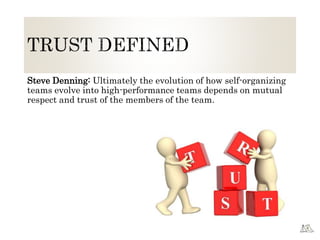
Steve Denning: Ultimately the evolution of how self-organizing
teams evolve into high-performance teams depends on mutual
respect and trust of the members of the team.
 Considered as faith in others’ behavior and goodwill that can
grow or vanish due to interaction and experiences.
 Lack of trust may negatively impact communication,
delegation, empowerment, productivity and results.
 4 elements needed in building trust:
1. Honesty
2. Openness
3. Consistency
4. Respect
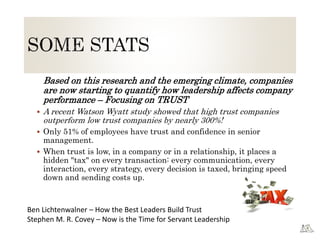
Based on this research and the emerging climate, companies
are now starting to quantify how leadership affects company
performance – Focusing on TRUST
 A recent Watson Wyatt study showed that high trust companies
outperform low trust companies by nearly 300%!
 Only 51% of employees have trust and confidence in senior
management.
 When trust is low, in a company or in a relationship, it places a
hidden "tax" on every transaction: every communication, every
interaction, every strategy, every decision is taxed, bringing speed
down and sending costs up.
Ben Lichtenwalner – How the Best Leaders Build Trust
Stephen M. R. Covey – Now is the Time for Servant Leadership
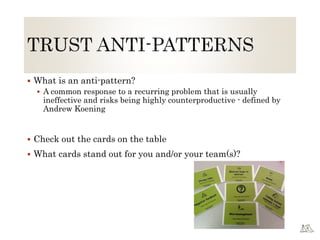
 What is an anti-pattern?
 A common response to a recurring problem that is usually
ineffective and risks being highly counterproductive - defined by
Andrew Koening
 Check out the cards on the table
 What cards stand out for you and/or your team(s)?
 Counteracting the anti-patterns
 Check out the cards on the table
 What cards would counteract your anti-patterns?
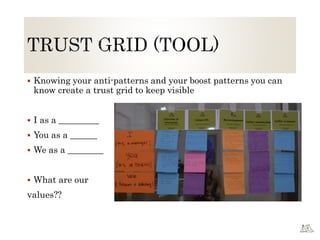
 Knowing your anti-patterns and your boost patterns you can
know create a trust grid to keep visible
 I as a _________
 You as a ______
 We as a ________
 What are our
values??
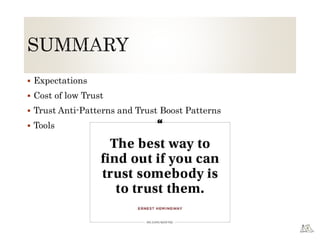
 Expectations
 Cost of low Trust
 Trust Anti-Patterns and Trust Boost Patterns
 Tools
Agile camp2016 trust

Agile camp2016 trust

  • 1.
  • 2.
    FIRST UP What doyou expect from your team? What do you expect from each other? Do we meet these expectations within our group(s)/one another?
  • 3.
    Steve Denning: Ultimatelythe evolution of how self-organizing teams evolve into high-performance teams depends on mutual respect and trust of the members of the team.
  • 4.
     Considered asfaith in others’ behavior and goodwill that can grow or vanish due to interaction and experiences.  Lack of trust may negatively impact communication, delegation, empowerment, productivity and results.  4 elements needed in building trust: 1. Honesty 2. Openness 3. Consistency 4. Respect
  • 5.
    Based on thisresearch and the emerging climate, companies are now starting to quantify how leadership affects company performance – Focusing on TRUST  A recent Watson Wyatt study showed that high trust companies outperform low trust companies by nearly 300%!  Only 51% of employees have trust and confidence in senior management.  When trust is low, in a company or in a relationship, it places a hidden "tax" on every transaction: every communication, every interaction, every strategy, every decision is taxed, bringing speed down and sending costs up. Ben Lichtenwalner – How the Best Leaders Build Trust Stephen M. R. Covey – Now is the Time for Servant Leadership
  • 6.
     What isan anti-pattern?  A common response to a recurring problem that is usually ineffective and risks being highly counterproductive - defined by Andrew Koening  Check out the cards on the table  What cards stand out for you and/or your team(s)?
  • 7.
     Counteracting theanti-patterns  Check out the cards on the table  What cards would counteract your anti-patterns?
  • 8.
     Knowing youranti-patterns and your boost patterns you can know create a trust grid to keep visible  I as a _________  You as a ______  We as a ________  What are our values??
  • 10.
     Expectations  Costof low Trust  Trust Anti-Patterns and Trust Boost Patterns  Tools

Editor's Notes

  • #3 Round table discussion Belief that what comes out is rooted in Trust Hope to hear: honest, open, respectful, work hard, productive, care, ownership, accountable, committed
  • #5 Without one of the 4 elements, trust can fray or even break
  • #6 Dive deeper around tax – checking work, multiple gates, 5 people have to make a decision but can’t align calendars, need to be invited because don’t trust the information coming back, etc.
  • #7 3 minute timebox
  • #8 7 minute exercise
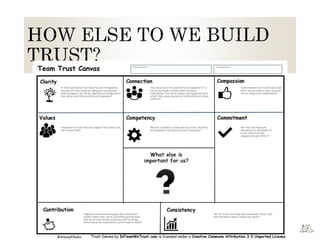
  • #10 Clarity. A Team experiences trust when they see transparency and mistrust when things are ambiguous. How shall we build and support the clarity, openness and transparency? How can we avoid the uncertainty and vagueness? Connection. It is natural for people to follow others and build relationships. How can we connect and engage with each other? How can we improve our relationships and reduce conflicts? Compassion. Team members need to care about each other. Are we ready to show concerns? Are we ready to be compassionate? Value. People want to trust those who support their values. How can we align them? Competency. We have confidence in those who stay fresh, innovative and competent. How do we grow our competency? Commitment. We trust only those who demonstrate a commitment to action. How do we take responsibility and fulfill it? Contribution. People are motivated and engaged when they deliver results. People trust results. Is anything getting done? How do our rules and policies promote getting things done? How do our organization’s culture reward results? Consistency. We like to see the things done consistently. Is our trust and confidence rising or falling each Sprint? The most important part. What else is important for us?