A ggregation  C omputation  O ver  D istributed  D ata  S treams (partial content) Yueshen Xu Middleware, CCNT  Zhejiang University Middleware, CCNT, ZJU 12/15/11
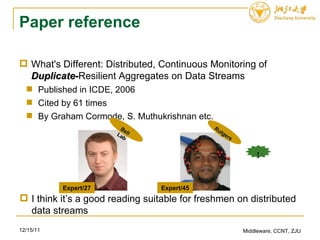
Paper reference What's Different: Distributed, Continuous Monitoring of  Duplicate- Resilient Aggregates on Data Streams Published in ICDE, 2006 Cited by 61 times By Graham Cormode, S. Muthukrishnan etc. 12/15/11 Middleware, CCNT, ZJU I think it’s a good reading suitable for freshmen on distributed data streams Bell Lab Expert/27 Rutgers Expert/45 !
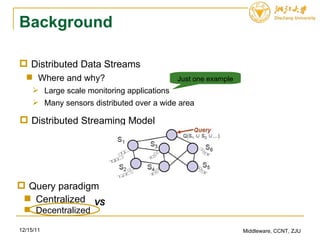
Background Distributed Data Streams Where and why? Large scale monitoring applications Many sensors distributed over a wide area 12/15/11 Middleware, CCNT, ZJU Just one example Distributed Streaming Model Query paradigm Centralized Decentralized VS
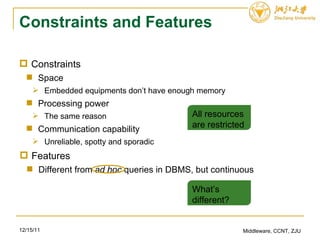
Constraints and Features Constraints Space  Embedded equipments don’t have enough memory  Processing power The same reason Communication capability Unreliable, spotty and sporadic 12/15/11 Middleware, CCNT, ZJU All resources are restricted Features Different from  ad hoc  queries in DBMS, but continuous What’s different?
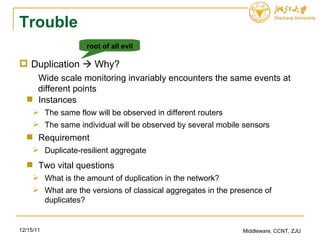
Trouble Duplication    Why? Wide scale monitoring invariably encounters the same events at different points 12/15/11 Middleware, CCNT, ZJU Instances The same flow will be observed in different routers The same individual will be observed by several mobile sensors Requirement Duplicate-resilient aggregate Two vital questions What is the amount of duplication in the network? What are the versions of classical aggregates in the presence of duplicates?   root of all evil
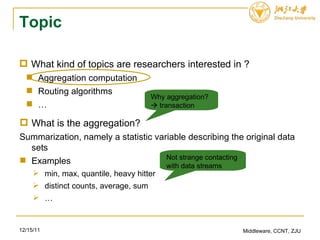
Topic What kind of topics are researchers interested in ? Aggregation computation Routing algorithms … What is the aggregation? Summarization, namely a statistic variable describing the original data sets Examples min, max, quantile, heavy hitter distinct counts, average, sum … 12/15/11 Middleware, CCNT, ZJU Not strange contacting with data streams Why aggregation?    transaction
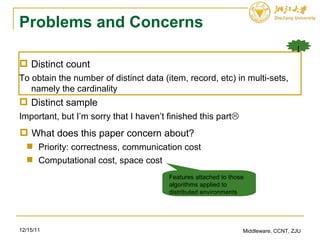
Problems and Concerns Distinct count To obtain the number of distinct data (item, record, etc) in multi-sets, namely the cardinality Distinct sample Important, but I’m sorry that I haven’t finished this part    12/15/11 Middleware, CCNT, ZJU What does this paper concern about? Priority: correctness, communication cost Computational cost, space cost ! Features attached to those algorithms applied to distributed environments
Distinct Counting:  Flajolet-Martin Sketch Flajolet-Martin Sketch P. Flajolet, G. Martin . Probabilistic Counting Algorithms for Data Base Applications . Journal of Computer and System Sciences, 1985(Cited by 628) Goal: To estimate the cardinalities of multi-sets of data using  relative small space by one pass scan The sketch is a kind of data structure, which is the way to obtain the aggregation results.  (skyline)   I think this method can be regarded as the classical application  of probability without complexity. 12/15/11 Middleware, CCNT, ZJU Give a question: How about you dealing with this problem? The computing paradigm of sketching Be appropriate for using in data streams inherently
Flajolet-Martin Sketch(Cont.) Preliminary    what do we need? the Multi-set M, containing all items/records, and |M| = n the upper bound on the number of distinct  items/records U, which is more than n the bitmap B, consisting of L elements, and 2 L  = U the hash function h(x: item/record), transforming each items  into a binary string distributed uniformly over the range of [1…2 L ], just like b 1 b 2 …b L , in which b 1  is the lowest digit, and b L  is the highest  the p(x), attaining the left most  position of ‘1’ 12/15/11 Middleware, CCNT, ZJU counting not computing 1 1 … 0 B 0 PPT  VS Whiteboard ? x record h(x) 1 L
Flajolet-Martin Sketch(Cont.) The algorithm itself the core task: Remarking the position of which the leftmost ‘1’ of the hash value recorded by p(x) in bitmap B  12/15/11 Middleware, CCNT, ZJU for i:=1 to L do bitmap[i] :=0  for all x in M do  begin  index := p(hash(x)); if bitmap[index] = the bitmap[index] :=1; end Why?
Flajolet-Martin Sketch(Cont.) The explanation The fact: bitmap[k] equals to 1 iff  after execution a pattern of the form 0 k-1 1 has appeared amongst hashed values of records in M The probability: the occurrence probability of the pattern 0 k-1 1 is 1/2 k Occurrence times: so if |M| = n, then bitmap[1] is accessed approximately n/2 times, bitmap[2] approximately n/4 times Extension: bitmap[k] will almost certainly be zero if k >> log 2 (n) and one if k << log 2 (n) wit a fringe of 0 and 1 for k ≈ log 2 (n) Selection: the leftmost 0, the rightmost 1 or something else 12/15/11 Middleware, CCNT, ZJU U The most practical part is over, and the left is very complicated taken for proving and error analysis, namely all about mathematic for i:=1 to L do bitmap[i] :=0  for all x in M do  begin  index := p(hash(x)); if bitmap[index] = the bitmap[index] :=1; end
Flajolet-Martin Sketch(Cont.) Conclusion Analysis Bit-based, reducing the space complexity by constant level Space complexity O(log(n))    O(log(log(n))) Duplicate-insensitive    duplicate-resilient and flexible Order-insensitive    stable and robust Additivity    The ability to merge two FM sketches together, and the merger is simply the bitwise-or of each pair of corresponding bitmaps Questions How to make the value of U? What’s the relationship of U and n? How to make the analysis to the error? … 12/15/11 Middleware, CCNT, ZJU nice qualities for distributed aggregation
Question What’s the relationship between sketch and skyline? Are they the same? Or… Does the  aggregation computation  belong to the research fields of  data mining ? No, I think 12/15/11 Middleware, CCNT, ZJU
Q&A 12/15/11 Middleware, CCNT, ZJU

Aggregation computation over distributed data streams

  • 1.
    A ggregation C omputation O ver D istributed D ata S treams (partial content) Yueshen Xu Middleware, CCNT Zhejiang University Middleware, CCNT, ZJU 12/15/11
  • 2.
    Paper reference What'sDifferent: Distributed, Continuous Monitoring of Duplicate- Resilient Aggregates on Data Streams Published in ICDE, 2006 Cited by 61 times By Graham Cormode, S. Muthukrishnan etc. 12/15/11 Middleware, CCNT, ZJU I think it’s a good reading suitable for freshmen on distributed data streams Bell Lab Expert/27 Rutgers Expert/45 !
  • 3.
    Background Distributed DataStreams Where and why? Large scale monitoring applications Many sensors distributed over a wide area 12/15/11 Middleware, CCNT, ZJU Just one example Distributed Streaming Model Query paradigm Centralized Decentralized VS
  • 4.
    Constraints and FeaturesConstraints Space Embedded equipments don’t have enough memory Processing power The same reason Communication capability Unreliable, spotty and sporadic 12/15/11 Middleware, CCNT, ZJU All resources are restricted Features Different from ad hoc queries in DBMS, but continuous What’s different?
  • 5.
    Trouble Duplication  Why? Wide scale monitoring invariably encounters the same events at different points 12/15/11 Middleware, CCNT, ZJU Instances The same flow will be observed in different routers The same individual will be observed by several mobile sensors Requirement Duplicate-resilient aggregate Two vital questions What is the amount of duplication in the network? What are the versions of classical aggregates in the presence of duplicates?   root of all evil
  • 6.
    Topic What kindof topics are researchers interested in ? Aggregation computation Routing algorithms … What is the aggregation? Summarization, namely a statistic variable describing the original data sets Examples min, max, quantile, heavy hitter distinct counts, average, sum … 12/15/11 Middleware, CCNT, ZJU Not strange contacting with data streams Why aggregation?  transaction
  • 7.
    Problems and ConcernsDistinct count To obtain the number of distinct data (item, record, etc) in multi-sets, namely the cardinality Distinct sample Important, but I’m sorry that I haven’t finished this part  12/15/11 Middleware, CCNT, ZJU What does this paper concern about? Priority: correctness, communication cost Computational cost, space cost ! Features attached to those algorithms applied to distributed environments
  • 8.
    Distinct Counting: Flajolet-Martin Sketch Flajolet-Martin Sketch P. Flajolet, G. Martin . Probabilistic Counting Algorithms for Data Base Applications . Journal of Computer and System Sciences, 1985(Cited by 628) Goal: To estimate the cardinalities of multi-sets of data using relative small space by one pass scan The sketch is a kind of data structure, which is the way to obtain the aggregation results. (skyline) I think this method can be regarded as the classical application of probability without complexity. 12/15/11 Middleware, CCNT, ZJU Give a question: How about you dealing with this problem? The computing paradigm of sketching Be appropriate for using in data streams inherently
  • 9.
    Flajolet-Martin Sketch(Cont.) Preliminary  what do we need? the Multi-set M, containing all items/records, and |M| = n the upper bound on the number of distinct items/records U, which is more than n the bitmap B, consisting of L elements, and 2 L = U the hash function h(x: item/record), transforming each items into a binary string distributed uniformly over the range of [1…2 L ], just like b 1 b 2 …b L , in which b 1 is the lowest digit, and b L is the highest the p(x), attaining the left most position of ‘1’ 12/15/11 Middleware, CCNT, ZJU counting not computing 1 1 … 0 B 0 PPT VS Whiteboard ? x record h(x) 1 L
  • 10.
    Flajolet-Martin Sketch(Cont.) Thealgorithm itself the core task: Remarking the position of which the leftmost ‘1’ of the hash value recorded by p(x) in bitmap B 12/15/11 Middleware, CCNT, ZJU for i:=1 to L do bitmap[i] :=0 for all x in M do begin index := p(hash(x)); if bitmap[index] = the bitmap[index] :=1; end Why?
  • 11.
    Flajolet-Martin Sketch(Cont.) Theexplanation The fact: bitmap[k] equals to 1 iff after execution a pattern of the form 0 k-1 1 has appeared amongst hashed values of records in M The probability: the occurrence probability of the pattern 0 k-1 1 is 1/2 k Occurrence times: so if |M| = n, then bitmap[1] is accessed approximately n/2 times, bitmap[2] approximately n/4 times Extension: bitmap[k] will almost certainly be zero if k >> log 2 (n) and one if k << log 2 (n) wit a fringe of 0 and 1 for k ≈ log 2 (n) Selection: the leftmost 0, the rightmost 1 or something else 12/15/11 Middleware, CCNT, ZJU U The most practical part is over, and the left is very complicated taken for proving and error analysis, namely all about mathematic for i:=1 to L do bitmap[i] :=0 for all x in M do begin index := p(hash(x)); if bitmap[index] = the bitmap[index] :=1; end
  • 12.
    Flajolet-Martin Sketch(Cont.) ConclusionAnalysis Bit-based, reducing the space complexity by constant level Space complexity O(log(n))  O(log(log(n))) Duplicate-insensitive  duplicate-resilient and flexible Order-insensitive  stable and robust Additivity  The ability to merge two FM sketches together, and the merger is simply the bitwise-or of each pair of corresponding bitmaps Questions How to make the value of U? What’s the relationship of U and n? How to make the analysis to the error? … 12/15/11 Middleware, CCNT, ZJU nice qualities for distributed aggregation
  • 13.
    Question What’s therelationship between sketch and skyline? Are they the same? Or… Does the aggregation computation belong to the research fields of data mining ? No, I think 12/15/11 Middleware, CCNT, ZJU
  • 14.