Social Recommender System
2015/4/10 1Middleware, CCNT, ZJU
Yueshen Xu
Middleware, CCNT, ZJU
xyshzjucs@zju.edu.cn
xyshzjucs@gmail.com
Knowledge
Engineering
&
E-Commerce
Outline
2015/4/10 2Middleware, CCNT, ZJU
 Where from?
 How to recommend?
 What to recommend?
 What’s the problem?
 ML & DM
 Related Topics
 Trends
What’s your
perspective?
Basic, Generalized, Comprehensible
Introduction
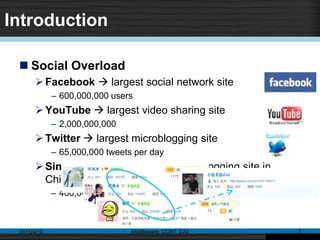
 Social Overload
Facebook  largest social network site
– 600,000,000 users
YouTube  largest video sharing site
– 2,000,000,000
Twitter  largest microblogging site
– 65,000,000 tweets per day
Sina microblog  largest microblogging site in
China
– 400,000,000 users
2015/4/10 Middleware, CCNT, ZJU 3
Introduction
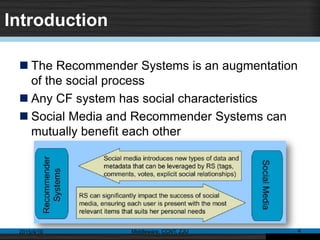
 The Recommender Systems is an augmentation
of the social process
 Any CF system has social characteristics
 Social Media and Recommender Systems can
mutually benefit each other
2015/4/10 Middleware, CCNT, ZJU 4
Introduction
2015/4/10 Middleware, CCNT, ZJU 5
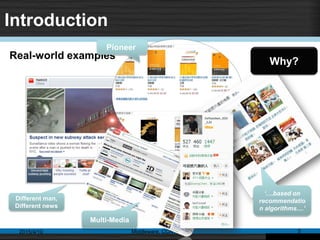
Real-world examples
Why?
Different man,
Different news
Pioneer
‘....based on
recommendatio
n algorithms....’
Multi-Media
Fundamental Recommendation Approaches
 Collaborative filtering based Recommendation
Aggregate ratings of objects from users and generate
recommendation based on inter-user/inter-item
similarity
 Demographic Recommendation
Age,gender,income…
 Content-based Recommendation
Music gene
 Hybrid Methods
Mixed
2015/4/10 Middleware, CCNT, ZJU 6
Your imagination
Fundamental Recommendation Approaches
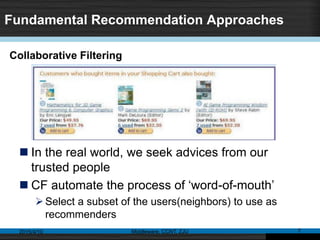
 In the real world, we seek advices from our
trusted people
 CF automate the process of ‘word-of-mouth’
Select a subset of the users(neighbors) to use as
recommenders
2015/4/10 Middleware, CCNT, ZJU 7
Collaborative Filtering
Fundamental Recommendation Approaches
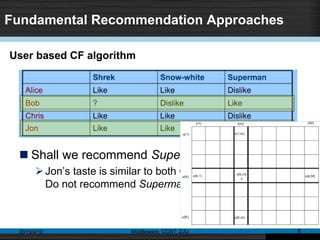
 Shall we recommend Superman for John?
Jon’s taste is similar to both Chris and Alice tastes 
Do not recommend Superman to him
2015/4/10 Middleware, CCNT, ZJU 8
User based CF algorithm
Fundamental Recommendation Approaches
2015/4/10 Middleware, CCNT, ZJU 9
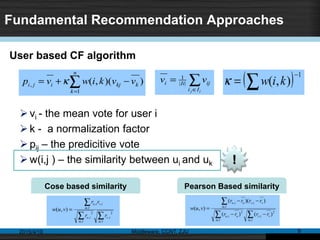
User based CF algorithm
vi - the mean vote for user i
k - a normalization factor
pij – the predicitive vote
w(i,j ) – the similarity between ui and uk !
Cose based similarity Pearson Based similarity
Fundamental Recommendation Approaches
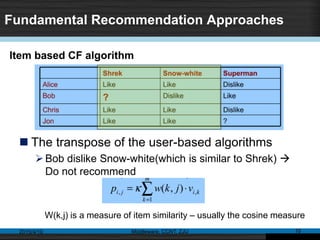
 The transpose of the user-based algorithms
Bob dislike Snow-white(which is similar to Shrek) 
Do not recommend
2015/4/10 Middleware, CCNT, ZJU 10
Item based CF algorithm
W(k,j) is a measure of item similarity – usually the cosine measure
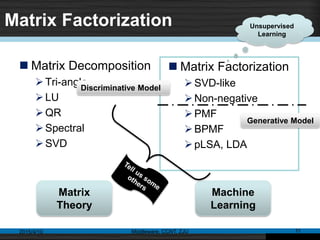
Matrix Factorization
 Matrix Decomposition
Tri-angle
LU
QR
Spectral
SVD
2015/4/10 Middleware, CCNT, ZJU 11
 Matrix Factorization
SVD-like
Non-negative
PMF
BPMF
pLSA, LDA
Matrix
Theory
Machine
Learning
Discriminative Model
Generative Model
Unsupervised
Learning
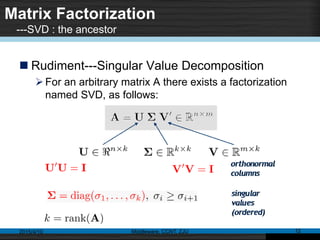
Matrix Factorization
---SVD : the ancestor
 Rudiment---Singular Value Decomposition
For an arbitrary matrix A there exists a factorization
named SVD, as follows:
2015/4/10 Middleware, CCNT, ZJU 12
Matrix Factorization
---Latent Semantic Analysis  PTM  LDA
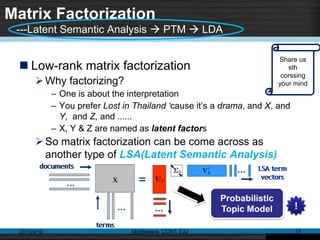
 Low-rank matrix factorization
Why factorizing?
– One is about the interpretation
– You prefer Lost in Thailand ‘cause it’s a drama, and X, and
Y, and Z, and ......
– X, Y & Z are named as latent factors
So matrix factorization can be come across as
another type of LSA(Latent Semantic Analysis)
2015/4/10 Middleware, CCNT, ZJU 13
Share us
sth
corssing
your mind
Probabilistic
Topic Model !
Matrix Factorization
---SVD-Like : low-rank matrix factorization
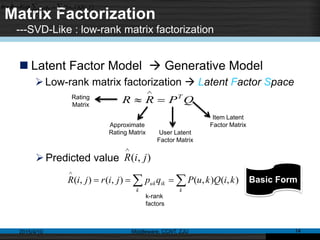
 Latent Factor Model  Generative Model
Low-rank matrix factorization  Latent Factor Space
2015/4/10 Middleware, CCNT, ZJU 14
QPRR T


QPRR T


QPRR T


QPRR T


QPRR T


QPRR T


Rating
Matrix
Approximate
Rating Matrix User Latent
Factor Matrix
Item Latent
Factor Matrix
 

ff
ifufui fiQfuPqpriuR ),(),(),(
Predicted value ),( jiR

 

kk
ikuk kiQkuPqpjirjiR ),(),(),(),(
k-rank
factors
Basic Form
Matrix Factorization
---SVD-Like : low-rank matrix factorization
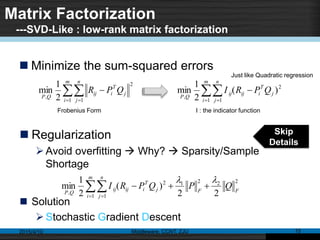
 Minimize the sum-squared errors
2015/4/10 Middleware, CCNT, ZJU 15
Skip
Details
 

m
i
n
j
j
T
iij
QP
QPR
1 1
2
, 2
1
min  

m
i
n
j
j
T
iijij
QP
QPRI
1 1
2
,
)(
2
1
min
Frobenius Form
Just like Quadratic regression
I : the indicator function
 Regularization
Avoid overfitting  Why?  Sparsity/Sample
Shortage
2221
1 1
2
, 22
)(
2
1
min FF
m
i
n
j
j
T
iijij
QP
QPQPRI

 
 Solution
Stochastic Gradient Descent
Matrix Factorization
---PMF : the production of Bayesian Theory
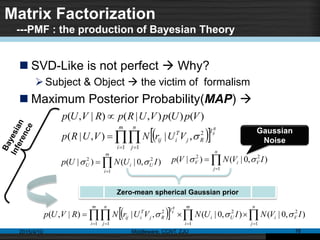
 SVD-Like is not perfect  Why?
Subject & Object  the victim of formalism
 Maximum Posterior Probability(MAP) 
2015/4/10 Middleware, CCNT, ZJU 16
)()(),|()|,( VpUpVURpRVUp 
   

m
i
n
j
I
Rj
T
iij
R
ij
VUrNVURp
1 1
2
,|),|( 


m
i
UiU IUNUp
1
22
),0|()|(  

n
j
ViV IVNVp
1
22
),0|()|( 
Gaussian
Noise
     

n
j
Vi
m
i
Ui
m
i
n
j
I
Rj
T
iij IVNIUNVUrNRVUp
R
ij
1
2
1
2
1 1
2
),0|(),0|(,|)|,( 
Zero-mean spherical Gaussian prior
Surroundings
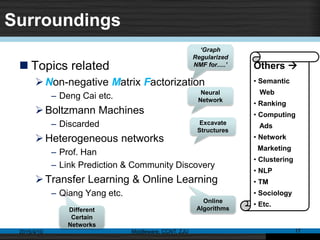
 Topics related
Non-negative Matrix Factorization
– Deng Cai etc.
Boltzmann Machines
– Discarded
Heterogeneous networks
– Prof. Han
– Link Prediction & Community Discovery
Transfer Learning & Online Learning
– Qiang Yang etc.
2015/4/10 Middleware, CCNT, ZJU 17
Excavate
Structures
Neural
Network
‘Graph
Regularized
NMF for.....’
Different
Certain
Networks
Online
Algorithms
Others 
• Semantic
Web
• Ranking
• Computing
Ads
• Network
Marketing
• Clustering
• NLP
• TM
• Sociology
• Etc.
Trends
---Horizontal Expansion
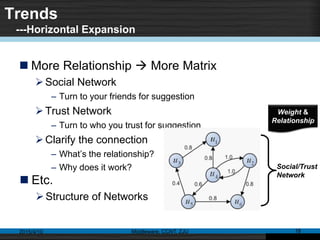
 More Relationship  More Matrix
Social Network
– Turn to your friends for suggestion
Trust Network
– Turn to who you trust for suggestion
Clarify the connection
– What’s the relationship?
– Why does it work?
2015/4/10 Middleware, CCNT, ZJU 18
Weight &
Relationship
Social/Trust
Network
 Etc.
Structure of Networks
Trends
---Vertical Expansion
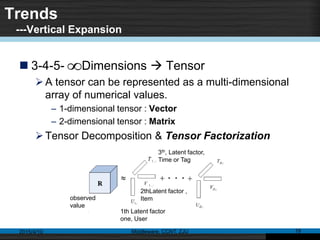
 3-4-5- Dimensions  Tensor
A tensor can be represented as a multi-dimensional
array of numerical values.
– 1-dimensional tensor : Vector
– 2-dimensional tensor : Matrix
Tensor Decomposition & Tensor Factorization
2015/4/10 Middleware, CCNT, ZJU 19
observed
value
3th, Latent factor,
Time or Tag
1th Latent factor
one, User
2thLatent factor ,
Item

2015/4/10 20Middleware, CCNT, ZJU
Social Recommender System

Social recommender system

  • 1.
    Social Recommender System 2015/4/101Middleware, CCNT, ZJU Yueshen Xu Middleware, CCNT, ZJU xyshzjucs@zju.edu.cn xyshzjucs@gmail.com Knowledge Engineering & E-Commerce
  • 2.
    Outline 2015/4/10 2Middleware, CCNT,ZJU  Where from?  How to recommend?  What to recommend?  What’s the problem?  ML & DM  Related Topics  Trends What’s your perspective? Basic, Generalized, Comprehensible
  • 3.
    Introduction  Social Overload Facebook largest social network site – 600,000,000 users YouTube  largest video sharing site – 2,000,000,000 Twitter  largest microblogging site – 65,000,000 tweets per day Sina microblog  largest microblogging site in China – 400,000,000 users 2015/4/10 Middleware, CCNT, ZJU 3
  • 4.
    Introduction  The RecommenderSystems is an augmentation of the social process  Any CF system has social characteristics  Social Media and Recommender Systems can mutually benefit each other 2015/4/10 Middleware, CCNT, ZJU 4
  • 5.
    Introduction 2015/4/10 Middleware, CCNT,ZJU 5 Real-world examples Why? Different man, Different news Pioneer ‘....based on recommendatio n algorithms....’ Multi-Media
  • 6.
    Fundamental Recommendation Approaches Collaborative filtering based Recommendation Aggregate ratings of objects from users and generate recommendation based on inter-user/inter-item similarity  Demographic Recommendation Age,gender,income…  Content-based Recommendation Music gene  Hybrid Methods Mixed 2015/4/10 Middleware, CCNT, ZJU 6 Your imagination
  • 7.
    Fundamental Recommendation Approaches In the real world, we seek advices from our trusted people  CF automate the process of ‘word-of-mouth’ Select a subset of the users(neighbors) to use as recommenders 2015/4/10 Middleware, CCNT, ZJU 7 Collaborative Filtering
  • 8.
    Fundamental Recommendation Approaches Shall we recommend Superman for John? Jon’s taste is similar to both Chris and Alice tastes  Do not recommend Superman to him 2015/4/10 Middleware, CCNT, ZJU 8 User based CF algorithm
  • 9.
    Fundamental Recommendation Approaches 2015/4/10Middleware, CCNT, ZJU 9 User based CF algorithm vi - the mean vote for user i k - a normalization factor pij – the predicitive vote w(i,j ) – the similarity between ui and uk ! Cose based similarity Pearson Based similarity
  • 10.
    Fundamental Recommendation Approaches The transpose of the user-based algorithms Bob dislike Snow-white(which is similar to Shrek)  Do not recommend 2015/4/10 Middleware, CCNT, ZJU 10 Item based CF algorithm W(k,j) is a measure of item similarity – usually the cosine measure
  • 11.
    Matrix Factorization  MatrixDecomposition Tri-angle LU QR Spectral SVD 2015/4/10 Middleware, CCNT, ZJU 11  Matrix Factorization SVD-like Non-negative PMF BPMF pLSA, LDA Matrix Theory Machine Learning Discriminative Model Generative Model Unsupervised Learning
  • 12.
    Matrix Factorization ---SVD :the ancestor  Rudiment---Singular Value Decomposition For an arbitrary matrix A there exists a factorization named SVD, as follows: 2015/4/10 Middleware, CCNT, ZJU 12
  • 13.
    Matrix Factorization ---Latent SemanticAnalysis  PTM  LDA  Low-rank matrix factorization Why factorizing? – One is about the interpretation – You prefer Lost in Thailand ‘cause it’s a drama, and X, and Y, and Z, and ...... – X, Y & Z are named as latent factors So matrix factorization can be come across as another type of LSA(Latent Semantic Analysis) 2015/4/10 Middleware, CCNT, ZJU 13 Share us sth corssing your mind Probabilistic Topic Model !
  • 14.
    Matrix Factorization ---SVD-Like :low-rank matrix factorization  Latent Factor Model  Generative Model Low-rank matrix factorization  Latent Factor Space 2015/4/10 Middleware, CCNT, ZJU 14 QPRR T   QPRR T   QPRR T   QPRR T   QPRR T   QPRR T   Rating Matrix Approximate Rating Matrix User Latent Factor Matrix Item Latent Factor Matrix    ff ifufui fiQfuPqpriuR ),(),(),( Predicted value ),( jiR     kk ikuk kiQkuPqpjirjiR ),(),(),(),( k-rank factors Basic Form
  • 15.
    Matrix Factorization ---SVD-Like :low-rank matrix factorization  Minimize the sum-squared errors 2015/4/10 Middleware, CCNT, ZJU 15 Skip Details    m i n j j T iij QP QPR 1 1 2 , 2 1 min    m i n j j T iijij QP QPRI 1 1 2 , )( 2 1 min Frobenius Form Just like Quadratic regression I : the indicator function  Regularization Avoid overfitting  Why?  Sparsity/Sample Shortage 2221 1 1 2 , 22 )( 2 1 min FF m i n j j T iijij QP QPQPRI     Solution Stochastic Gradient Descent
  • 16.
    Matrix Factorization ---PMF :the production of Bayesian Theory  SVD-Like is not perfect  Why? Subject & Object  the victim of formalism  Maximum Posterior Probability(MAP)  2015/4/10 Middleware, CCNT, ZJU 16 )()(),|()|,( VpUpVURpRVUp       m i n j I Rj T iij R ij VUrNVURp 1 1 2 ,|),|(    m i UiU IUNUp 1 22 ),0|()|(    n j ViV IVNVp 1 22 ),0|()|(  Gaussian Noise        n j Vi m i Ui m i n j I Rj T iij IVNIUNVUrNRVUp R ij 1 2 1 2 1 1 2 ),0|(),0|(,|)|,(  Zero-mean spherical Gaussian prior
  • 17.
    Surroundings  Topics related Non-negativeMatrix Factorization – Deng Cai etc. Boltzmann Machines – Discarded Heterogeneous networks – Prof. Han – Link Prediction & Community Discovery Transfer Learning & Online Learning – Qiang Yang etc. 2015/4/10 Middleware, CCNT, ZJU 17 Excavate Structures Neural Network ‘Graph Regularized NMF for.....’ Different Certain Networks Online Algorithms Others  • Semantic Web • Ranking • Computing Ads • Network Marketing • Clustering • NLP • TM • Sociology • Etc.
  • 18.
    Trends ---Horizontal Expansion  MoreRelationship  More Matrix Social Network – Turn to your friends for suggestion Trust Network – Turn to who you trust for suggestion Clarify the connection – What’s the relationship? – Why does it work? 2015/4/10 Middleware, CCNT, ZJU 18 Weight & Relationship Social/Trust Network  Etc. Structure of Networks
  • 19.
    Trends ---Vertical Expansion  3-4-5-Dimensions  Tensor A tensor can be represented as a multi-dimensional array of numerical values. – 1-dimensional tensor : Vector – 2-dimensional tensor : Matrix Tensor Decomposition & Tensor Factorization 2015/4/10 Middleware, CCNT, ZJU 19 observed value 3th, Latent factor, Time or Tag 1th Latent factor one, User 2thLatent factor , Item 
  • 20.
    2015/4/10 20Middleware, CCNT,ZJU Social Recommender System