Aircrafts
Types and Construction
Nikhilesh Vaidya,
T.Y.
Instrumentation Engg.,
S.G.G.S.I.E.&T., Nanded.
What is an Airplane?
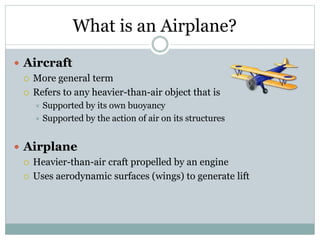
 Aircraft
 More general term
 Refers to any heavier-than-air object that is
 Supported by its own buoyancy
 Supported by the action of air on its structures
 Airplane
 Heavier-than-air craft propelled by an engine
 Uses aerodynamic surfaces (wings) to generate lift
What is an Airplane?
Every airplane is an aircraft, but not every aircraft is
an airplane.
 Space shuttle
 Gliders
 Helicopters
Types of Aircraft
 Aircraft are categorized according to their intended
purpose.
 There are three common categories, they are:
 General Aviation
 Commercial Aviation
 Military Aviation
General Aviation
 General aviation includes those used for training,
business and agricultural.
 Aircraft in this category generally hold less than 12
passengers.
Commercial Aviation
 This category includes commuter, cargo, and
Firefighting aircraft.
 Usually hold in excess of 20 passengers.
Military Aircraft
 Military aircraft include
Cargo, Fighter, Bomber,
trainer, and special
mission.
 A-attack
 B-Bomber
 C-Cargo
 F-Fighter
 H-Helicopter
 K-Refueling Tanker
 O-Observation
 S-Surveillance
 T-Trainer
 U-Utility
 V-Vertical Take-off
 X-Experimental
Military Aviation Helicopters
 Helicopters are rotary wing A/C ranging in size from
single seat to 50 passenger.
 Some carry loads in excess of 10 tons.
 Fuel capacities range from 70-1000 gal.
 Internal fuel tanks are usually located under the
cabin floor.
 Auxiliary fuel tanks are located in the aft section or
attached to the outside of the cabin
Military Aviation Helicopters
 Helicopters are constructed mainly of Aluminum,
Magnesium, Titanium, and composites.
 Hazards included:
 Rotor blades which can dip to 4’ of the ground
 The tail rotor which can be nearly invisible when spinning.
 Approaching from uphill or carrying objects above the waist.
Military Aviation Helicopters
 Safety around Helicopters:
 Always approach in sight of the pilot
 Approach when pilot gives signal
 Approach from downhill if possible.
 Carry objects horizontally below waist
 Maintain sufficient clearance for the main rotor and tail rotor,
Clear the ground around the A/C for at least 50’ the the
helipad.
Types
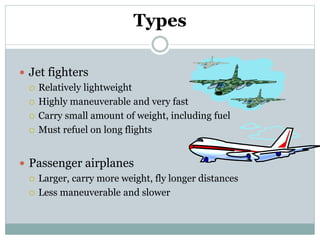
 Jet fighters
 Relatively lightweight
 Highly maneuverable and very fast
 Carry small amount of weight, including fuel
 Must refuel on long flights
 Passenger airplanes
 Larger, carry more weight, fly longer distances
 Less maneuverable and slower
More Types
Twin-engine
Sport plane
Turboprop
Cargo plane Business jet
Single-engine
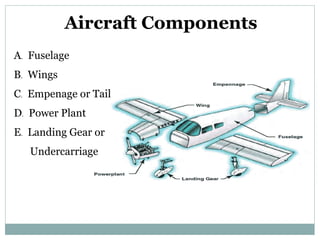
A. Fuselage
B. Wings
C. Empenage or Tail
D. Power Plant
E. Landing Gear or
Undercarriage
Aircraft Components
Propeller
Landing
Gear
Wing
Left Aileron
Fuselage
Empennage
Nacelle
Right Aileron
Wing
Horizonta
l
Stabilizer
Vertical
Stabilizer
Rudder
Elevator
Fuselage
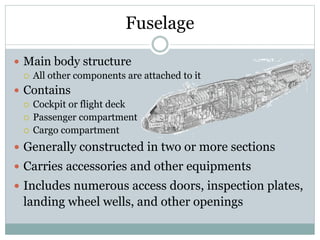
 Main body structure
 All other components are attached to it
 Contains
 Cockpit or flight deck
 Passenger compartment
 Cargo compartment
 Generally constructed in two or more sections
 Carries accessories and other equipments
 Includes numerous access doors, inspection plates,
landing wheel wells, and other openings
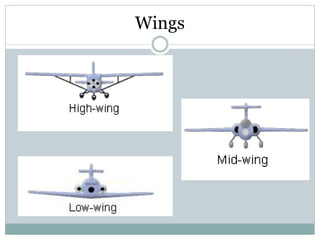
Wings
 Most important lift-producing part of the aircraft
 Also carries the fuel
 Designed so that the outer tips of the wings are
higher than where the wings are attached to the
fuselage
 Called the dihedral
 Helps keep the airplane from rolling unexpectedly
Wings
Wing Designs
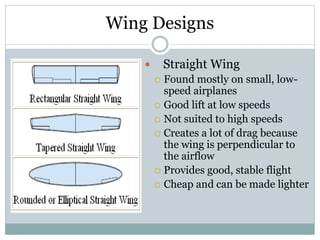
 Straight Wing
 Found mostly on small, low-
speed airplanes
 Good lift at low speeds
 Not suited to high speeds
 Creates a lot of drag because
the wing is perpendicular to
the airflow
 Provides good, stable flight
 Cheap and can be made lighter
Wing Designs
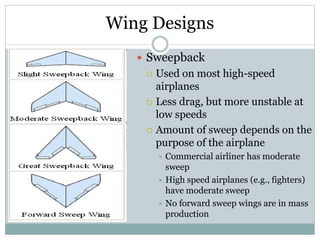
 Sweepback
 Used on most high-speed
airplanes
 Less drag, but more unstable at
low speeds
 Amount of sweep depends on the
purpose of the airplane
 Commercial airliner has moderate
sweep
 High speed airplanes (e.g., fighters)
have moderate sweep
 No forward sweep wings are in mass
production
Wing Designs
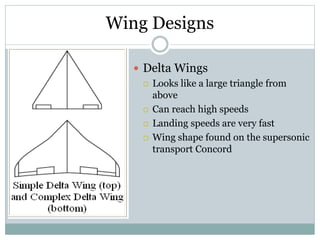
 Delta Wings
 Looks like a large triangle from
above
 Can reach high speeds
 Landing speeds are very fast
 Wing shape found on the supersonic
transport Concord
Empennage
 Also known as the tail
assembly
 Provides stability and
control
 Two main parts
 Vertical stabilizer (fin) to
which the rudder is
attached
 Horizontal stabilizer to
which the elevators are
attached
Power Plant
A unit or machine that converts chemical energy contains in
the fuel to thrust force. Thrust force is essential for moving
the airplane forward and producing lift force. With the piston
engine, the propeller is used to convert torque at engine shaft
to be thrust. With the jet engine, the jet engine output is the
thrust force.
Undercarriage
 Also known as the landing gear, which is made up of
 Struts
 Wheels
 Brakes
 Can be fixed or retractable
 Located underneath of the
fuselage with shock strut
 Fixed / Retractable
 Tri- cycle –Conventional type
 Floating gear for seaplane /ski-
equipped for ice surface landing etc..
Landing Gear
Controls
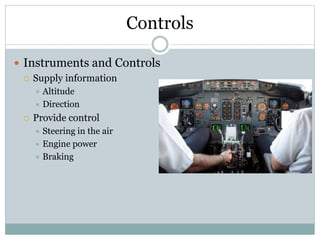
 Instruments and Controls
 Supply information
 Altitude
 Direction
 Provide control
 Steering in the air and on the ground
 Engine power
 Braking
Black box
- High Strength to Weight
ratio
- Light weight
- Corrosion Resistant
- Should be non flammable
- High quality
• STEEL & ITS ALLOYS (Strong )
• ALUMINIUM & ITS ALLOY
(Commonly use)
• TITANIUM ALLOYS (Heat Barriers)
• MAGNESIUM ALLOYS (3 times lighter
than AL)
• PLASTICS & COMPOSITE MATERIAL
Material used in airframe construction
 Airframe Materials
Properties
Examples:
Aircrafts

Aircrafts

  • 1.
    Aircrafts Types and Construction NikhileshVaidya, T.Y. Instrumentation Engg., S.G.G.S.I.E.&T., Nanded.
  • 2.
    What is anAirplane?  Aircraft  More general term  Refers to any heavier-than-air object that is  Supported by its own buoyancy  Supported by the action of air on its structures  Airplane  Heavier-than-air craft propelled by an engine  Uses aerodynamic surfaces (wings) to generate lift
  • 3.
    What is anAirplane? Every airplane is an aircraft, but not every aircraft is an airplane.  Space shuttle  Gliders  Helicopters
  • 4.
    Types of Aircraft Aircraft are categorized according to their intended purpose.  There are three common categories, they are:  General Aviation  Commercial Aviation  Military Aviation
  • 5.
    General Aviation  Generalaviation includes those used for training, business and agricultural.  Aircraft in this category generally hold less than 12 passengers.
  • 6.
    Commercial Aviation  Thiscategory includes commuter, cargo, and Firefighting aircraft.  Usually hold in excess of 20 passengers.
  • 7.
    Military Aircraft  Militaryaircraft include Cargo, Fighter, Bomber, trainer, and special mission.  A-attack  B-Bomber  C-Cargo  F-Fighter  H-Helicopter  K-Refueling Tanker  O-Observation  S-Surveillance  T-Trainer  U-Utility  V-Vertical Take-off  X-Experimental
  • 8.
    Military Aviation Helicopters Helicopters are rotary wing A/C ranging in size from single seat to 50 passenger.  Some carry loads in excess of 10 tons.  Fuel capacities range from 70-1000 gal.  Internal fuel tanks are usually located under the cabin floor.  Auxiliary fuel tanks are located in the aft section or attached to the outside of the cabin
  • 9.
    Military Aviation Helicopters Helicopters are constructed mainly of Aluminum, Magnesium, Titanium, and composites.  Hazards included:  Rotor blades which can dip to 4’ of the ground  The tail rotor which can be nearly invisible when spinning.  Approaching from uphill or carrying objects above the waist.
  • 10.
    Military Aviation Helicopters Safety around Helicopters:  Always approach in sight of the pilot  Approach when pilot gives signal  Approach from downhill if possible.  Carry objects horizontally below waist  Maintain sufficient clearance for the main rotor and tail rotor, Clear the ground around the A/C for at least 50’ the the helipad.
  • 11.
    Types  Jet fighters Relatively lightweight  Highly maneuverable and very fast  Carry small amount of weight, including fuel  Must refuel on long flights  Passenger airplanes  Larger, carry more weight, fly longer distances  Less maneuverable and slower
  • 12.
  • 13.
    A. Fuselage B. Wings C.Empenage or Tail D. Power Plant E. Landing Gear or Undercarriage Aircraft Components
  • 14.
  • 15.
    Fuselage  Main bodystructure  All other components are attached to it  Contains  Cockpit or flight deck  Passenger compartment  Cargo compartment  Generally constructed in two or more sections  Carries accessories and other equipments  Includes numerous access doors, inspection plates, landing wheel wells, and other openings
  • 16.
    Wings  Most importantlift-producing part of the aircraft  Also carries the fuel  Designed so that the outer tips of the wings are higher than where the wings are attached to the fuselage  Called the dihedral  Helps keep the airplane from rolling unexpectedly
  • 17.
  • 18.
    Wing Designs  StraightWing  Found mostly on small, low- speed airplanes  Good lift at low speeds  Not suited to high speeds  Creates a lot of drag because the wing is perpendicular to the airflow  Provides good, stable flight  Cheap and can be made lighter
  • 19.
    Wing Designs  Sweepback Used on most high-speed airplanes  Less drag, but more unstable at low speeds  Amount of sweep depends on the purpose of the airplane  Commercial airliner has moderate sweep  High speed airplanes (e.g., fighters) have moderate sweep  No forward sweep wings are in mass production
  • 20.
    Wing Designs  DeltaWings  Looks like a large triangle from above  Can reach high speeds  Landing speeds are very fast  Wing shape found on the supersonic transport Concord
  • 21.
    Empennage  Also knownas the tail assembly  Provides stability and control  Two main parts  Vertical stabilizer (fin) to which the rudder is attached  Horizontal stabilizer to which the elevators are attached
  • 22.
    Power Plant A unitor machine that converts chemical energy contains in the fuel to thrust force. Thrust force is essential for moving the airplane forward and producing lift force. With the piston engine, the propeller is used to convert torque at engine shaft to be thrust. With the jet engine, the jet engine output is the thrust force.
  • 23.
    Undercarriage  Also knownas the landing gear, which is made up of  Struts  Wheels  Brakes  Can be fixed or retractable
  • 24.
     Located underneathof the fuselage with shock strut  Fixed / Retractable  Tri- cycle –Conventional type  Floating gear for seaplane /ski- equipped for ice surface landing etc.. Landing Gear
  • 25.
    Controls  Instruments andControls  Supply information  Altitude  Direction  Provide control  Steering in the air and on the ground  Engine power  Braking
  • 26.
  • 27.
    - High Strengthto Weight ratio - Light weight - Corrosion Resistant - Should be non flammable - High quality • STEEL & ITS ALLOYS (Strong ) • ALUMINIUM & ITS ALLOY (Commonly use) • TITANIUM ALLOYS (Heat Barriers) • MAGNESIUM ALLOYS (3 times lighter than AL) • PLASTICS & COMPOSITE MATERIAL Material used in airframe construction  Airframe Materials Properties Examples: