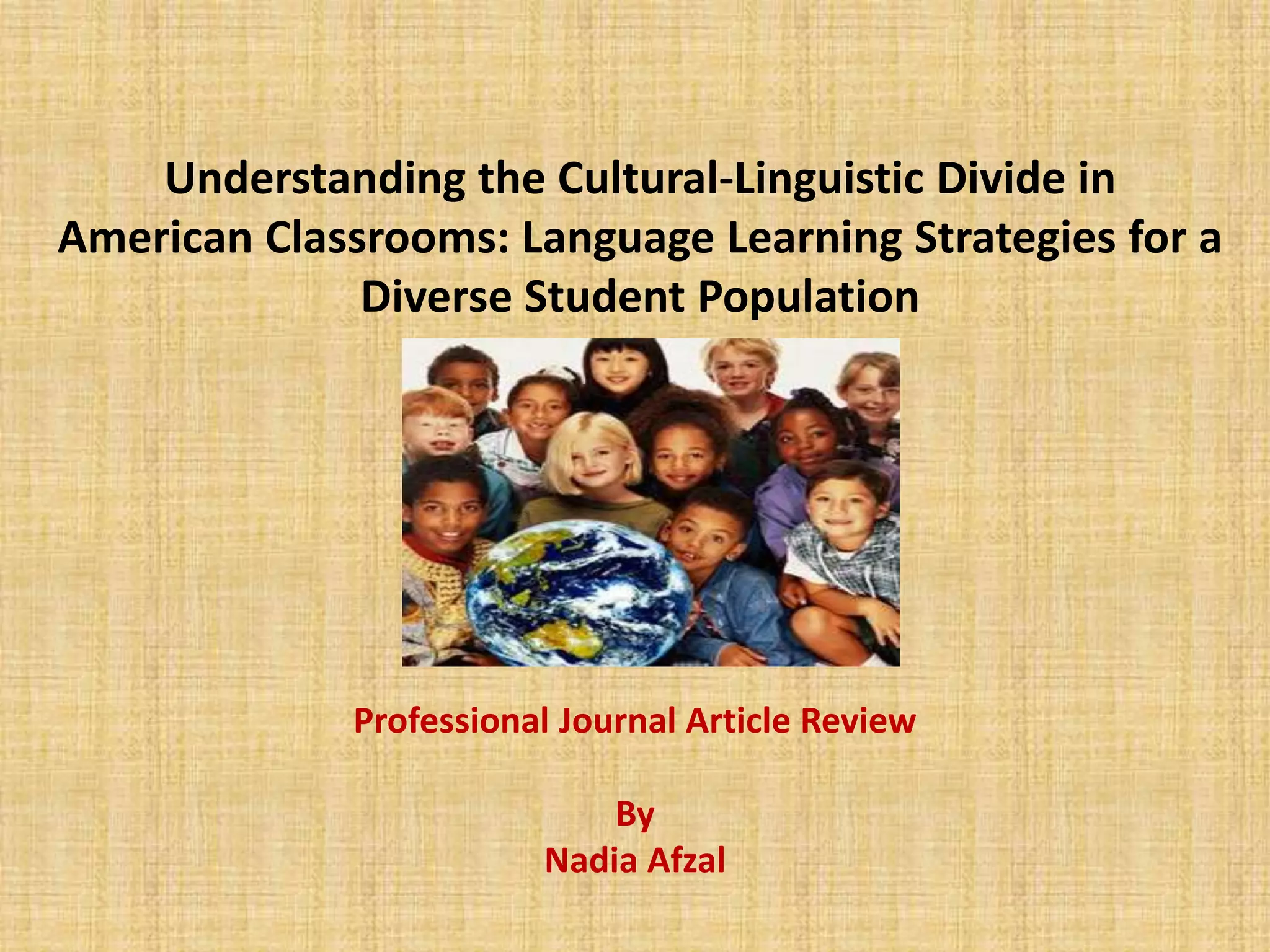
Understanding the Cultural-Linguistic Divide in
American Classrooms: Language Learning Strategies for a
Diverse Student Population
Professional Journal Article Review
By
Nadia Afzal
Introduction
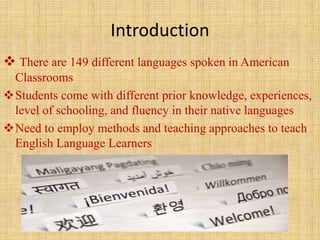
 There are 149 different languages spoken in American
Classrooms
Students come with different prior knowledge, experiences,
level of schooling, and fluency in their native languages
Need to employ methods and teaching approaches to teach
English Language Learners
Purpose
 Create awareness on effects of cultural diversity on vocabulary
and prior knowledge required for listening, reading, speaking
and writing
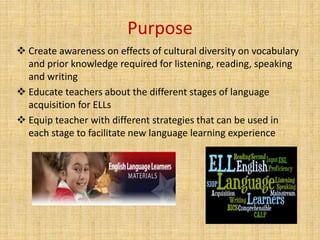
 Educate teachers about the different stages of language
acquisition for ELLs
 Equip teacher with different strategies that can be used in
each stage to facilitate new language learning experience
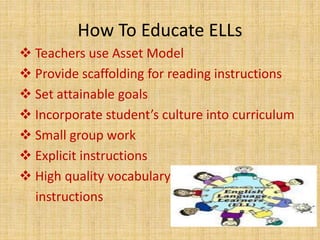
How To Educate ELLs
 Teachers use Asset Model
 Provide scaffolding for reading instructions
 Set attainable goals
 Incorporate student’s culture into curriculum
 Small group work
 Explicit instructions
 High quality vocabulary
instructions
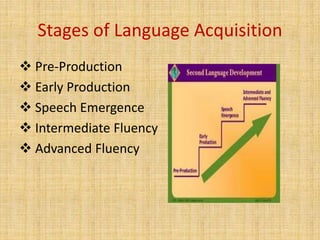
Stages of Language Acquisition
 Pre-Production
 Early Production
 Speech Emergence
 Intermediate Fluency
 Advanced Fluency
Stage 1: Pre- Production
 Students are active listeners
 Students rarely use English
 Students rely on pictorial and other non-
verbal representations
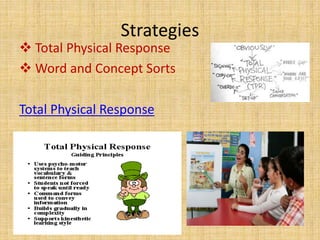
Strategies
 Total Physical Response
 Word and Concept Sorts
Total Physical Response
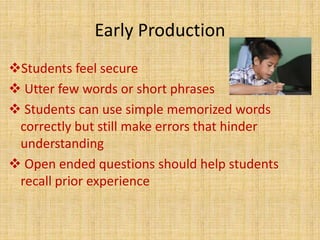
Early Production
Students feel secure
 Utter few words or short phrases
 Students can use simple memorized words
correctly but still make errors that hinder
understanding
 Open ended questions should help students
recall prior experience
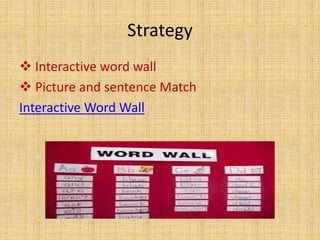
Strategy
 Interactive word wall
 Picture and sentence Match
Interactive Word Wall
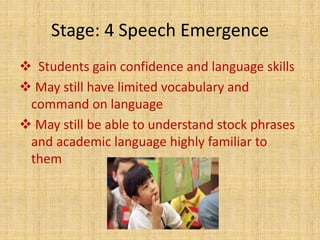
Stage: 4 Speech Emergence
 Students gain confidence and language skills
 May still have limited vocabulary and
command on language
 May still be able to understand stock phrases
and academic language highly familiar to
them
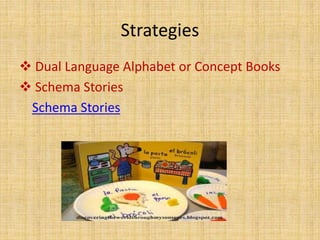
Strategies
 Dual Language Alphabet or Concept Books
 Schema Stories
Schema Stories
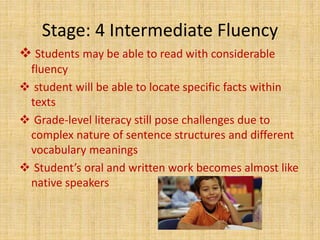
Stage: 4 Intermediate Fluency
 Students may be able to read with considerable
fluency
 student will be able to locate specific facts within
texts
 Grade-level literacy still pose challenges due to
complex nature of sentence structures and different
vocabulary meanings
 Student’s oral and written work becomes almost like
native speakers
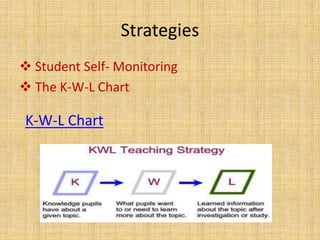
Strategies
 Student Self- Monitoring
 The K-W-L Chart
K-W-L Chart
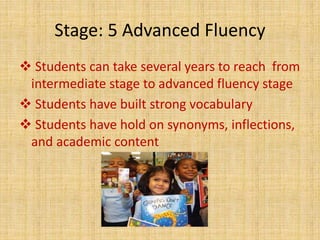
Stage: 5 Advanced Fluency
 Students can take several years to reach from
intermediate stage to advanced fluency stage
 Students have built strong vocabulary
 Students have hold on synonyms, inflections,
and academic content
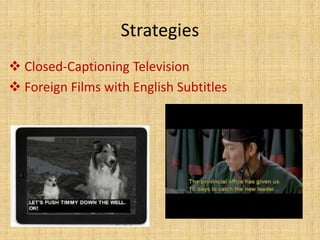
Strategies
 Closed-Captioning Television
 Foreign Films with English Subtitles
Reference
Holmes, K. P., Rutledge, S., & Gauthier, L. (2009). Understanding
the Cultural-Linguistic Divide in American Classrooms:
Language Learning Strategies for a Diverse Student
Population. Reading Horizons, 49(4), 285-300.

Afzal nadia professional_journal_article_review (1)

  • 1.
    Understanding the Cultural-LinguisticDivide in American Classrooms: Language Learning Strategies for a Diverse Student Population Professional Journal Article Review By Nadia Afzal
  • 2.
    Introduction  There are149 different languages spoken in American Classrooms Students come with different prior knowledge, experiences, level of schooling, and fluency in their native languages Need to employ methods and teaching approaches to teach English Language Learners
  • 3.
    Purpose  Create awarenesson effects of cultural diversity on vocabulary and prior knowledge required for listening, reading, speaking and writing  Educate teachers about the different stages of language acquisition for ELLs  Equip teacher with different strategies that can be used in each stage to facilitate new language learning experience
  • 4.
    How To EducateELLs  Teachers use Asset Model  Provide scaffolding for reading instructions  Set attainable goals  Incorporate student’s culture into curriculum  Small group work  Explicit instructions  High quality vocabulary instructions
  • 5.
    Stages of LanguageAcquisition  Pre-Production  Early Production  Speech Emergence  Intermediate Fluency  Advanced Fluency
  • 6.
    Stage 1: Pre-Production  Students are active listeners  Students rarely use English  Students rely on pictorial and other non- verbal representations
  • 7.
    Strategies  Total PhysicalResponse  Word and Concept Sorts Total Physical Response
  • 8.
    Early Production Students feelsecure  Utter few words or short phrases  Students can use simple memorized words correctly but still make errors that hinder understanding  Open ended questions should help students recall prior experience
  • 9.
    Strategy  Interactive wordwall  Picture and sentence Match Interactive Word Wall
  • 10.
    Stage: 4 SpeechEmergence  Students gain confidence and language skills  May still have limited vocabulary and command on language  May still be able to understand stock phrases and academic language highly familiar to them
  • 11.
    Strategies  Dual LanguageAlphabet or Concept Books  Schema Stories Schema Stories
  • 12.
    Stage: 4 IntermediateFluency  Students may be able to read with considerable fluency  student will be able to locate specific facts within texts  Grade-level literacy still pose challenges due to complex nature of sentence structures and different vocabulary meanings  Student’s oral and written work becomes almost like native speakers
  • 13.
    Strategies  Student Self-Monitoring  The K-W-L Chart K-W-L Chart
  • 14.
    Stage: 5 AdvancedFluency  Students can take several years to reach from intermediate stage to advanced fluency stage  Students have built strong vocabulary  Students have hold on synonyms, inflections, and academic content
  • 15.
    Strategies  Closed-Captioning Television Foreign Films with English Subtitles
  • 16.
    Reference Holmes, K. P.,Rutledge, S., & Gauthier, L. (2009). Understanding the Cultural-Linguistic Divide in American Classrooms: Language Learning Strategies for a Diverse Student Population. Reading Horizons, 49(4), 285-300.