Finalized English Language Proficiency Standards Training ELD ELPS Time Allocations Materials Language Objectives Strategies Methodologies
Format of the English Language Proficiency  Standards (ELPS)  Planning for ELD instruction Using Academic Content Planning an ELD Lesson ELPS and ILLPs
A REVIEW OF THE FORMAT
Arizona English Language Proficiency Standards Listening & Speaking Domain Comprehension of Oral Communication, Delivery of Oral Communication Reading Domain Print Concept, Phonemic Awareness/Decoding, Fluency, Comprehending Text Writing Domain Writing Applications, Standard English Conventions, Writing Process, Writing Elements, Research Language Strand Standard English Conventions, Vocabulary
ELL I corresponds to Kindergarten ELL II corresponds to grades 1-2 ELL III corresponds to grades 3-5 ELL IV corresponds to grades 6-8 ELL V corresponds to grades 9-12
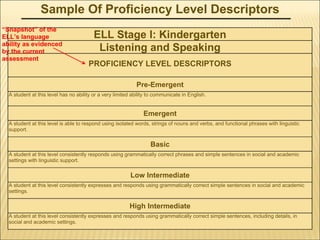
Sample Of Proficiency Level Descriptors Snapshot of  ELL Stage I: Kindergarten Listening and Speaking student coming into ELL program. PROFICIENCY LEVEL DESCRIPTORS Pre-Emergent A student at this level has no ability or a very limited ability to communicate in English. Emergent A student at this level is able to respond using isolated words, strings of nouns and verbs, and functional phrases with linguistic support. Basic A student at this level consistently responds using grammatically correct phrases and simple sentences in social and academic settings with linguistic support. Low Intermediate A student at this level consistently expresses and responds using grammatically correct simple sentences in social and academic settings. High Intermediate A student at this level consistently expresses and responds using grammatically correct simple sentences, including details, in social and academic settings. ELL Stage I: Kindergarten Listening and Speaking “ Snapshot” of the ELL’s language ability as evidenced by the current assessment
Proficient The students will demonstrate competency in (Domain) based on the knowledge, skills and abilities specified in the Performance Indicators at the High Intermediate level in order to access grade-level academic content.
STAGE I (K) STAGE II (1-2) STAGE III (3-5) STAGE IV (6-8) STAGE V (9-12) Stage I PRINT ALL Stage II  PRINT ALL Stage III  PRINT ALL Stage IV PRINT ALL Stage V  PRINT ALL Stage I Listening and Speaking Stage II  Listening and Speaking Stage III  Listening and Speaking Stage IV Listening and Speaking Stage V  Listening and Speaking Stage I Reading Domain Stage II  Reading Domain Stage III  Reading Domain Stage IV Reading Domain Stage V  Reading Domain Stage I  Writing Domain Stage II  Writing Domain Stage III  Writing Domain Stage IV Writing Domain Stage V  Writing Domain Stage I Language Strand Stage II  Language Strand Stage III  Language Strand Stage IV Language Strand Stage V  Language Strand LINKS TO THE ELP STANDARDS Below are links to the Finalized ELP Standards. The revised Standards are “all inclusive” for each STAGE. CLICK ON ANY LINK BELOW TO ACCESS THE SPECIFIC STAGE, DOMAIN OR LANGUAGE STRAND .  GUIDANCE DOCUMENT UPDATED (All Stages) ELP GLOSSARY IRREGULAR NOUNS/VERBS LANGUAGE DEMANDS/LANGUAGE COMPLEXITIES (by permission of WestED)
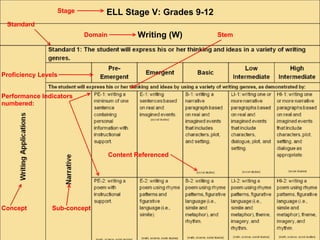
ELL Stage V: Grades 9-12 Writing (W) Stage Domain Standard Proficiency Levels Concept Performance Indicators numbered: Sub-concept Content Referenced Stem
Each Performance Indicator is a specific skill.  Always look at the High Intermediate Performance Indicator as the goal. Scaffold back for beginning instruction, if necessary.
 
PE-5: sequencing pictures to retell text heard or read .  Pre-requisite skill N/A
 
Complete Sentences
Instructional Support No Instructional Support
Math, Science, Social Studies
i.e. and e.g. Within certain performance indicators, e.g. or i.e. is used.  ‘ e.g.’ - used to show a few typical examples ‘ i.e.’ - used to denote those items listed that  must  be taught within that performance indicator
i.e. e.g.
STAGE I (K) STAGE II (1-2) STAGE III (3-5) STAGE IV (6-8) STAGE V (9-12) Stage I PRINT ALL Stage II  PRINT ALL Stage III  PRINT ALL Stage IV PRINT ALL Stage V  PRINT ALL Stage I Listening and Speaking Stage II  Listening and Speaking Stage III  Listening and Speaking Stage IV Listening and Speaking Stage V  Listening and Speaking Stage I Reading Domain Stage II  Reading Domain Stage III  Reading Domain Stage IV Reading Domain Stage V  Reading Domain Stage I  Writing Domain Stage II  Writing Domain Stage III  Writing Domain Stage IV Writing Domain Stage V  Writing Domain Stage I Language Strand Stage II  Language Strand Stage III  Language Strand Stage IV Language Strand Stage V  Language Strand LINKS TO THE ELP STANDARDS Below are links to the Finalized ELP Standards. The revised Standards are “all inclusive” for each STAGE. CLICK ON ANY LINK BELOW TO ACCESS THE SPECIFIC STAGE, DOMAIN OR LANGUAGE STRAND .  GUIDANCE DOCUMENT UPDATED (All Stages) ELP GLOSSARY IRREGULAR NOUNS/VERBS LANGUAGE DEMANDS/LANGUAGE COMPLEXITIES (by permission of WestED) Example coding for lesson plans
Coding for Domains (for lesson planning) ELL Stage V: Grades 9-12 Writing (W) Stage –Domain-Standard Number: Performance Indicator  Example:  V-W-1:PE-1
Language Strand Standard 1: Standard English Conventions  (for lesson planning) ELL Stage II: Grades 1-2 Language Strand (L) Stage –Strand-Standard Number (Sub-concept): Performance Indicator Example:  II-L-1(Adj):B-4
Coding for Language Strand Standard 2: Vocabulary (for lesson planning) ELL Stage IV: Grades 6-8 Language Strand (L) Stage –Strand-Standard Number: Performance Indicator Example:  IV-L-2:LI-1
Coding Practice / Dictation: Number a piece of paper 1-5. Listen for examples of coding. Dictate the code for the corresponding example Stage Domain/Strand  Concept/Standard Performance Indicator
Coding Dictation Check your Answers I-LS-2: PE-4 III-W-1: HI-3 II-R-1: B-2 IV-L-1 (V): E-6 V-L-2: LI-2
Strategies | Methodologies Materials ELP Standards Language Objectives Time Allocations When planning for ELD instruction:
SEI Time Allocations
Time Allocation Oral English/ Conversation  and Vocabulary 60 minutes Grammar 60 minutes Writing 60 minutes  Reading 60 minutes Standards  to Use Listening & Speaking Domain Language Strand Vocabulary  Language Strand Standard English Conventions  Writing Domain   Reading Domain Time Allocations  for All Grades and All Proficiency Levels
If Proficient on the Writing subtest If Proficient on the Reading  subtest Time Allocation Oral English/ Conversation  and Vocabulary 60 minutes Grammar 60 minutes Writing 60 minutes  Reading 60 minutes Standards  to Use Listening & Speaking Domain Language Strand Vocabulary  Language Strand Standard English Conventions  Writing Domain   Reading Domain Intermediate  Proficiency  Level
English Language Development
Language Star Component Taught Phonology Morphology Lexicon Semantics All Components  Applied All Components  Applied Morphology Syntax Time Allocation Oral English/ Conversation Vocabulary Reading  Writing  Grammar Standards  to Use Listening & Speaking Domain Language Strand Vocabulary  Reading Domain  Writing Domain   Language Strand Standard English Conventions
Language Objectives
Determining the Language Objective of a Lesson What is the concept (language focus) you want your students to be able to do? Create an outcome-based language objective which consists of action verbs. It states what you will actually see the students doing when the objective is performed and the actions will be something that can be observed. By thinking of the language objective first, activities that do not naturally lend themselves to meeting the language goals are automatically ruled out.
Language Objectives The student will  ________  by using  _________. Function   Language Target Function Verbs: articulate describe predict summarize Language Targets: past tense verbs comparative adjectives Kate Kinsella (function) (language target) These functions are found in the Performance Indicators The student will use  ________ to ____________. (function) (language target)
Sample Language Objectives Example 1 Students will  describe   a character’s emotions using  precise adjectives . or Students will use  precise adjectives  to  describe   a character’s emotions . Example 2 Students will  defend  a position using  present tense persuasive verbs . or Students will use  present tense persuasive verbs   to  defend  a position.
The time allocation helps to identify the area of explicit instruction, and the  Performance Indicators  drive instruction for that hour. While teachers may use strategies that incorporate more than one language modality during a lesson, the outcome is based on the Performance Indicator. WHAT is driving your instruction?
WHAT is driving your instruction? Scenario: I am teaching during my Oral English/Conversation and Vocabulary time allocation and I am using the Listening/Speaking Domain (Stage II), Standard #2, Delivery of Oral Communication Concept, Performance Indicator B-5…
Concept Performance Indicator Standard Stem  Take a look at this performance indicator… May the student read the question? Yes! But what is driving the instruction?  May the student write the question? Listening & Speaking  (Delivery of Oral Communications)
This is an example of a possible language objective . During the  Oral   English/ Conversation and Vocabulary  time allocation, students will work with a partner to ask and respond to Yes/No questions in the present tense using sentence frames. Students will work with a partner  to ask and respond  to Yes/No  questions in the present tense using sentence frames.
Identify the language objective The student will ask and respond to social and academic questions.  The student express orally his or her own thinking and ideas. The student will ask and respond to academic questions by orally producing sentences in the present tense. No, this is the standard, not down to the PI level. Also, this is only the function. No, this is only the function. Yes, this is the function (performance indicator) and a language target.
Materials
ELD   [ELP standard/Language Objective] is the driver and ACADEMIC CONTENT  is the vehicle. (What does this mean?)
“ Classroom materials used in an ELD class  may reflect content from a variety of academic disciplines .  Classroom materials must be appropriate for the students’ level of English language proficiency.  Selection of content materials must be based on the materials’ effectiveness in facilitating and promoting the specific English language objective(s) of the class.  Such materials must predominantly feature specific language constructions that align with the English language objectives based on the ELL Proficiency Standards and the DSI.”  (SEI Models, September 13, 2007)  ELD and Content - The lesson objective is ELD
Strategies and  Methodologies
Strategies Supporting or scaffolding student language development to promote success Interactive lessons with hands-on activities and cooperative learning
Always establish the language objective ALWAYS use the 50/50 Rule Teacher speaks 50% Student speaks 50% ALWAYS push students to their productive discomfort level ALWAYS have students respond in complete sentences ALWAYS remember the teacher does nothing students can do themselves Super SEI Strategies
ELD Methodologies Language Warm-Up Vocabulary Frames Vertical Sentences Four Picture Story/Process Re-Tell Syntax Surgery What We Know Verb Tense Study Function Junction Morph House This or That Single Picture Text Webbing Reverse Questioning
Academic Content with Language as the Driver
ELPS II-L-1(V):LI-6 It falls on trees and houses. It is falling on trees and houses.
ELPS II-LS-2:B-7 What is made from water in the air? A is made from water in the air. snowflake B-7: responding to academic questions using key words and phrases.
ELPS II-R-4:B-7 B-7: identifying the topic/main idea and key details from text heard or read, using sentence frames.
ELPS II-W-3:B-1: B-1: generating ideas through class discussion and guided writing to record ideas ( e.g., graphic organizers, etc .) with instructional support.
For example a teacher could (using ELPS): front load vocabulary have the students listen and speak select a reading selection using the vocabulary  teach a grammar lesson relevant to the information used in reading have students write about it Interdependent and Explicit Within the Four Hours Oral English/ Conversation  Vocabulary Grammar  Reading   Writing
Planning a Lesson  with the  Listening and Speaking Domain
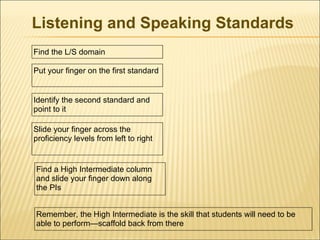
Listening and Speaking Standards Find the L/S domain Put your finger on the first standard  Identify the second standard and point to it Slide your finger across the proficiency levels from left to right Find a High Intermediate column and slide your finger down along the PIs Remember, the High Intermediate is the skill that students will need to be able to perform—scaffold back from there
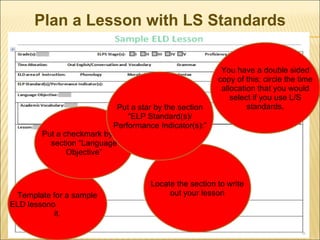
Plan a Lesson with LS Standards Template for a sample ELD lessontake a look at it. You have a double sided copy of this; circle the time allocation that you would select if you use L/S standards. Locate the section to write out your lesson Put a checkmark by the section “Language Objective” Put a star by the section “ELP Standard(s)/ Performance Indicator(s):”
Here is an area designated for a PUSH activity
SEI SUPER STRATEGY  So what does PUSH! Look like? Tell me another way to say that using our grammar rules. Tell me another way to write that. What other word can we use here? How is this word spelled? Where we can find that information on the Grammar Wall? Please say that in a complete sentence. Give me two reasons for your answer. What grammar rule did you apply? Push students to their productive discomfort level.
Lesson Locate a performance indicator in the Listening and Speaking Domain. Individually or with a partner(s) create a code. (example: III-LS-1:LI-1) Develop a Language Objective (refer to slide 29)   Design a sample lesson in the “Lesson” section  Develop a “PUSH” Activity.  PUSH
 PUSH
PRESENTATIONS
ILLPS Attachment A The lesson for the ELL in the mainstream classroom comes from the ELP Standards/Performance Indicators that come from Attachment A. (LOOK at this column  ELP Standards and Performance Indicator to be Covered)
 
QUESTIONS

ELPS_Train_The_Trainer_COPY

  • 1.
    Finalized English LanguageProficiency Standards Training ELD ELPS Time Allocations Materials Language Objectives Strategies Methodologies
  • 2.
    Format of theEnglish Language Proficiency Standards (ELPS) Planning for ELD instruction Using Academic Content Planning an ELD Lesson ELPS and ILLPs
  • 3.
    A REVIEW OFTHE FORMAT
  • 4.
    Arizona English LanguageProficiency Standards Listening & Speaking Domain Comprehension of Oral Communication, Delivery of Oral Communication Reading Domain Print Concept, Phonemic Awareness/Decoding, Fluency, Comprehending Text Writing Domain Writing Applications, Standard English Conventions, Writing Process, Writing Elements, Research Language Strand Standard English Conventions, Vocabulary
  • 5.
    ELL I correspondsto Kindergarten ELL II corresponds to grades 1-2 ELL III corresponds to grades 3-5 ELL IV corresponds to grades 6-8 ELL V corresponds to grades 9-12
  • 6.
    Sample Of ProficiencyLevel Descriptors Snapshot of ELL Stage I: Kindergarten Listening and Speaking student coming into ELL program. PROFICIENCY LEVEL DESCRIPTORS Pre-Emergent A student at this level has no ability or a very limited ability to communicate in English. Emergent A student at this level is able to respond using isolated words, strings of nouns and verbs, and functional phrases with linguistic support. Basic A student at this level consistently responds using grammatically correct phrases and simple sentences in social and academic settings with linguistic support. Low Intermediate A student at this level consistently expresses and responds using grammatically correct simple sentences in social and academic settings. High Intermediate A student at this level consistently expresses and responds using grammatically correct simple sentences, including details, in social and academic settings. ELL Stage I: Kindergarten Listening and Speaking “ Snapshot” of the ELL’s language ability as evidenced by the current assessment
  • 7.
    Proficient The studentswill demonstrate competency in (Domain) based on the knowledge, skills and abilities specified in the Performance Indicators at the High Intermediate level in order to access grade-level academic content.
  • 8.
    STAGE I (K)STAGE II (1-2) STAGE III (3-5) STAGE IV (6-8) STAGE V (9-12) Stage I PRINT ALL Stage II PRINT ALL Stage III PRINT ALL Stage IV PRINT ALL Stage V PRINT ALL Stage I Listening and Speaking Stage II Listening and Speaking Stage III Listening and Speaking Stage IV Listening and Speaking Stage V Listening and Speaking Stage I Reading Domain Stage II Reading Domain Stage III Reading Domain Stage IV Reading Domain Stage V Reading Domain Stage I Writing Domain Stage II Writing Domain Stage III Writing Domain Stage IV Writing Domain Stage V Writing Domain Stage I Language Strand Stage II Language Strand Stage III Language Strand Stage IV Language Strand Stage V Language Strand LINKS TO THE ELP STANDARDS Below are links to the Finalized ELP Standards. The revised Standards are “all inclusive” for each STAGE. CLICK ON ANY LINK BELOW TO ACCESS THE SPECIFIC STAGE, DOMAIN OR LANGUAGE STRAND . GUIDANCE DOCUMENT UPDATED (All Stages) ELP GLOSSARY IRREGULAR NOUNS/VERBS LANGUAGE DEMANDS/LANGUAGE COMPLEXITIES (by permission of WestED)
  • 9.
    ELL Stage V:Grades 9-12 Writing (W) Stage Domain Standard Proficiency Levels Concept Performance Indicators numbered: Sub-concept Content Referenced Stem
  • 10.
    Each Performance Indicatoris a specific skill. Always look at the High Intermediate Performance Indicator as the goal. Scaffold back for beginning instruction, if necessary.
  • 11.
  • 12.
    PE-5: sequencing picturesto retell text heard or read . Pre-requisite skill N/A
  • 13.
  • 14.
  • 15.
    Instructional Support NoInstructional Support
  • 16.
  • 17.
    i.e. and e.g.Within certain performance indicators, e.g. or i.e. is used. ‘ e.g.’ - used to show a few typical examples ‘ i.e.’ - used to denote those items listed that must be taught within that performance indicator
  • 18.
  • 19.
    STAGE I (K)STAGE II (1-2) STAGE III (3-5) STAGE IV (6-8) STAGE V (9-12) Stage I PRINT ALL Stage II PRINT ALL Stage III PRINT ALL Stage IV PRINT ALL Stage V PRINT ALL Stage I Listening and Speaking Stage II Listening and Speaking Stage III Listening and Speaking Stage IV Listening and Speaking Stage V Listening and Speaking Stage I Reading Domain Stage II Reading Domain Stage III Reading Domain Stage IV Reading Domain Stage V Reading Domain Stage I Writing Domain Stage II Writing Domain Stage III Writing Domain Stage IV Writing Domain Stage V Writing Domain Stage I Language Strand Stage II Language Strand Stage III Language Strand Stage IV Language Strand Stage V Language Strand LINKS TO THE ELP STANDARDS Below are links to the Finalized ELP Standards. The revised Standards are “all inclusive” for each STAGE. CLICK ON ANY LINK BELOW TO ACCESS THE SPECIFIC STAGE, DOMAIN OR LANGUAGE STRAND . GUIDANCE DOCUMENT UPDATED (All Stages) ELP GLOSSARY IRREGULAR NOUNS/VERBS LANGUAGE DEMANDS/LANGUAGE COMPLEXITIES (by permission of WestED) Example coding for lesson plans
  • 20.
    Coding for Domains(for lesson planning) ELL Stage V: Grades 9-12 Writing (W) Stage –Domain-Standard Number: Performance Indicator Example: V-W-1:PE-1
  • 21.
    Language Strand Standard1: Standard English Conventions (for lesson planning) ELL Stage II: Grades 1-2 Language Strand (L) Stage –Strand-Standard Number (Sub-concept): Performance Indicator Example: II-L-1(Adj):B-4
  • 22.
    Coding for LanguageStrand Standard 2: Vocabulary (for lesson planning) ELL Stage IV: Grades 6-8 Language Strand (L) Stage –Strand-Standard Number: Performance Indicator Example: IV-L-2:LI-1
  • 23.
    Coding Practice /Dictation: Number a piece of paper 1-5. Listen for examples of coding. Dictate the code for the corresponding example Stage Domain/Strand Concept/Standard Performance Indicator
  • 24.
    Coding Dictation Checkyour Answers I-LS-2: PE-4 III-W-1: HI-3 II-R-1: B-2 IV-L-1 (V): E-6 V-L-2: LI-2
  • 25.
    Strategies | MethodologiesMaterials ELP Standards Language Objectives Time Allocations When planning for ELD instruction:
  • 26.
  • 27.
    Time Allocation OralEnglish/ Conversation and Vocabulary 60 minutes Grammar 60 minutes Writing 60 minutes Reading 60 minutes Standards to Use Listening & Speaking Domain Language Strand Vocabulary Language Strand Standard English Conventions Writing Domain Reading Domain Time Allocations for All Grades and All Proficiency Levels
  • 28.
    If Proficient onthe Writing subtest If Proficient on the Reading subtest Time Allocation Oral English/ Conversation and Vocabulary 60 minutes Grammar 60 minutes Writing 60 minutes Reading 60 minutes Standards to Use Listening & Speaking Domain Language Strand Vocabulary Language Strand Standard English Conventions Writing Domain Reading Domain Intermediate Proficiency Level
  • 29.
  • 30.
    Language Star ComponentTaught Phonology Morphology Lexicon Semantics All Components Applied All Components Applied Morphology Syntax Time Allocation Oral English/ Conversation Vocabulary Reading Writing Grammar Standards to Use Listening & Speaking Domain Language Strand Vocabulary Reading Domain Writing Domain Language Strand Standard English Conventions
  • 31.
  • 32.
    Determining the LanguageObjective of a Lesson What is the concept (language focus) you want your students to be able to do? Create an outcome-based language objective which consists of action verbs. It states what you will actually see the students doing when the objective is performed and the actions will be something that can be observed. By thinking of the language objective first, activities that do not naturally lend themselves to meeting the language goals are automatically ruled out.
  • 33.
    Language Objectives Thestudent will ________ by using _________. Function Language Target Function Verbs: articulate describe predict summarize Language Targets: past tense verbs comparative adjectives Kate Kinsella (function) (language target) These functions are found in the Performance Indicators The student will use ________ to ____________. (function) (language target)
  • 34.
    Sample Language ObjectivesExample 1 Students will describe a character’s emotions using precise adjectives . or Students will use precise adjectives to describe a character’s emotions . Example 2 Students will defend a position using present tense persuasive verbs . or Students will use present tense persuasive verbs to defend a position.
  • 35.
    The time allocationhelps to identify the area of explicit instruction, and the Performance Indicators drive instruction for that hour. While teachers may use strategies that incorporate more than one language modality during a lesson, the outcome is based on the Performance Indicator. WHAT is driving your instruction?
  • 36.
    WHAT is drivingyour instruction? Scenario: I am teaching during my Oral English/Conversation and Vocabulary time allocation and I am using the Listening/Speaking Domain (Stage II), Standard #2, Delivery of Oral Communication Concept, Performance Indicator B-5…
  • 37.
    Concept Performance IndicatorStandard Stem Take a look at this performance indicator… May the student read the question? Yes! But what is driving the instruction? May the student write the question? Listening & Speaking (Delivery of Oral Communications)
  • 38.
    This is anexample of a possible language objective . During the Oral English/ Conversation and Vocabulary time allocation, students will work with a partner to ask and respond to Yes/No questions in the present tense using sentence frames. Students will work with a partner to ask and respond to Yes/No questions in the present tense using sentence frames.
  • 39.
    Identify the languageobjective The student will ask and respond to social and academic questions. The student express orally his or her own thinking and ideas. The student will ask and respond to academic questions by orally producing sentences in the present tense. No, this is the standard, not down to the PI level. Also, this is only the function. No, this is only the function. Yes, this is the function (performance indicator) and a language target.
  • 40.
  • 41.
    ELD [ELP standard/Language Objective] is the driver and ACADEMIC CONTENT is the vehicle. (What does this mean?)
  • 42.
    “ Classroom materialsused in an ELD class may reflect content from a variety of academic disciplines . Classroom materials must be appropriate for the students’ level of English language proficiency. Selection of content materials must be based on the materials’ effectiveness in facilitating and promoting the specific English language objective(s) of the class. Such materials must predominantly feature specific language constructions that align with the English language objectives based on the ELL Proficiency Standards and the DSI.” (SEI Models, September 13, 2007) ELD and Content - The lesson objective is ELD
  • 43.
    Strategies and Methodologies
  • 44.
    Strategies Supporting orscaffolding student language development to promote success Interactive lessons with hands-on activities and cooperative learning
  • 45.
    Always establish thelanguage objective ALWAYS use the 50/50 Rule Teacher speaks 50% Student speaks 50% ALWAYS push students to their productive discomfort level ALWAYS have students respond in complete sentences ALWAYS remember the teacher does nothing students can do themselves Super SEI Strategies
  • 46.
    ELD Methodologies LanguageWarm-Up Vocabulary Frames Vertical Sentences Four Picture Story/Process Re-Tell Syntax Surgery What We Know Verb Tense Study Function Junction Morph House This or That Single Picture Text Webbing Reverse Questioning
  • 47.
    Academic Content withLanguage as the Driver
  • 48.
    ELPS II-L-1(V):LI-6 Itfalls on trees and houses. It is falling on trees and houses.
  • 49.
    ELPS II-LS-2:B-7 Whatis made from water in the air? A is made from water in the air. snowflake B-7: responding to academic questions using key words and phrases.
  • 50.
    ELPS II-R-4:B-7 B-7:identifying the topic/main idea and key details from text heard or read, using sentence frames.
  • 51.
    ELPS II-W-3:B-1: B-1:generating ideas through class discussion and guided writing to record ideas ( e.g., graphic organizers, etc .) with instructional support.
  • 52.
    For example ateacher could (using ELPS): front load vocabulary have the students listen and speak select a reading selection using the vocabulary teach a grammar lesson relevant to the information used in reading have students write about it Interdependent and Explicit Within the Four Hours Oral English/ Conversation Vocabulary Grammar Reading Writing
  • 53.
    Planning a Lesson with the Listening and Speaking Domain
  • 54.
    Listening and SpeakingStandards Find the L/S domain Put your finger on the first standard Identify the second standard and point to it Slide your finger across the proficiency levels from left to right Find a High Intermediate column and slide your finger down along the PIs Remember, the High Intermediate is the skill that students will need to be able to perform—scaffold back from there
  • 55.
    Plan a Lessonwith LS Standards Template for a sample ELD lessontake a look at it. You have a double sided copy of this; circle the time allocation that you would select if you use L/S standards. Locate the section to write out your lesson Put a checkmark by the section “Language Objective” Put a star by the section “ELP Standard(s)/ Performance Indicator(s):”
  • 56.
    Here is anarea designated for a PUSH activity
  • 57.
    SEI SUPER STRATEGY So what does PUSH! Look like? Tell me another way to say that using our grammar rules. Tell me another way to write that. What other word can we use here? How is this word spelled? Where we can find that information on the Grammar Wall? Please say that in a complete sentence. Give me two reasons for your answer. What grammar rule did you apply? Push students to their productive discomfort level.
  • 58.
    Lesson Locate aperformance indicator in the Listening and Speaking Domain. Individually or with a partner(s) create a code. (example: III-LS-1:LI-1) Develop a Language Objective (refer to slide 29)  Design a sample lesson in the “Lesson” section Develop a “PUSH” Activity. PUSH
  • 59.
  • 60.
  • 61.
    ILLPS Attachment AThe lesson for the ELL in the mainstream classroom comes from the ELP Standards/Performance Indicators that come from Attachment A. (LOOK at this column ELP Standards and Performance Indicator to be Covered)
  • 62.
  • 63.

Editor's Notes

  • #24 1. Stage one, listening and speaking domain, standard 2, pre-emergent 4 2. Stage three, writing domain, standard 1, high intermediate 3 3. 1 st grade, reading domain, print concepts standard, Basic-2 4. 7 th grade, language strand, standard 1, verbs, Emergent-6 5. 9 th grade, language strand, vocabulary standard, low intermediate 2
  • #25 1. Stage one, listening and speaking domain, standard 2, pre-emergent 4 2. Stage three, writing domain, standard 1, high intermediate 3 3. 1 st grade, reading domain, print concepts standard, Basic-2 4. 7 th grade, language strand, standard 1, verbs, Emergent-6 5. 9 th grade, language strand, vocabulary standard, low intermediate 2