Geography
Department,
Euro school
CONTENT
 Introduction
 Size and Extent
 Location
 Political Divisions
 Physical Features
 Northern Lowlands
 Central Lowlands
 Southern plateaus
 Great River Valleys
 Island Groups
 Key factors controlling the climate of Asia
 Annual Rainfall
 Climatic Regions
 Conclusion
 Bibliography
INTRODUCTION
 Asia is a continent of diverse cultures and
ancient civilizations. It is a land of
economical, political and socio-cultural
contrast. The geographical diversities
present in the Asian landmass are truly
remarkable.
SIZE AND EXTENT
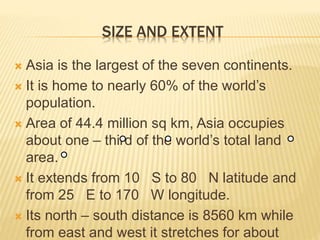
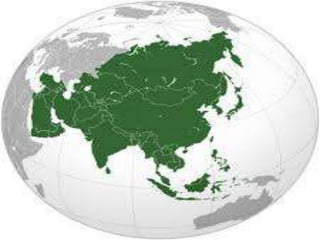
 Asia is the largest of the seven continents.
 It is home to nearly 60% of the world’s
population.
 Area of 44.4 million sq km, Asia occupies
about one – third of the world’s total land
area.
 It extends from 10 S to 80 N latitude and
from 25 E to 170 W longitude.
 Its north – south distance is 8560 km while
from east and west it stretches for about
LOCATION
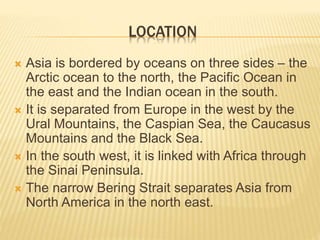
 Asia is bordered by oceans on three sides – the
Arctic ocean to the north, the Pacific Ocean in
the east and the Indian ocean in the south.
 It is separated from Europe in the west by the
Ural Mountains, the Caspian Sea, the Caucasus
Mountains and the Black Sea.
 In the south west, it is linked with Africa through
the Sinai Peninsula.
 The narrow Bering Strait separates Asia from
North America in the north east.
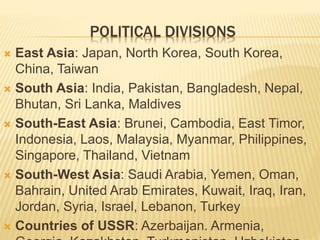
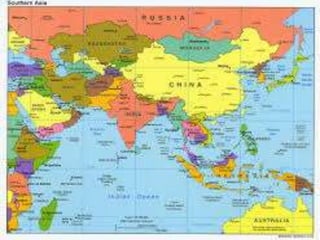
POLITICAL DIVISIONS
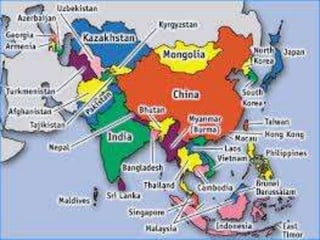
 East Asia: Japan, North Korea, South Korea,
China, Taiwan
 South Asia: India, Pakistan, Bangladesh, Nepal,
Bhutan, Sri Lanka, Maldives
 South-East Asia: Brunei, Cambodia, East Timor,
Indonesia, Laos, Malaysia, Myanmar, Philippines,
Singapore, Thailand, Vietnam
 South-West Asia: Saudi Arabia, Yemen, Oman,
Bahrain, United Arab Emirates, Kuwait, Iraq, Iran,
Jordan, Syria, Israel, Lebanon, Turkey
 Countries of USSR: Azerbaijan. Armenia,
PHYSICAL FEATURES
 Asia can be divided into five major physical
divisions
 The Northern Lowlands
 The Central Mountains
 The Southern Plateaus
 The Great River Valleys
 The Island Groups
THE NORTHERN LOWLANDS
 Located to the north of Asia, bordering the
Arctic Ocean.
 Northern part of these lowlands is called the
Siberian Plain.
 It forms the greatest continuous plain in the
world.
 It is drained by three major rivers: Ob,
Yenisey and Lena.
 In the south of the Siberian Plain lies the
lowland surrounding the Aral Sea known as
THE CENTRAL MOUNTAINS
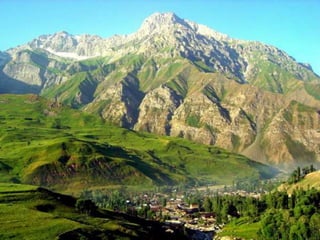
 They are extensive system of young fold
mountains that lie to the south of northern
lowlands.
 Almost all the mountain ranges in Asia
radiate from a nodal in the centre called the
Pamir Knot.
 Two mountain ranges lie to the west of the
Pamir Knot.
 the Himalayas tun south-eastwars into
northern India and Nepal.
 They are the highest mountain ranges in the
THE SOUTHERN PLATEAUS
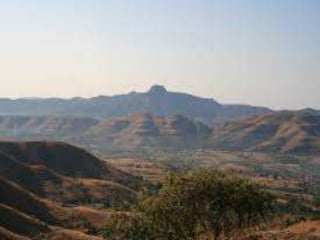
 They are three vast plateaus located to the
south of the Central Mountains.
 They comprise old stable blocks made up of
hard crystalline rocks.
 The Plateau of Peninsular India has a steep
range along the Arabian Seas coast and
gently slopes towards the Bay of Bengal in
the east.
 Many rivers flow through the plateau such as
the Mahanadi, the Krishna, the Kaveri, and
the Godavari.
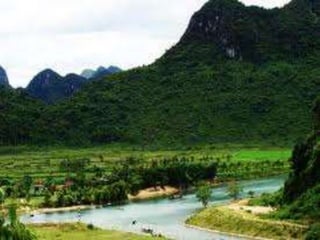
THE GREAT RIVER VALLEYS
 Several large rivers arise from the snow
covered peaks and the plateaus of the
Central highlands of Asia and have deposited
large quantities of alluvium.
 These river valleys are located in between
the Central Highlands and Southern
Plateaus.
 The Indus valley is formed by the Indus and
its five tributaries and Tigris-Euphrates valley
is situated in Iraq.
 The Ganga-Brahmaputra valley occupies
THE ISLAND GROUPS
 To the east and south east of Asia, there are
number of island countries.
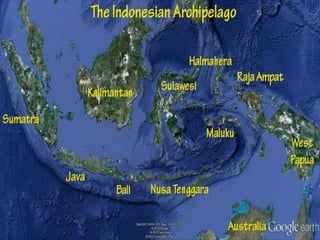
 The largest archipelago in the world is the
Indonesian Archipelago.
 It includes the islands f Borneo, Sumatra,
Java, Sulawesi, Bali and Timor.
 The Lakshadweep Islands in the Arabian
Seas the Andaman and Nicobar Islands in
the Bay of Bengal belong to India.
KEY FACTORS CONTROLLING THE CLIMATE
OF ASIA
 Size and Latitudinal Extent : The continent
has a vast size and latitudinal extent, covering
all the three heat zones. Thus, it has all varieties
of climate, ranging from the hot and wet
equatorial to the cold arctic type.
 Distance from the Sea: the interior of Asia lies
far away from the sea. In the absence of the
moderating influence of the sea, these areas
experience extreme climate.
 Relief : Most of the mountain ranges of Asia run
in and east – west direction. They obstruct the
rain – bearing winds coming from the south.
They also check the cold northern winds from
reaching the south.
 Winds: the monsoon winds, which are
characterized by the seasonal reversal of wind
direction, affect the distribution of rainfall over
large parts of Asia.
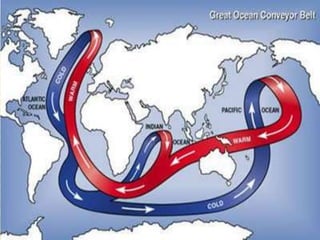
 Ocean Currents: the ocean currents, like the
warm Kuro Shio and the cold Oya Shio, also
influence the climate of Asia, particularly along
the eastern coastal margins.
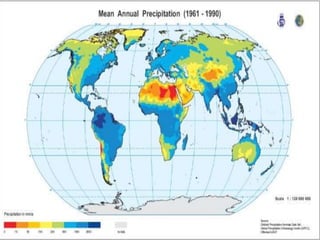
ANNUAL RAINFALL
 Heavy Rainfall more 200cm per year : The
Equatorial region, coastal areas of south-east
Asia, foothills of the Himalayas, north-east India
and the western coast of India experience very
heavy rainfall.
 Moderate rainfall 100-200cm per year : Parts
of India, south – east Asia, central and southern
China, North and South Korea and parts of
Japan.
 Low Rainfall of less than 50cm per year:
South-west Asia, Central Asia and Northern
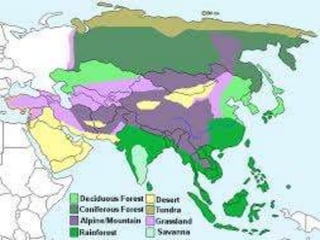
CLIMATIC REGIONS
 Asia is a vast continent with a variety of temperature
and rainfall conditions. Each climatic region has its
own characteristic natural vegetation and Wildlife.
 The Equatorial Region
 The Monsoon Region
 The Desert Region
 The Mediterranean Region
 The Steppes
 The Temperate Region
 The Taiga Region
 The Tundra Region
CONCLUSION
 With its diverse physical features and the
climatic conditions they are subjected to
clearly, no two places in Asia experience quit
the same weather. It is a land of skyward
mountains, colossal plains, murky swamps
and unforgiving deserts. All these features
truly justify Asia as a land of contrasts.
BIBLIOGRAPHY
 Internet:
 Google Images
 Books:
 Earth Our Planet by Sampa Mukherjee
Asia

Asia

  • 3.
  • 5.
    CONTENT  Introduction  Sizeand Extent  Location  Political Divisions  Physical Features  Northern Lowlands  Central Lowlands  Southern plateaus  Great River Valleys  Island Groups  Key factors controlling the climate of Asia  Annual Rainfall  Climatic Regions  Conclusion  Bibliography
  • 6.
    INTRODUCTION  Asia isa continent of diverse cultures and ancient civilizations. It is a land of economical, political and socio-cultural contrast. The geographical diversities present in the Asian landmass are truly remarkable.
  • 8.
    SIZE AND EXTENT Asia is the largest of the seven continents.  It is home to nearly 60% of the world’s population.  Area of 44.4 million sq km, Asia occupies about one – third of the world’s total land area.  It extends from 10 S to 80 N latitude and from 25 E to 170 W longitude.  Its north – south distance is 8560 km while from east and west it stretches for about
  • 10.
    LOCATION  Asia isbordered by oceans on three sides – the Arctic ocean to the north, the Pacific Ocean in the east and the Indian ocean in the south.  It is separated from Europe in the west by the Ural Mountains, the Caspian Sea, the Caucasus Mountains and the Black Sea.  In the south west, it is linked with Africa through the Sinai Peninsula.  The narrow Bering Strait separates Asia from North America in the north east.
  • 12.
    POLITICAL DIVISIONS  EastAsia: Japan, North Korea, South Korea, China, Taiwan  South Asia: India, Pakistan, Bangladesh, Nepal, Bhutan, Sri Lanka, Maldives  South-East Asia: Brunei, Cambodia, East Timor, Indonesia, Laos, Malaysia, Myanmar, Philippines, Singapore, Thailand, Vietnam  South-West Asia: Saudi Arabia, Yemen, Oman, Bahrain, United Arab Emirates, Kuwait, Iraq, Iran, Jordan, Syria, Israel, Lebanon, Turkey  Countries of USSR: Azerbaijan. Armenia,
  • 14.
    PHYSICAL FEATURES  Asiacan be divided into five major physical divisions  The Northern Lowlands  The Central Mountains  The Southern Plateaus  The Great River Valleys  The Island Groups
  • 15.
    THE NORTHERN LOWLANDS Located to the north of Asia, bordering the Arctic Ocean.  Northern part of these lowlands is called the Siberian Plain.  It forms the greatest continuous plain in the world.  It is drained by three major rivers: Ob, Yenisey and Lena.  In the south of the Siberian Plain lies the lowland surrounding the Aral Sea known as
  • 17.
    THE CENTRAL MOUNTAINS They are extensive system of young fold mountains that lie to the south of northern lowlands.  Almost all the mountain ranges in Asia radiate from a nodal in the centre called the Pamir Knot.  Two mountain ranges lie to the west of the Pamir Knot.  the Himalayas tun south-eastwars into northern India and Nepal.  They are the highest mountain ranges in the
  • 19.
    THE SOUTHERN PLATEAUS They are three vast plateaus located to the south of the Central Mountains.  They comprise old stable blocks made up of hard crystalline rocks.  The Plateau of Peninsular India has a steep range along the Arabian Seas coast and gently slopes towards the Bay of Bengal in the east.  Many rivers flow through the plateau such as the Mahanadi, the Krishna, the Kaveri, and the Godavari.
  • 21.
    THE GREAT RIVERVALLEYS  Several large rivers arise from the snow covered peaks and the plateaus of the Central highlands of Asia and have deposited large quantities of alluvium.  These river valleys are located in between the Central Highlands and Southern Plateaus.  The Indus valley is formed by the Indus and its five tributaries and Tigris-Euphrates valley is situated in Iraq.  The Ganga-Brahmaputra valley occupies
  • 23.
    THE ISLAND GROUPS To the east and south east of Asia, there are number of island countries.  The largest archipelago in the world is the Indonesian Archipelago.  It includes the islands f Borneo, Sumatra, Java, Sulawesi, Bali and Timor.  The Lakshadweep Islands in the Arabian Seas the Andaman and Nicobar Islands in the Bay of Bengal belong to India.
  • 25.
    KEY FACTORS CONTROLLINGTHE CLIMATE OF ASIA  Size and Latitudinal Extent : The continent has a vast size and latitudinal extent, covering all the three heat zones. Thus, it has all varieties of climate, ranging from the hot and wet equatorial to the cold arctic type.  Distance from the Sea: the interior of Asia lies far away from the sea. In the absence of the moderating influence of the sea, these areas experience extreme climate.  Relief : Most of the mountain ranges of Asia run in and east – west direction. They obstruct the rain – bearing winds coming from the south. They also check the cold northern winds from reaching the south.
  • 26.
     Winds: themonsoon winds, which are characterized by the seasonal reversal of wind direction, affect the distribution of rainfall over large parts of Asia.  Ocean Currents: the ocean currents, like the warm Kuro Shio and the cold Oya Shio, also influence the climate of Asia, particularly along the eastern coastal margins.
  • 28.
    ANNUAL RAINFALL  HeavyRainfall more 200cm per year : The Equatorial region, coastal areas of south-east Asia, foothills of the Himalayas, north-east India and the western coast of India experience very heavy rainfall.  Moderate rainfall 100-200cm per year : Parts of India, south – east Asia, central and southern China, North and South Korea and parts of Japan.  Low Rainfall of less than 50cm per year: South-west Asia, Central Asia and Northern
  • 30.
    CLIMATIC REGIONS  Asiais a vast continent with a variety of temperature and rainfall conditions. Each climatic region has its own characteristic natural vegetation and Wildlife.  The Equatorial Region  The Monsoon Region  The Desert Region  The Mediterranean Region  The Steppes  The Temperate Region  The Taiga Region  The Tundra Region
  • 32.
    CONCLUSION  With itsdiverse physical features and the climatic conditions they are subjected to clearly, no two places in Asia experience quit the same weather. It is a land of skyward mountains, colossal plains, murky swamps and unforgiving deserts. All these features truly justify Asia as a land of contrasts.
  • 33.
    BIBLIOGRAPHY  Internet:  GoogleImages  Books:  Earth Our Planet by Sampa Mukherjee