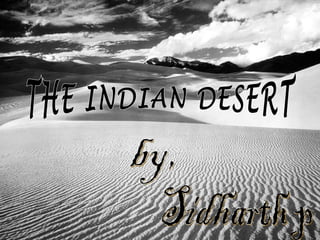
THE INDIAN DESERT Sidharth p by,
Description... Luni is the only large river in this region Barchans (crescent shaped dunes) cover larger areas but  longitudinal dunes become more prominent near indo-pakistan boundary.  Jaisalmer has many group of  Barchans.
Located... Indian desert lies towards the western margins of Aravalli hills.  In India the Thar desert extends from the Sutlej River, surrounded by the  Aravalli Range  on the east, on the south by the salt marsh known as the  Rann of Kutch  (parts of which are sometimes included in the Thar), and on the west by the  Indus River .  Its boundary to the large thorny steppe to the north is ill-defined. , about 3/5th of the total geographical area of the state.
Climate... Desert is an undulating sandy plain covered with sand dunes.  Desert region receives very low rain fall below 150mm per year all falling between July and September. Streams appear during rainy season. It has arid climate with low vegetation cover. The climate is harsh with temperatures ranging form near freezing up to 50°C.  The Thar desert has a Tropical dry climate. East of the Thar Desert, the region running from  Punjab  and  Haryana  to  Kathiawar  experiences a tropical and sub-tropical  steppe  climate.
People... The  Indian Desert is mainly inhabited by  Hindus ,  Muslims , and  Sikhs . A colourful culture rich in tradition prevails in the desert. The people have a great passion for music and poetry.  About 40% of the total population of Rajasthan state live in the Thar desert.  The main occupation of the people in desert is  agriculture  and  animal husbandry . The living standard of the people in the desert is low. The Thar desert is the most densely populated desert in the world, with a population density of 83 people per km2. vs 7 in other deserts.  Jodhpur , the largest city in the region, lies in the scrub forest zone.  Bikaner  and  Jaisalmer  are located in the desert proper .
Thank you

Indian desert

  • 1.
    THE INDIAN DESERTSidharth p by,
  • 2.
    Description... Luni isthe only large river in this region Barchans (crescent shaped dunes) cover larger areas but longitudinal dunes become more prominent near indo-pakistan boundary. Jaisalmer has many group of Barchans.
  • 3.
    Located... Indian desertlies towards the western margins of Aravalli hills. In India the Thar desert extends from the Sutlej River, surrounded by the Aravalli Range on the east, on the south by the salt marsh known as the Rann of Kutch (parts of which are sometimes included in the Thar), and on the west by the Indus River . Its boundary to the large thorny steppe to the north is ill-defined. , about 3/5th of the total geographical area of the state.
  • 4.
    Climate... Desert isan undulating sandy plain covered with sand dunes. Desert region receives very low rain fall below 150mm per year all falling between July and September. Streams appear during rainy season. It has arid climate with low vegetation cover. The climate is harsh with temperatures ranging form near freezing up to 50°C. The Thar desert has a Tropical dry climate. East of the Thar Desert, the region running from Punjab and Haryana to Kathiawar experiences a tropical and sub-tropical steppe climate.
  • 5.
    People... The Indian Desert is mainly inhabited by Hindus , Muslims , and Sikhs . A colourful culture rich in tradition prevails in the desert. The people have a great passion for music and poetry. About 40% of the total population of Rajasthan state live in the Thar desert. The main occupation of the people in desert is agriculture and animal husbandry . The living standard of the people in the desert is low. The Thar desert is the most densely populated desert in the world, with a population density of 83 people per km2. vs 7 in other deserts. Jodhpur , the largest city in the region, lies in the scrub forest zone. Bikaner and Jaisalmer are located in the desert proper .
  • 6.