DR JOSE OSORIO
The Evolution of Atrial Fibrillation Ablation:
Utilizing Current Technology to Improve
Efficiency, Safety and Efficacy
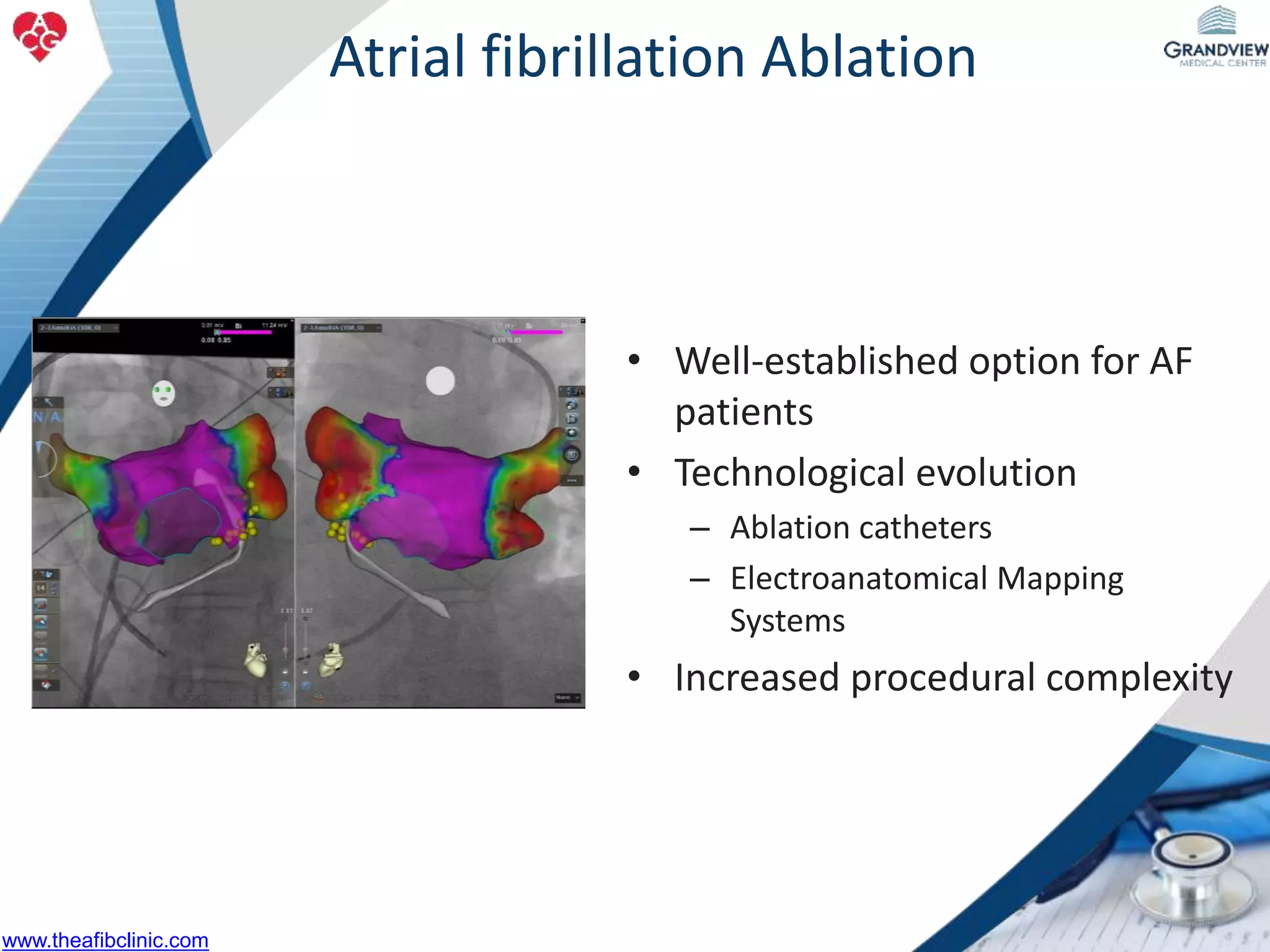
Atrial fibrillation Ablation
• Well-established option for AF
patients
• Technological evolution
– Ablation catheters
– Electroanatomical Mapping
Systems
• Increased procedural complexity
www.theafibclinic.com
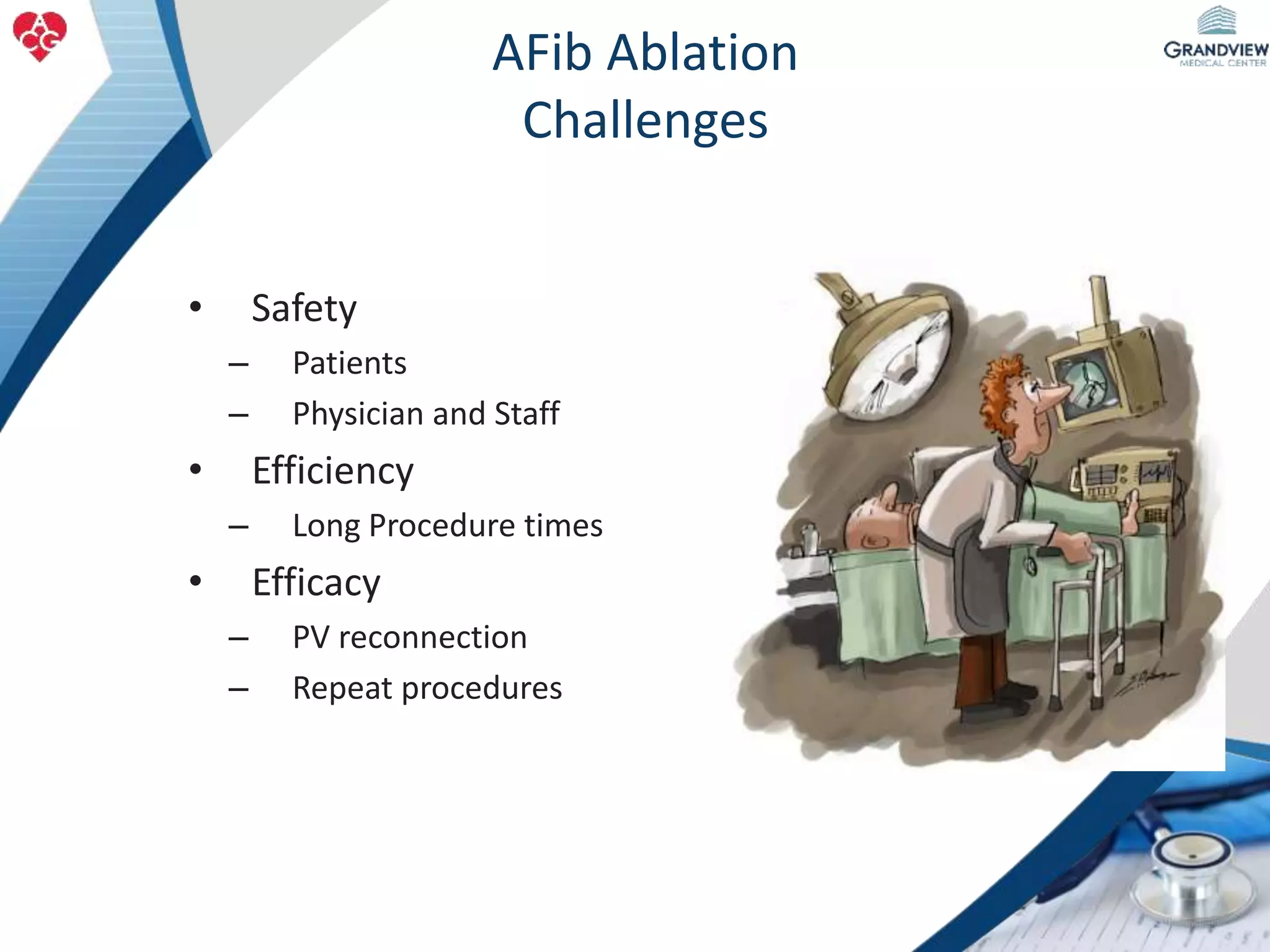
• Safety
– Patients
– Physician and Staff
• Efficiency
– Long Procedure times
• Efficacy
– PV reconnection
– Repeat procedures
AFib Ablation
Challenges
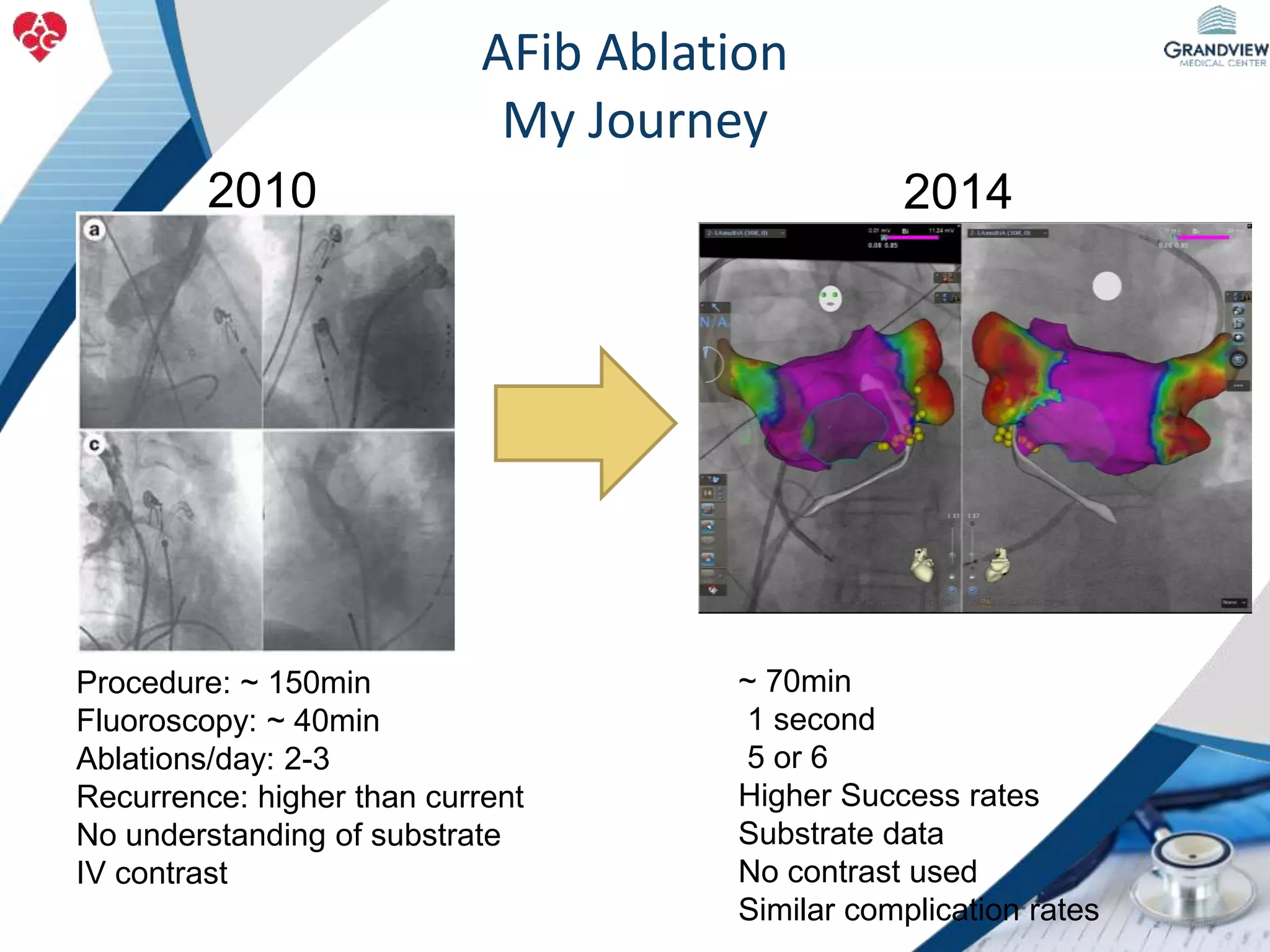
AFib Ablation
My Journey
Procedure: ~ 150min
Fluoroscopy: ~ 40min
Ablations/day: 2-3
Recurrence: higher than current
No understanding of substrate
IV contrast
2010
~ 70min
1 second
5 or 6
Higher Success rates
Substrate data
No contrast used
Similar complication rates
2014
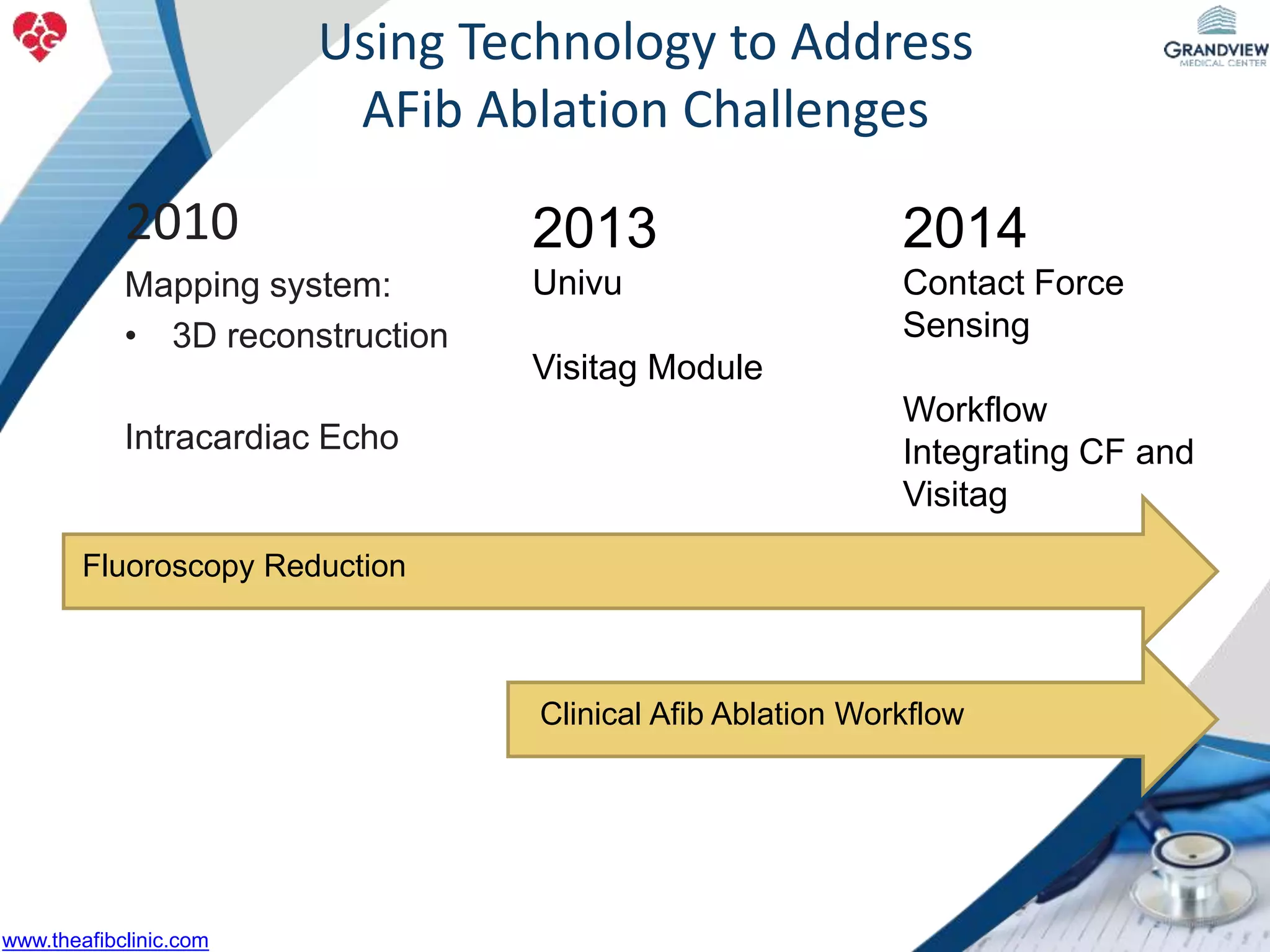
Using Technology to Address
AFib Ablation Challenges
2010
Mapping system:
• 3D reconstruction
Intracardiac Echo
2013
Univu
Visitag Module
2014
Contact Force
Sensing
Workflow
Integrating CF and
Visitag
Fluoroscopy Reduction
Clinical Afib Ablation Workflow
www.theafibclinic.com
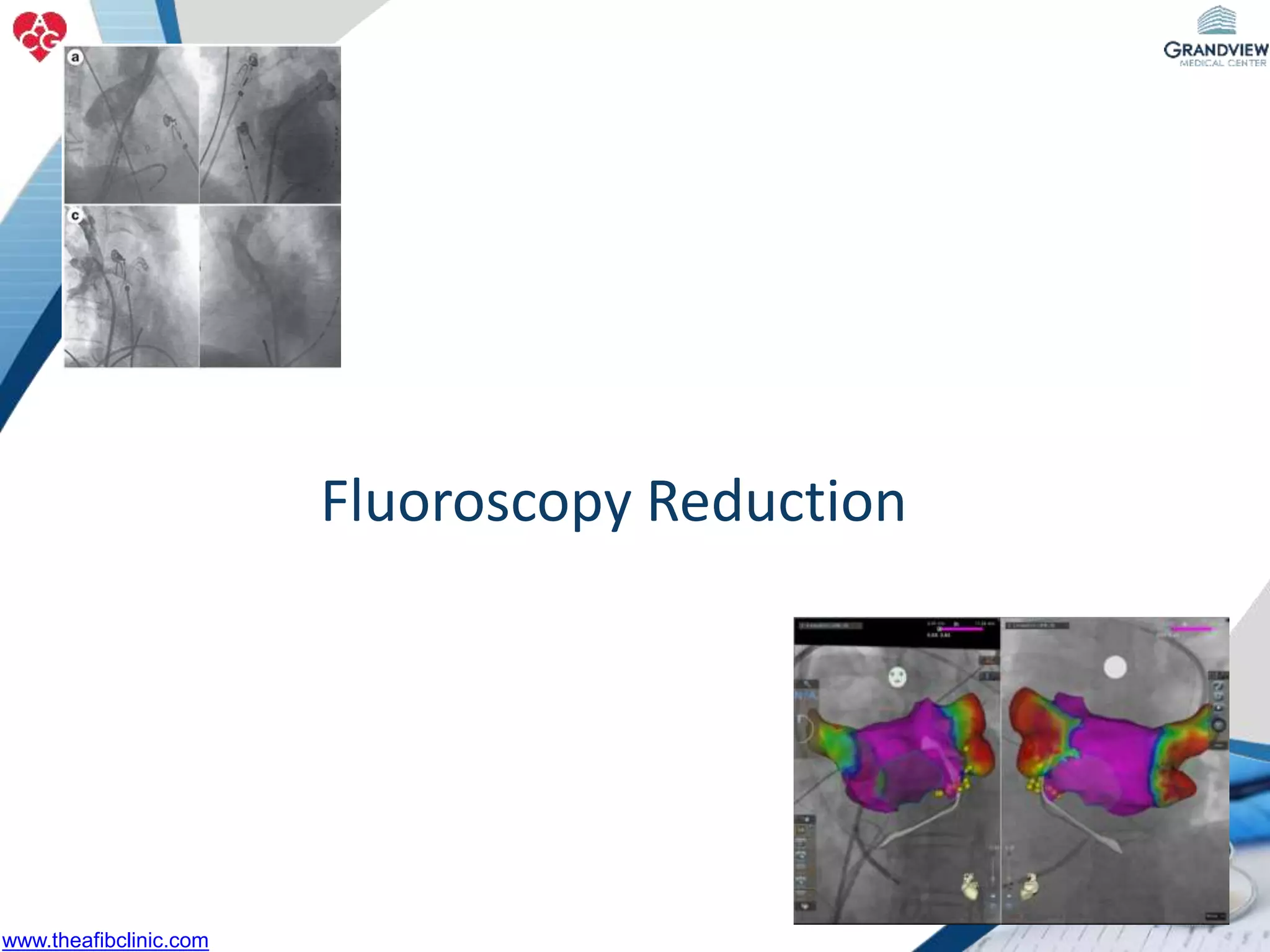
Fluoroscopy Reduction
www.theafibclinic.com
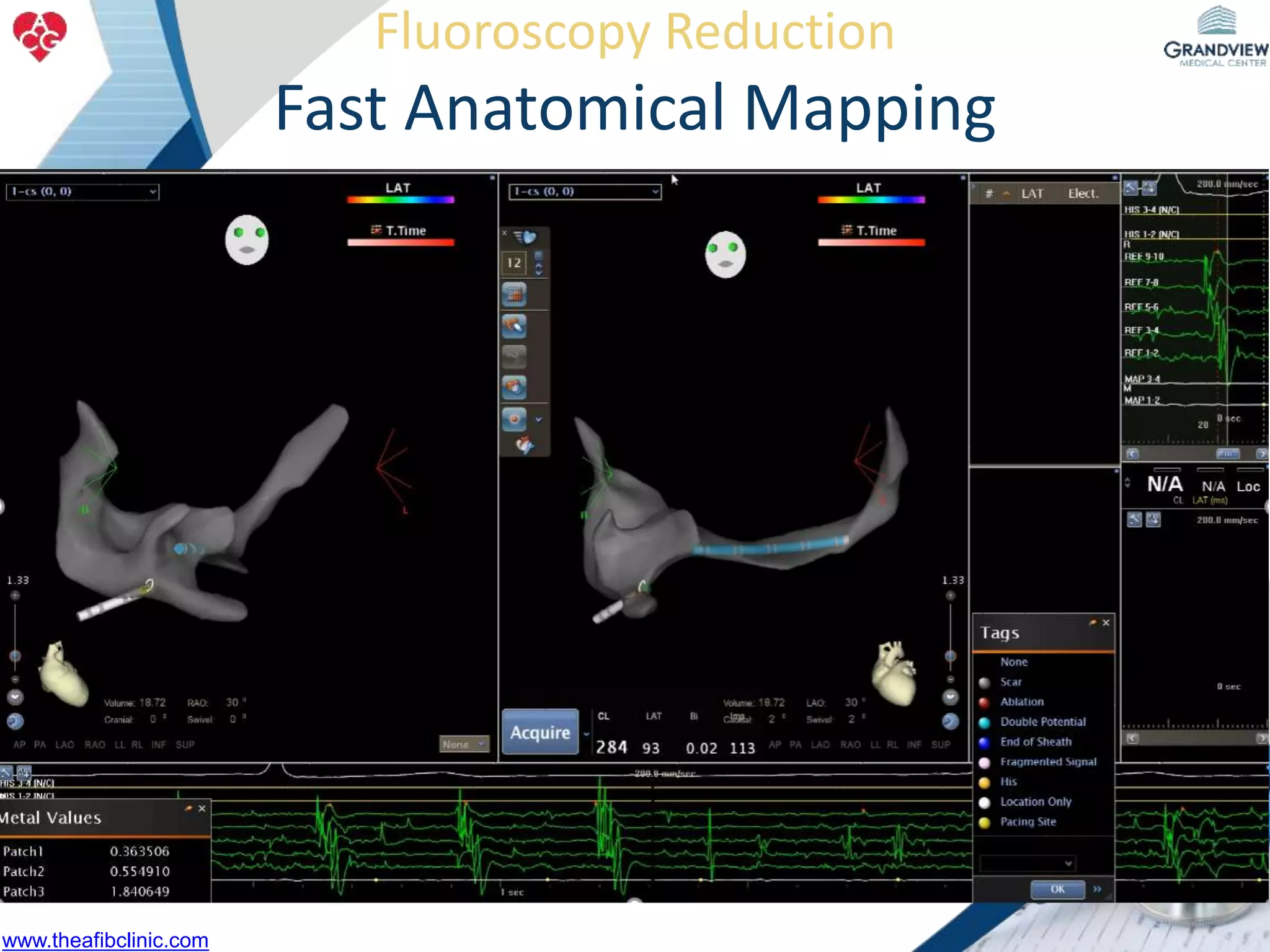
Fluoroscopy Reduction
Fast Anatomical Mapping
www.theafibclinic.com
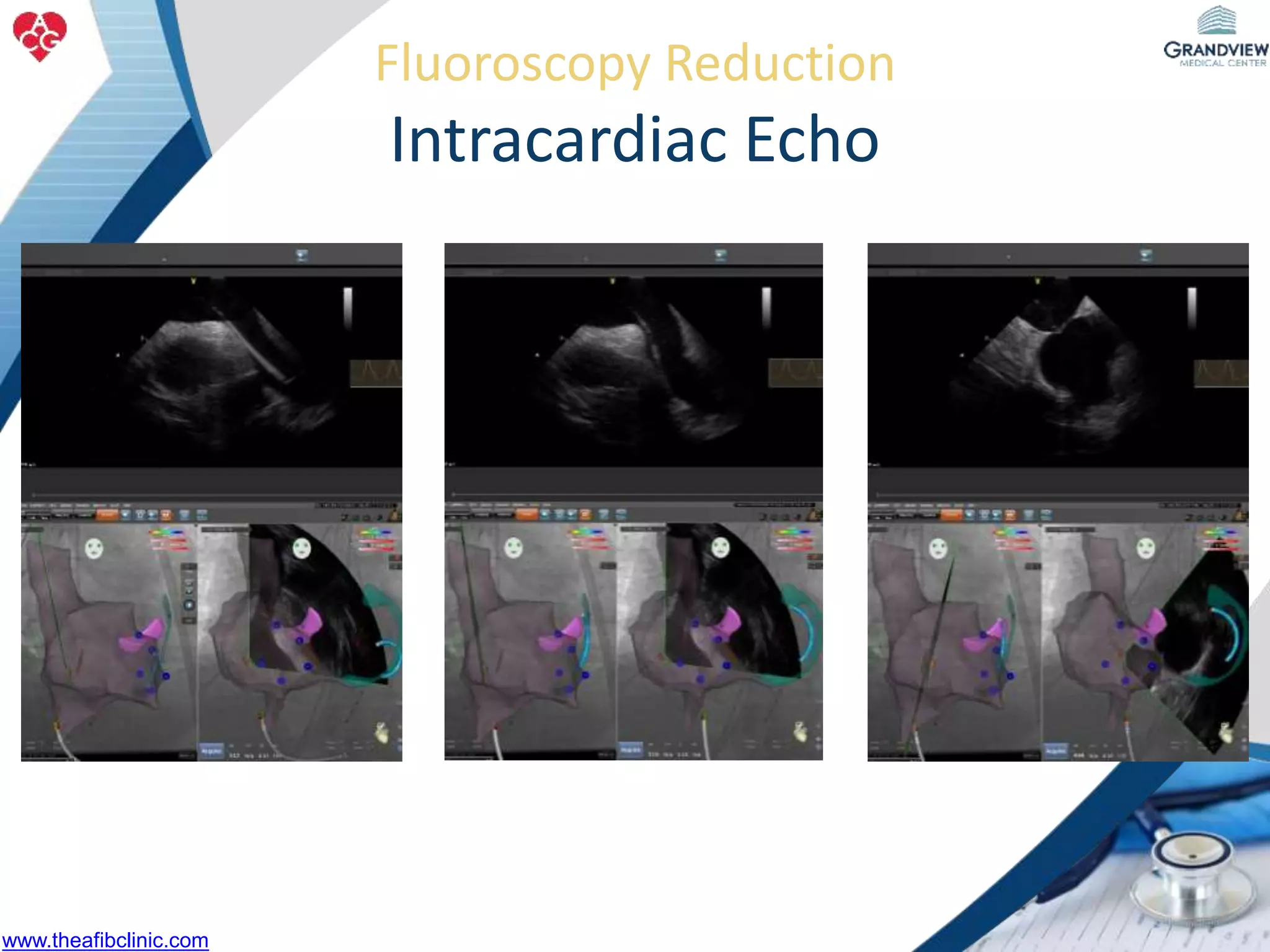
Fluoroscopy Reduction
Intracardiac Echo
www.theafibclinic.com
Fluoroscopy Reduction
Integrating EA Mapping and Imaging
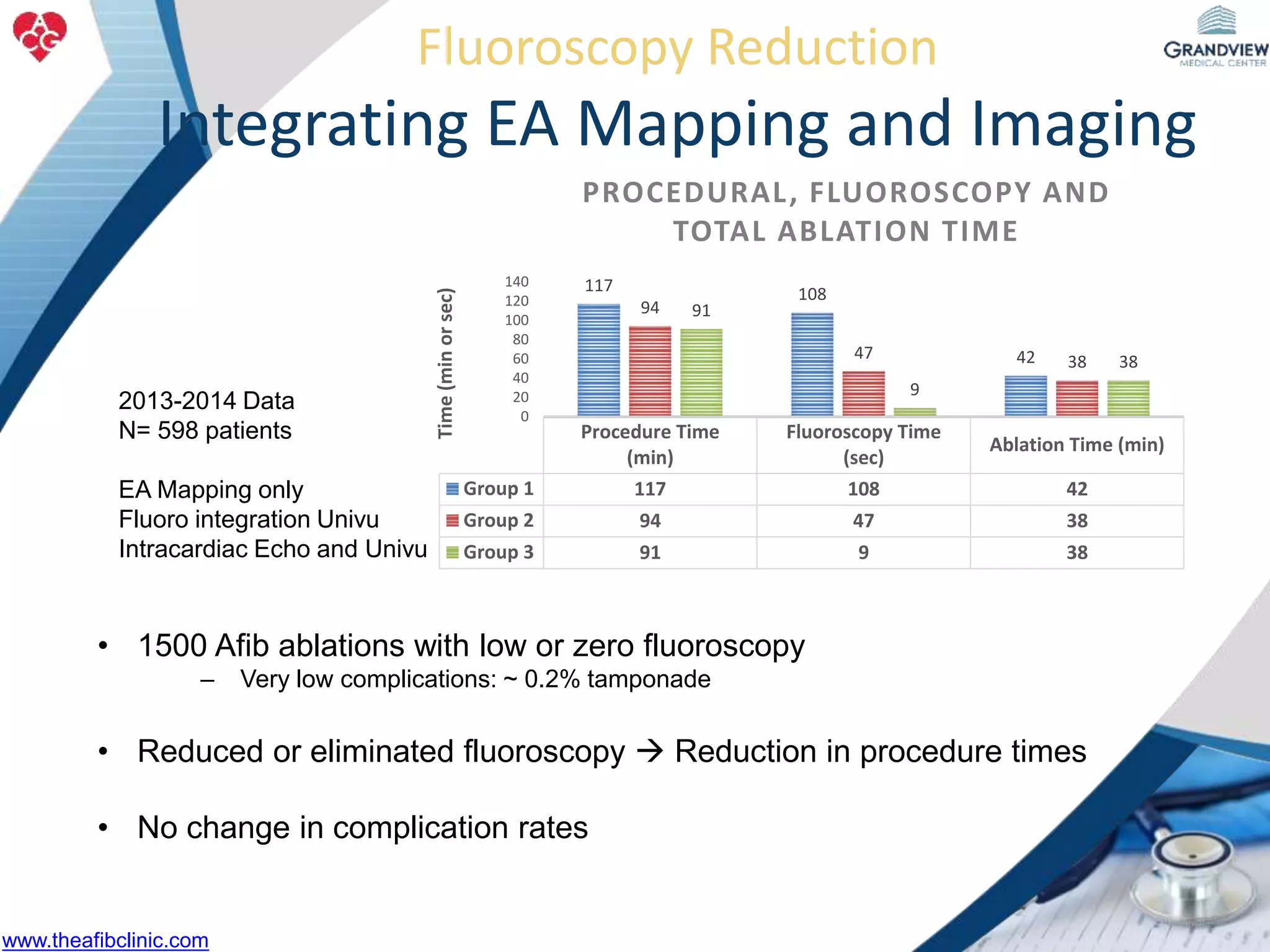
• 1500 Afib ablations with low or zero fluoroscopy
– Very low complications: ~ 0.2% tamponade
• Reduced or eliminated fluoroscopy  Reduction in procedure times
• No change in complication rates
Procedure Time
(min)
Fluoroscopy Time
(sec)
Ablation Time (min)
Group 1 117 108 42
Group 2 94 47 38
Group 3 91 9 38
117 108
42
94
47 38
91
9
38
0
20
40
60
80
100
120
140
Time(minorsec)
PROCEDURAL, FLUOROSCOPY AND
TOTAL ABLATION TIME
2013-2014 Data
N= 598 patients
EA Mapping only
Fluoro integration Univu
Intracardiac Echo and Univu
www.theafibclinic.com
• Can we achieve it all?
• Clinical Workflow for Afib ablation with ST
catheter
– Biophysics of the Contact Force Catheters
– SmartTouch And Visitag Stability Module Integration
Safety, Efficiency and Efficacy
www.theafibclinic.com
Biophysics
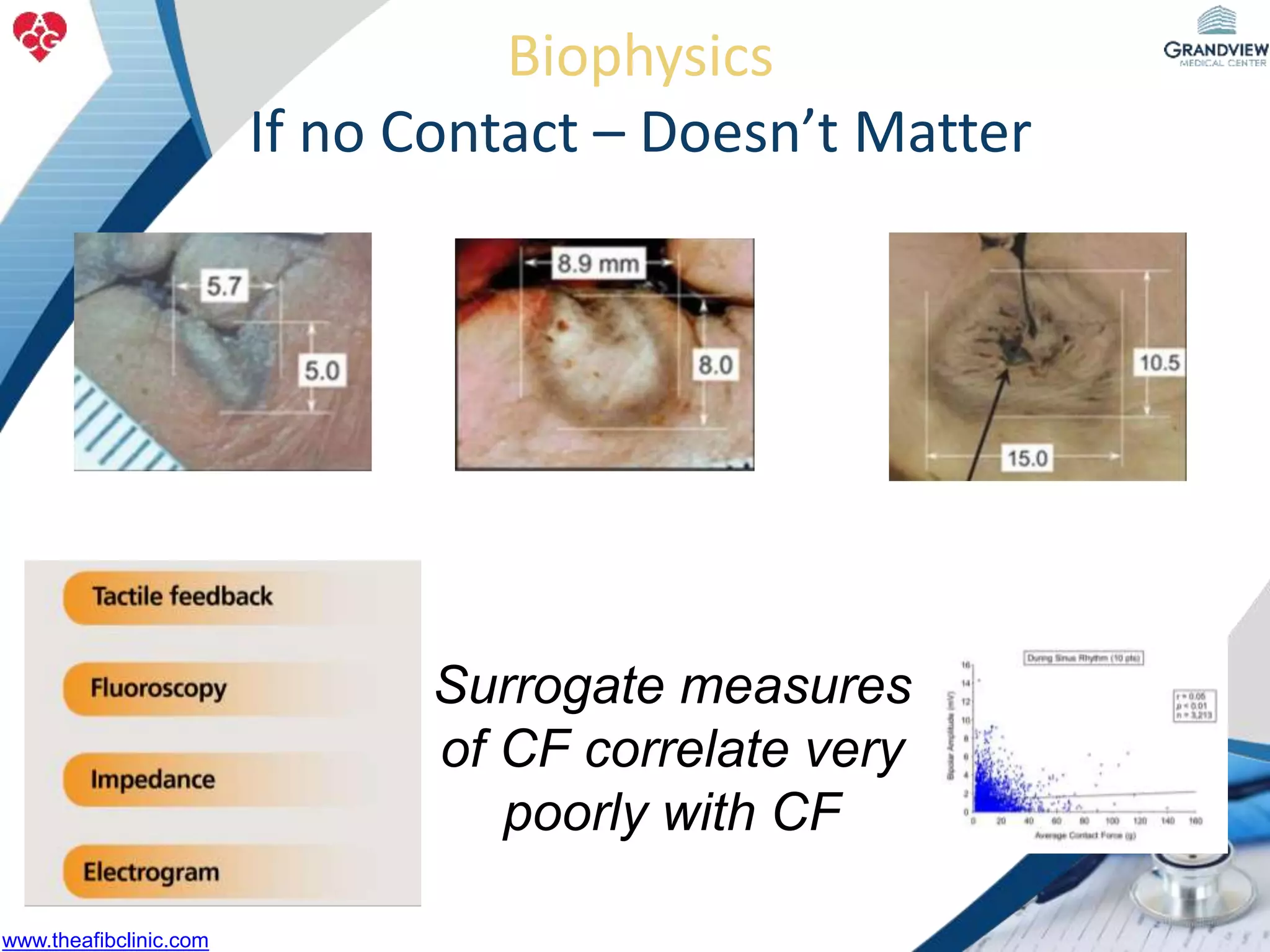
If no Contact – Doesn’t Matter
Surrogate measures
of CF correlate very
poorly with CF
www.theafibclinic.com
Biophysics
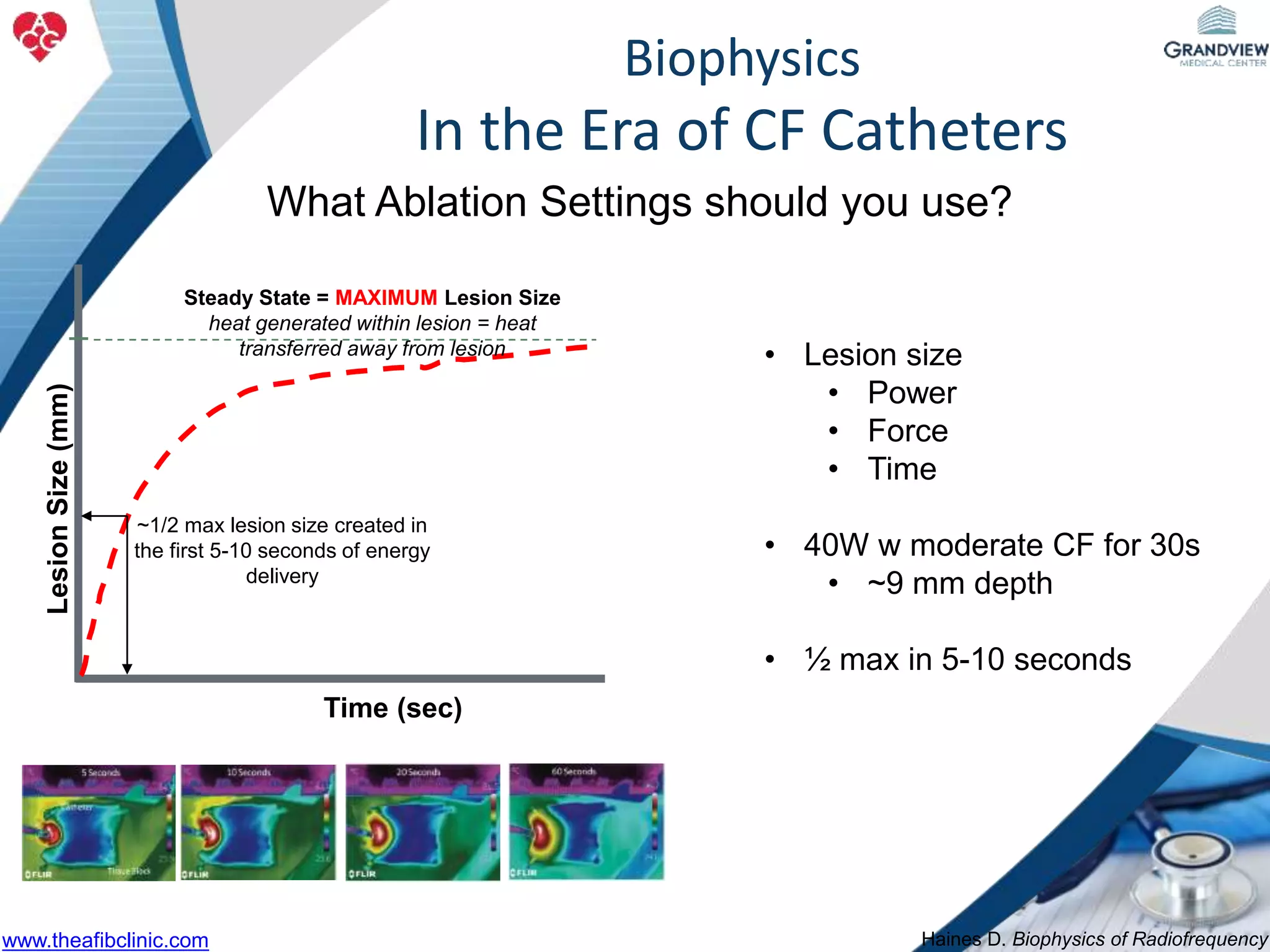
In the Era of CF Catheters
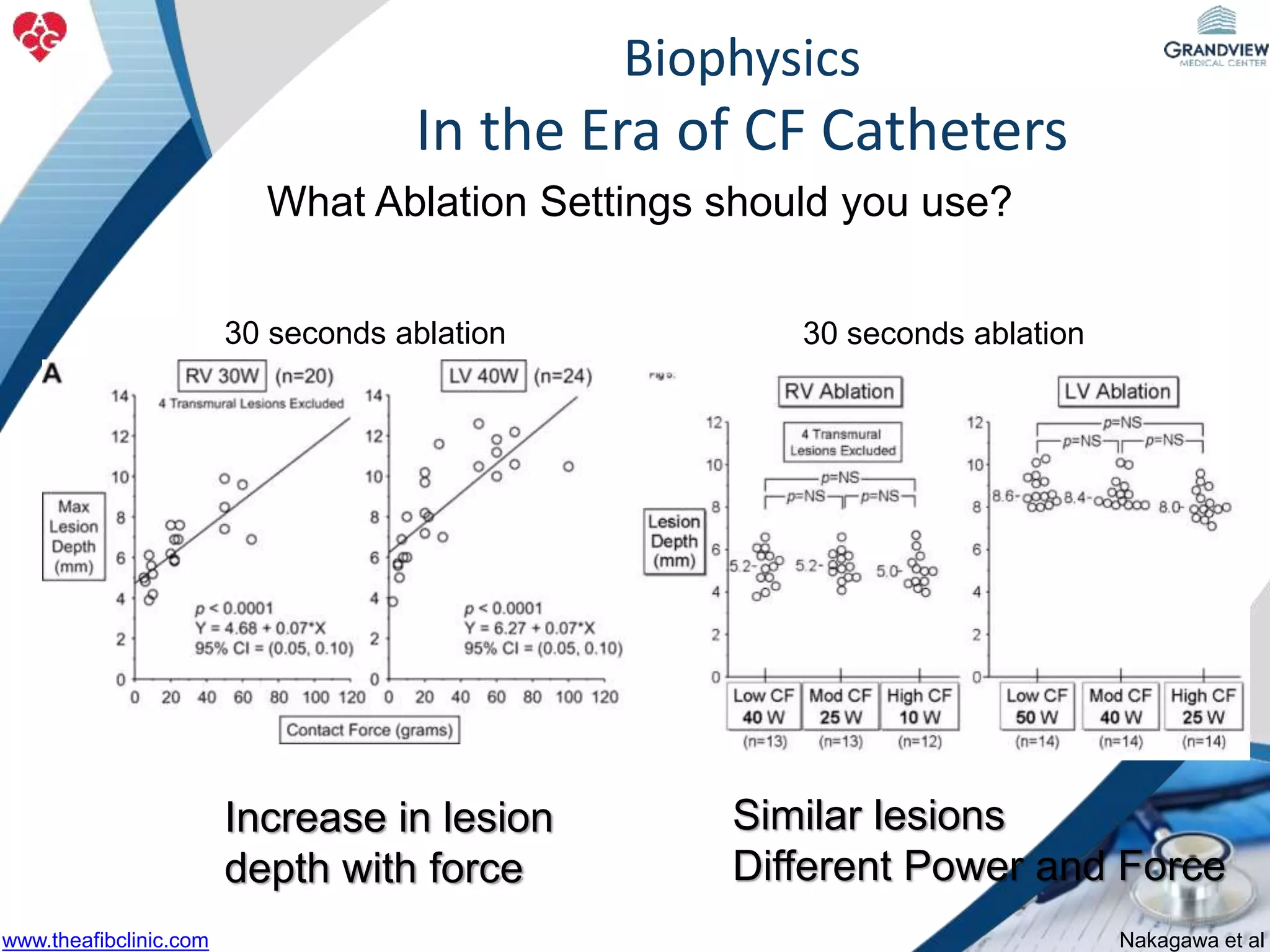
What Ablation Settings should you use?
Increase in lesion
depth with force
Similar lesions
Different Power and Force
30 seconds ablation 30 seconds ablation
Nakagawa et alwww.theafibclinic.com
Biophysics
In the Era of CF Catheters
LesionSize(mm)
Time (sec)
Steady State = MAXIMUM Lesion Size
heat generated within lesion = heat
transferred away from lesion
~1/2 max lesion size created in
the first 5-10 seconds of energy
delivery
What Ablation Settings should you use?
Haines D. Biophysics of Radiofrequency
• Lesion size
• Power
• Force
• Time
• 40W w moderate CF for 30s
• ~9 mm depth
• ½ max in 5-10 seconds
www.theafibclinic.com
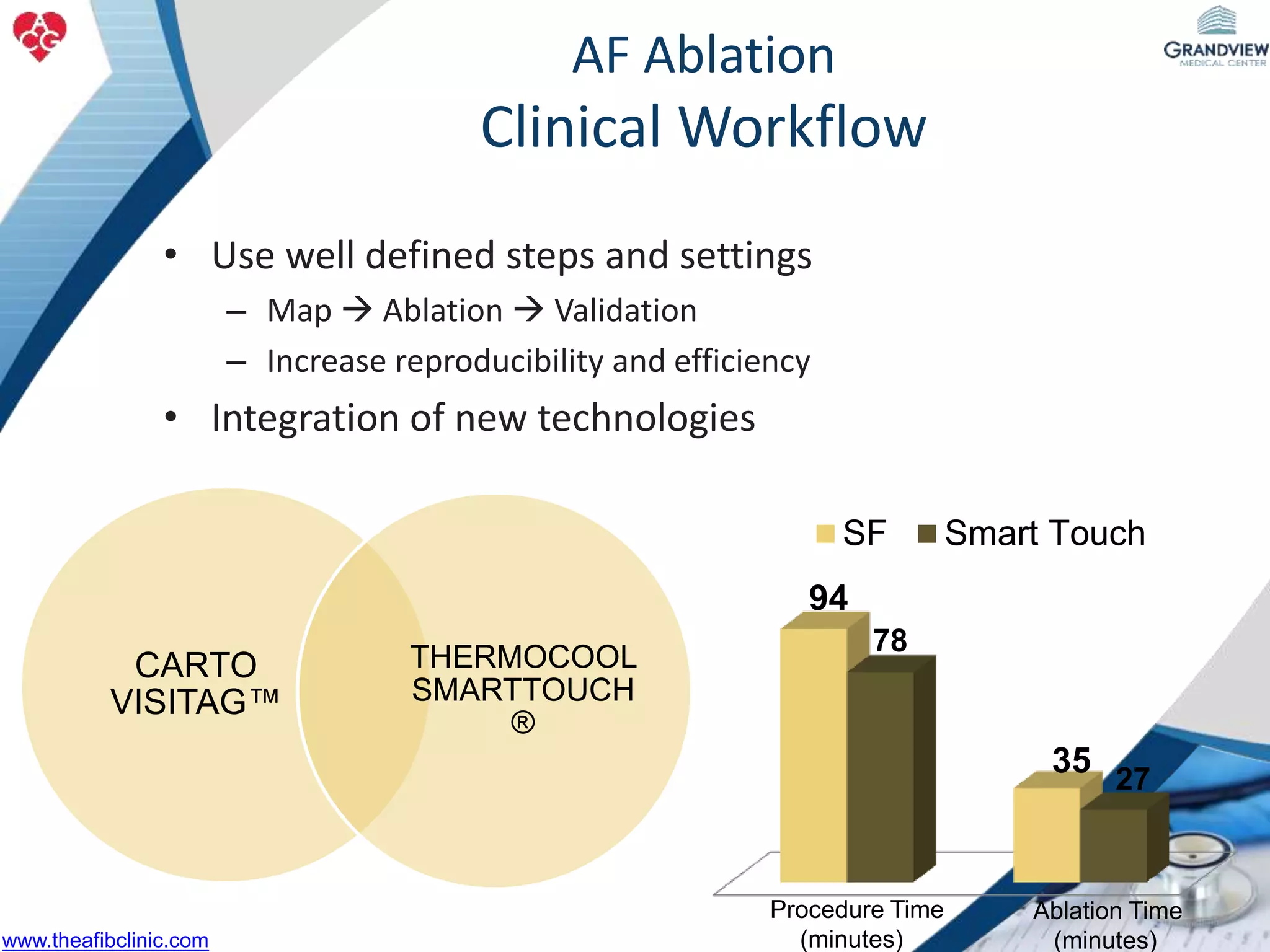
AF Ablation
Clinical Workflow
• Use well defined steps and settings
– Map  Ablation  Validation
– Increase reproducibility and efficiency
• Integration of new technologies
CARTO
VISITAG™
THERMOCOOL
SMARTTOUCH
®
94
35
78
27
SF Smart Touch
Procedure Time
(minutes)
Ablation Time
(minutes)www.theafibclinic.com
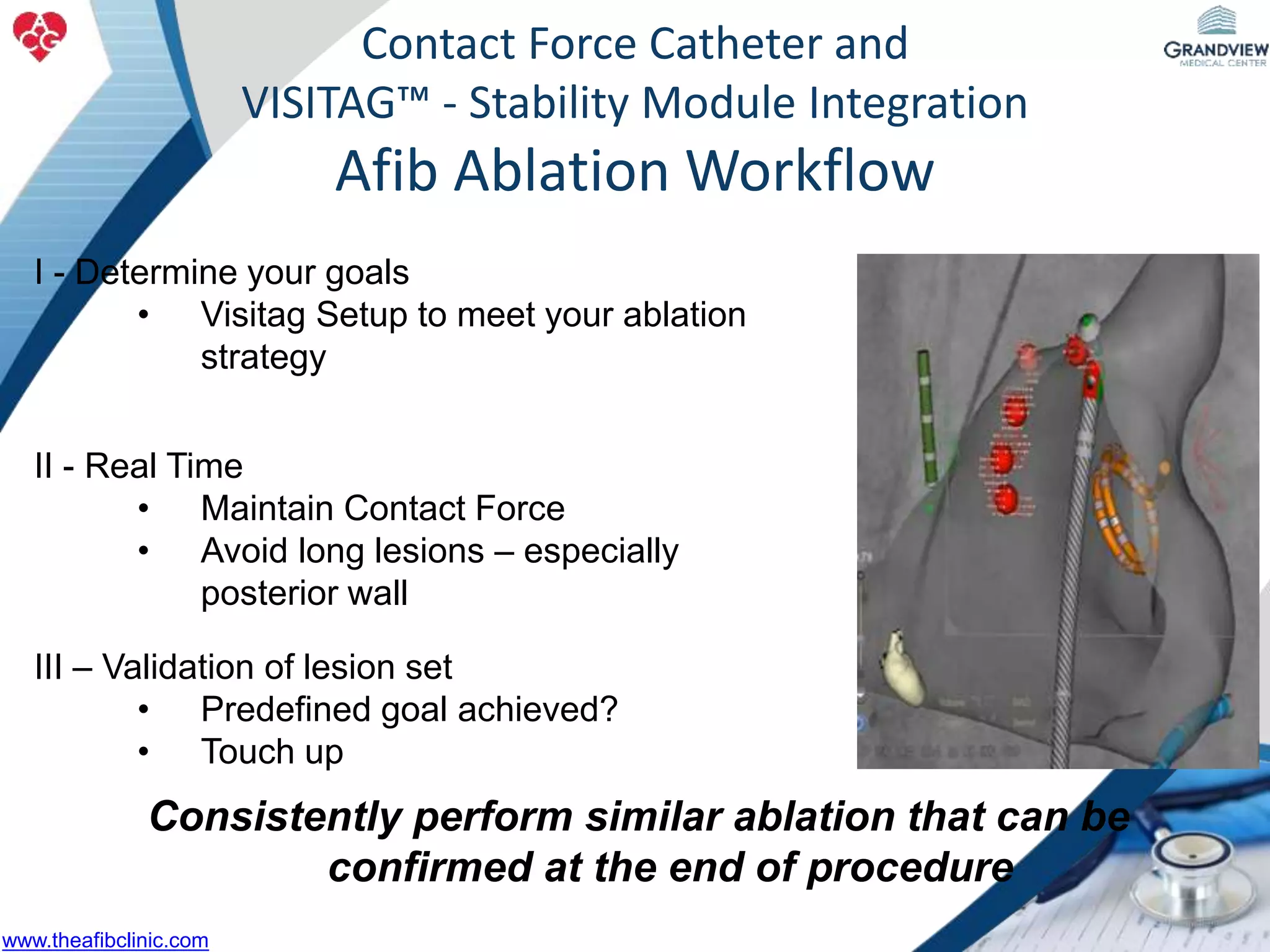
I - Determine your goals
• Visitag Setup to meet your ablation
strategy
Contact Force Catheter and
VISITAG™ - Stability Module Integration
Afib Ablation Workflow
Consistently perform similar ablation that can be
confirmed at the end of procedure
II - Real Time
• Maintain Contact Force
• Avoid long lesions – especially
posterior wall
III – Validation of lesion set
• Predefined goal achieved?
• Touch up
www.theafibclinic.com
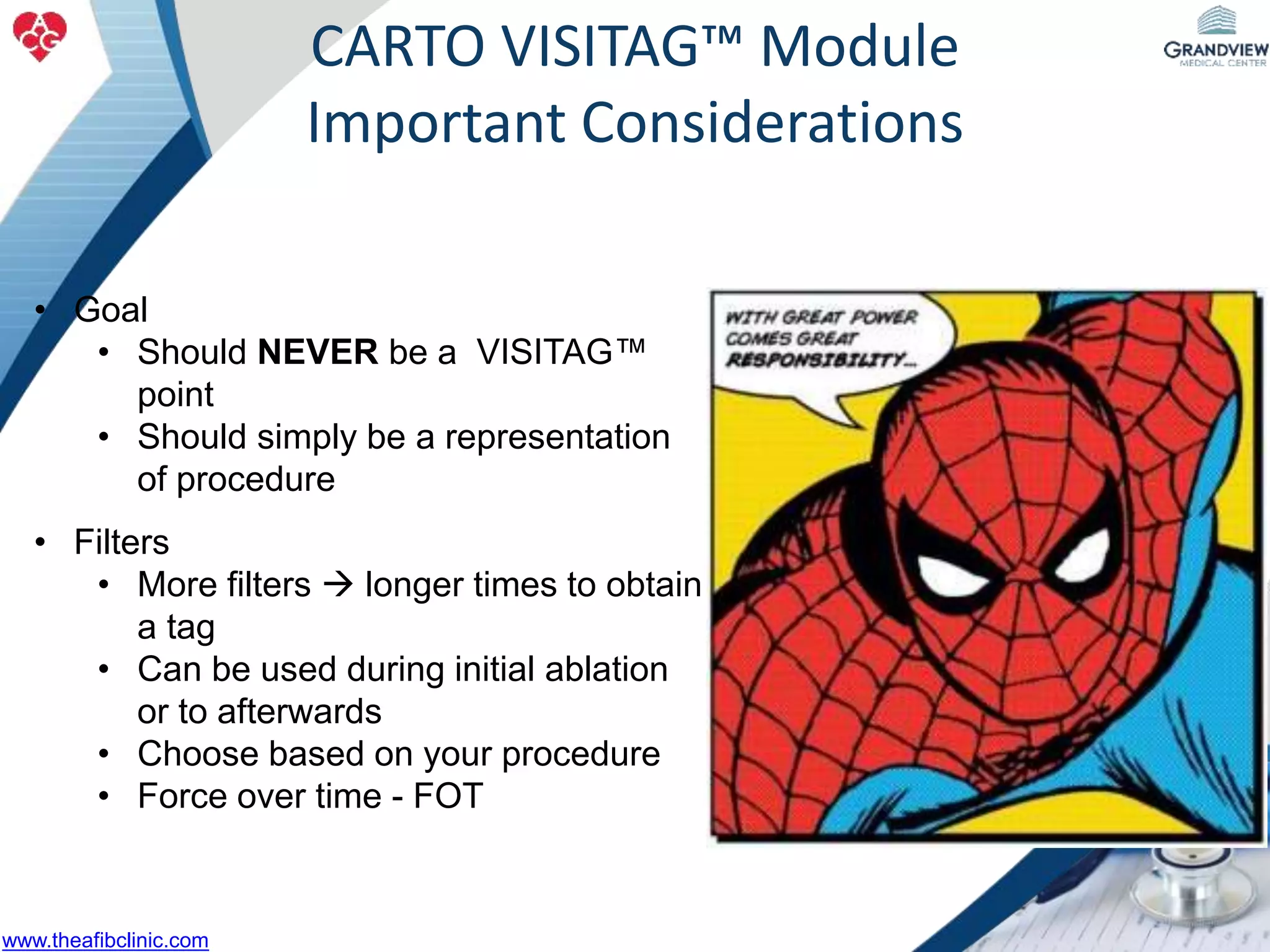
• Goal
• Should NEVER be a VISITAG™
point
• Should simply be a representation
of procedure
CARTO VISITAG™ Module
Important Considerations
• Filters
• More filters  longer times to obtain
a tag
• Can be used during initial ablation
or to afterwards
• Choose based on your procedure
• Force over time - FOT
www.theafibclinic.com
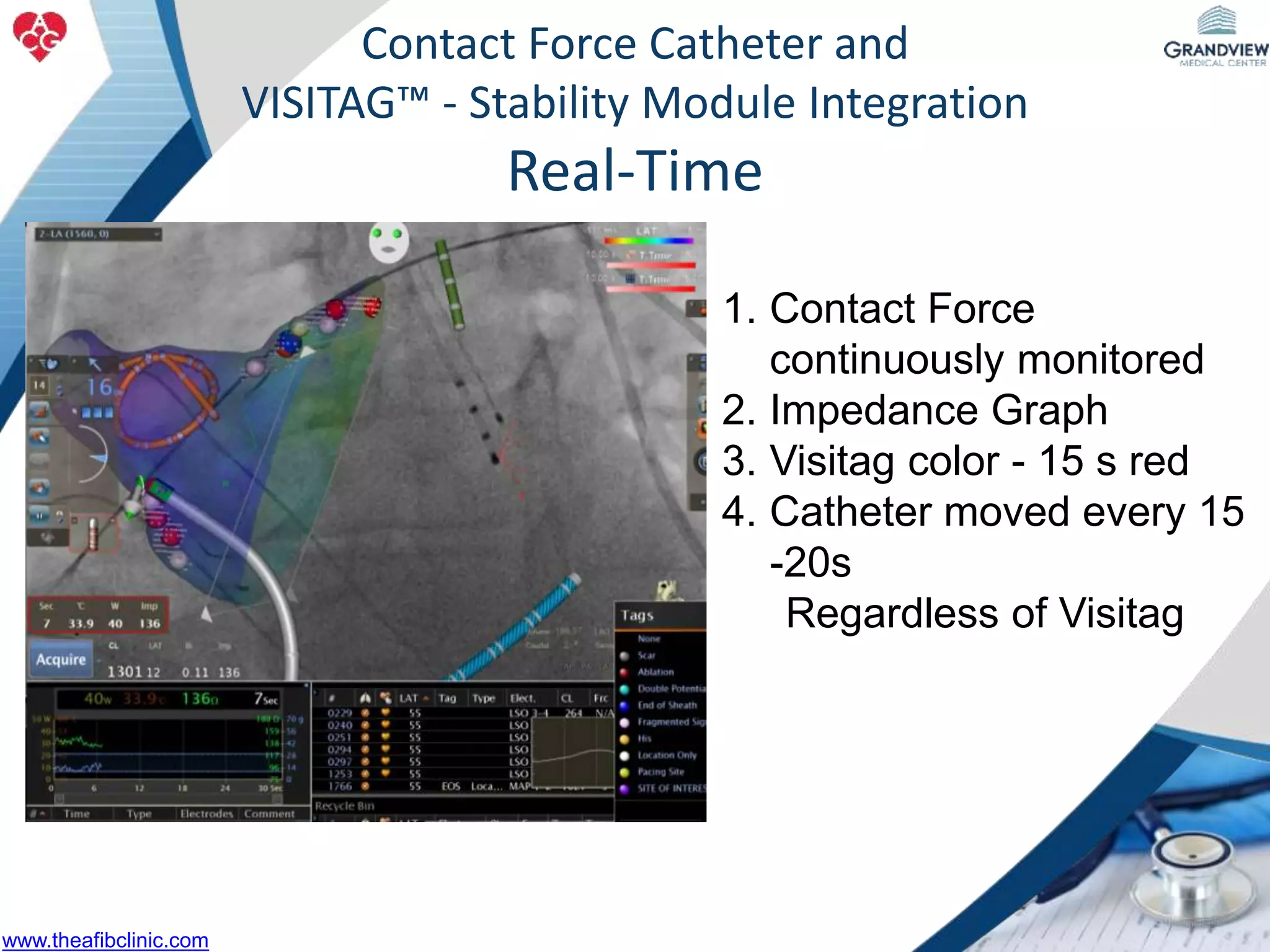
1. Contact Force
continuously monitored
2. Impedance Graph
3. Visitag color - 15 s red
4. Catheter moved every 15
-20s
Regardless of Visitag
Contact Force Catheter and
VISITAG™ - Stability Module Integration
Real-Time
www.theafibclinic.com
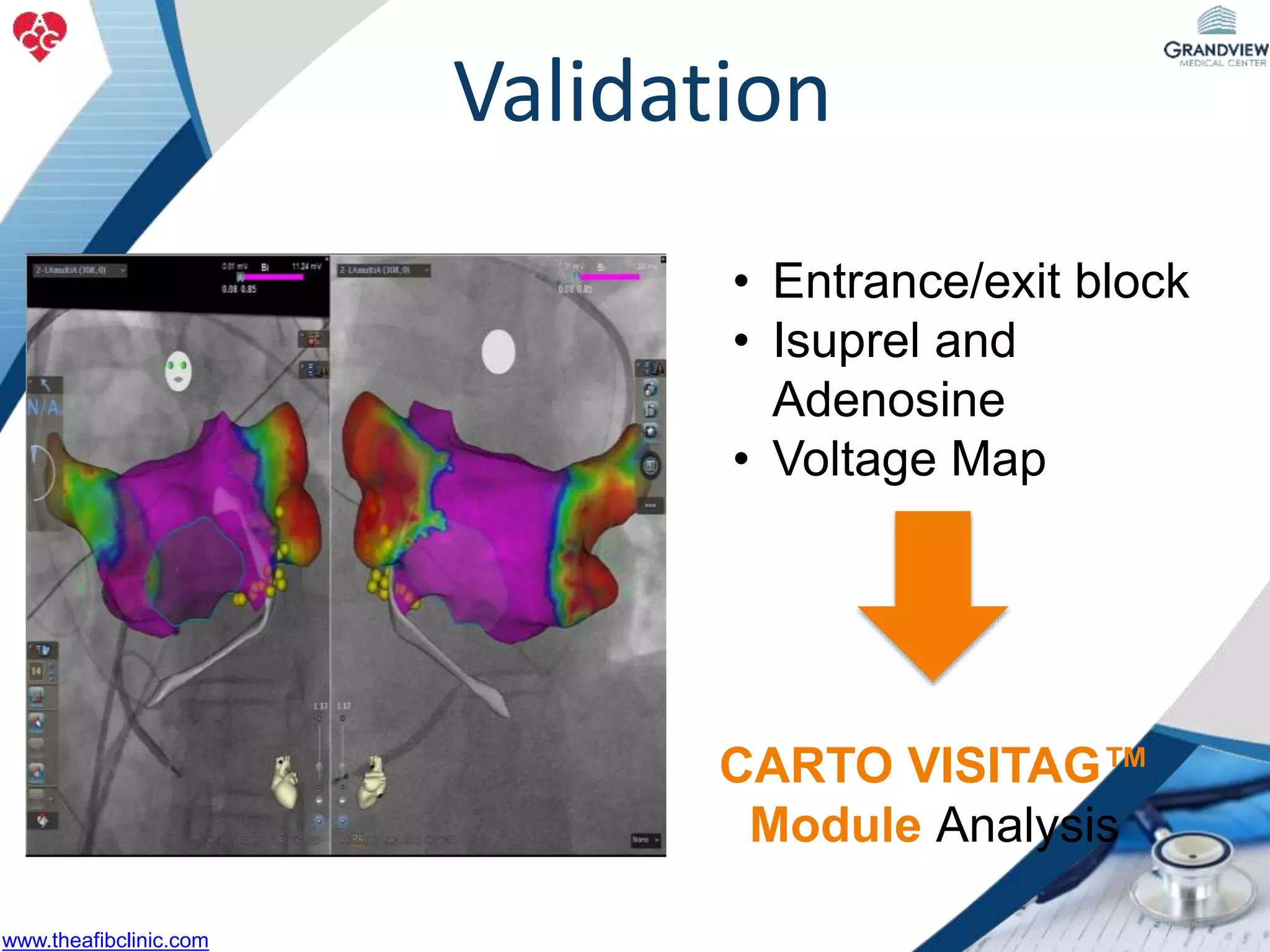
• Entrance/exit block
• Isuprel and
Adenosine
• Voltage Map
Validation
CARTO VISITAG™
Module Analysis
www.theafibclinic.com
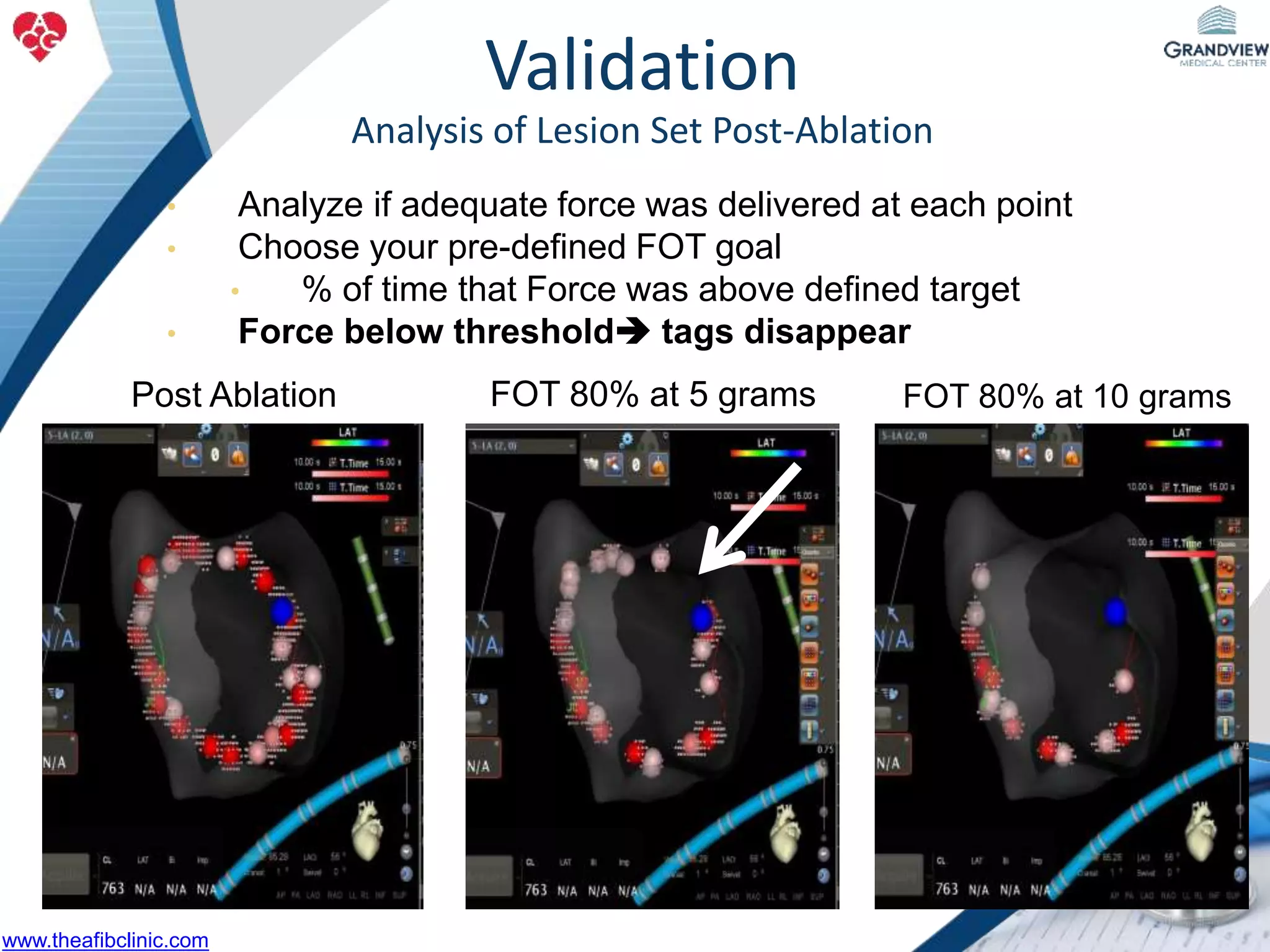
FOT 80% at 5 grams FOT 80% at 10 gramsPost Ablation
• Analyze if adequate force was delivered at each point
• Choose your pre-defined FOT goal
• % of time that Force was above defined target
• Force below threshold tags disappear
Validation
Analysis of Lesion Set Post-Ablation
www.theafibclinic.com
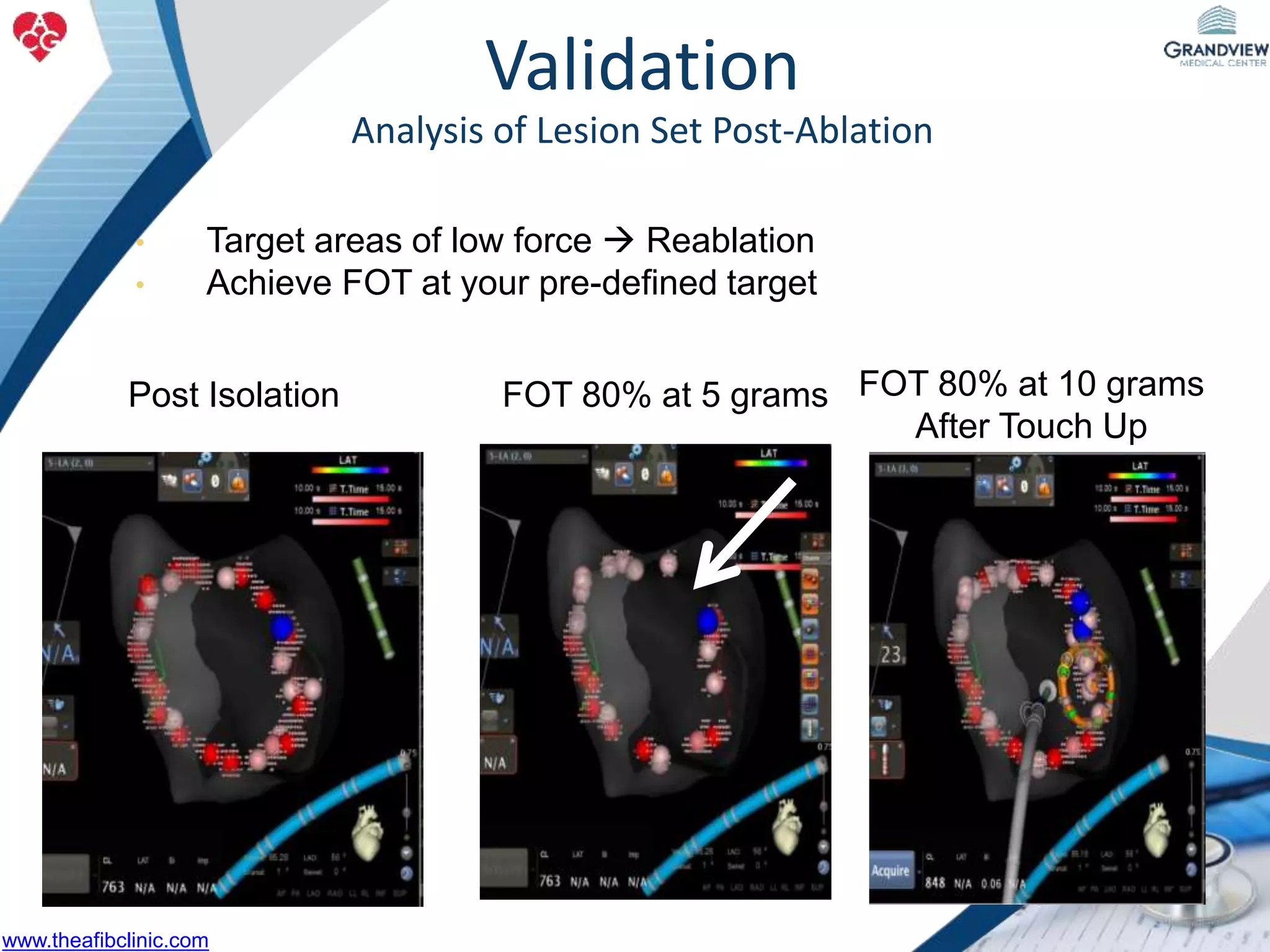
• Target areas of low force  Reablation
• Achieve FOT at your pre-defined target
FOT 80% at 5 grams FOT 80% at 10 grams
After Touch Up
Post Isolation
Validation
Analysis of Lesion Set Post-Ablation
www.theafibclinic.com
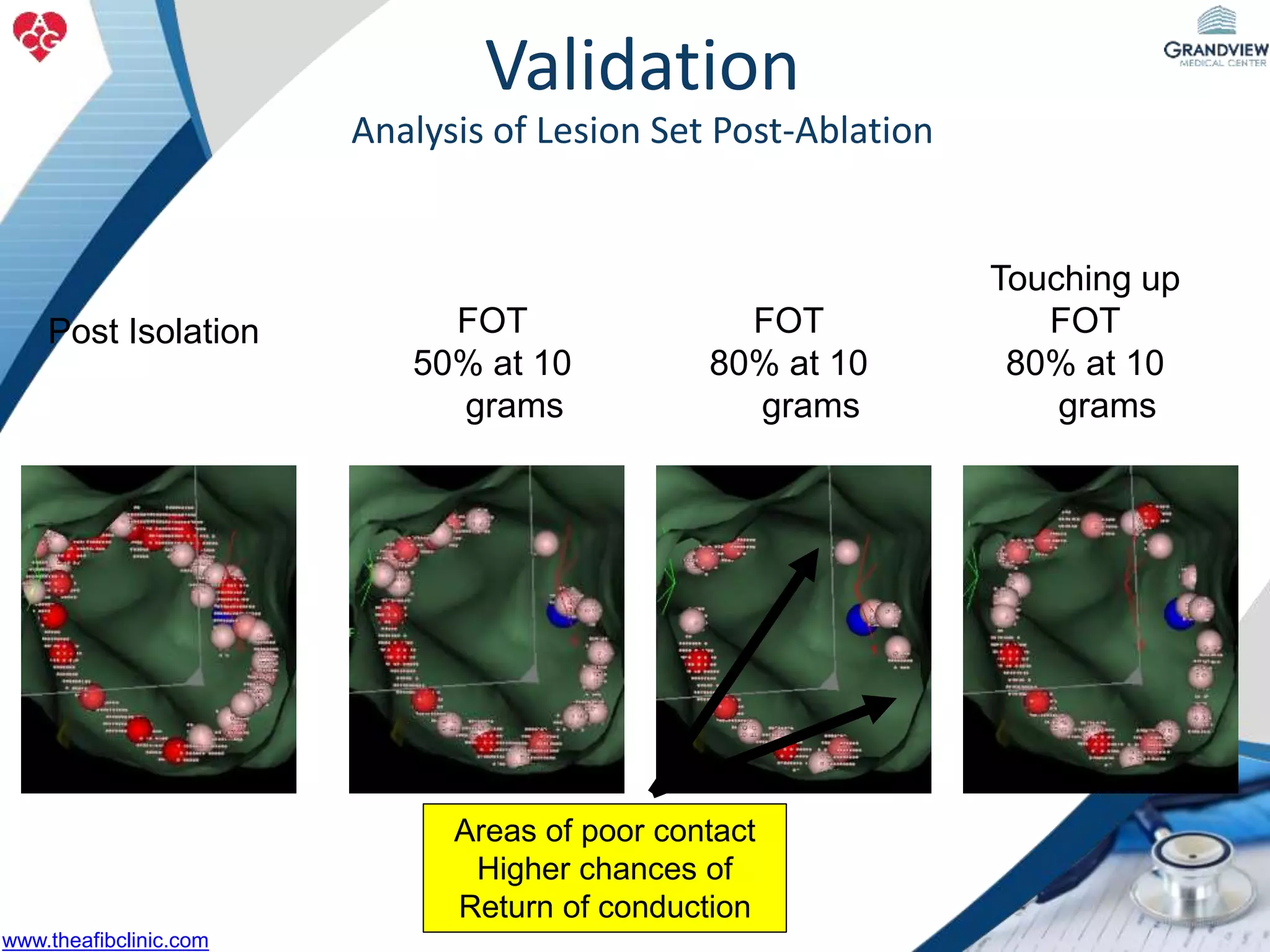
FOT
50% at 10
grams
Post Isolation
Touching up
FOT
80% at 10
grams
FOT
80% at 10
grams
Areas of poor contact
Higher chances of
Return of conduction
Validation
Analysis of Lesion Set Post-Ablation
www.theafibclinic.com
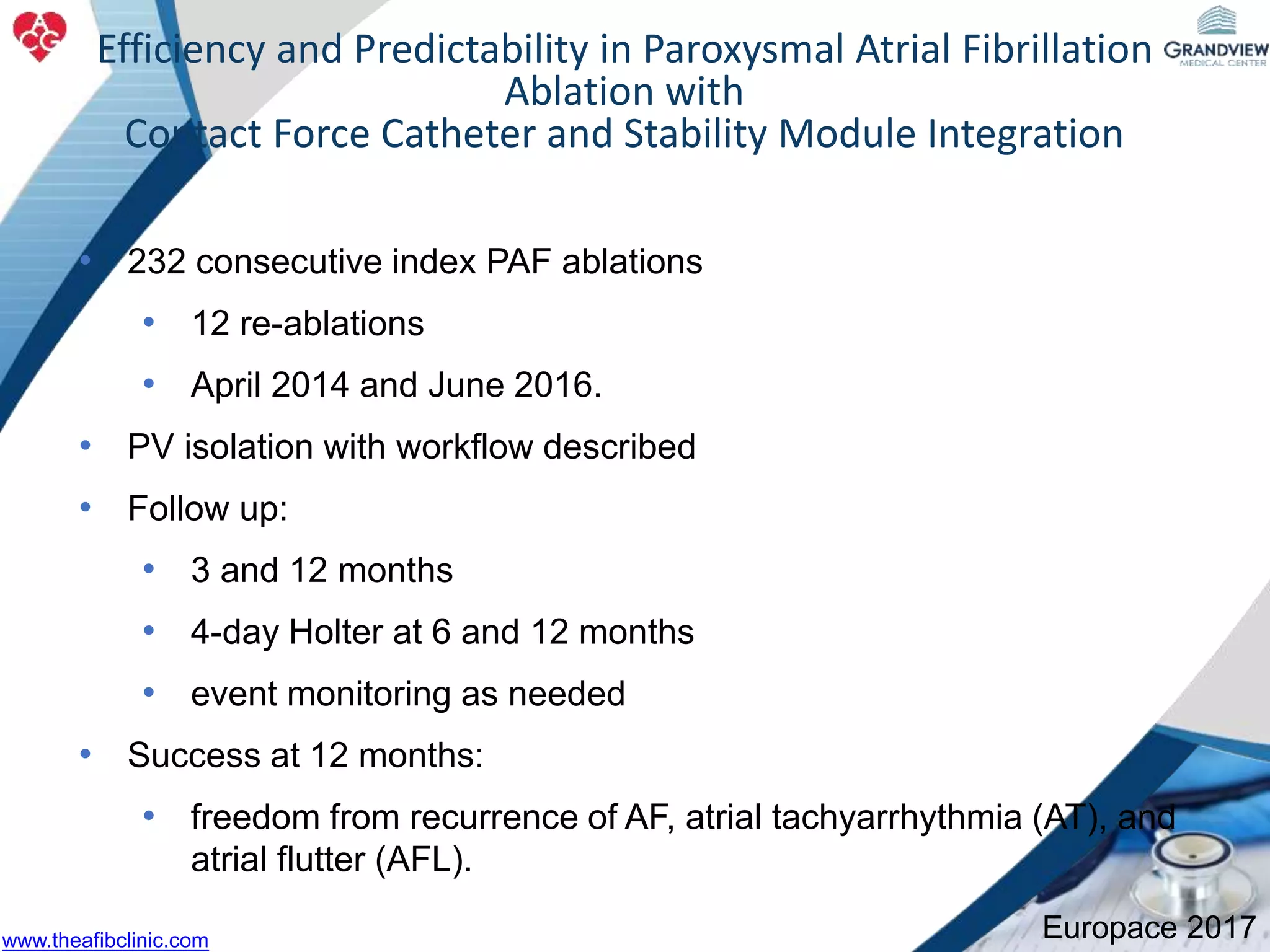
• 232 consecutive index PAF ablations
• 12 re-ablations
• April 2014 and June 2016.
• PV isolation with workflow described
• Follow up:
• 3 and 12 months
• 4-day Holter at 6 and 12 months
• event monitoring as needed
• Success at 12 months:
• freedom from recurrence of AF, atrial tachyarrhythmia (AT), and
atrial flutter (AFL).
40826Efficiency and Predictability in Paroxysmal Atrial Fibrillation
Ablation with
Contact Force Catheter and Stability Module Integration
Europace 2017www.theafibclinic.com
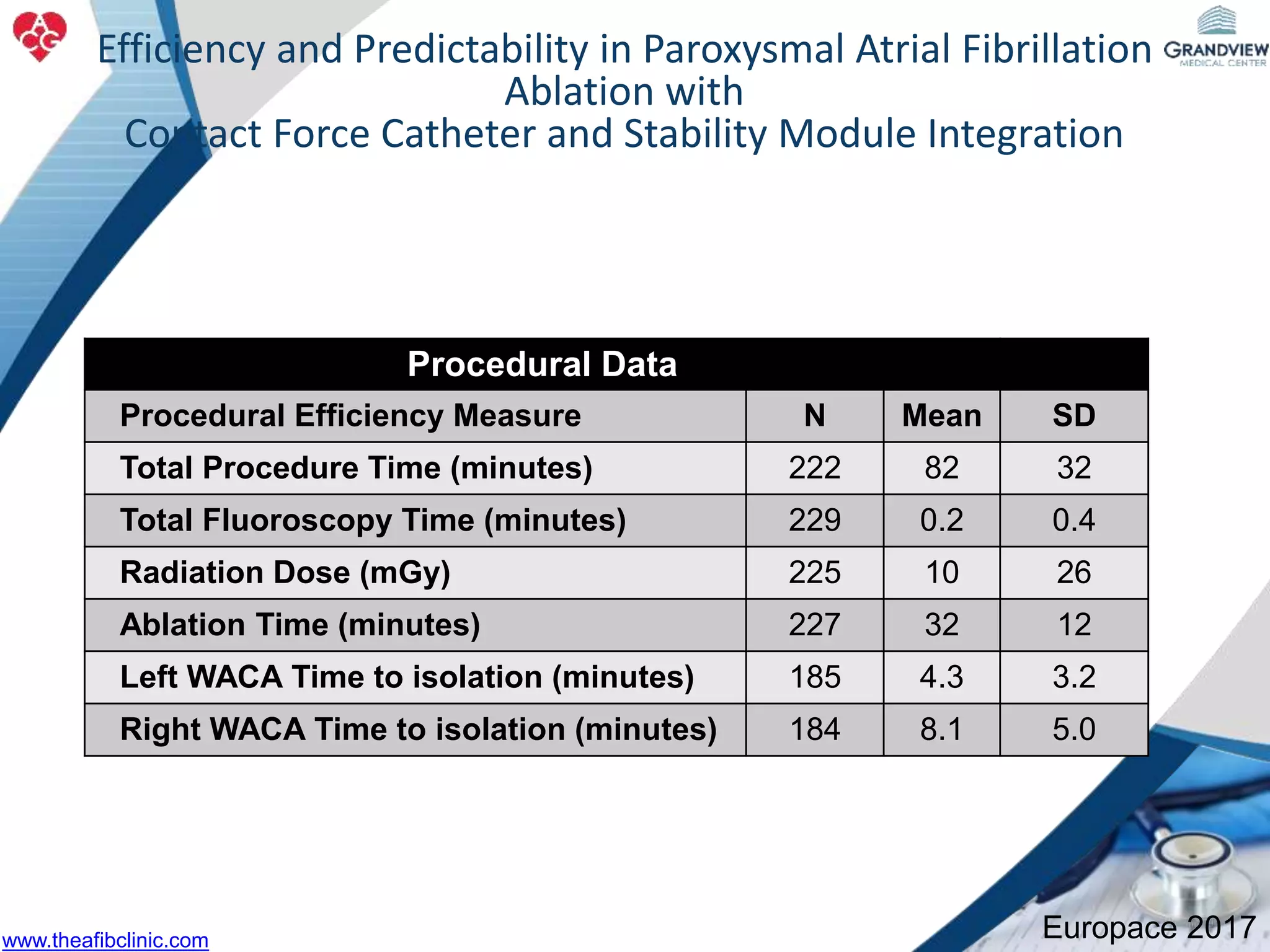
Procedural Data
Procedural Efficiency Measure N Mean SD
Total Procedure Time (minutes) 222 82 32
Total Fluoroscopy Time (minutes) 229 0.2 0.4
Radiation Dose (mGy) 225 10 26
Ablation Time (minutes) 227 32 12
Left WACA Time to isolation (minutes) 185 4.3 3.2
Right WACA Time to isolation (minutes) 184 8.1 5.0
Europace 2017
Efficiency and Predictability in Paroxysmal Atrial Fibrillation
Ablation with
Contact Force Catheter and Stability Module Integration
www.theafibclinic.com
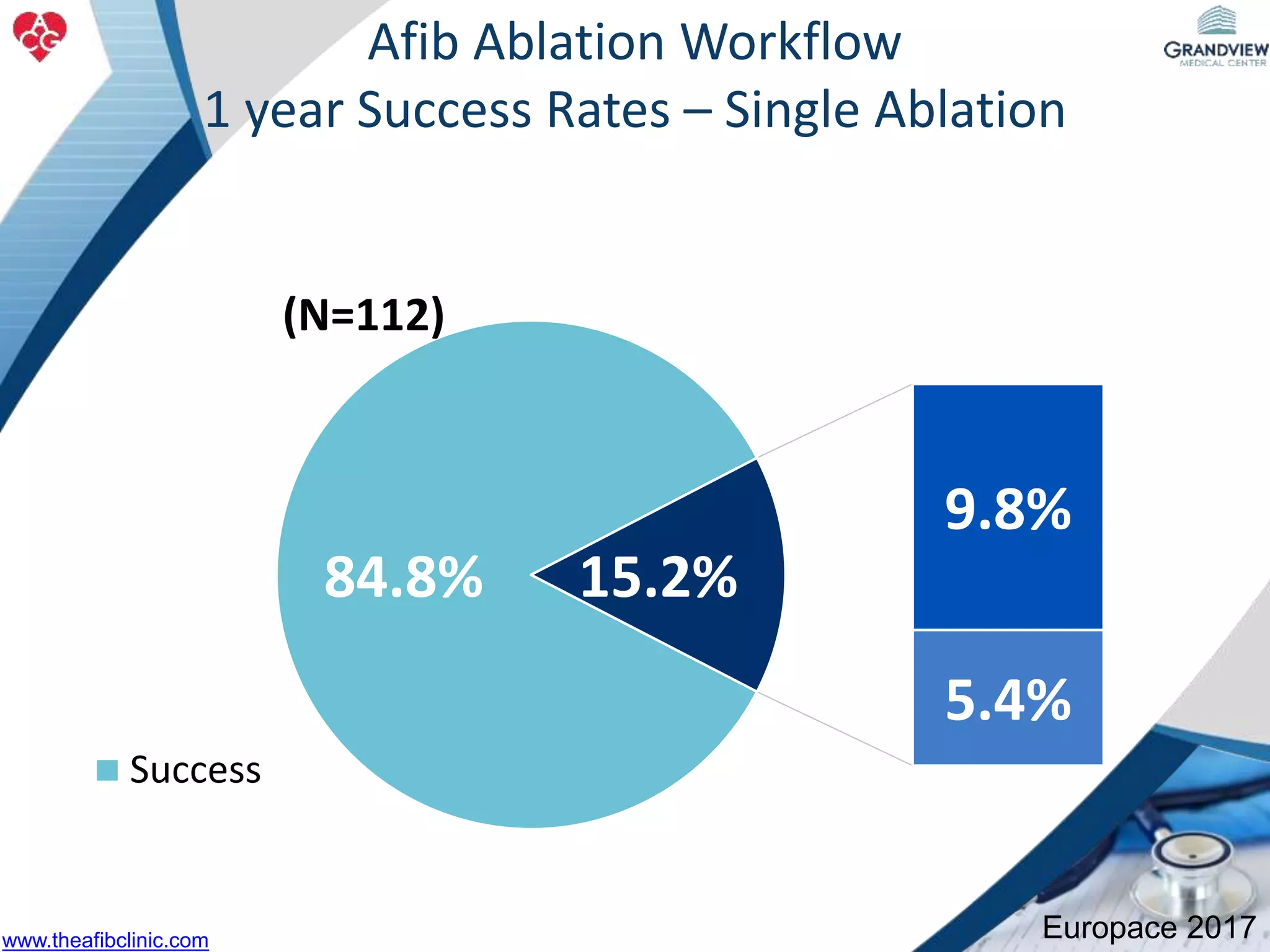
84.8%
9.8%
5.4%
15.2%
(N=112)
Success
Afib Ablation Workflow
1 year Success Rates – Single Ablation
Europace 2017www.theafibclinic.com
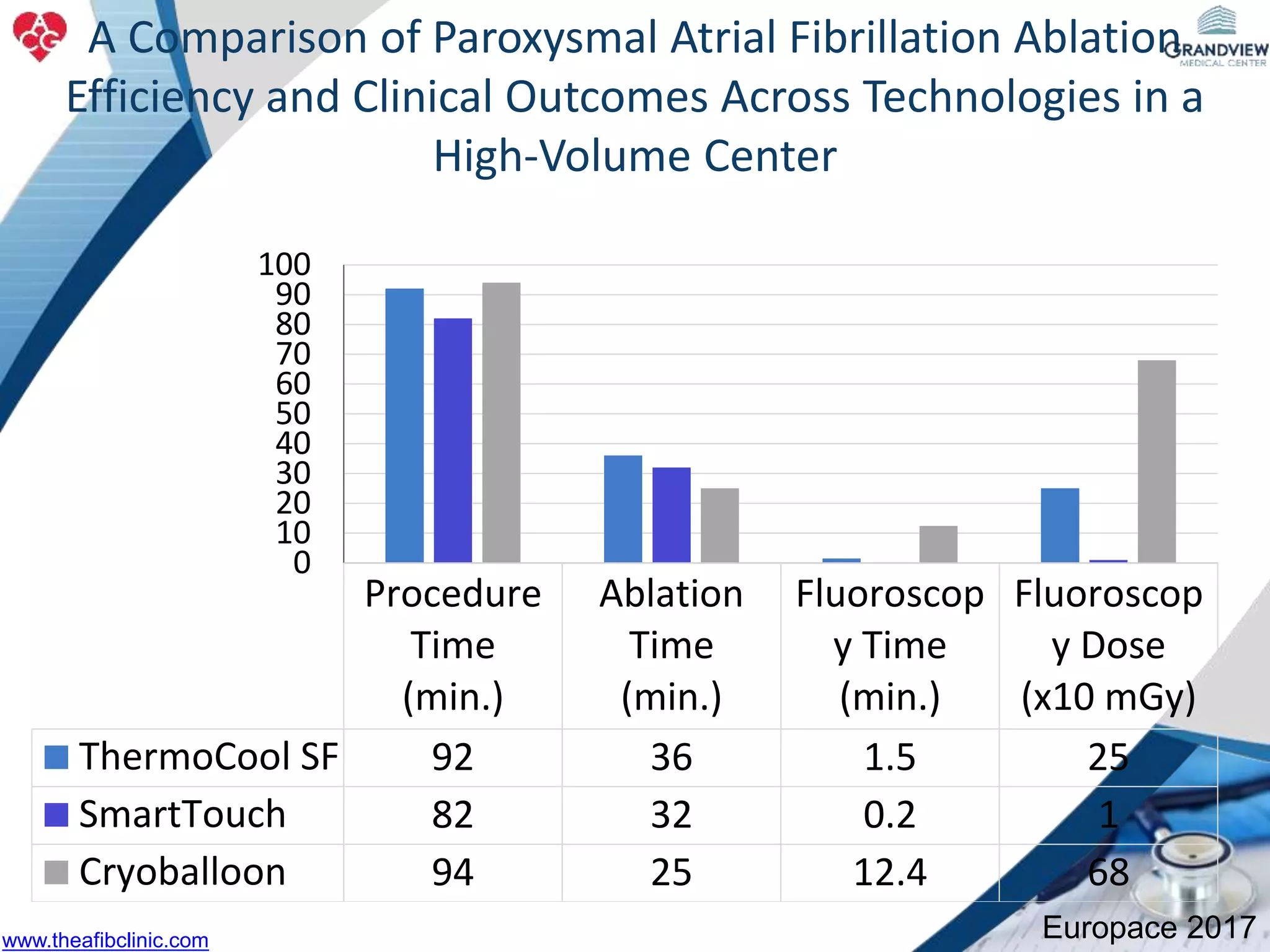
Procedure
Time
(min.)
Ablation
Time
(min.)
Fluoroscop
y Time
(min.)
Fluoroscop
y Dose
(x10 mGy)
ThermoCool SF 92 36 1.5 25
SmartTouch 82 32 0.2 1
Cryoballoon 94 25 12.4 68
0
10
20
30
40
50
60
70
80
90
100
Europace 2017
A Comparison of Paroxysmal Atrial Fibrillation Ablation
Efficiency and Clinical Outcomes Across Technologies in a
High-Volume Center
www.theafibclinic.com
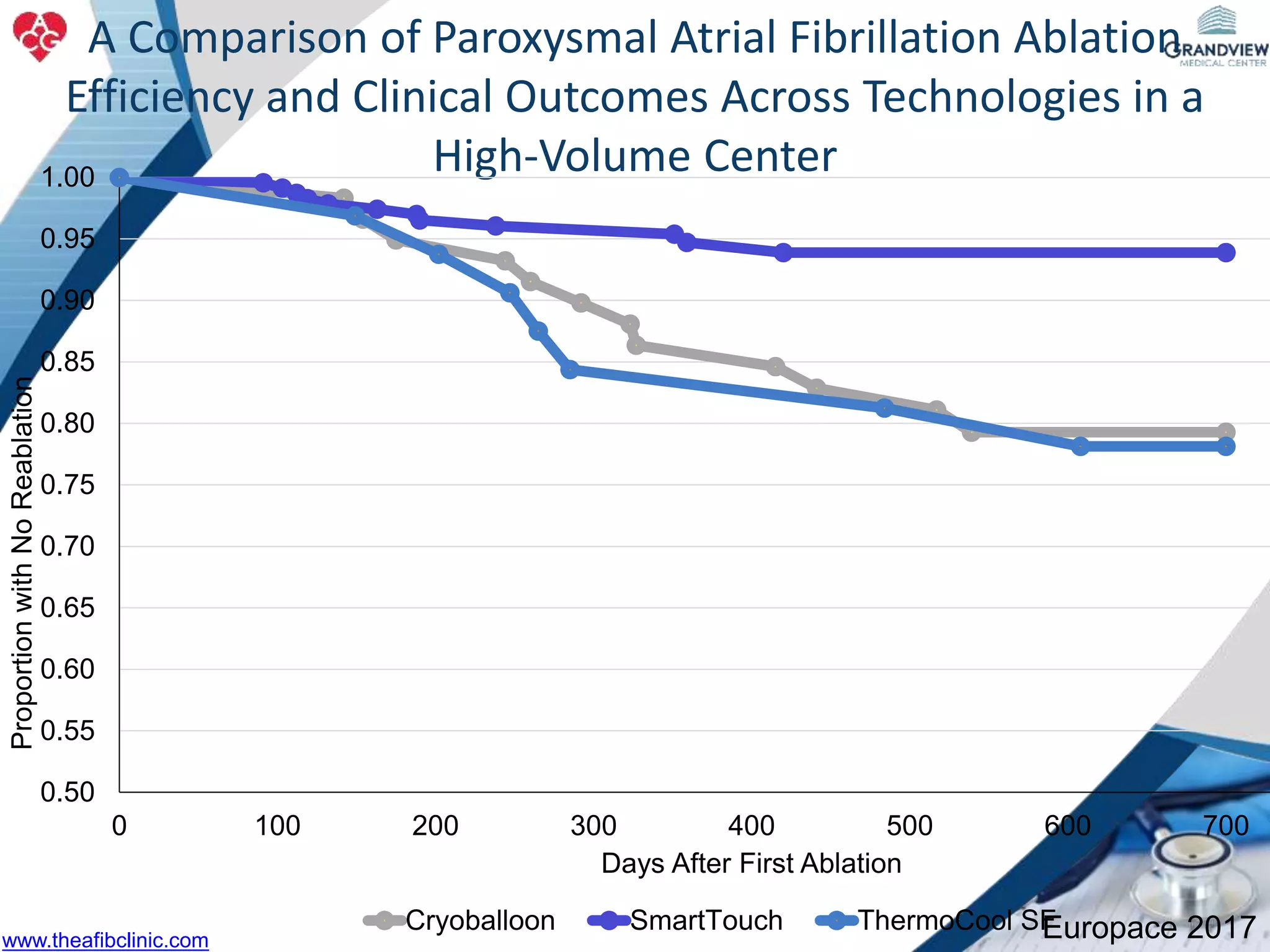
A Comparison of Paroxysmal Atrial Fibrillation Ablation
Efficiency and Clinical Outcomes Across Technologies in a
High-Volume Center
0.50
0.55
0.60
0.65
0.70
0.75
0.80
0.85
0.90
0.95
1.00
0 100 200 300 400 500 600 700
ProportionwithNoReablation
Days After First Ablation
Cryoballoon SmartTouch ThermoCool SFEuropace 2017www.theafibclinic.com
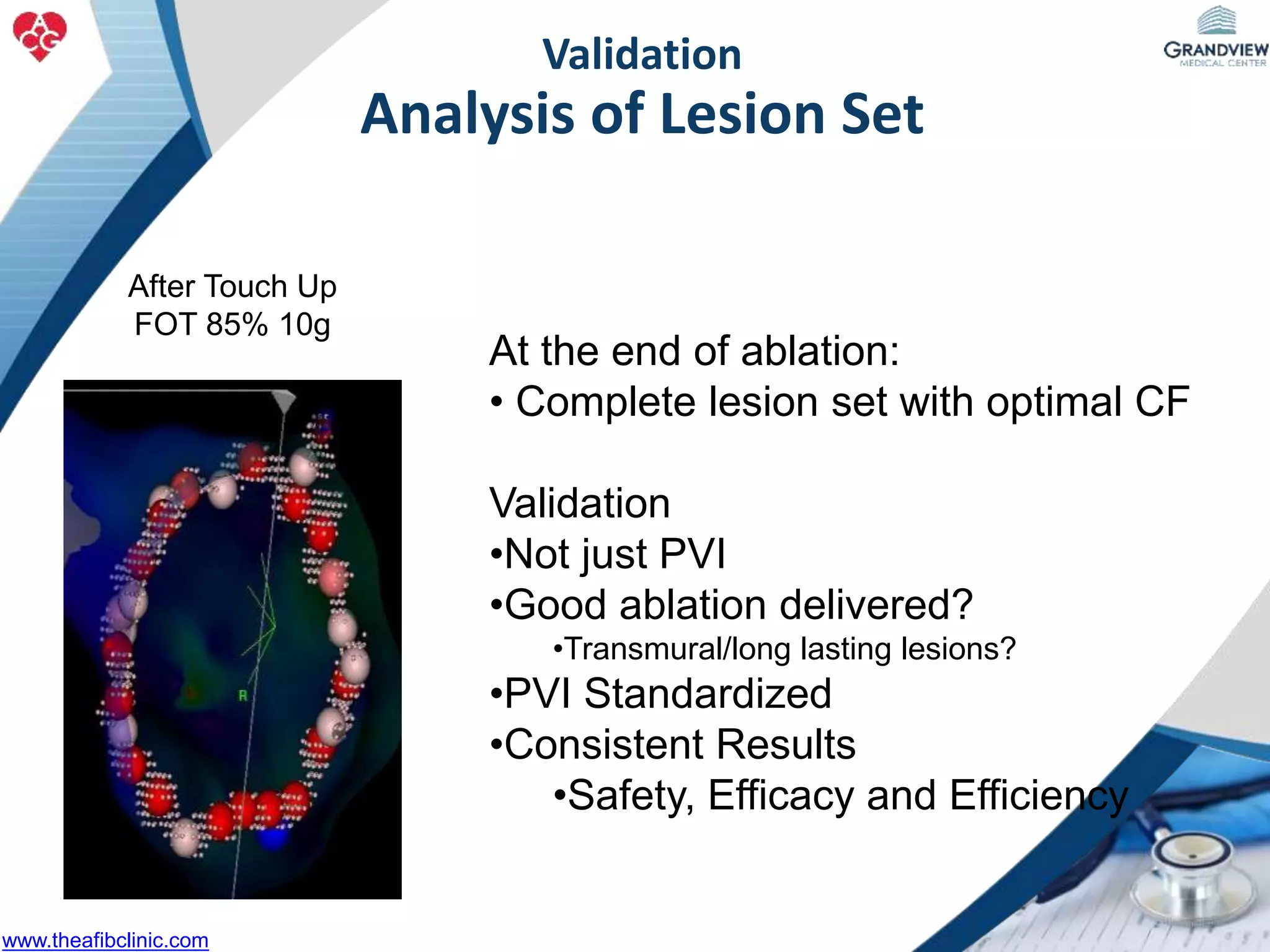
At the end of ablation:
• Complete lesion set with optimal CF
Validation
•Not just PVI
•Good ablation delivered?
•Transmural/long lasting lesions?
•PVI Standardized
•Consistent Results
•Safety, Efficacy and Efficiency
After Touch Up
FOT 85% 10g
Validation
Analysis of Lesion Set
www.theafibclinic.com
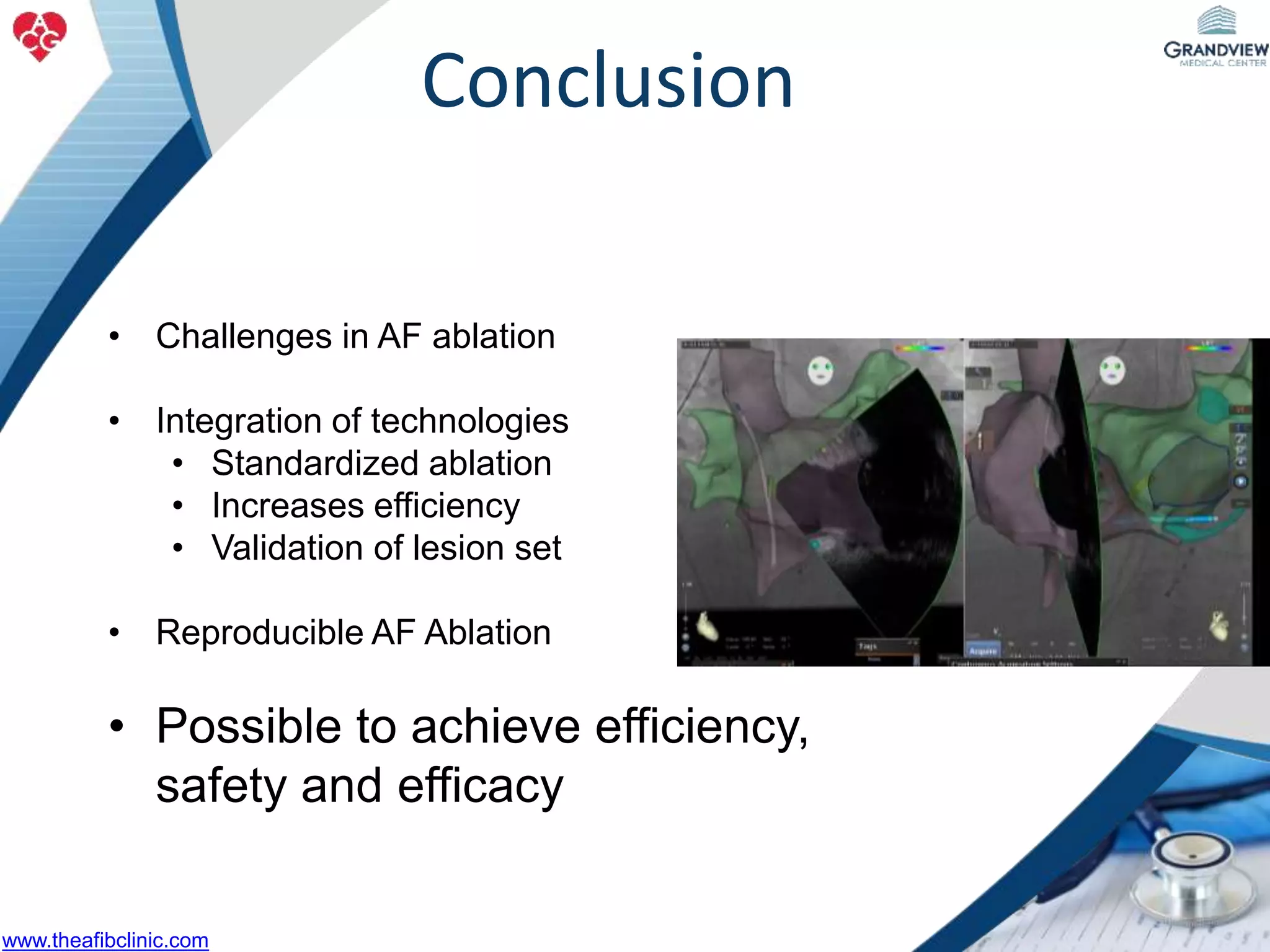
• Challenges in AF ablation
• Integration of technologies
• Standardized ablation
• Increases efficiency
• Validation of lesion set
• Reproducible AF Ablation
• Possible to achieve efficiency,
safety and efficacy
Conclusion
www.theafibclinic.com

The Evolution of Atrial Fibrillation Ablation: Utilizing Current Technology to Improve Efficiency, Safety and Efficacy

  • 1.
    DR JOSE OSORIO TheEvolution of Atrial Fibrillation Ablation: Utilizing Current Technology to Improve Efficiency, Safety and Efficacy
  • 2.
    Atrial fibrillation Ablation •Well-established option for AF patients • Technological evolution – Ablation catheters – Electroanatomical Mapping Systems • Increased procedural complexity www.theafibclinic.com
  • 3.
    • Safety – Patients –Physician and Staff • Efficiency – Long Procedure times • Efficacy – PV reconnection – Repeat procedures AFib Ablation Challenges
  • 4.
    AFib Ablation My Journey Procedure:~ 150min Fluoroscopy: ~ 40min Ablations/day: 2-3 Recurrence: higher than current No understanding of substrate IV contrast 2010 ~ 70min 1 second 5 or 6 Higher Success rates Substrate data No contrast used Similar complication rates 2014
  • 5.
    Using Technology toAddress AFib Ablation Challenges 2010 Mapping system: • 3D reconstruction Intracardiac Echo 2013 Univu Visitag Module 2014 Contact Force Sensing Workflow Integrating CF and Visitag Fluoroscopy Reduction Clinical Afib Ablation Workflow www.theafibclinic.com
  • 6.
  • 7.
    Fluoroscopy Reduction Fast AnatomicalMapping www.theafibclinic.com
  • 8.
  • 9.
    Fluoroscopy Reduction Integrating EAMapping and Imaging • 1500 Afib ablations with low or zero fluoroscopy – Very low complications: ~ 0.2% tamponade • Reduced or eliminated fluoroscopy  Reduction in procedure times • No change in complication rates Procedure Time (min) Fluoroscopy Time (sec) Ablation Time (min) Group 1 117 108 42 Group 2 94 47 38 Group 3 91 9 38 117 108 42 94 47 38 91 9 38 0 20 40 60 80 100 120 140 Time(minorsec) PROCEDURAL, FLUOROSCOPY AND TOTAL ABLATION TIME 2013-2014 Data N= 598 patients EA Mapping only Fluoro integration Univu Intracardiac Echo and Univu www.theafibclinic.com
  • 10.
    • Can weachieve it all? • Clinical Workflow for Afib ablation with ST catheter – Biophysics of the Contact Force Catheters – SmartTouch And Visitag Stability Module Integration Safety, Efficiency and Efficacy www.theafibclinic.com
  • 11.
    Biophysics If no Contact– Doesn’t Matter Surrogate measures of CF correlate very poorly with CF www.theafibclinic.com
  • 12.
    Biophysics In the Eraof CF Catheters What Ablation Settings should you use? Increase in lesion depth with force Similar lesions Different Power and Force 30 seconds ablation 30 seconds ablation Nakagawa et alwww.theafibclinic.com
  • 13.
    Biophysics In the Eraof CF Catheters LesionSize(mm) Time (sec) Steady State = MAXIMUM Lesion Size heat generated within lesion = heat transferred away from lesion ~1/2 max lesion size created in the first 5-10 seconds of energy delivery What Ablation Settings should you use? Haines D. Biophysics of Radiofrequency • Lesion size • Power • Force • Time • 40W w moderate CF for 30s • ~9 mm depth • ½ max in 5-10 seconds www.theafibclinic.com
  • 14.
    AF Ablation Clinical Workflow •Use well defined steps and settings – Map  Ablation  Validation – Increase reproducibility and efficiency • Integration of new technologies CARTO VISITAG™ THERMOCOOL SMARTTOUCH ® 94 35 78 27 SF Smart Touch Procedure Time (minutes) Ablation Time (minutes)www.theafibclinic.com
  • 15.
    I - Determineyour goals • Visitag Setup to meet your ablation strategy Contact Force Catheter and VISITAG™ - Stability Module Integration Afib Ablation Workflow Consistently perform similar ablation that can be confirmed at the end of procedure II - Real Time • Maintain Contact Force • Avoid long lesions – especially posterior wall III – Validation of lesion set • Predefined goal achieved? • Touch up www.theafibclinic.com
  • 16.
    • Goal • ShouldNEVER be a VISITAG™ point • Should simply be a representation of procedure CARTO VISITAG™ Module Important Considerations • Filters • More filters  longer times to obtain a tag • Can be used during initial ablation or to afterwards • Choose based on your procedure • Force over time - FOT www.theafibclinic.com
  • 17.
    1. Contact Force continuouslymonitored 2. Impedance Graph 3. Visitag color - 15 s red 4. Catheter moved every 15 -20s Regardless of Visitag Contact Force Catheter and VISITAG™ - Stability Module Integration Real-Time www.theafibclinic.com
  • 18.
    • Entrance/exit block •Isuprel and Adenosine • Voltage Map Validation CARTO VISITAG™ Module Analysis www.theafibclinic.com
  • 19.
    FOT 80% at5 grams FOT 80% at 10 gramsPost Ablation • Analyze if adequate force was delivered at each point • Choose your pre-defined FOT goal • % of time that Force was above defined target • Force below threshold tags disappear Validation Analysis of Lesion Set Post-Ablation www.theafibclinic.com
  • 20.
    • Target areasof low force  Reablation • Achieve FOT at your pre-defined target FOT 80% at 5 grams FOT 80% at 10 grams After Touch Up Post Isolation Validation Analysis of Lesion Set Post-Ablation www.theafibclinic.com
  • 21.
    FOT 50% at 10 grams PostIsolation Touching up FOT 80% at 10 grams FOT 80% at 10 grams Areas of poor contact Higher chances of Return of conduction Validation Analysis of Lesion Set Post-Ablation www.theafibclinic.com
  • 22.
    • 232 consecutiveindex PAF ablations • 12 re-ablations • April 2014 and June 2016. • PV isolation with workflow described • Follow up: • 3 and 12 months • 4-day Holter at 6 and 12 months • event monitoring as needed • Success at 12 months: • freedom from recurrence of AF, atrial tachyarrhythmia (AT), and atrial flutter (AFL). 40826Efficiency and Predictability in Paroxysmal Atrial Fibrillation Ablation with Contact Force Catheter and Stability Module Integration Europace 2017www.theafibclinic.com
  • 23.
    Procedural Data Procedural EfficiencyMeasure N Mean SD Total Procedure Time (minutes) 222 82 32 Total Fluoroscopy Time (minutes) 229 0.2 0.4 Radiation Dose (mGy) 225 10 26 Ablation Time (minutes) 227 32 12 Left WACA Time to isolation (minutes) 185 4.3 3.2 Right WACA Time to isolation (minutes) 184 8.1 5.0 Europace 2017 Efficiency and Predictability in Paroxysmal Atrial Fibrillation Ablation with Contact Force Catheter and Stability Module Integration www.theafibclinic.com
  • 24.
    84.8% 9.8% 5.4% 15.2% (N=112) Success Afib Ablation Workflow 1year Success Rates – Single Ablation Europace 2017www.theafibclinic.com
  • 25.
    Procedure Time (min.) Ablation Time (min.) Fluoroscop y Time (min.) Fluoroscop y Dose (x10mGy) ThermoCool SF 92 36 1.5 25 SmartTouch 82 32 0.2 1 Cryoballoon 94 25 12.4 68 0 10 20 30 40 50 60 70 80 90 100 Europace 2017 A Comparison of Paroxysmal Atrial Fibrillation Ablation Efficiency and Clinical Outcomes Across Technologies in a High-Volume Center www.theafibclinic.com
  • 26.
    A Comparison ofParoxysmal Atrial Fibrillation Ablation Efficiency and Clinical Outcomes Across Technologies in a High-Volume Center 0.50 0.55 0.60 0.65 0.70 0.75 0.80 0.85 0.90 0.95 1.00 0 100 200 300 400 500 600 700 ProportionwithNoReablation Days After First Ablation Cryoballoon SmartTouch ThermoCool SFEuropace 2017www.theafibclinic.com
  • 27.
    At the endof ablation: • Complete lesion set with optimal CF Validation •Not just PVI •Good ablation delivered? •Transmural/long lasting lesions? •PVI Standardized •Consistent Results •Safety, Efficacy and Efficiency After Touch Up FOT 85% 10g Validation Analysis of Lesion Set www.theafibclinic.com
  • 28.
    • Challenges inAF ablation • Integration of technologies • Standardized ablation • Increases efficiency • Validation of lesion set • Reproducible AF Ablation • Possible to achieve efficiency, safety and efficacy Conclusion www.theafibclinic.com