

ICHH-2012                                            Rizvi College of
                                                       Architecture


International Conference On Human Habitat


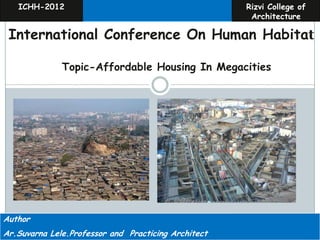
 Topic-Affordable Housing In Megacities


       Author
       Ar.Suvarna Lele.Professor and Practicing Architect


                                                    Ar.Suvarna Lele
                                                  Ar,Sarita Deshpande
ICHH-2012                                            Rizvi College of
                                                         Architecture

 International Conference On Human Habitat

              Topic-Affordable Housing In Megacities


Author                                                 Ar.Suvarna Lele
Ar.Suvarna Lele.Professor and Practicing Architect   Ar,Sarita Deshpande
Housing Scenario and Urbanization : India


1. India is undergoing transition from rural to
   urban society.
2. Increasing migration from rural to urban
   areas.
3. Mismatch between demand and supply of
   sites and services.
4. Disparity between high land costs of
      construction and lower incomes leading
      to non sustainable situation.
5.Lack of equitable supply of land, shelter and
      services at affordable prices.
6. Depletion of resources in construction and
      negligence of ecology in design.
7. Lack of application of cost effectiveness
      and energy efficiency in construction.
Housing Scenario and Urbanization : India


1.28% urban population growth (Census 2001).

2.40% by 2020 (Vision 2020 – Planning Commission).

3. 50% by 2041 (draft Urban India Report).

4.Growing urbanisation has led to :

a) pressure on the availability of land and infrastructure

b) deterioration of housing conditions of the weaker sections of society

c) increased number of slums and squatter settlements.
Necessity of Providing Affordable housing

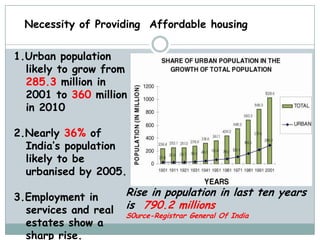
1.Urban population
  likely to grow from
  285.3 million in
  2001 to 360 million
  in 2010

2.Nearly 36% of
  India’s population
  likely to be
  urbanised by 2005.

3.Employment in       Rise in population in last ten years
  services and real   is 790.2 millions
                      S0urce-Registrar General Of India
  estates show a
  sharp rise.
 Housing Requirement


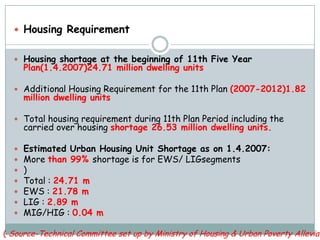
   Housing shortage at the beginning of 11th Five Year
      Plan(1.4.2007)24.71 million dwelling units

   Additional Housing Requirement for the 11th Plan (2007-2012)1.82
      million dwelling units

   Total housing requirement during 11th Plan Period including the
      carried over housing shortage 26.53 million dwelling units.

     Estimated Urban Housing Unit Shortage as on 1.4.2007:
     More than 99% shortage is for EWS/ LIGsegments
     )
     Total : 24.71 m
     EWS : 21.78 m
     LIG : 2.89 m
     MIG/HIG : 0.04 m

( Source-Technical Committee set up by Ministry of Housing & Urban Poverty Alleviat
Demand side indicators
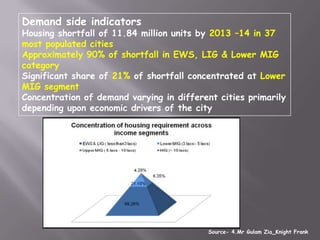
Housing shortfall of 11.84 million units by 2013 –14 in 37
most populated cities
Approximately 90% of shortfall in EWS, LIG & Lower MIG
category
Significant share of 21% of shortfall concentrated at Lower
MIG segment
Concentration of demand varying in different cities primarily
depending upon economic drivers of the city


                                           Source- 4.Mr Gulam Zia_Knight Frank
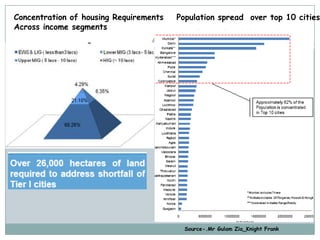
Concentration of housing Requirements   Population spread over top 10 cities
Across income segments


                                          Source-.Mr Gulam Zia_Knight Frank
Housing Scenario In Larger Cities-
Why Affordable Housing-from a developers
perspective.

1.Large housing segment largely ignored.

2.Property prices unaffordable for middle income
group.

3.Economic slowdown has rendered buyers
cautious.

4.Consequently, developers forced to shift focus
from the luxury segment to the middle income
housing segment.

5.‘Value for money’ has now gained prominence.
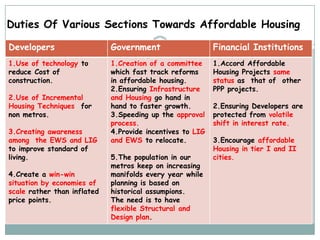
Duties Of Various Sections Towards Affordable Housing

Developers                   Government                    Financial Institutions
1.Use of technology to       1.Creation of a committee     1.Accord Affordable
reduce Cost of               which fast track reforms      Housing Projects same
construction.                in affordable housing.        status as that of other
                             2.Ensuring Infrastructure     PPP projects.
2.Use of Incremental         and Housing go hand in
Housing Techniques for       hand to faster growth.        2.Ensuring Developers are
non metros.                  3.Speeding up the approval    protected from volatile
                             process.                      shift in interest rate.
3.Creating awareness         4.Provide incentives to LIG
among the EWS and LIG        and EWS to relocate.          3.Encourage affordable
to improve standard of                                     Housing in tier I and II
living.                      5.The population in our       cities.
                             metros keep on increasing
4.Create a win-win           manifolds every year while
situation by economies of    planning is based on
scale rather than inflated   historical assumpions.
price points.                The need is to have
                             flexible Structural and
                             Design plan.
Achieving Affordability Through Matrix of


1) Appropriate Technology-
1.Use of renewable resources for building Materials
2.Use of raw materials resources based on waste products
3.Efficient use of existing conventional materials by producing factory
made (precast)building components
4.ndustrialization of housing sector
5.Affordability and sustainability.

2)Public private Partnership-
1.Timely delivery by developers.
2.Ease of working by the government.
3.Transparency by both the parties.
3.Project Management


           Source- Conference ‘Innovations in Affordable Housing India
           2010’
                                     Source.Mr.Uday Dharmadhikari-Usha Breco Realty
                                     ltd.
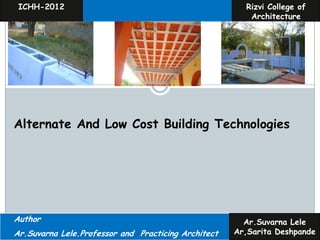
ICHH-2012                                             Rizvi College of
                                                        Architecture


Alternate And Low Cost Building Technologies


Author                                                 Ar.Suvarna Lele
Ar.Suvarna Lele.Professor and Practicing Architect   Ar,Sarita Deshpande
Conventional Building Materials Finite Resource
Base Demand of Materials
CONVENTIONAL
BUILDING MATERIALS
Brick, cement, steel, stone, timber,glass, plastics, ceramics and other
metals

DIRECT CONSEQUENCE
cost escalation leading to increased cost of shelter


IN-DIRECT CONSEQUENCE
Rapid & irrationally managed utilization of finite natural Resources


POSSIBLE MANIFESTATIONS
1.Environmental degradation;
2.Enhanced use of fertile top-soil, Deforestation,
3.Lime-quarrying, Surface working in stone belts
4.Factory made products like cement, steel etc. calls for high energy
input
5.Enhanced cost on account of transportation
   Construction Cost Savings


   Innovative construction means and methods.

   Improved construction schedules.

   More efficient structural designs.

   Simplified specifications and submittal process.

   Optimized mix designs.
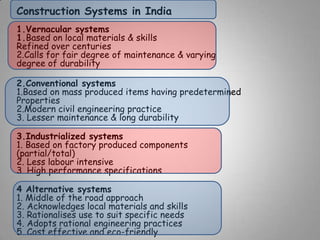
Construction Systems in India
1.Vernacular systems
1.Based on local materials & skills
Refined over centuries
2.Calls for fair degree of maintenance & varying
degree of durability

2.Conventional systems
1.Based on mass produced items having predetermined
Properties
2.Modern civil engineering practice
3. Lesser maintenance & long durability

3.Industrialized systems
1. Based on factory produced components
(partial/total)
2. Less labour intensive
3. High performance specifications

4 Alternative systems
1. Middle of the road approach
2. Acknowledges local materials and skills
3. Rationalises use to suit specific needs
4. Adopts rational engineering practices
5. Cost effective and eco-friendly
Innovative Concrete Technologies


                         High-Performance Concrete


High-Strength Concrete   Self- Consolidating Concrete
Improved Quality Systems


                          Testing Labs


Product Development


                      Material Handling
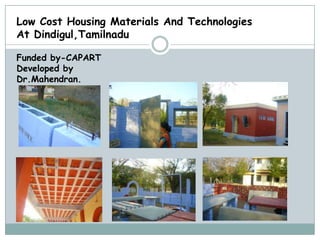
Low Cost Housing Materials And Technologies
At Dindigul,Tamilnadu

Funded by-CAPART
Developed by
Dr.Mahendran.
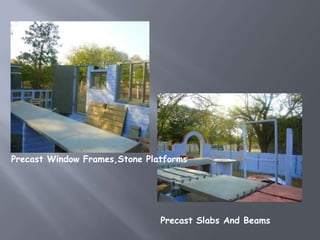
Precast Window Frames,Stone Platforms


                               Precast Slabs And Beams
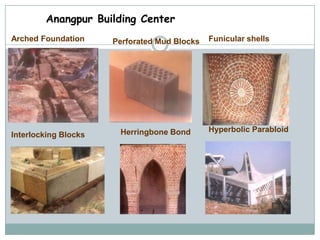
Anangpur Building Center
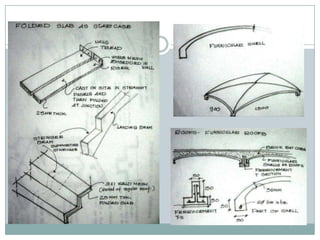
Arched Foundation     Perforated Mud Blocks   Funicular shells


                       Herringbone Bond       Hyperbolic Parabloid
Interlocking Blocks
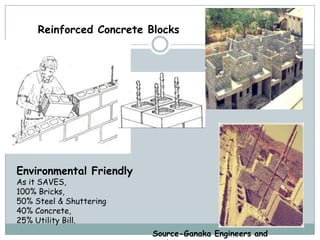
Reinforced Concrete Blocks


Environmental Friendly
As it SAVES,
100% Bricks,
50% Steel & Shuttering
40% Concrete,
25% Utility Bill.
                          Source-Ganaka Engineers and
Commercialisation Of Technologies by BMTPC
ICHH-2012                                             Rizvi College of
                                                        Architecture


International Conference On Human Habitat


                 C.B.R.I Technnologies


Author                                                 Ar.Suvarna Lele
Ar.Suvarna Lele.Professor and Practicing Architect   Ar,Sarita Deshpande
ICHH-2012                                           Rizvi College of
                                                      Architecture


International Conference On Human Habitat


   Appropriate Building Technologies


Author
                                                     Ar.Suvarna Lele
Ar.Suvarna Lele.Professor and Practicing Architect
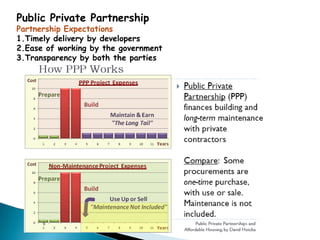
Public Private Partnership
Partnership Expectations
1.Timely delivery by developers
2.Ease of working by the government
3.Transparency by both the parties
Public And Private Partnership in Affordable housing

The public-private partnership can be formally defined
as:
In these partnerships, private developers, non-profit agencies, and
in some cases religious agencies receive some funds or support
from the municipal, state, or federal government (or all three, in
some cases) in order to build or renovate and manage affordable
housing. This can be used both for rental housing and as a means
of encouraging low-income home ownership. This is also an
approach that has been used in a number of other countries.

A contractual relationship where a private party takes
responsibility for all or part of a government’s (departments)
functions… a contractual arrangement between a public sector
agency and a private sector concern, whereby resources and risks
are shared for the purposes of delivering a public service or for
developing public infrastructure. (Hardcastle & Boothroyd, 2003, p.
31).
The Scheme of Affordable Housing in Partnership as per National
Urban Housing & Habitat Policy (NUHHP) 2007


1.The Scheme of Affordable Housing in Partnership aims at
operationalising the strategy envisaged in the National Urban
Housing & Habitat Policy (NUHHP) 2007,
of promoting various types of public-private partnerships – of the
government sector with the private sector, the cooperative sector,
the financial services sector, the state parastatals, urban local
bodies, etc. – for realizing the goal of affordable housing for all.

2. It intends to provide a major stimulus to economic activities
through affordable housing for the creation of employment,
especially for the construction workers and other urban poor who
are likely to be amongst the most vulnerable groups in recession. It
also targets the creation of demand for a large variety of industrial
goods through the multiplier effect of housing on other economic
activities.
Need for PPP in Housing

1.Synergy
2.Capitalize and maximise on core domain of respective
players
3.Scale of Development
4.Humongous need for combined capabilities
5.Investment Gap Funding
6.Cost spread over project lifecycle in PPP model rather
than being front loaded in traditional procurement model
7.Improving Quality &Efficiency
8.Returns for private players linked directly to
efficiency and quality delivery
9.Risk Mitigation
10Appropriate allocation between stakeholders
11On-Time Delivery
12Faster and time approvals, payments also linked to
timely completion
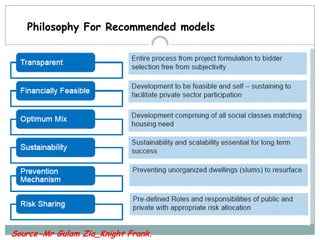
Philosophy For Recommended models


Source-Mr Gulam Zia_Knight Frank.
Role OF National Housing Bank Towards Affordable Housin
  Some Basic Facts Regarding Construction Industry.

  1.A basic human necessity supporting economic activities .
  2.Second largest employment generator, next to agriculture.
  3.Has forward and backward linkages with over 250 ancillary
  industries.
  4.Every Rupee spent on construction, an estimated 75-80 paise is
  added to GDP.
  5.GOI created enabling Fiscal, Monetary and Legal Environment
  6.Housing Industry Growth in last 5 years –
                                Physical Terms       3.0 % p.a.
                                  Financial Terms      30% p.a.
  7.Contribution of Housing in GDP is about 6%
  8.Percentage of Mortgage Debt to GDP is 8.50% (E) in 2005-06,
  still way below China’s (12%), Malaysia (22%), Hong-Kong (40%) and
  US (65%).
Focus Areas And Strategies
    Rural Housing              Urban Renewal           Market Development
Customized Products       Customized Products          Risk Mitigation
 Supplementing Govt.      Supplementing Govt.         Mortgage Credit
   Schemes                  Schemes
 Productive Housing       Financing SHGs             Guarantee/Insurance
    (PHIRA)                   - Partnership Approach    Rural Risk Fund
 Financing SHGs           Slum Redevelopment
    - Partnership            and up gradation          RMBS
Approach                   Integrated Township        Credit Enhancement
 Rural Industrial/Agro      Development Projects       Reverse Mortgage
    enterprise clusters    Social Housing
 Using Local              Rental Housing             Other Measures
Institutional              Housing for Working         NHB Residex
   Mechanism for             Women, Sr. Citizen         Electronic filing of
origination                                              Mortgages
                           Active participation of
   and Servicing of
Loans                       NGOs/MFIs/25A Cos.
 Schemes in                and Private Sector
convergence
NHB Support For Private Sector
                            35
1.Any private sector housing initiative with a EWS component

2.Integrated township in rural/semi-rural with housing and part
commercial, other related infrastructure

3.Equity participation and refinance support to HFCs with focus
on rural housing

4.Housing for workers of units in rural/semi-rural areas and of
their vendors/ancillary units, including SEZs/ AEZs.

5.Develop and Finance Public Private Partnerships to implement
township projects and mass housing. NHB can take equity in
the SPV and provide medium/long-term debt.
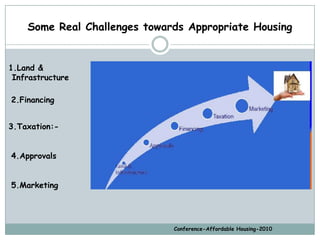
Some Real Challenges towards Appropriate Housing


1.Land &
 Infrastructure

2.Financing


3.Taxation:-


4.Approvals


5.Marketing


                              Conference-Affordable Housing-2010
A Quote By Pt.Jawaharlal Nenru.


We need to have an integrated framework in
which spatial development of cities goes hand in
hand with improvement in the quality of living
of ordinary people living there. An important
element of our strategy has to be slum
improvement and providing housing for the
poor…….. The Mission has to walk on two legs
of improved infrastructure and improved basic
services…..”
ICHH-2012                                            Rizvi College of
                                                         Architecture


                 THANK YOU

                 Ar.Suvarna Lele

   Resources:
   1.Mr Shridhar,www.nhb.org.in
   2.Dr Shailesh Agarwal-BMTPC
   3.Mr.Uday Dharmadhikari-Usha Breco
   Realty ltd.
   4.Mr Gulam Zia_Knight Frank.
   5.Er Ganesh Kamat-Ganaka Engineers
   Architects
   6.Dr Mahinran-Gandhigram Institute


Author                                                 Ar.Suvarna Lele
Ar.Suvarna Lele.Professor and Practicing Architect   Ar,Sarita Deshpande

AFFORDABLE HOUSING in megacities.

  • 1.
    ICHH-2012 Rizvi College of Architecture International Conference On Human Habitat Topic-Affordable Housing In Megacities Author Ar.Suvarna Lele.Professor and Practicing Architect Ar.Suvarna Lele Ar,Sarita Deshpande
  • 2.
    ICHH-2012 Rizvi College of Architecture International Conference On Human Habitat Topic-Affordable Housing In Megacities Author Ar.Suvarna Lele Ar.Suvarna Lele.Professor and Practicing Architect Ar,Sarita Deshpande
  • 3.
    Housing Scenario andUrbanization : India 1. India is undergoing transition from rural to urban society. 2. Increasing migration from rural to urban areas. 3. Mismatch between demand and supply of sites and services. 4. Disparity between high land costs of construction and lower incomes leading to non sustainable situation. 5.Lack of equitable supply of land, shelter and services at affordable prices. 6. Depletion of resources in construction and negligence of ecology in design. 7. Lack of application of cost effectiveness and energy efficiency in construction.
  • 4.
    Housing Scenario andUrbanization : India 1.28% urban population growth (Census 2001). 2.40% by 2020 (Vision 2020 – Planning Commission). 3. 50% by 2041 (draft Urban India Report). 4.Growing urbanisation has led to : a) pressure on the availability of land and infrastructure b) deterioration of housing conditions of the weaker sections of society c) increased number of slums and squatter settlements.
  • 5.
    Necessity of ProvidingAffordable housing 1.Urban population likely to grow from 285.3 million in 2001 to 360 million in 2010 2.Nearly 36% of India’s population likely to be urbanised by 2005. 3.Employment in Rise in population in last ten years services and real is 790.2 millions S0urce-Registrar General Of India estates show a sharp rise.
  • 6.
     Housing Requirement  Housing shortage at the beginning of 11th Five Year Plan(1.4.2007)24.71 million dwelling units  Additional Housing Requirement for the 11th Plan (2007-2012)1.82 million dwelling units  Total housing requirement during 11th Plan Period including the carried over housing shortage 26.53 million dwelling units.  Estimated Urban Housing Unit Shortage as on 1.4.2007:  More than 99% shortage is for EWS/ LIGsegments  )  Total : 24.71 m  EWS : 21.78 m  LIG : 2.89 m  MIG/HIG : 0.04 m ( Source-Technical Committee set up by Ministry of Housing & Urban Poverty Alleviat
  • 7.
    Demand side indicators Housingshortfall of 11.84 million units by 2013 –14 in 37 most populated cities Approximately 90% of shortfall in EWS, LIG & Lower MIG category Significant share of 21% of shortfall concentrated at Lower MIG segment Concentration of demand varying in different cities primarily depending upon economic drivers of the city Source- 4.Mr Gulam Zia_Knight Frank
  • 8.
    Concentration of housingRequirements Population spread over top 10 cities Across income segments Source-.Mr Gulam Zia_Knight Frank
  • 9.
    Housing Scenario InLarger Cities- Why Affordable Housing-from a developers perspective. 1.Large housing segment largely ignored. 2.Property prices unaffordable for middle income group. 3.Economic slowdown has rendered buyers cautious. 4.Consequently, developers forced to shift focus from the luxury segment to the middle income housing segment. 5.‘Value for money’ has now gained prominence.
  • 10.
    Duties Of VariousSections Towards Affordable Housing Developers Government Financial Institutions 1.Use of technology to 1.Creation of a committee 1.Accord Affordable reduce Cost of which fast track reforms Housing Projects same construction. in affordable housing. status as that of other 2.Ensuring Infrastructure PPP projects. 2.Use of Incremental and Housing go hand in Housing Techniques for hand to faster growth. 2.Ensuring Developers are non metros. 3.Speeding up the approval protected from volatile process. shift in interest rate. 3.Creating awareness 4.Provide incentives to LIG among the EWS and LIG and EWS to relocate. 3.Encourage affordable to improve standard of Housing in tier I and II living. 5.The population in our cities. metros keep on increasing 4.Create a win-win manifolds every year while situation by economies of planning is based on scale rather than inflated historical assumpions. price points. The need is to have flexible Structural and Design plan.
  • 11.
    Achieving Affordability ThroughMatrix of 1) Appropriate Technology- 1.Use of renewable resources for building Materials 2.Use of raw materials resources based on waste products 3.Efficient use of existing conventional materials by producing factory made (precast)building components 4.ndustrialization of housing sector 5.Affordability and sustainability. 2)Public private Partnership- 1.Timely delivery by developers. 2.Ease of working by the government. 3.Transparency by both the parties.
  • 12.
    3.Project Management Source- Conference ‘Innovations in Affordable Housing India 2010’ Source.Mr.Uday Dharmadhikari-Usha Breco Realty ltd.
  • 13.
    ICHH-2012 Rizvi College of Architecture Alternate And Low Cost Building Technologies Author Ar.Suvarna Lele Ar.Suvarna Lele.Professor and Practicing Architect Ar,Sarita Deshpande
  • 14.
    Conventional Building MaterialsFinite Resource Base Demand of Materials CONVENTIONAL BUILDING MATERIALS Brick, cement, steel, stone, timber,glass, plastics, ceramics and other metals DIRECT CONSEQUENCE cost escalation leading to increased cost of shelter IN-DIRECT CONSEQUENCE Rapid & irrationally managed utilization of finite natural Resources POSSIBLE MANIFESTATIONS 1.Environmental degradation; 2.Enhanced use of fertile top-soil, Deforestation, 3.Lime-quarrying, Surface working in stone belts 4.Factory made products like cement, steel etc. calls for high energy input 5.Enhanced cost on account of transportation
  • 15.
    Construction Cost Savings  Innovative construction means and methods.  Improved construction schedules.  More efficient structural designs.  Simplified specifications and submittal process.  Optimized mix designs.
  • 16.
    Construction Systems inIndia 1.Vernacular systems 1.Based on local materials & skills Refined over centuries 2.Calls for fair degree of maintenance & varying degree of durability 2.Conventional systems 1.Based on mass produced items having predetermined Properties 2.Modern civil engineering practice 3. Lesser maintenance & long durability 3.Industrialized systems 1. Based on factory produced components (partial/total) 2. Less labour intensive 3. High performance specifications 4 Alternative systems 1. Middle of the road approach 2. Acknowledges local materials and skills 3. Rationalises use to suit specific needs 4. Adopts rational engineering practices 5. Cost effective and eco-friendly
  • 17.
    Innovative Concrete Technologies High-Performance Concrete High-Strength Concrete Self- Consolidating Concrete
  • 18.
    Improved Quality Systems Testing Labs Product Development Material Handling
  • 19.
    Low Cost HousingMaterials And Technologies At Dindigul,Tamilnadu Funded by-CAPART Developed by Dr.Mahendran.
  • 20.
    Precast Window Frames,StonePlatforms Precast Slabs And Beams
  • 21.
    Anangpur Building Center ArchedFoundation Perforated Mud Blocks Funicular shells Herringbone Bond Hyperbolic Parabloid Interlocking Blocks
  • 22.
    Reinforced Concrete Blocks EnvironmentalFriendly As it SAVES, 100% Bricks, 50% Steel & Shuttering 40% Concrete, 25% Utility Bill. Source-Ganaka Engineers and
  • 23.
  • 24.
    ICHH-2012 Rizvi College of Architecture International Conference On Human Habitat C.B.R.I Technnologies Author Ar.Suvarna Lele Ar.Suvarna Lele.Professor and Practicing Architect Ar,Sarita Deshpande
  • 27.
    ICHH-2012 Rizvi College of Architecture International Conference On Human Habitat Appropriate Building Technologies Author Ar.Suvarna Lele Ar.Suvarna Lele.Professor and Practicing Architect
  • 28.
    Public Private Partnership PartnershipExpectations 1.Timely delivery by developers 2.Ease of working by the government 3.Transparency by both the parties
  • 29.
    Public And PrivatePartnership in Affordable housing The public-private partnership can be formally defined as: In these partnerships, private developers, non-profit agencies, and in some cases religious agencies receive some funds or support from the municipal, state, or federal government (or all three, in some cases) in order to build or renovate and manage affordable housing. This can be used both for rental housing and as a means of encouraging low-income home ownership. This is also an approach that has been used in a number of other countries. A contractual relationship where a private party takes responsibility for all or part of a government’s (departments) functions… a contractual arrangement between a public sector agency and a private sector concern, whereby resources and risks are shared for the purposes of delivering a public service or for developing public infrastructure. (Hardcastle & Boothroyd, 2003, p. 31).
  • 30.
    The Scheme ofAffordable Housing in Partnership as per National Urban Housing & Habitat Policy (NUHHP) 2007 1.The Scheme of Affordable Housing in Partnership aims at operationalising the strategy envisaged in the National Urban Housing & Habitat Policy (NUHHP) 2007, of promoting various types of public-private partnerships – of the government sector with the private sector, the cooperative sector, the financial services sector, the state parastatals, urban local bodies, etc. – for realizing the goal of affordable housing for all. 2. It intends to provide a major stimulus to economic activities through affordable housing for the creation of employment, especially for the construction workers and other urban poor who are likely to be amongst the most vulnerable groups in recession. It also targets the creation of demand for a large variety of industrial goods through the multiplier effect of housing on other economic activities.
  • 31.
    Need for PPPin Housing 1.Synergy 2.Capitalize and maximise on core domain of respective players 3.Scale of Development 4.Humongous need for combined capabilities 5.Investment Gap Funding 6.Cost spread over project lifecycle in PPP model rather than being front loaded in traditional procurement model 7.Improving Quality &Efficiency 8.Returns for private players linked directly to efficiency and quality delivery 9.Risk Mitigation 10Appropriate allocation between stakeholders 11On-Time Delivery 12Faster and time approvals, payments also linked to timely completion
  • 32.
    Philosophy For Recommendedmodels Source-Mr Gulam Zia_Knight Frank.
  • 33.
    Role OF NationalHousing Bank Towards Affordable Housin Some Basic Facts Regarding Construction Industry. 1.A basic human necessity supporting economic activities . 2.Second largest employment generator, next to agriculture. 3.Has forward and backward linkages with over 250 ancillary industries. 4.Every Rupee spent on construction, an estimated 75-80 paise is added to GDP. 5.GOI created enabling Fiscal, Monetary and Legal Environment 6.Housing Industry Growth in last 5 years – Physical Terms 3.0 % p.a. Financial Terms 30% p.a. 7.Contribution of Housing in GDP is about 6% 8.Percentage of Mortgage Debt to GDP is 8.50% (E) in 2005-06, still way below China’s (12%), Malaysia (22%), Hong-Kong (40%) and US (65%).
  • 34.
    Focus Areas AndStrategies Rural Housing Urban Renewal Market Development Customized Products Customized Products Risk Mitigation  Supplementing Govt.  Supplementing Govt.  Mortgage Credit Schemes Schemes  Productive Housing  Financing SHGs Guarantee/Insurance (PHIRA) - Partnership Approach  Rural Risk Fund  Financing SHGs  Slum Redevelopment - Partnership and up gradation RMBS Approach  Integrated Township Credit Enhancement  Rural Industrial/Agro Development Projects  Reverse Mortgage enterprise clusters  Social Housing  Using Local  Rental Housing Other Measures Institutional  Housing for Working  NHB Residex Mechanism for Women, Sr. Citizen  Electronic filing of origination Mortgages  Active participation of and Servicing of Loans NGOs/MFIs/25A Cos.  Schemes in and Private Sector convergence
  • 35.
    NHB Support ForPrivate Sector 35 1.Any private sector housing initiative with a EWS component 2.Integrated township in rural/semi-rural with housing and part commercial, other related infrastructure 3.Equity participation and refinance support to HFCs with focus on rural housing 4.Housing for workers of units in rural/semi-rural areas and of their vendors/ancillary units, including SEZs/ AEZs. 5.Develop and Finance Public Private Partnerships to implement township projects and mass housing. NHB can take equity in the SPV and provide medium/long-term debt.
  • 36.
    Some Real Challengestowards Appropriate Housing 1.Land & Infrastructure 2.Financing 3.Taxation:- 4.Approvals 5.Marketing Conference-Affordable Housing-2010
  • 37.
    A Quote ByPt.Jawaharlal Nenru. We need to have an integrated framework in which spatial development of cities goes hand in hand with improvement in the quality of living of ordinary people living there. An important element of our strategy has to be slum improvement and providing housing for the poor…….. The Mission has to walk on two legs of improved infrastructure and improved basic services…..”
  • 38.
    ICHH-2012 Rizvi College of Architecture THANK YOU Ar.Suvarna Lele Resources: 1.Mr Shridhar,www.nhb.org.in 2.Dr Shailesh Agarwal-BMTPC 3.Mr.Uday Dharmadhikari-Usha Breco Realty ltd. 4.Mr Gulam Zia_Knight Frank. 5.Er Ganesh Kamat-Ganaka Engineers Architects 6.Dr Mahinran-Gandhigram Institute Author Ar.Suvarna Lele Ar.Suvarna Lele.Professor and Practicing Architect Ar,Sarita Deshpande