COEP LIVING ON THE
EDGE
• DEVELOPMENT PLAN: ACCESSIBILITY TO PERI-
URBAN AREAS
Presentation By
COLLEGE OF ENGINEERING, PUNE
(COEP)
COEP LIVING ON THE
EDGE
COLLEGE OF
ENGINEERING, PUNE
DEVELOPMENT PLAN:
ACCESSIBILITY TO PERI-URBAN
AREAS
 Aishwarya Borate
 Abhishek Goturkar
 Jaysing Jadhav
 Prajakta Sonar
 Saudamini Telang
 Ketaki Tappu
GROUP MEMBERS
COEP LIVING ON THE
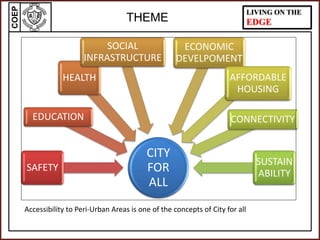
EDGETHEME
CITY
FOR
ALL
SAFETY
EDUCATION
HEALTH
SOCIAL
INFRASTRUCTURE
ECONOMIC
DEVELPOMENT
AFFORDABLE
HOUSING
CONNECTIVITY
SUSTAIN
ABILITY
Accessibility to Peri-Urban Areas is one of the concepts of City for all
COEP LIVING ON THE
EDGE
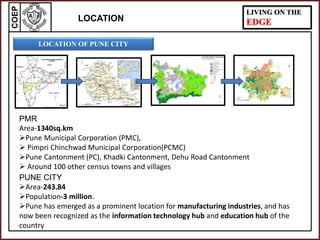
LOCATION OF PUNE CITY
PUNE CITY
Area-243.84
Population-3 million.
Pune has emerged as a prominent location for manufacturing industries, and has
now been recognized as the information technology hub and education hub of the
country
LOCATION
PMR
Area-1340sq.km
Pune Municipal Corporation (PMC),
 Pimpri Chinchwad Municipal Corporation(PCMC)
Pune Cantonment (PC), Khadki Cantonment, Dehu Road Cantonment
 Around 100 other census towns and villages
COEP LIVING ON THE
EDGE
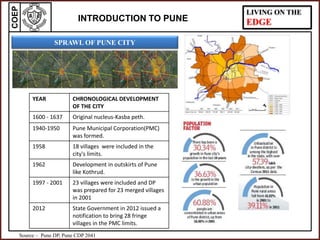
SPRAWL OF PUNE CITY
YEAR CHRONOLOGICAL DEVELOPMENT
OF THE CITY
1600 - 1637 Original nucleus-Kasba peth.
1940-1950 Pune Municipal Corporation(PMC)
was formed.
1958 18 villages were included in the
city's limits.
1962 Development in outskirts of Pune
like Kothrud.
1997 - 2001 23 villages were included and DP
was prepared for 23 merged villages
in 2001
2012 State Government in 2012 issued a
notification to bring 28 fringe
villages in the PMC limits.
INTRODUCTION TO PUNE
Source – Pune DP, Pune CDP 2041
COEP LIVING ON THE
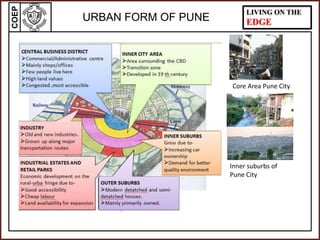
EDGEURBAN FORM OF PUNE
Inner suburbs of
Pune City
Core Area Pune City
COEP LIVING ON THE
EDGE
CHARACTERISTICS OF PERI-
URBAN AREAS
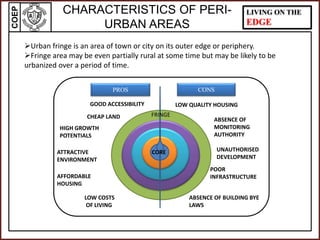
CHEAP LAND
HIGH GROWTH
POTENTIALS
ATTRACTIVE
ENVIRONMENT
GOOD ACCESSIBILITY
AFFORDABLE
HOUSING
ABSENCE OF BUILDING BYE
LAWS
ABSENCE OF
MONITORING
AUTHORITY
LOW QUALITY HOUSING
POOR
INFRASTRUCTURE
PROS CONS
UNAUTHORISED
DEVELOPMENT
LOW COSTS
OF LIVING
FRINGE
CORE
Urban fringe is an area of town or city on its outer edge or periphery.
Fringe area may be even partially rural at some time but may be likely to be
urbanized over a period of time.
COEP LIVING ON THE
EDGE
AMBEGAON
BK (PT.)
AMBEGAON
KH (PT.)
UNDARI
(PT.)
M
U
L
A
- M U T H A
MUTHA RIVER
R I V E
R
KHADAKWASALA
LAKE
NScale - 1:22500
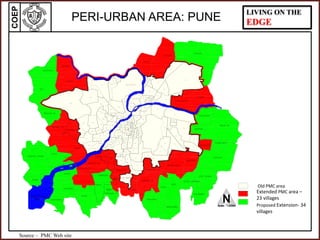
PERI-URBAN AREA: PUNE
Source – PMC Web site
Old PMC area
Extended PMC area –
23 villages
Proposed Extension- 34
villages
COEP LIVING ON THE
EDGE
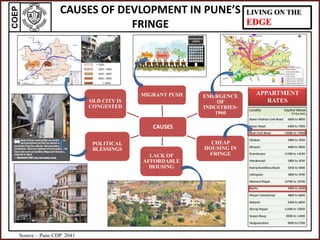
CAUSES OF DEVLOPMENT IN PUNE’S
FRINGE
CAUSES
MIGRANT PUSH EMERGENCE
OF
INDUSTRIES-
1960
CHEAP
HOUSING IN
FRINGELACK OF
AFFORDABLE
HOUSING
POLITICAL
BLESSINGS
OLD CITY IS
CONGESTED
APPARTMENT
RATES
Source – Pune CDP 2041
COEP LIVING ON THE
EDGEHOUSING
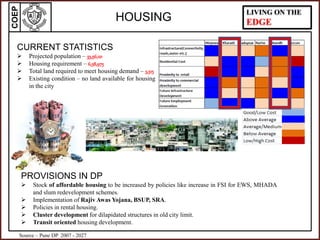
PROVISIONS IN DP
 Stock of affordable housing to be increased by policies like increase in FSI for EWS, MHADA
and slum redevelopment schemes.
 Implementation of Rajiv Awas Yojana, BSUP, SRA.
 Policies in rental housing.
 Cluster development for dilapidated structures in old city limit.
 Transit oriented housing development.
CURRENT STATISTICS
 Projected population – 33,56,121
 Housing requirement – 6,58,975
 Total land required to meet housing demand – 3,515
 Existing condition – no land available for housing
in the city
Source – Pune DP 2007 - 2027
COEP LIVING ON THE
EDGEHOUSING PROBLEMS
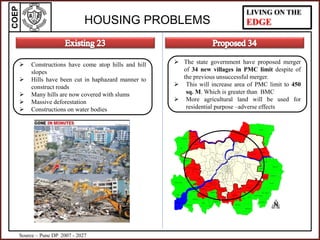
 Constructions have come atop hills and hill
slopes
 Hills have been cut in haphazard manner to
construct roads
 Many hills are now covered with slums
 Massive deforestation
 Constructions on water bodies
 The state government have proposed merger
of 34 new villages in PMC limit despite of
the previous unsuccessful merger.
 This will increase area of PMC limit to 450
sq. M. Which is greater than BMC
 More agricultural land will be used for
residential purpose –adverse effects
Source – Pune DP 2007 - 2027
AMBEGAON
BK (PT.)
AMBEGAON
KH (PT.)
UNDARI
(PT.)
M
U
L
A
- M U T H A
MUTHA
RIVER
R I V E
R
KHADAKWASALA
LAKE
NScale - 1:22500
COEP LIVING ON THE
EDGEPROVISIONS IN DP
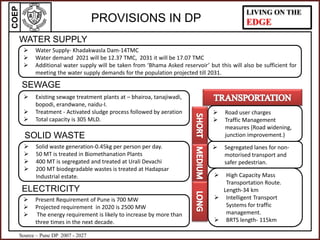
WATER SUPPLY
 High Capacity Mass
Transportation Route.
Length-34 km
 Intelligent Transport
Systems for traffic
management.
 BRTS length- 115km
 Segregated lanes for non-
motorised transport and
safer pedestrian.
 Road user charges
 Traffic Management
measures (Road widening,
junction improvement.)
SEWAGE
SOLID WASTE
ELECTRICITY
 Present Requirement of Pune is 700 MW
 Projected requirement in 2020 is 2500 MW
 The energy requirement is likely to increase by more than
three times in the next decade.
 Solid waste generation-0.45kg per person per day.
 50 MT is treated in Biomethanation Plants
 400 MT is segregated and treated at Urali Devachi
 200 MT biodegradable wastes is treated at Hadapsar
Industrial estate.
 Water Supply- Khadakwasla Dam-14TMC
 Water demand 2021 will be 12.37 TMC, 2031 it will be 17.07 TMC
 Additional water supply will be taken from ‘Bhama Asked reservoir’ but this will also be sufficient for
meeting the water supply demands for the population projected till 2031.
 Existing sewage treatment plants at – bhairoa, tanajiwadi,
bopodi, erandwane, naidu-I.
 Treatment - Activated sludge process followed by aeration
 Total capacity is 305 MLD.
Source – Pune DP 2007 - 2027
COEP LIVING ON THE
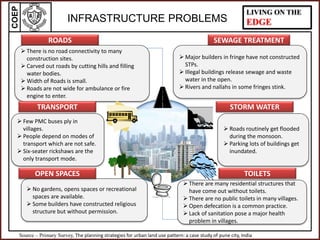
EDGEINFRASTRUCTURE PROBLEMS
ROADS SEWAGE TREATMENT
 There is no road connectivity to many
construction sites.
 Carved out roads by cutting hills and filling
water bodies.
 Width of Roads is small.
 Roads are not wide for ambulance or fire
engine to enter.
 Few PMC buses ply in
villages.
 People depend on modes of
transport which are not safe.
 Six-seater rickshaws are the
only transport mode.
 No gardens, opens spaces or recreational
spaces are available.
 Some builders have constructed religious
structure but without permission.
 Major builders in fringe have not constructed
STPs.
 Illegal buildings release sewage and waste
water in the open.
 Rivers and nallahs in some fringes stink.
 Roads routinely get flooded
during the monsoon.
 Parking lots of buildings get
inundated.
 There are many residential structures that
have come out without toilets.
 There are no public toilets in many villages.
 Open defecation is a common practice.
 Lack of sanitation pose a major health
problem in villages.
TRANSPORT STORM WATER
OPEN SPACES TOILETS
Source – Primary Survey, The planning strategies for urban land use pattern: a case study of pune city, India
COEP LIVING ON THE
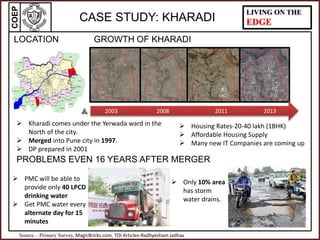
EDGECASE STUDY: KHARADI
2003 2008 2011 2013
GROWTH OF KHARADI
 Kharadi comes under the Yerwada ward in the
North of the city.
 Merged into Pune city in 1997.
 DP prepared in 2001
PROBLEMS EVEN 16 YEARS AFTER MERGER
 PMC will be able to
provide only 40 LPCD
drinking water
 Get PMC water every
alternate day for 15
minutes
 Only 10% area
has storm
water drains.
LOCATION
 Housing Rates-20-40 lakh (1BHK)
 Affordable Housing Supply
 Many new IT Companies are coming up
Source – Primary Survey, MagicBricks.com, TOI Articles-Radhyesham Jadhav
COEP LIVING ON THE
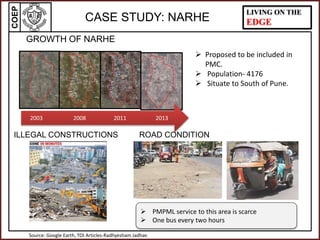
EDGECASE STUDY: NARHE
2003 2008 2011 2013
GROWTH OF NARHE
 Proposed to be included in
PMC.
 Population- 4176
 Situate to South of Pune.
Source: Google Earth, TOI Articles-Radhyesham Jadhav
 PMPML service to this area is scarce
 One bus every two hours
ILLEGAL CONSTRUCTIONS ROAD CONDITION
COEP LIVING ON THE
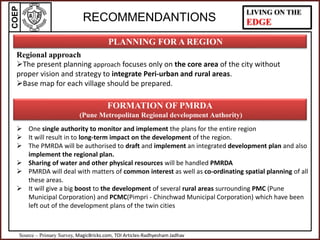
EDGERECOMMENDANTIONS
PLANNING FOR A REGION
Regional approach
The present planning approach focuses only on the core area of the city without
proper vision and strategy to integrate Peri-urban and rural areas.
Base map for each village should be prepared.
 One single authority to monitor and implement the plans for the entire region
 It will result in to long-term impact on the development of the region.
 The PMRDA will be authorised to draft and implement an integrated development plan and also
implement the regional plan.
 Sharing of water and other physical resources will be handled PMRDA
 PMRDA will deal with matters of common interest as well as co-ordinating spatial planning of all
these areas.
 It will give a big boost to the development of several rural areas surrounding PMC (Pune
Municipal Corporation) and PCMC(Pimpri - Chinchwad Municipal Corporation) which have been
left out of the development plans of the twin cities
FORMATION OF PMRDA
(Pune Metropolitan Regional development Authority)
Source – Primary Survey, MagicBricks.com, TOI Articles-Radhyesham Jadhav
COEP LIVING ON THE
EDGE
HOUSING
RECOMMENDANTIONS
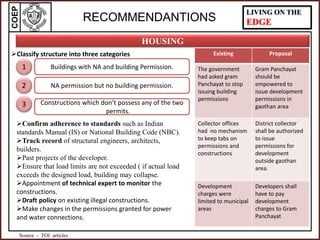
Classify structure into three categories Existing Proposal
The government
had asked gram
Panchayat to stop
issuing building
permissions
Gram Panchayat
should be
empowered to
issue development
permissions in
gaothan area
Collector offices
had no mechanism
to keep tabs on
permissions and
constructions
District collector
shall be authorized
to issue
permissions for
development
outside gaothan
area.
Development
charges were
limited to municipal
areas
Developers shall
have to pay
development
charges to Gram
Panchayat
Confirm adherence to standards such as Indian
standards Manual (IS) or National Building Code (NBC).
Track record of structural engineers, architects,
builders.
Past projects of the developer.
Ensure that load limits are not exceeded ( if actual load
exceeds the designed load, building may collapse.
Appointment of technical expert to monitor the
constructions.
Draft policy on existing illegal constructions.
Make changes in the permissions granted for power
and water connections.
Buildings with NA and building Permission.
NA permission but no building permission.
Constructions which don’t possess any of the two
permits.
1
2
3
Source - TOI articles
COEP LIVING ON THE
EDGE
 It is essential to provide an identity to citizens in the urban areas for participation in the decision
making and implementation process.
 Creation of participatory structures
 Handing a checklist to the citizens before purchasing properties
 Checklist may contain.
CITIZEN PARTICIPATION
RECOMMENDANTIONS
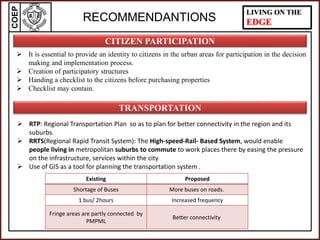
 RTP: Regional Transportation Plan so as to plan for better connectivity in the region and its
suburbs.
 RRTS(Regional Rapid Transit System): The High-speed-Rail- Based System, would enable
people living in metropolitan suburbs to commute to work places there by easing the pressure
on the infrastructure, services within the city
 Use of GIS as a tool for planning the transportation system .
TRANSPORTATION
Existing Proposed
Shortage of Buses More buses on roads.
1 bus/ 2hours Increased frequency
Fringe areas are partly connected by
PMPML
Better connectivity
COEP LIVING ON THE
EDGERECOMMENDANTIONS
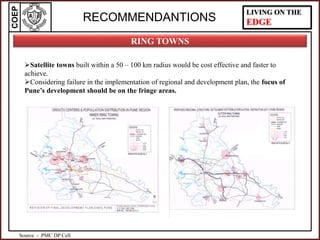
Satellite towns built within a 50 – 100 km radius would be cost effective and faster to
achieve.
Considering failure in the implementation of regional and development plan, the focus of
Pune’s development should be on the fringe areas.
RING TOWNS
Source - PMC DP Cell
COEP LIVING ON THE
EDGE
THANK YOU

Development Plan- Planning Intervention By (COEP) College of Engineering Pune

  • 1.
    COEP LIVING ONTHE EDGE • DEVELOPMENT PLAN: ACCESSIBILITY TO PERI- URBAN AREAS Presentation By COLLEGE OF ENGINEERING, PUNE (COEP)
  • 2.
    COEP LIVING ONTHE EDGE COLLEGE OF ENGINEERING, PUNE DEVELOPMENT PLAN: ACCESSIBILITY TO PERI-URBAN AREAS  Aishwarya Borate  Abhishek Goturkar  Jaysing Jadhav  Prajakta Sonar  Saudamini Telang  Ketaki Tappu GROUP MEMBERS
  • 3.
    COEP LIVING ONTHE EDGETHEME CITY FOR ALL SAFETY EDUCATION HEALTH SOCIAL INFRASTRUCTURE ECONOMIC DEVELPOMENT AFFORDABLE HOUSING CONNECTIVITY SUSTAIN ABILITY Accessibility to Peri-Urban Areas is one of the concepts of City for all
  • 4.
    COEP LIVING ONTHE EDGE LOCATION OF PUNE CITY PUNE CITY Area-243.84 Population-3 million. Pune has emerged as a prominent location for manufacturing industries, and has now been recognized as the information technology hub and education hub of the country LOCATION PMR Area-1340sq.km Pune Municipal Corporation (PMC),  Pimpri Chinchwad Municipal Corporation(PCMC) Pune Cantonment (PC), Khadki Cantonment, Dehu Road Cantonment  Around 100 other census towns and villages
  • 5.
    COEP LIVING ONTHE EDGE SPRAWL OF PUNE CITY YEAR CHRONOLOGICAL DEVELOPMENT OF THE CITY 1600 - 1637 Original nucleus-Kasba peth. 1940-1950 Pune Municipal Corporation(PMC) was formed. 1958 18 villages were included in the city's limits. 1962 Development in outskirts of Pune like Kothrud. 1997 - 2001 23 villages were included and DP was prepared for 23 merged villages in 2001 2012 State Government in 2012 issued a notification to bring 28 fringe villages in the PMC limits. INTRODUCTION TO PUNE Source – Pune DP, Pune CDP 2041
  • 6.
    COEP LIVING ONTHE EDGEURBAN FORM OF PUNE Inner suburbs of Pune City Core Area Pune City
  • 7.
    COEP LIVING ONTHE EDGE CHARACTERISTICS OF PERI- URBAN AREAS CHEAP LAND HIGH GROWTH POTENTIALS ATTRACTIVE ENVIRONMENT GOOD ACCESSIBILITY AFFORDABLE HOUSING ABSENCE OF BUILDING BYE LAWS ABSENCE OF MONITORING AUTHORITY LOW QUALITY HOUSING POOR INFRASTRUCTURE PROS CONS UNAUTHORISED DEVELOPMENT LOW COSTS OF LIVING FRINGE CORE Urban fringe is an area of town or city on its outer edge or periphery. Fringe area may be even partially rural at some time but may be likely to be urbanized over a period of time.
  • 8.
    COEP LIVING ONTHE EDGE AMBEGAON BK (PT.) AMBEGAON KH (PT.) UNDARI (PT.) M U L A - M U T H A MUTHA RIVER R I V E R KHADAKWASALA LAKE NScale - 1:22500 PERI-URBAN AREA: PUNE Source – PMC Web site Old PMC area Extended PMC area – 23 villages Proposed Extension- 34 villages
  • 9.
    COEP LIVING ONTHE EDGE CAUSES OF DEVLOPMENT IN PUNE’S FRINGE CAUSES MIGRANT PUSH EMERGENCE OF INDUSTRIES- 1960 CHEAP HOUSING IN FRINGELACK OF AFFORDABLE HOUSING POLITICAL BLESSINGS OLD CITY IS CONGESTED APPARTMENT RATES Source – Pune CDP 2041
  • 10.
    COEP LIVING ONTHE EDGEHOUSING PROVISIONS IN DP  Stock of affordable housing to be increased by policies like increase in FSI for EWS, MHADA and slum redevelopment schemes.  Implementation of Rajiv Awas Yojana, BSUP, SRA.  Policies in rental housing.  Cluster development for dilapidated structures in old city limit.  Transit oriented housing development. CURRENT STATISTICS  Projected population – 33,56,121  Housing requirement – 6,58,975  Total land required to meet housing demand – 3,515  Existing condition – no land available for housing in the city Source – Pune DP 2007 - 2027
  • 11.
    COEP LIVING ONTHE EDGEHOUSING PROBLEMS  Constructions have come atop hills and hill slopes  Hills have been cut in haphazard manner to construct roads  Many hills are now covered with slums  Massive deforestation  Constructions on water bodies  The state government have proposed merger of 34 new villages in PMC limit despite of the previous unsuccessful merger.  This will increase area of PMC limit to 450 sq. M. Which is greater than BMC  More agricultural land will be used for residential purpose –adverse effects Source – Pune DP 2007 - 2027 AMBEGAON BK (PT.) AMBEGAON KH (PT.) UNDARI (PT.) M U L A - M U T H A MUTHA RIVER R I V E R KHADAKWASALA LAKE NScale - 1:22500
  • 12.
    COEP LIVING ONTHE EDGEPROVISIONS IN DP WATER SUPPLY  High Capacity Mass Transportation Route. Length-34 km  Intelligent Transport Systems for traffic management.  BRTS length- 115km  Segregated lanes for non- motorised transport and safer pedestrian.  Road user charges  Traffic Management measures (Road widening, junction improvement.) SEWAGE SOLID WASTE ELECTRICITY  Present Requirement of Pune is 700 MW  Projected requirement in 2020 is 2500 MW  The energy requirement is likely to increase by more than three times in the next decade.  Solid waste generation-0.45kg per person per day.  50 MT is treated in Biomethanation Plants  400 MT is segregated and treated at Urali Devachi  200 MT biodegradable wastes is treated at Hadapsar Industrial estate.  Water Supply- Khadakwasla Dam-14TMC  Water demand 2021 will be 12.37 TMC, 2031 it will be 17.07 TMC  Additional water supply will be taken from ‘Bhama Asked reservoir’ but this will also be sufficient for meeting the water supply demands for the population projected till 2031.  Existing sewage treatment plants at – bhairoa, tanajiwadi, bopodi, erandwane, naidu-I.  Treatment - Activated sludge process followed by aeration  Total capacity is 305 MLD. Source – Pune DP 2007 - 2027
  • 13.
    COEP LIVING ONTHE EDGEINFRASTRUCTURE PROBLEMS ROADS SEWAGE TREATMENT  There is no road connectivity to many construction sites.  Carved out roads by cutting hills and filling water bodies.  Width of Roads is small.  Roads are not wide for ambulance or fire engine to enter.  Few PMC buses ply in villages.  People depend on modes of transport which are not safe.  Six-seater rickshaws are the only transport mode.  No gardens, opens spaces or recreational spaces are available.  Some builders have constructed religious structure but without permission.  Major builders in fringe have not constructed STPs.  Illegal buildings release sewage and waste water in the open.  Rivers and nallahs in some fringes stink.  Roads routinely get flooded during the monsoon.  Parking lots of buildings get inundated.  There are many residential structures that have come out without toilets.  There are no public toilets in many villages.  Open defecation is a common practice.  Lack of sanitation pose a major health problem in villages. TRANSPORT STORM WATER OPEN SPACES TOILETS Source – Primary Survey, The planning strategies for urban land use pattern: a case study of pune city, India
  • 14.
    COEP LIVING ONTHE EDGECASE STUDY: KHARADI 2003 2008 2011 2013 GROWTH OF KHARADI  Kharadi comes under the Yerwada ward in the North of the city.  Merged into Pune city in 1997.  DP prepared in 2001 PROBLEMS EVEN 16 YEARS AFTER MERGER  PMC will be able to provide only 40 LPCD drinking water  Get PMC water every alternate day for 15 minutes  Only 10% area has storm water drains. LOCATION  Housing Rates-20-40 lakh (1BHK)  Affordable Housing Supply  Many new IT Companies are coming up Source – Primary Survey, MagicBricks.com, TOI Articles-Radhyesham Jadhav
  • 15.
    COEP LIVING ONTHE EDGECASE STUDY: NARHE 2003 2008 2011 2013 GROWTH OF NARHE  Proposed to be included in PMC.  Population- 4176  Situate to South of Pune. Source: Google Earth, TOI Articles-Radhyesham Jadhav  PMPML service to this area is scarce  One bus every two hours ILLEGAL CONSTRUCTIONS ROAD CONDITION
  • 16.
    COEP LIVING ONTHE EDGERECOMMENDANTIONS PLANNING FOR A REGION Regional approach The present planning approach focuses only on the core area of the city without proper vision and strategy to integrate Peri-urban and rural areas. Base map for each village should be prepared.  One single authority to monitor and implement the plans for the entire region  It will result in to long-term impact on the development of the region.  The PMRDA will be authorised to draft and implement an integrated development plan and also implement the regional plan.  Sharing of water and other physical resources will be handled PMRDA  PMRDA will deal with matters of common interest as well as co-ordinating spatial planning of all these areas.  It will give a big boost to the development of several rural areas surrounding PMC (Pune Municipal Corporation) and PCMC(Pimpri - Chinchwad Municipal Corporation) which have been left out of the development plans of the twin cities FORMATION OF PMRDA (Pune Metropolitan Regional development Authority) Source – Primary Survey, MagicBricks.com, TOI Articles-Radhyesham Jadhav
  • 17.
    COEP LIVING ONTHE EDGE HOUSING RECOMMENDANTIONS Classify structure into three categories Existing Proposal The government had asked gram Panchayat to stop issuing building permissions Gram Panchayat should be empowered to issue development permissions in gaothan area Collector offices had no mechanism to keep tabs on permissions and constructions District collector shall be authorized to issue permissions for development outside gaothan area. Development charges were limited to municipal areas Developers shall have to pay development charges to Gram Panchayat Confirm adherence to standards such as Indian standards Manual (IS) or National Building Code (NBC). Track record of structural engineers, architects, builders. Past projects of the developer. Ensure that load limits are not exceeded ( if actual load exceeds the designed load, building may collapse. Appointment of technical expert to monitor the constructions. Draft policy on existing illegal constructions. Make changes in the permissions granted for power and water connections. Buildings with NA and building Permission. NA permission but no building permission. Constructions which don’t possess any of the two permits. 1 2 3 Source - TOI articles
  • 18.
    COEP LIVING ONTHE EDGE  It is essential to provide an identity to citizens in the urban areas for participation in the decision making and implementation process.  Creation of participatory structures  Handing a checklist to the citizens before purchasing properties  Checklist may contain. CITIZEN PARTICIPATION RECOMMENDANTIONS  RTP: Regional Transportation Plan so as to plan for better connectivity in the region and its suburbs.  RRTS(Regional Rapid Transit System): The High-speed-Rail- Based System, would enable people living in metropolitan suburbs to commute to work places there by easing the pressure on the infrastructure, services within the city  Use of GIS as a tool for planning the transportation system . TRANSPORTATION Existing Proposed Shortage of Buses More buses on roads. 1 bus/ 2hours Increased frequency Fringe areas are partly connected by PMPML Better connectivity
  • 19.
    COEP LIVING ONTHE EDGERECOMMENDANTIONS Satellite towns built within a 50 – 100 km radius would be cost effective and faster to achieve. Considering failure in the implementation of regional and development plan, the focus of Pune’s development should be on the fringe areas. RING TOWNS Source - PMC DP Cell
  • 20.
    COEP LIVING ONTHE EDGE THANK YOU