HISTIDINE-NICKEL
AFFINITY COLUMN
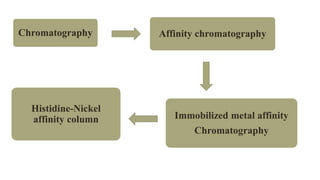
Chromatography Affinity chromatography
Immobilized metal affinity
Chromatography
Histidine-Nickel
affinity column
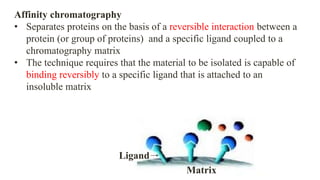
Affinity chromatography
• Separates proteins on the basis of a reversible interaction between a
protein (or group of proteins) and a specific ligand coupled to a
chromatography matrix
• The technique requires that the material to be isolated is capable of
binding reversibly to a specific ligand that is attached to an
insoluble matrix
Matrix
Ligand
Matrix
An ideal matrix for affinity chromatography must have the following
characteristics:
1. High surface-area to volume ratio
2. Chemical groups that are easily modified for covalent attachment of
ligands
3. Minimal nonspecific binding properties
4. Good flow characteristics
5. Mechanical and chemical stability.
The common matrices:
1. Cross-linked Dextrans
2. Agarose
3. Polystyrene
4. Cellulose
5. Porous Glass
6. Silica
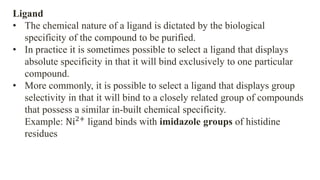
Ligand
• The chemical nature of a ligand is dictated by the biological
specificity of the compound to be purified.
• In practice it is sometimes possible to select a ligand that displays
absolute specificity in that it will bind exclusively to one particular
compound.
• More commonly, it is possible to select a ligand that displays group
selectivity in that it will bind to a closely related group of compounds
that possess a similar in-built chemical specificity.
Example: Ni2+
ligand binds with imidazole groups of histidine
residues
Spacer Arm
• To prevent the attachment of the ligand to the matrix interfering with
its ability to bind the macromolecule, it is generally advantageous to
interpose a spacer arm between the ligand and the matrix.
• The optimum length of this spacer arm is 6 to 10 carbon atoms or their
equivalent.
• Some spacers are purely hydrophobic, most commonly consisting of
methylene (CH2) groups; others are hydrophilic, possessing carbonyl
(CO) or imido (NH) groups.
• Spacers are most important for small immobilized ligands but
generally are not necessary for macromolecular ligands
Practical Procedure
1. Incubate crude sample (e.g., cell lysate or serum) with the affinity
support to allow the target molecule in the sample to bind to the
immobilized ligand.
2. Wash away non-bound sample components from the support using
appropriate buffers that maintain the binding interaction between target
and ligand.
3. Elute (dissociate and recover) the target molecule from the immobilized
ligand by altering the buffer conditions so that the binding interaction
no longer occurs.
Metal chelate chromatography (immobilized metal affinity
chromatography)
• Immobilized metal ion such as Co2+
, Ni2+
or Mn2+
is used to bind
proteins selectively by reaction with special groups of amino acid
residues (imidazole groups of histidine residues), sterically available on
the surface of the proteins.
• The immobilization of the protein involves the formation of a
coordinate bond that must be sufficiently stable to allow protein
attachment and retention during the elution of non-binding
contaminating material.
• The subsequent release of the protein can be achieved either by simply
lowering the pH or by the use of some chemicals or ions
Histidine-nickel Affinity Column
• Histidine is the amino acid that exhibits the strongest interaction with
immobilized metal ion matrices, as electron donor groups on the
histidine imidazole ring readily form coordination bonds with the
immobilized transition metal.
• Peptides containing sequences of consecutive histidine residues are
efficiently retained on IMAC column matrices.
• Following washing of the matrix material, peptides containing
polyhistidine sequences can be easily eluted by either adjusting the
pH of the column buffer or adding free imidazole to the column
buffer.
• Tags of six histidine residues are generally long enough to yield high-
affinity interactions with the matrix.
• Purification of polyhistidine affinity-tagged proteins has been
facilitated by the development of the commercially available matrices
nickel-nitrilotriacetic acid (š‘š‘–2+-NTA) which are coupled to a solid
support resin.
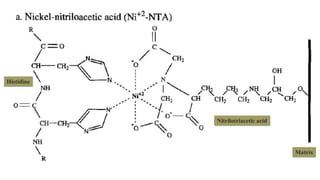
• These matrices coordinate metal ions through four coordination sites
while leaving two of the transition metal coordination sites exposed to
interact with histidine residues in the affinity tag.
Histidine
Nitrilotriacetic acid
Matrix
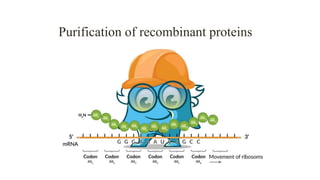
Purification of recombinant proteins
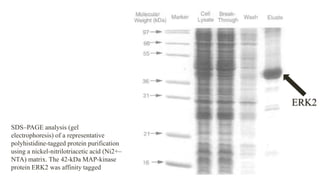
SDS–PAGE analysis (gel
electrophoresis) of a representative
polyhistidine-tagged protein purification
using a nickel-nitrilotriacetic acid (Ni2+–
NTA) matrix. The 42-kDa MAP-kinase
protein ERK2 was affinity tagged
ERK2
Reference:
• Purification of Proteins Using Polyhistidine Affinity Tags
Joshua A. Bornhorst and Joseph J. Falke
• Principles and Techniques of Biochemistry and Molecular Biology
(Seventh edition)
By Keith Wilson and John Walker

Affinity Chromatography | Histidine Nickel Affinity Column

  • 1.
  • 2.
    Chromatography Affinity chromatography Immobilizedmetal affinity Chromatography Histidine-Nickel affinity column
  • 3.
    Affinity chromatography • Separatesproteins on the basis of a reversible interaction between a protein (or group of proteins) and a specific ligand coupled to a chromatography matrix • The technique requires that the material to be isolated is capable of binding reversibly to a specific ligand that is attached to an insoluble matrix Matrix Ligand
  • 4.
    Matrix An ideal matrixfor affinity chromatography must have the following characteristics: 1. High surface-area to volume ratio 2. Chemical groups that are easily modified for covalent attachment of ligands 3. Minimal nonspecific binding properties 4. Good flow characteristics 5. Mechanical and chemical stability.
  • 5.
    The common matrices: 1.Cross-linked Dextrans 2. Agarose 3. Polystyrene 4. Cellulose 5. Porous Glass 6. Silica
  • 6.
    Ligand • The chemicalnature of a ligand is dictated by the biological specificity of the compound to be purified. • In practice it is sometimes possible to select a ligand that displays absolute specificity in that it will bind exclusively to one particular compound. • More commonly, it is possible to select a ligand that displays group selectivity in that it will bind to a closely related group of compounds that possess a similar in-built chemical specificity. Example: Ni2+ ligand binds with imidazole groups of histidine residues
  • 7.
    Spacer Arm • Toprevent the attachment of the ligand to the matrix interfering with its ability to bind the macromolecule, it is generally advantageous to interpose a spacer arm between the ligand and the matrix. • The optimum length of this spacer arm is 6 to 10 carbon atoms or their equivalent. • Some spacers are purely hydrophobic, most commonly consisting of methylene (CH2) groups; others are hydrophilic, possessing carbonyl (CO) or imido (NH) groups. • Spacers are most important for small immobilized ligands but generally are not necessary for macromolecular ligands
  • 8.
  • 9.
    1. Incubate crudesample (e.g., cell lysate or serum) with the affinity support to allow the target molecule in the sample to bind to the immobilized ligand. 2. Wash away non-bound sample components from the support using appropriate buffers that maintain the binding interaction between target and ligand. 3. Elute (dissociate and recover) the target molecule from the immobilized ligand by altering the buffer conditions so that the binding interaction no longer occurs.
  • 12.
    Metal chelate chromatography(immobilized metal affinity chromatography) • Immobilized metal ion such as Co2+ , Ni2+ or Mn2+ is used to bind proteins selectively by reaction with special groups of amino acid residues (imidazole groups of histidine residues), sterically available on the surface of the proteins. • The immobilization of the protein involves the formation of a coordinate bond that must be sufficiently stable to allow protein attachment and retention during the elution of non-binding contaminating material. • The subsequent release of the protein can be achieved either by simply lowering the pH or by the use of some chemicals or ions
  • 13.
    Histidine-nickel Affinity Column •Histidine is the amino acid that exhibits the strongest interaction with immobilized metal ion matrices, as electron donor groups on the histidine imidazole ring readily form coordination bonds with the immobilized transition metal. • Peptides containing sequences of consecutive histidine residues are efficiently retained on IMAC column matrices. • Following washing of the matrix material, peptides containing polyhistidine sequences can be easily eluted by either adjusting the pH of the column buffer or adding free imidazole to the column buffer. • Tags of six histidine residues are generally long enough to yield high- affinity interactions with the matrix.
  • 14.
    • Purification ofpolyhistidine affinity-tagged proteins has been facilitated by the development of the commercially available matrices nickel-nitrilotriacetic acid (š‘š‘–2+-NTA) which are coupled to a solid support resin. • These matrices coordinate metal ions through four coordination sites while leaving two of the transition metal coordination sites exposed to interact with histidine residues in the affinity tag.
  • 15.
  • 16.
  • 17.
    SDS–PAGE analysis (gel electrophoresis)of a representative polyhistidine-tagged protein purification using a nickel-nitrilotriacetic acid (Ni2+– NTA) matrix. The 42-kDa MAP-kinase protein ERK2 was affinity tagged ERK2
  • 18.
    Reference: • Purification ofProteins Using Polyhistidine Affinity Tags Joshua A. Bornhorst and Joseph J. Falke • Principles and Techniques of Biochemistry and Molecular Biology (Seventh edition) By Keith Wilson and John Walker