AUTORADIOGRAPHY
M.Sc. SEM III
- Prakruti Khatsuriya
Autoradiography
• Autoradiography is the bio-analytical technique used to
visualize the distribution of radioactive labeled substance
with radioisotope in a biological sample.
• It is a method by which a radioactive material can be
localized within a particular tissue, cell, cell organelles or
even biomolecules.
• Autoradiography is an imaging technique that uses
radioactive sources contained within the exposed sample.
• In vitro autoradiography methods involve the isolation of
cellular components such as DNA, RNA, proteins or lipids,
followed by labeling with suitable radioisotopes.
• In in vivo autoradiography, radioisotopes are coupled with
radioactive tracers and administered orally or via injection,
and the distribution of radiation is evaluated in thin tissue or
whole-body cryosections.
• In vivo autoradiography using laboratory animals is widely
used in metabolic studies, disease monitoring and new drug
development experiments.
• Common radioisotopes in autoradiography are sulfur-35,
hydrogen-3, carbon-14, 125-iodine or phosphorus-32
(35S, 3H, 14C, 125I and 32P, respectively) which are used to
determine the distribution of the radiolabeled molecules in
tissues, cells or cellular organelles, but also in the study of
protein modifications and DNA / RNA.
General Principle OfAutoradiography
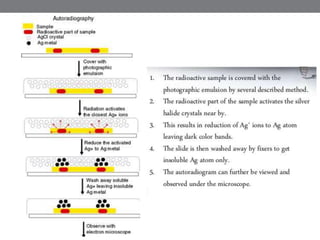
• The principle of autoradiographic imaging is the precipitation
of silver (Ag) atoms, resulting from the ionization of a silver
halide (AgX – silver bromide, chloride, iodide or fluoride –
AgBr, AgCl, AgI or AgF, respectively) by radiolabeled
samples.
• AgX are light sensitive compounds commonly used in
photography. They are generally suspended in a gelatin
photographic emulsion.
• Each AgX molecule is individually encapsulated in the
gelatin, and functions as an independent detector of
radioactive decay from the radiolabeled sample.
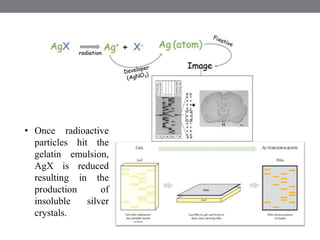
• Once radioactive
particles hit the
gelatin emulsion,
AgX is reduced
resulting in the
production of
insoluble silver
crystals.
• Gelatin photographic emulsions are used to coat photographic and X-
ray films, which are made of a flexible base (usually cellulose
acetate).
• When a radiolabeled sample is in contact with in a coated X-ray film
(exposure), it generates a latent (hidden) image corresponding to the
radioactivity distribution within the sample.
• To make the image visible, the exposed photographic / X-ray film
must be submerged in a developing reagent, a chemical mixture that
converts the silver crystals into metallic silver, darkening the gelatin
emulsion.
• Silver nitrate (AgNO3) is highly efficient in the reduction of AgX
molecules and is usually a component of developer solutions.
• The reaction is then stopped by a fixative reagent, which removes the
excess AgX from the photographic / X-ray film.
• Highly radioactive areas (e.g. areas with higher concentration of a
radiolabeled drug, or with higher metabolic activity) reduce more
AgX molecules, resulting in higher optical density in the film (darker
areas).
• Thus, autoradiography must be avoided in samples that are
homogeneously labeled.
• Although it can be quantitative, autoradiography can be a slow
process, depending on the half-life of the radioisotopes used.
• In a clinical context, advanced autoradiographic methods like
positron-emission tomography (PET) and single-photon emission
computerized tomography (SPECT) are used in the diagnosis, staging
and monitoring of disease.
Autoradiography: Methods
Classic autoradiography techniques are performed according
to the following general sequential steps:
• In vivo autoradiography
• In vitro autoradiography
Applications OfAutoradiography
• Autoradiography can be used to study the local distribution of
the radioactive isotopes. The distribution of the isotopes in
different objects and organs is studied by stripping films or X-
ray films.
• Receptor autoradiography.
• Rate of DNA replication.
• Detection of protein phosphorylation.
• Detection of sugar movement in plant tissue.
• Other techniques.
ThankYou…
• Q. Write a note on Autoradiography. [7 mks]
• Q. Explain the general principles of Autoradiography. [7 mks]

Autoradiography

  • 1.
  • 2.
    Autoradiography • Autoradiography isthe bio-analytical technique used to visualize the distribution of radioactive labeled substance with radioisotope in a biological sample. • It is a method by which a radioactive material can be localized within a particular tissue, cell, cell organelles or even biomolecules. • Autoradiography is an imaging technique that uses radioactive sources contained within the exposed sample. • In vitro autoradiography methods involve the isolation of cellular components such as DNA, RNA, proteins or lipids, followed by labeling with suitable radioisotopes.
  • 3.
    • In invivo autoradiography, radioisotopes are coupled with radioactive tracers and administered orally or via injection, and the distribution of radiation is evaluated in thin tissue or whole-body cryosections. • In vivo autoradiography using laboratory animals is widely used in metabolic studies, disease monitoring and new drug development experiments. • Common radioisotopes in autoradiography are sulfur-35, hydrogen-3, carbon-14, 125-iodine or phosphorus-32 (35S, 3H, 14C, 125I and 32P, respectively) which are used to determine the distribution of the radiolabeled molecules in tissues, cells or cellular organelles, but also in the study of protein modifications and DNA / RNA.
  • 4.
    General Principle OfAutoradiography •The principle of autoradiographic imaging is the precipitation of silver (Ag) atoms, resulting from the ionization of a silver halide (AgX – silver bromide, chloride, iodide or fluoride – AgBr, AgCl, AgI or AgF, respectively) by radiolabeled samples. • AgX are light sensitive compounds commonly used in photography. They are generally suspended in a gelatin photographic emulsion. • Each AgX molecule is individually encapsulated in the gelatin, and functions as an independent detector of radioactive decay from the radiolabeled sample.
  • 5.
    • Once radioactive particleshit the gelatin emulsion, AgX is reduced resulting in the production of insoluble silver crystals.
  • 7.
    • Gelatin photographicemulsions are used to coat photographic and X- ray films, which are made of a flexible base (usually cellulose acetate). • When a radiolabeled sample is in contact with in a coated X-ray film (exposure), it generates a latent (hidden) image corresponding to the radioactivity distribution within the sample. • To make the image visible, the exposed photographic / X-ray film must be submerged in a developing reagent, a chemical mixture that converts the silver crystals into metallic silver, darkening the gelatin emulsion. • Silver nitrate (AgNO3) is highly efficient in the reduction of AgX molecules and is usually a component of developer solutions.
  • 8.
    • The reactionis then stopped by a fixative reagent, which removes the excess AgX from the photographic / X-ray film. • Highly radioactive areas (e.g. areas with higher concentration of a radiolabeled drug, or with higher metabolic activity) reduce more AgX molecules, resulting in higher optical density in the film (darker areas). • Thus, autoradiography must be avoided in samples that are homogeneously labeled. • Although it can be quantitative, autoradiography can be a slow process, depending on the half-life of the radioisotopes used. • In a clinical context, advanced autoradiographic methods like positron-emission tomography (PET) and single-photon emission computerized tomography (SPECT) are used in the diagnosis, staging and monitoring of disease.
  • 9.
    Autoradiography: Methods Classic autoradiographytechniques are performed according to the following general sequential steps: • In vivo autoradiography • In vitro autoradiography
  • 10.
    Applications OfAutoradiography • Autoradiographycan be used to study the local distribution of the radioactive isotopes. The distribution of the isotopes in different objects and organs is studied by stripping films or X- ray films. • Receptor autoradiography. • Rate of DNA replication. • Detection of protein phosphorylation. • Detection of sugar movement in plant tissue. • Other techniques.
  • 11.
    ThankYou… • Q. Writea note on Autoradiography. [7 mks] • Q. Explain the general principles of Autoradiography. [7 mks]