AEROMODELLING
WORKSHOP
 Aeromodelling is the art of designing, building
and flying miniaturized aircrafts
(powered or non-powered).
What is Aeromodelling?
 It is both a hobby and sport; the hobby aspect
involves building and assembling model aircraft,
and the sport part involves the flying.

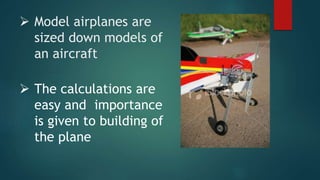
 Model airplanes are
sized down models of
an aircraft
 The calculations are
easy and importance
is given to building of
the plane
What is this Workshop about?
 Did you always want to get into the aviation
industry? Have you ever dreamt of becoming an
Aeronautical Engineer? Ever wondered how it
feels to design your own aircraft and see it soar
into the sky? Then Take a Break and come to Jet
wings RC Aircraft Workshop.
WHY ?
 This workshop by Jet wings gives you an
opportunity to understand the theory behind the
functioning of aircraft and aircraft design. It
makes you innovate by coming up with your own
design of an RC aircraft and fabricate it from
scratch. An interactive lecture session and design
session helps you design the best performing
aircraft.
Basic Aerodynamics
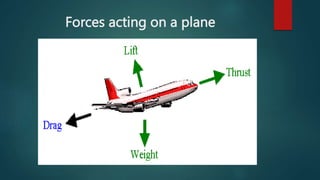
Forces acting on a plane
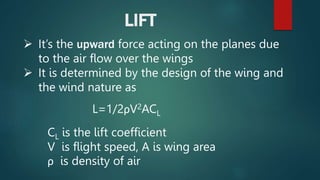
LIFT
 It’s the upward force acting on the planes due
to the air flow over the wings
 It is determined by the design of the wing and
the wind nature as
L=1/2ρV2ACL
CL is the lift coefficient
V is flight speed, A is wing area
ρ is density of air
THRUST
 It’s the force provided by the engine of the
plane
 Mainly two type of thrust generators are used
1. IC Engines
2. Electric Motors
We will be seeing about electric motors here
WEIGHT
This is the weight of the plane along with its
payload and motors.
This should be minimized as much as possible by
proper design.
DRAG
This is the weight of the plane along with its
payload and motors.
This should be minimized as much as possible by
proper design.
Difference between aircraft and
airplane?
 An aircraft is any machine that can fly.
 Airplanes, hot air balloons, helicopters, or
even flying platforms are considered aircraft.
 An airplane is a specific type of aircraft that
has fixed wings and engine, it is heavier than
air that is capable of sustained, powered, and
controlled flight.
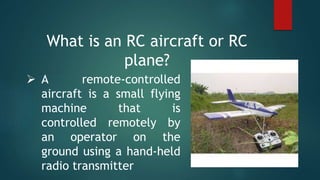
What is an RC aircraft or RC
plane?
 A remote-controlled
aircraft is a small flying
machine that is
controlled remotely by
an operator on the
ground using a hand-held
radio transmitter
Materials used for RC aircrafts
 Balsa
 Styrofoam
 Depron
 Coroplast
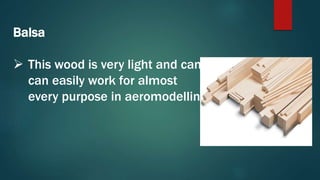
Balsa
 This wood is very light and can
can easily work for almost
every purpose in aeromodelling.
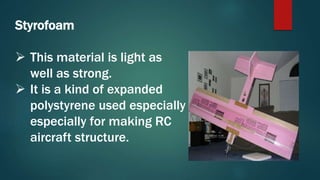
Styrofoam
 This material is light as
well as strong.
 It is a kind of expanded
polystyrene used especially
especially for making RC
aircraft structure.
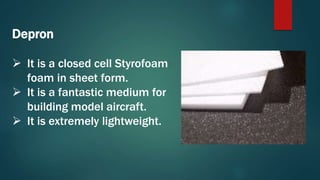
Depron
 It is a closed cell Styrofoam
foam in sheet form.
 It is a fantastic medium for
building model aircraft.
 It is extremely lightweight.
Coroplast
 Coroplast is simply the two
sheets of plastic separated
by another layer of zigzagged
zigzagged plastic.
 It is lightweight, inexpensive,
inexpensive, and fairly sturdy.
COMPONENTS
Electrical components
 Brushless motor
 Servos motor
 Transmitter
 Receiver
 Electronic speed controller
 LI Po Battery.
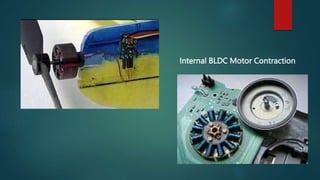
Brush-Less DC motor (BLDC)
 A Brush-Less DC motor (BLDC) is a synchronous
electric motor which is powered by direct-current
electricity (DC) .
 Which has an electronically controlled
commutation system, instead of a mechanical
commutation system based on brushes.
 In such motors, current and torque, voltage and
rpm are linearly related.
Internal BLDC Motor Contraction
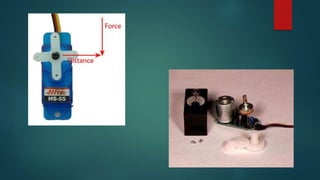
 A Servo is a small device that has an output
shaft.
 This shaft can be positioned to specific angular
positions by sending the servo a coded signal.
 As long as the coded signal exists on the input
line, the servo will maintain the angular
position of the shaft.
 As the coded signal changes, the angular
position of the shaft changes.
servo motor
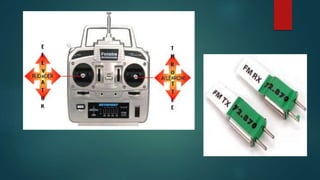
 A transmitter is an electronic device which,
usually with the aid of an antenna, propagates
an electromagnetic signal such as radio,
television, or other telecommunications.
 When talking about RC transmitter modes we are
referring to how the transmitter is set up to
control the airplane
 which sticks operate which controls on the
model.
Transmitter
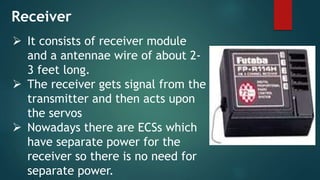
 It consists of receiver module
and a antennae wire of about 2-
3 feet long.
 The receiver gets signal from the
transmitter and then acts upon
the servos
 Nowadays there are ECSs which
have separate power for the
receiver so there is no need for
separate power.
Receiver
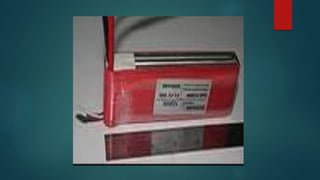
 Li-poly batteries are also gaining favor in the
world of Radio-controlled aircraft as well as
Radio-controlled cars
where the advantages of both lower weight
and greatly increased run times can be
sufficient justification for the price.
 However ,lithium polymer-specific chargers
are required to avoid fire and explosion.
Lithium polymer batteries
WING ASPECTS
 The lift generation is decided by the shape
of the wings and the aerofoil
 The lifting force is provided by the
difference in the pressure of air flowing
below and above the wing and is governed
by Bernoulli’s principle
Wings and Aerofoil
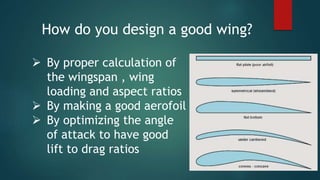
How do you design a good wing?
 By proper calculation of
the wingspan , wing
loading and aspect ratios
 By making a good aerofoil
 By optimizing the angle
of attack to have good
lift to drag ratios
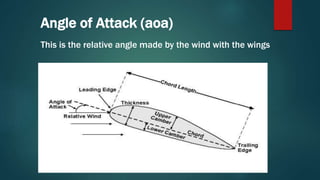
Angle of Attack (aoa)
This is the relative angle made by the wind with the wings
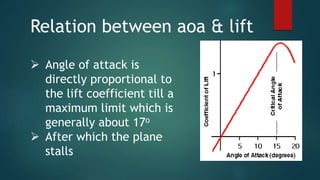
 Angle of attack is
directly proportional to
the lift coefficient till a
maximum limit which is
generally about 17o
 After which the plane
stalls
Relation between aoa & lift
CONTROL SURFACES
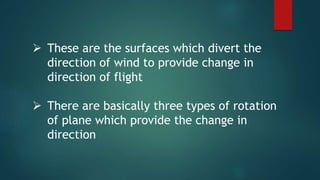
 These are the surfaces which divert the
direction of wind to provide change in
direction of flight
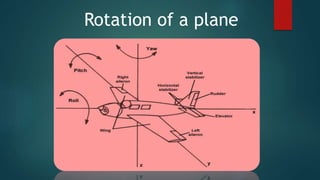
 There are basically three types of rotation
of plane which provide the change in
direction
Rotation of a plane
DESIGN PRINCIPLES
 It is the ratio of the weight of the plane to
the wing area
 Gives a measure of the load given per unit
area of the wing
 Wing loading is an important factor which
decides the balance between the forces
Wing Loading
 Aspect Ratio is the ratio of square of
wingspan to the area of the wing
AR = l2 / A
Where ‘l’ is the wingspan and A is the area of
wing
Typical aspect ratios for gliders are 6-8
Aspect Ratio(AR)
POWERING THE
PLANE
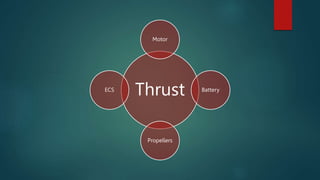
Thrust
Motor
Battery
Propellers
ECS
 After the thrust required is calculated the
configuration of the motor is decided
 The motor is selected by its KV rating which
is basically the RPM per volt it can deliver
 The KV rating is calculated by max current so
while selecting a battery and ECS see to it
that continuous current rating is greater than
motor rating.
Motor specifications
 One of the usually motors used is the 2204
motor which provides about 350 gms of thrust
 The thrust provided also depends upon the
propellers used which is again specified by its
pitch and diameter length.
Typical motors

Aeromodelling.pptx

  • 1.
  • 2.
     Aeromodelling isthe art of designing, building and flying miniaturized aircrafts (powered or non-powered). What is Aeromodelling?  It is both a hobby and sport; the hobby aspect involves building and assembling model aircraft, and the sport part involves the flying.
  • 3.
     Model airplanesare sized down models of an aircraft  The calculations are easy and importance is given to building of the plane
  • 4.
    What is thisWorkshop about?  Did you always want to get into the aviation industry? Have you ever dreamt of becoming an Aeronautical Engineer? Ever wondered how it feels to design your own aircraft and see it soar into the sky? Then Take a Break and come to Jet wings RC Aircraft Workshop.
  • 5.
    WHY ?  Thisworkshop by Jet wings gives you an opportunity to understand the theory behind the functioning of aircraft and aircraft design. It makes you innovate by coming up with your own design of an RC aircraft and fabricate it from scratch. An interactive lecture session and design session helps you design the best performing aircraft.
  • 6.
  • 7.
  • 8.
    LIFT  It’s theupward force acting on the planes due to the air flow over the wings  It is determined by the design of the wing and the wind nature as L=1/2ρV2ACL CL is the lift coefficient V is flight speed, A is wing area ρ is density of air
  • 9.
    THRUST  It’s theforce provided by the engine of the plane  Mainly two type of thrust generators are used 1. IC Engines 2. Electric Motors We will be seeing about electric motors here
  • 10.
    WEIGHT This is theweight of the plane along with its payload and motors. This should be minimized as much as possible by proper design.
  • 11.
    DRAG This is theweight of the plane along with its payload and motors. This should be minimized as much as possible by proper design.
  • 12.
    Difference between aircraftand airplane?  An aircraft is any machine that can fly.  Airplanes, hot air balloons, helicopters, or even flying platforms are considered aircraft.  An airplane is a specific type of aircraft that has fixed wings and engine, it is heavier than air that is capable of sustained, powered, and controlled flight.
  • 13.
    What is anRC aircraft or RC plane?  A remote-controlled aircraft is a small flying machine that is controlled remotely by an operator on the ground using a hand-held radio transmitter
  • 14.
    Materials used forRC aircrafts  Balsa  Styrofoam  Depron  Coroplast
  • 15.
    Balsa  This woodis very light and can can easily work for almost every purpose in aeromodelling.
  • 16.
    Styrofoam  This materialis light as well as strong.  It is a kind of expanded polystyrene used especially especially for making RC aircraft structure.
  • 17.
    Depron  It isa closed cell Styrofoam foam in sheet form.  It is a fantastic medium for building model aircraft.  It is extremely lightweight.
  • 18.
    Coroplast  Coroplast issimply the two sheets of plastic separated by another layer of zigzagged zigzagged plastic.  It is lightweight, inexpensive, inexpensive, and fairly sturdy.
  • 19.
  • 20.
    Electrical components  Brushlessmotor  Servos motor  Transmitter  Receiver  Electronic speed controller  LI Po Battery.
  • 21.
    Brush-Less DC motor(BLDC)  A Brush-Less DC motor (BLDC) is a synchronous electric motor which is powered by direct-current electricity (DC) .  Which has an electronically controlled commutation system, instead of a mechanical commutation system based on brushes.  In such motors, current and torque, voltage and rpm are linearly related.
  • 22.
  • 23.
     A Servois a small device that has an output shaft.  This shaft can be positioned to specific angular positions by sending the servo a coded signal.  As long as the coded signal exists on the input line, the servo will maintain the angular position of the shaft.  As the coded signal changes, the angular position of the shaft changes. servo motor
  • 25.
     A transmitteris an electronic device which, usually with the aid of an antenna, propagates an electromagnetic signal such as radio, television, or other telecommunications.  When talking about RC transmitter modes we are referring to how the transmitter is set up to control the airplane  which sticks operate which controls on the model. Transmitter
  • 27.
     It consistsof receiver module and a antennae wire of about 2- 3 feet long.  The receiver gets signal from the transmitter and then acts upon the servos  Nowadays there are ECSs which have separate power for the receiver so there is no need for separate power. Receiver
  • 28.
     Li-poly batteriesare also gaining favor in the world of Radio-controlled aircraft as well as Radio-controlled cars where the advantages of both lower weight and greatly increased run times can be sufficient justification for the price.  However ,lithium polymer-specific chargers are required to avoid fire and explosion. Lithium polymer batteries
  • 30.
  • 31.
     The liftgeneration is decided by the shape of the wings and the aerofoil  The lifting force is provided by the difference in the pressure of air flowing below and above the wing and is governed by Bernoulli’s principle Wings and Aerofoil
  • 32.
    How do youdesign a good wing?  By proper calculation of the wingspan , wing loading and aspect ratios  By making a good aerofoil  By optimizing the angle of attack to have good lift to drag ratios
  • 33.
    Angle of Attack(aoa) This is the relative angle made by the wind with the wings
  • 34.
     Angle ofattack is directly proportional to the lift coefficient till a maximum limit which is generally about 17o  After which the plane stalls Relation between aoa & lift
  • 35.
  • 37.
     These arethe surfaces which divert the direction of wind to provide change in direction of flight  There are basically three types of rotation of plane which provide the change in direction
  • 38.
  • 39.
  • 40.
     It isthe ratio of the weight of the plane to the wing area  Gives a measure of the load given per unit area of the wing  Wing loading is an important factor which decides the balance between the forces Wing Loading
  • 41.
     Aspect Ratiois the ratio of square of wingspan to the area of the wing AR = l2 / A Where ‘l’ is the wingspan and A is the area of wing Typical aspect ratios for gliders are 6-8 Aspect Ratio(AR)
  • 42.
  • 43.
  • 44.
     After thethrust required is calculated the configuration of the motor is decided  The motor is selected by its KV rating which is basically the RPM per volt it can deliver  The KV rating is calculated by max current so while selecting a battery and ECS see to it that continuous current rating is greater than motor rating. Motor specifications
  • 45.
     One ofthe usually motors used is the 2204 motor which provides about 350 gms of thrust  The thrust provided also depends upon the propellers used which is again specified by its pitch and diameter length. Typical motors