Aerodrome
Bello Ibrahim Msc, MWSO, MIOSH
Introduction
It is noteworthy that with the best planning
system in the world today, it is impossible to
Completely eliminate the risk of fire outbreak in
Domestic, Commercial, Industrial and other public
places.
This lecture intends primarily to discuss various
aspects of fire prevention, i.e.
How to prevent fire from occurring
What to do if it occurs, and
Evacuation of personnel to a place of safety.
Definitions
Aerodrome:
Fuel
Any combustible material – solid, liquid or gas
Oxygen
The air we breathe is
about 21% oxygen –
fire needs only
16% oxygen
Heat
The energy necessary to
increase the temperature of
fuel to where sufficient
vapors are given off for
ignition to occur
Fire is an aggregation of Heat, Air and Fuel.
There are 5 Classes of Fire
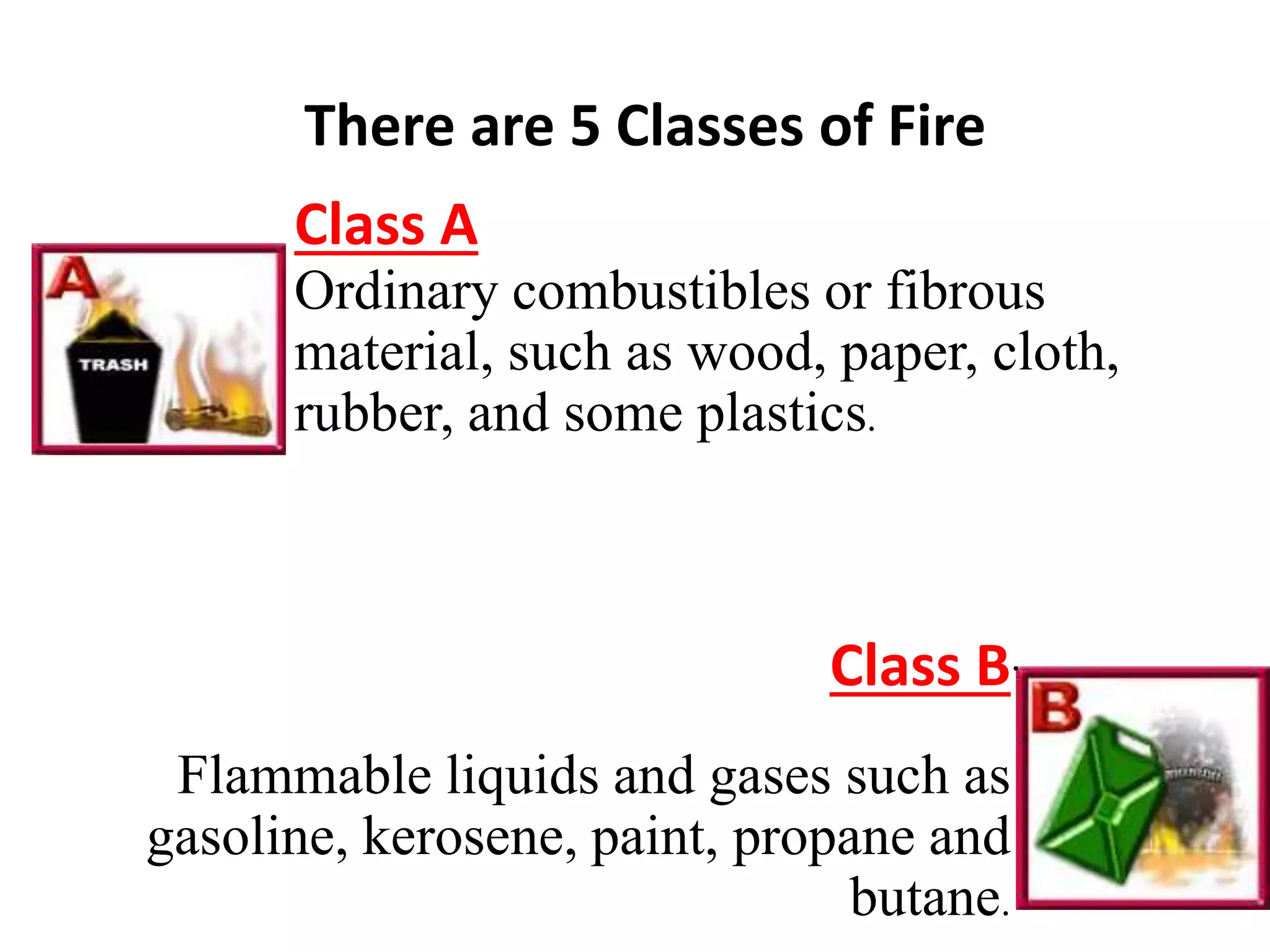
Class A
Ordinary combustibles or fibrous
material, such as wood, paper, cloth,
rubber, and some plastics.
Class B
Flammable liquids and gases such as
gasoline, kerosene, paint, propane and
butane.
.
Class C
Energized electrical equipment,
such as appliances, switches,
panel boxes and power tools.
Class D
Certain combustible
metals, such as
magnesium, titanium,
potassium, and sodium
Class K Fire: This is also called kitchen fire, it
involve cooking oil & fat.
TYPES OF EXTINGUISHERS
Basically we have 4 types of fire extinguishers, they are
1. DCP (Dry Chemical Powder)
2. CO2 (Carbon (iv)Oxide)
Foam Extinguisher
Kitchen Fire Extinguisher
Aerodrome environment can be divided
into:-
 Airside, &
 Landside.
AERODROME
•Airside is where aircraft operational activities
take place; it includes Apron, Tarmac, Taxiways,
Runways, Hangars, e.t.c.
Land Side
This is where activities that do not have direct
relation with aircraft takes place eg: Offices,
Shops, Parking area, Restaurants, Banks,
Fuel Farms, etc.
Fire Prevention @ Airside
.
Based on the operational activities taking place at
the air side, those that require strict fire
prevention guidelines include:-
Aircraft fueling (including defueling)
Ground handling operations
Bush Fire
Bush Fire
Electrical faults
Arson
Negligence by personnel working around the perimeter
fence
Causes of Bush Fire
Bush Fire Challenges
 Sudden change in wind parameters (direction, speed and
type), &
Smoke/dust
Bush Fire Prevention Tips
All electrical cables should be properly buried and
protected
Grasses around the two active runways should be
trimmed and properly maintained
Security should be at alert to oversee any act relating
arsonist
Personnel working around the perimeter fence should
NOT carry any naked flame or source of ignition
Vehicles working around the runway should have spark
arrestor
Safety Measures During Aircraft Refueling.
Fueling zone should be established before
fueling commences.
Fueling Zone
Aircraft-borne auxiliary power unit (APU’s)
should be started before fueling connections
are made.
Ground power units can only be operated outside
the fueling zone.
No source of ignition, e.g. footwear’s with
expose iron and do not operate mobile phones.
 All exits to the aircraft (if passengers on
board) should be widely open.
Appropriate fire extinguisher should be
stationed and be manned by a staff.
Strict NO smoking should be observed.
Fuel delivery side of the truck should not be
parked close to the undercarriage or aircraft
engine.
Fueling apparatus should be grounded to
prevent static ignition.
Fueling vehicles should be positioned such that,
accessibility to the aircraft by ARFFS vehicles is not
interrupted.
Proper fuel truck positioning
Fuel Spillage
Spillage of fuel beneath the aircraft constitutes a
severe hazard to personnel, aircraft and other
equipment.
The following should be observed in case of
fuel spillage:-
Report to ARFFS and Operation
Departments.
Leakages should be shutdown.
All operations i.e. fueling, ground power, cargo or
baggage handling operating within 15m radius from
the spillage should be stopped.
Fueling while Passengers on Board
Passengers should be informed that fueling is
about to take place.
‘No smoking’ sign in the aircraft interior
should be put ON.
Stairways should be positioned at normal
passenger exits; and be kept ajar.
Aircraft interior lightening should be ON to enable
emergency exits be identified.
Fire Prevention During Ground
Operations.
Do not park or operate operational vehicles
under the wing of an aircraft.
All operational vehicles should have an exhaust
system and spark arrestors.
GPU should only be operated 6 meters from
fueling zone.
Proper positioning of operational vehicles.
Care should be taken when handling materials that
have the potentials of providing sparks often
collisions e.g. metals.
Fire Prevention @ Land Side
Land side is where activities that do not have
direct contact to aircraft occur such as:-
Restaurants
Car park
 Fuel dumps and aviation fuel farms
Offices e.t.c.
Aviation fuel farm: Fuel farm is located at the
landside and has direct link to airside.
No smoking sings should be pasted in all strategic
position within the farm.
Fuel servicing equipment should be properly
manned and the area be free of weeds.
In view of the above the following should be
observed:-
Appropriate fire extinguisher should be stationed at
fuel storage areas and lodging stations.
Fuel hydrants, pits, cabinet should be located
15m from building.
Emergency shut offs should be free of obstruction
and placards be placed 2m above the ground.
Fuel trucks should be parked at least 15m
from buildings and 3m apart.
FIRE PREVENTION @ OFFICES/
HOMES
Fire at work can mean more than perhaps a few
days off, occupants can be badly injured or
killed and properties destroyed.
The following guidelines should be observed in
offices/homes so as to minimize any fire hazard
or fire outbreak.
FIRE PREVENTION @ OFFICES/ HOMES
passage ways and exits free from storage waste.
Smoke only where permitted, use large, non-tip
ashtrays.
Smoking in the leaving or bed rooms should be
discouraged
Petrol and other highly flammable liquids must be
properly stored.
The use of boiling ring should be stopped rather
use electric kettles with automatic switch-offs
devices.
Know the location of the main switch in your office
Over loading of electrical sockets should
discouraged
All electrical appliances should be of high
quality.
Switch off all electrical appliances during closing
hours.
Heat producing equipment like copiers, work
processors, kettle should be kept away from any
combustible materials.
KITCHEN FIRE PREVENTION
Closes/ rags should be kept away from stoves
Flammable substance like aerosols, kerosene should
be kept away from cooking area
Lighters matches should be kept away from children
Never leave cooking unattended
Do not spray water into electrical outlets when cleaning
or washing dishes
Get a kitchen fire extinguisher and a fire blanket
Provide sufficient ventilation in the kitchen
Have an escape route or emergency exit
WHAT TO DO UPON DISCOVERY OF
FIRE OR ITS SIGN
If fire occurs DO NOT PANIC, follow the
following steps.
Use appropriate fire extinguisher to control a small
fire, IF you can
Activate fire alarm if any
or use verbal method.
Notify fire department (064-430741, 064895435 &
08157992863).
In case of class K fire use fire blanket or wet a rag
with water and cover the burning substance.
Fire involving cooking gas make sure you TURN
OFF the gas to cut off its supply
Shut down equipment within your vicinity, if you
can.
If smoke is present, crawl low and move towards
an exit.
Before opening any door use the back of your
hand to feel for heat on the door surface, if it is hot
do not open.
Provide fire personnel with details of what happen
and any hazard within the building you might know.
Isolate the area by closing doors, windows, if you can
and evacuate immediately.
If your clothes caught fire don’t run, Drop and Roll
EMERGENCY EVERCUATION
Blocked and obstructed exit
Exit is blocked and poorly lit
All dead ends or closed exits be marked ‘NO EXIT’
Blocked extinguisher
Safety is every ones responsibilities so
all hands most be on deck to have safe
Aerodrome.
Conclusion
FIN
?

Aerodrome fire prevention

  • 1.
  • 2.
    Introduction It is noteworthythat with the best planning system in the world today, it is impossible to Completely eliminate the risk of fire outbreak in Domestic, Commercial, Industrial and other public places.
  • 3.
    This lecture intendsprimarily to discuss various aspects of fire prevention, i.e. How to prevent fire from occurring What to do if it occurs, and Evacuation of personnel to a place of safety.
  • 4.
  • 5.
    Fuel Any combustible material– solid, liquid or gas Oxygen The air we breathe is about 21% oxygen – fire needs only 16% oxygen Heat The energy necessary to increase the temperature of fuel to where sufficient vapors are given off for ignition to occur Fire is an aggregation of Heat, Air and Fuel.
  • 6.
    There are 5Classes of Fire Class A Ordinary combustibles or fibrous material, such as wood, paper, cloth, rubber, and some plastics. Class B Flammable liquids and gases such as gasoline, kerosene, paint, propane and butane. .
  • 7.
    Class C Energized electricalequipment, such as appliances, switches, panel boxes and power tools. Class D Certain combustible metals, such as magnesium, titanium, potassium, and sodium
  • 8.
    Class K Fire:This is also called kitchen fire, it involve cooking oil & fat.
  • 9.
    TYPES OF EXTINGUISHERS Basicallywe have 4 types of fire extinguishers, they are 1. DCP (Dry Chemical Powder)
  • 10.
    2. CO2 (Carbon(iv)Oxide)
  • 11.
  • 12.
    Aerodrome environment canbe divided into:-  Airside, &  Landside. AERODROME
  • 13.
    •Airside is whereaircraft operational activities take place; it includes Apron, Tarmac, Taxiways, Runways, Hangars, e.t.c.
  • 14.
    Land Side This iswhere activities that do not have direct relation with aircraft takes place eg: Offices, Shops, Parking area, Restaurants, Banks, Fuel Farms, etc.
  • 15.
    Fire Prevention @Airside . Based on the operational activities taking place at the air side, those that require strict fire prevention guidelines include:- Aircraft fueling (including defueling) Ground handling operations Bush Fire
  • 16.
  • 17.
    Electrical faults Arson Negligence bypersonnel working around the perimeter fence Causes of Bush Fire
  • 18.
    Bush Fire Challenges Sudden change in wind parameters (direction, speed and type), & Smoke/dust
  • 19.
    Bush Fire PreventionTips All electrical cables should be properly buried and protected Grasses around the two active runways should be trimmed and properly maintained Security should be at alert to oversee any act relating arsonist Personnel working around the perimeter fence should NOT carry any naked flame or source of ignition Vehicles working around the runway should have spark arrestor
  • 20.
    Safety Measures DuringAircraft Refueling. Fueling zone should be established before fueling commences.
  • 21.
  • 22.
    Aircraft-borne auxiliary powerunit (APU’s) should be started before fueling connections are made. Ground power units can only be operated outside the fueling zone.
  • 23.
    No source ofignition, e.g. footwear’s with expose iron and do not operate mobile phones.  All exits to the aircraft (if passengers on board) should be widely open.
  • 24.
    Appropriate fire extinguishershould be stationed and be manned by a staff. Strict NO smoking should be observed.
  • 25.
    Fuel delivery sideof the truck should not be parked close to the undercarriage or aircraft engine. Fueling apparatus should be grounded to prevent static ignition.
  • 26.
    Fueling vehicles shouldbe positioned such that, accessibility to the aircraft by ARFFS vehicles is not interrupted.
  • 27.
  • 28.
    Fuel Spillage Spillage offuel beneath the aircraft constitutes a severe hazard to personnel, aircraft and other equipment.
  • 29.
    The following shouldbe observed in case of fuel spillage:- Report to ARFFS and Operation Departments. Leakages should be shutdown.
  • 30.
    All operations i.e.fueling, ground power, cargo or baggage handling operating within 15m radius from the spillage should be stopped.
  • 31.
    Fueling while Passengerson Board Passengers should be informed that fueling is about to take place. ‘No smoking’ sign in the aircraft interior should be put ON.
  • 32.
    Stairways should bepositioned at normal passenger exits; and be kept ajar. Aircraft interior lightening should be ON to enable emergency exits be identified.
  • 33.
    Fire Prevention DuringGround Operations. Do not park or operate operational vehicles under the wing of an aircraft. All operational vehicles should have an exhaust system and spark arrestors. GPU should only be operated 6 meters from fueling zone.
  • 34.
    Proper positioning ofoperational vehicles. Care should be taken when handling materials that have the potentials of providing sparks often collisions e.g. metals.
  • 35.
    Fire Prevention @Land Side Land side is where activities that do not have direct contact to aircraft occur such as:- Restaurants Car park  Fuel dumps and aviation fuel farms Offices e.t.c.
  • 36.
    Aviation fuel farm:Fuel farm is located at the landside and has direct link to airside.
  • 37.
    No smoking singsshould be pasted in all strategic position within the farm. Fuel servicing equipment should be properly manned and the area be free of weeds. In view of the above the following should be observed:-
  • 38.
    Appropriate fire extinguishershould be stationed at fuel storage areas and lodging stations.
  • 39.
    Fuel hydrants, pits,cabinet should be located 15m from building. Emergency shut offs should be free of obstruction and placards be placed 2m above the ground.
  • 40.
    Fuel trucks shouldbe parked at least 15m from buildings and 3m apart.
  • 41.
    FIRE PREVENTION @OFFICES/ HOMES Fire at work can mean more than perhaps a few days off, occupants can be badly injured or killed and properties destroyed. The following guidelines should be observed in offices/homes so as to minimize any fire hazard or fire outbreak.
  • 42.
    FIRE PREVENTION @OFFICES/ HOMES passage ways and exits free from storage waste. Smoke only where permitted, use large, non-tip ashtrays.
  • 43.
    Smoking in theleaving or bed rooms should be discouraged Petrol and other highly flammable liquids must be properly stored.
  • 44.
    The use ofboiling ring should be stopped rather use electric kettles with automatic switch-offs devices. Know the location of the main switch in your office Over loading of electrical sockets should discouraged
  • 45.
    All electrical appliancesshould be of high quality. Switch off all electrical appliances during closing hours. Heat producing equipment like copiers, work processors, kettle should be kept away from any combustible materials.
  • 46.
    KITCHEN FIRE PREVENTION Closes/rags should be kept away from stoves Flammable substance like aerosols, kerosene should be kept away from cooking area
  • 47.
    Lighters matches shouldbe kept away from children Never leave cooking unattended Do not spray water into electrical outlets when cleaning or washing dishes Get a kitchen fire extinguisher and a fire blanket Provide sufficient ventilation in the kitchen Have an escape route or emergency exit
  • 48.
    WHAT TO DOUPON DISCOVERY OF FIRE OR ITS SIGN If fire occurs DO NOT PANIC, follow the following steps. Use appropriate fire extinguisher to control a small fire, IF you can Activate fire alarm if any or use verbal method.
  • 49.
    Notify fire department(064-430741, 064895435 & 08157992863). In case of class K fire use fire blanket or wet a rag with water and cover the burning substance. Fire involving cooking gas make sure you TURN OFF the gas to cut off its supply
  • 50.
    Shut down equipmentwithin your vicinity, if you can. If smoke is present, crawl low and move towards an exit. Before opening any door use the back of your hand to feel for heat on the door surface, if it is hot do not open.
  • 51.
    Provide fire personnelwith details of what happen and any hazard within the building you might know. Isolate the area by closing doors, windows, if you can and evacuate immediately. If your clothes caught fire don’t run, Drop and Roll
  • 52.
  • 53.
    Exit is blockedand poorly lit
  • 54.
    All dead endsor closed exits be marked ‘NO EXIT’
  • 55.
  • 57.
    Safety is everyones responsibilities so all hands most be on deck to have safe Aerodrome. Conclusion
  • 58.
  • 59.

Editor's Notes

  • #2 GG
  • #27 Improper Positioning of Fuel Truck