Aerial Firefighting
A Strategic Perspective
David Pearce
Manager
State Aviation Operations
South Australian Country Fire Service
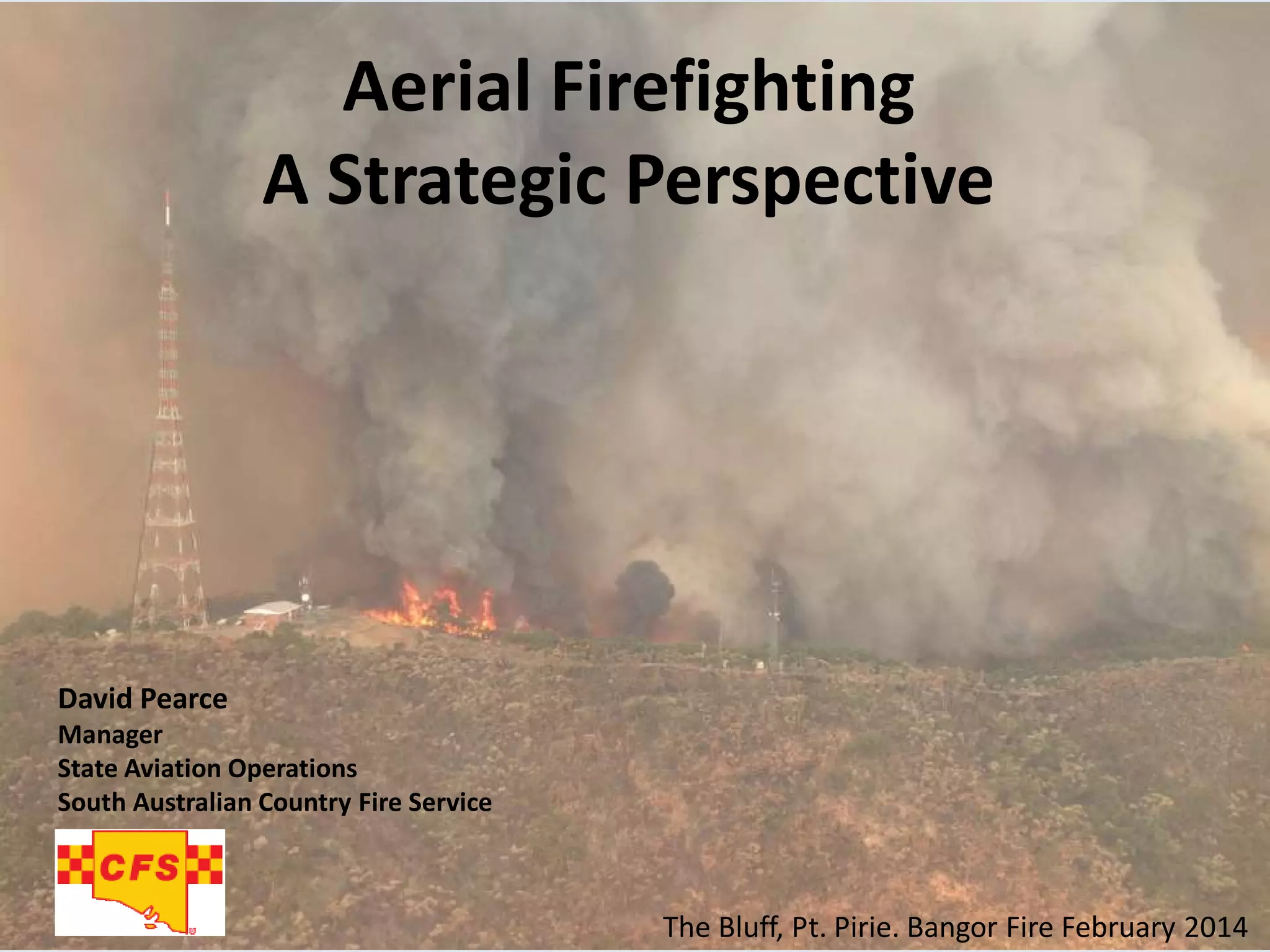
The Bluff, Pt. Pirie. Bangor Fire February 2014
Air Fleet and Firefighting Capacity
National Aerial Firefighting Centre (NAFC)
Managing Community Expectations
Aerial Fleet and
Firefighting Capability
Front
line
aircraft
Single Engine Air Tanker (SEAT)
High volume type 1 helicopter
CFS front line aircraft
Single Engine Air Tanker
3200 litre tank (3.2 tonne)
1600hp jet turbine
Speed 360km/h
CFS front line aircraft
High volume Helicopter
7500 litre tank (7.5 t)
2 x 4500hp jet turbines
Speed 170km/h
Naracoorte for Air Observation
Millicent for Air Attack Supervision
Port Lincoln for Air Observation
3 x Cessna 182s
Woodside and Port Lincoln for Air Attack Supervision
1 x Cessna 208B Turbine Caravan
2 x AS 350 Squirrel
Woodside for Air Attack Supervision
1 x S64E Aircrane
Brukunga fire bombing
10 x AT 802F Single Engine Air Tanker
Woodside - 4 aircraft Primary Response Zone Mount Lofty Ranges
Port Lincoln - 2 aircraft Primary Response Zone Lower Eyre Peninsula
Mount Gambier - 2 aircraft Primary Response Zone Lower South East
Woodside - 2 aircraft Secondary response zone
Total aerial firefighting fleet of 17 aircraft
11 fire bombing aircraft providing a
first strike capability of 40,000 litres
6 observation and coordination aircraft
located around the State
Ability to relocate aerial firefighting resources
in line with actual fire risk
34 recognised aerial firefighting bases
14 Helibases throughout the Mt lofty Ranges
Aerial firefighting fleet selection
Some of the principles used for fleet configuration in South
Australia are;
Any fleet changes must provide increased support to ground
firefighting resources
The types and number of aircraft must enhance and support the
initial attack strategy through speed of response and total litres
delivered (initial total drop capacity)
The types and number of aircraft selected must enhance the
capacity to support the broader areas of the State
The types and number of aircraft selected must enhance the
ability to resource sustained and multiple aerial firefighting
operations
Essentially NAFC was formed in 2003 because the State and
Territory governments and the Australian Government saw an
opportunity to better utilise highly specialised, highly mobile,
relatively scarce and relatively expensive aerial firefighting
resources through national collaboration and cooperation.
The South Australian Country Fire Service is a full
member of NAFC.
NAFC leases and coordinates a national fleet of highly
specialised firefighting aircraft that are readily available
for use by State and Territory emergency service and land
management agencies across Australia.
NAFC facilitates the sharing of these aerial firefighting
resources between States and Territories during the fire
season.
Managing Community Expectations
In South Australia, the role of aircraft
is integrated within the overall task of
bushfire suppression. Aircraft alone
do not ‘put out fires’. In order to be
effective they must always be
deployed in support of ground-based
strategies and tactics.
Aircraft support
Firefighters
suppress
Managing Community Expectations
The most common misconceptions are;
Aircraft alone extinguish bushfires.
Aircraft can bomb at night and in low visibility conditions.
The bigger the aircraft, the bigger the fire it can extinguish.
CFS will have aircraft at every fire.
Of course, there is always a very helpful member of
the public who has the best idea for putting out fires!What about old
Cessna engines
from the Mohave
Desert mounted on
6x4 trailers. Then
set them up ahead
of the fire to blow it
back on itself
Fuel air bombs. If we
drop a really big
fuel/air bomb on a fire
it will consume all
oxygen and extinguish
the fire………..
Sand balls, lets use
foundry sand and form
it into balls and drop it
on the fire. It used to
work when I went to
primary school in the
fire bucket at the front
of the classroom!
This may be a crazy
thought and I am not
sure of the effects of a
low level sonic boom
from an F18a fighter.
Would this provide some
sort of huge impact
sufficient to blow out
some fires?
Overhead sprinklers
between helicopters, if
we put big sprinklers
on a hose between two
helicopters it will put
out the fire. It works in
buildings doesn’t it?Thankyou…..Any
questions?

Aerial Firefighting A Strategic Perspective - David Pearce

  • 1.
    Aerial Firefighting A StrategicPerspective David Pearce Manager State Aviation Operations South Australian Country Fire Service The Bluff, Pt. Pirie. Bangor Fire February 2014
  • 2.
    Air Fleet andFirefighting Capacity National Aerial Firefighting Centre (NAFC) Managing Community Expectations
  • 3.
  • 4.
    Front line aircraft Single Engine AirTanker (SEAT) High volume type 1 helicopter
  • 5.
    CFS front lineaircraft Single Engine Air Tanker 3200 litre tank (3.2 tonne) 1600hp jet turbine Speed 360km/h
  • 6.
    CFS front lineaircraft High volume Helicopter 7500 litre tank (7.5 t) 2 x 4500hp jet turbines Speed 170km/h
  • 7.
    Naracoorte for AirObservation Millicent for Air Attack Supervision Port Lincoln for Air Observation 3 x Cessna 182s
  • 8.
    Woodside and PortLincoln for Air Attack Supervision 1 x Cessna 208B Turbine Caravan
  • 9.
    2 x AS350 Squirrel Woodside for Air Attack Supervision
  • 10.
    1 x S64EAircrane Brukunga fire bombing
  • 11.
    10 x AT802F Single Engine Air Tanker Woodside - 4 aircraft Primary Response Zone Mount Lofty Ranges Port Lincoln - 2 aircraft Primary Response Zone Lower Eyre Peninsula Mount Gambier - 2 aircraft Primary Response Zone Lower South East Woodside - 2 aircraft Secondary response zone
  • 12.
    Total aerial firefightingfleet of 17 aircraft 11 fire bombing aircraft providing a first strike capability of 40,000 litres 6 observation and coordination aircraft located around the State Ability to relocate aerial firefighting resources in line with actual fire risk 34 recognised aerial firefighting bases 14 Helibases throughout the Mt lofty Ranges
  • 13.
    Aerial firefighting fleetselection Some of the principles used for fleet configuration in South Australia are; Any fleet changes must provide increased support to ground firefighting resources The types and number of aircraft must enhance and support the initial attack strategy through speed of response and total litres delivered (initial total drop capacity) The types and number of aircraft selected must enhance the capacity to support the broader areas of the State The types and number of aircraft selected must enhance the ability to resource sustained and multiple aerial firefighting operations
  • 14.
    Essentially NAFC wasformed in 2003 because the State and Territory governments and the Australian Government saw an opportunity to better utilise highly specialised, highly mobile, relatively scarce and relatively expensive aerial firefighting resources through national collaboration and cooperation.
  • 15.
    The South AustralianCountry Fire Service is a full member of NAFC. NAFC leases and coordinates a national fleet of highly specialised firefighting aircraft that are readily available for use by State and Territory emergency service and land management agencies across Australia. NAFC facilitates the sharing of these aerial firefighting resources between States and Territories during the fire season.
  • 16.
    Managing Community Expectations InSouth Australia, the role of aircraft is integrated within the overall task of bushfire suppression. Aircraft alone do not ‘put out fires’. In order to be effective they must always be deployed in support of ground-based strategies and tactics.
  • 17.
  • 18.
    Managing Community Expectations Themost common misconceptions are; Aircraft alone extinguish bushfires. Aircraft can bomb at night and in low visibility conditions. The bigger the aircraft, the bigger the fire it can extinguish. CFS will have aircraft at every fire.
  • 19.
    Of course, thereis always a very helpful member of the public who has the best idea for putting out fires!What about old Cessna engines from the Mohave Desert mounted on 6x4 trailers. Then set them up ahead of the fire to blow it back on itself Fuel air bombs. If we drop a really big fuel/air bomb on a fire it will consume all oxygen and extinguish the fire……….. Sand balls, lets use foundry sand and form it into balls and drop it on the fire. It used to work when I went to primary school in the fire bucket at the front of the classroom! This may be a crazy thought and I am not sure of the effects of a low level sonic boom from an F18a fighter. Would this provide some sort of huge impact sufficient to blow out some fires? Overhead sprinklers between helicopters, if we put big sprinklers on a hose between two helicopters it will put out the fire. It works in buildings doesn’t it?Thankyou…..Any questions?