Aeration
Introduction to aeration
• It’s a process of incorporating air in the
mixture
• Aeration happens due to following ways
Beating Whisking
Intro….
• Raising agents are also used for aeration
which creates gas bubbles puffing up &
eventually increase the volume of the product
and provides required spongy structure after
the baking usually done
for dough and batters that cause a foaming
action which lightens and softens the finished
product.
Intro….
• Use of too much raising agent raise the food
too rapidly and breaks the surface area and
allows the gas produced to escape, and as a
result, the dough sinks and become heavy.
Types of Raising Agents
–Physical raising agent
–Biological raising agent
–Chemical raising agent
Physical Raising Agent
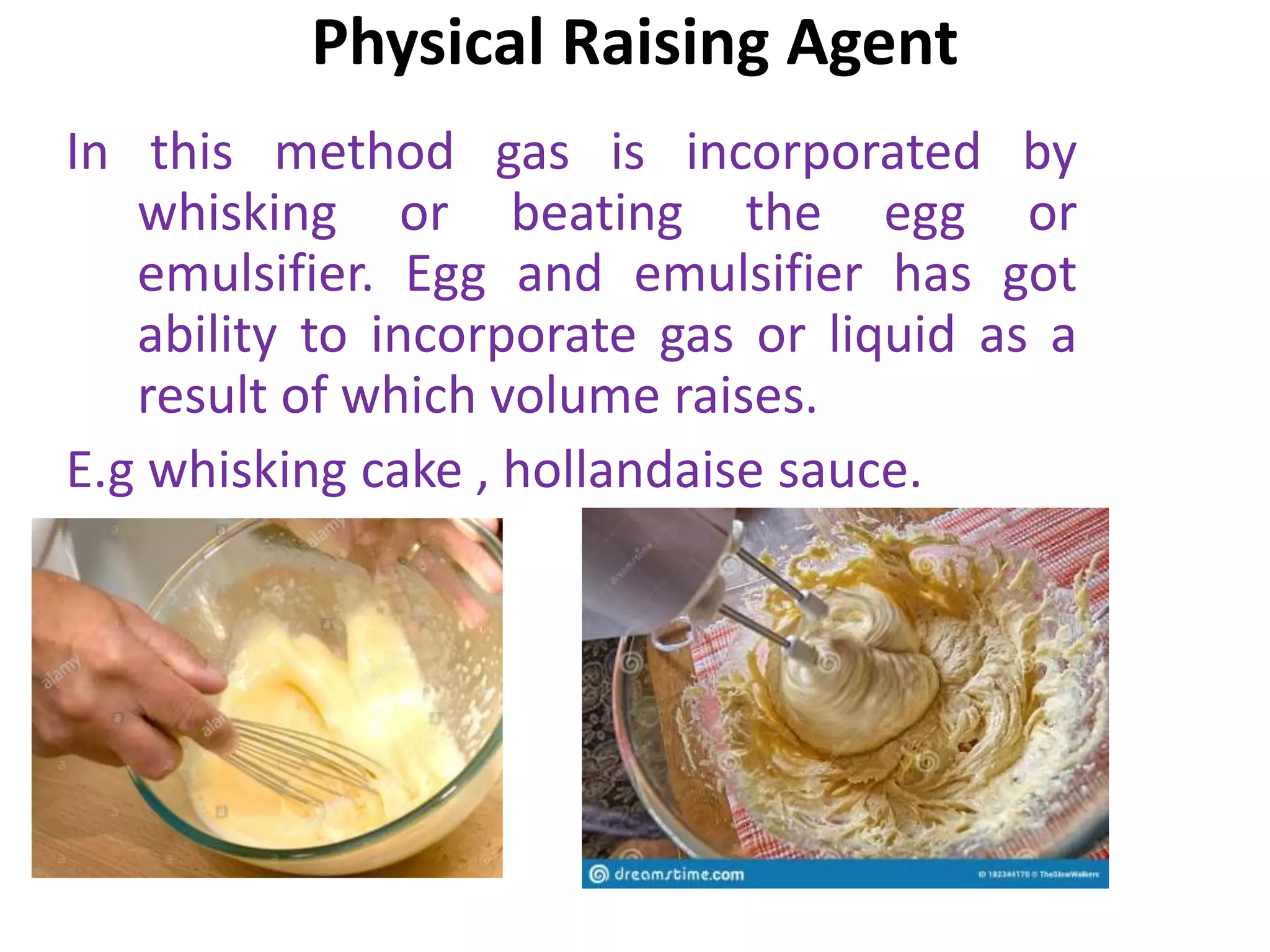
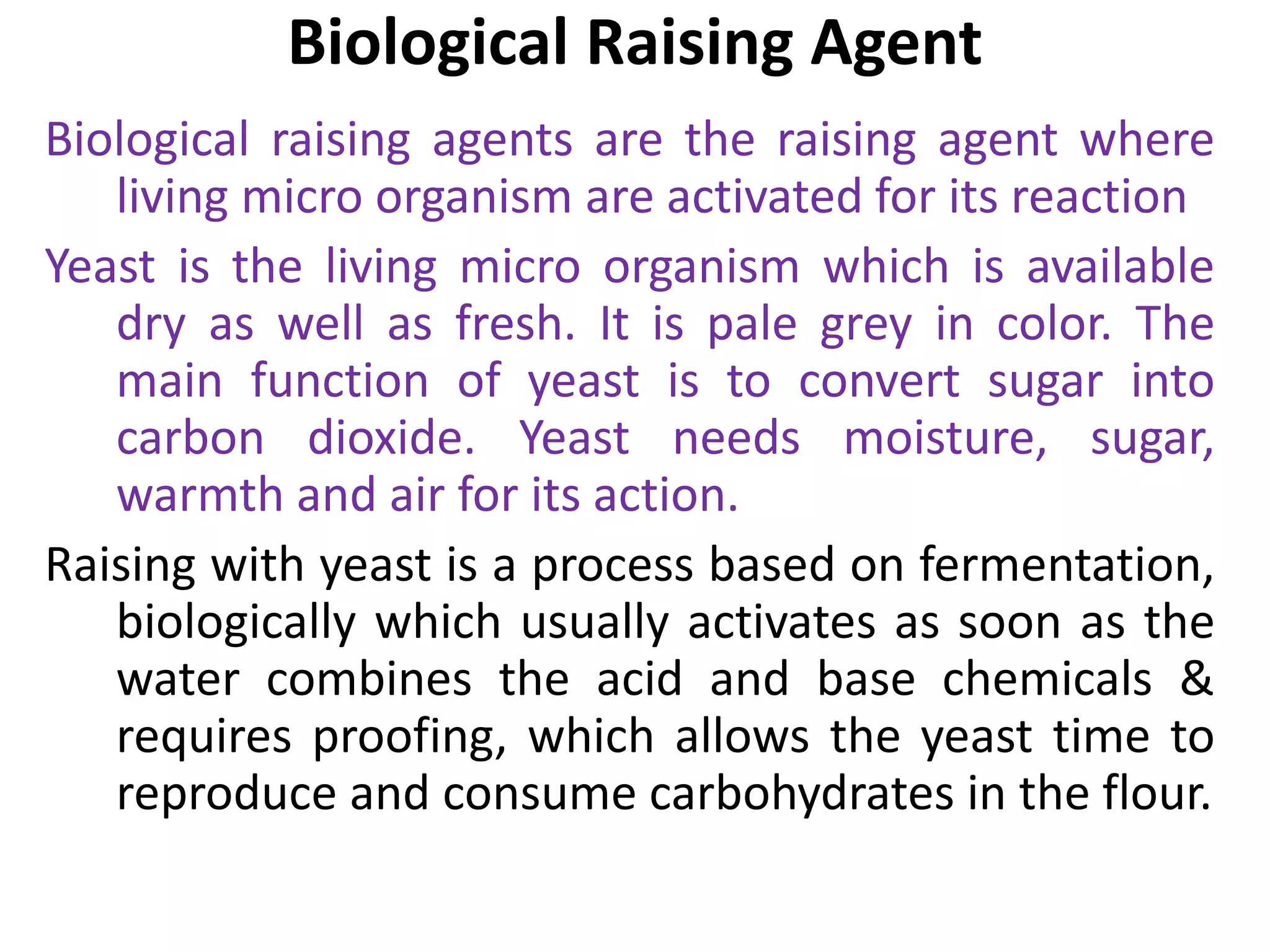
In this method gas is incorporated by
whisking or beating the egg or
emulsifier. Egg and emulsifier has got
ability to incorporate gas or liquid as a
result of which volume raises.
E.g whisking cake , hollandaise sauce.
Biological Raising Agent
Biological raising agents are the raising agent where
living micro organism are activated for its reaction
Yeast is the living micro organism which is available
dry as well as fresh. It is pale grey in color. The
main function of yeast is to convert sugar into
carbon dioxide. Yeast needs moisture, sugar,
warmth and air for its action.
Raising with yeast is a process based on fermentation,
biologically which usually activates as soon as the
water combines the acid and base chemicals &
requires proofing, which allows the yeast time to
reproduce and consume carbohydrates in the flour.
Varities of biological raising agent
• Yeast
• Beer
• Buttermilk
• Sourdough starter
• Yogurt
Chemical Raising Agent
Chemical leaveners are chemical mixtures or
compounds that release gases (usually carbon
dioxide) when they react with moisture and heat
Chemical leaveners are used in quick cakes, as well as
cookies and numerous other applications where a
long biological fermentation is impractical or
undesirable to taste and texture.
Varieties of chemical Raising Agent
• Baking powder
• Baking soda (sodium bicarbonate)
• Mono calcium phosphate
• Sodium aluminum phosphate (SALP)
• Sodium acid pyrophosphate (SAPP)
• Potassium bi-tartrate (cream of tartar)

Aeration

  • 1.
  • 2.
    Introduction to aeration •It’s a process of incorporating air in the mixture • Aeration happens due to following ways Beating Whisking
  • 3.
    Intro…. • Raising agentsare also used for aeration which creates gas bubbles puffing up & eventually increase the volume of the product and provides required spongy structure after the baking usually done for dough and batters that cause a foaming action which lightens and softens the finished product.
  • 4.
    Intro…. • Use oftoo much raising agent raise the food too rapidly and breaks the surface area and allows the gas produced to escape, and as a result, the dough sinks and become heavy.
  • 5.
    Types of RaisingAgents –Physical raising agent –Biological raising agent –Chemical raising agent
  • 6.
    Physical Raising Agent Inthis method gas is incorporated by whisking or beating the egg or emulsifier. Egg and emulsifier has got ability to incorporate gas or liquid as a result of which volume raises. E.g whisking cake , hollandaise sauce.
  • 7.
    Biological Raising Agent Biologicalraising agents are the raising agent where living micro organism are activated for its reaction Yeast is the living micro organism which is available dry as well as fresh. It is pale grey in color. The main function of yeast is to convert sugar into carbon dioxide. Yeast needs moisture, sugar, warmth and air for its action. Raising with yeast is a process based on fermentation, biologically which usually activates as soon as the water combines the acid and base chemicals & requires proofing, which allows the yeast time to reproduce and consume carbohydrates in the flour.
  • 8.
    Varities of biologicalraising agent • Yeast • Beer • Buttermilk • Sourdough starter • Yogurt
  • 9.
    Chemical Raising Agent Chemicalleaveners are chemical mixtures or compounds that release gases (usually carbon dioxide) when they react with moisture and heat Chemical leaveners are used in quick cakes, as well as cookies and numerous other applications where a long biological fermentation is impractical or undesirable to taste and texture.
  • 10.
    Varieties of chemicalRaising Agent • Baking powder • Baking soda (sodium bicarbonate) • Mono calcium phosphate • Sodium aluminum phosphate (SALP) • Sodium acid pyrophosphate (SAPP) • Potassium bi-tartrate (cream of tartar)