ABOUT EGGS
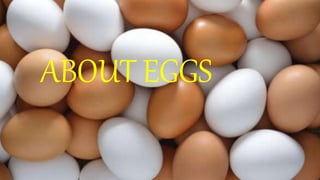
Eggs are one of the most nutritious and versatile foods in
the kitchen are served on their own, used as an ingredient
in many dishes starting from soup to desserts. It provides
texture, structure, flavour and moisture as well as the
nutrition. Eggs can be brown or white; colour has no effect
on quality or flavour but depends on the breed of the hen.
Egg is a main component of the human diet serving as a
dietary source of protein, fat, and other nutrients. The
chicken egg is made up of approximately two-thirds white
and one-third yolk
STRUCTURE OF AN EGG
Parts of Egg Total
weight(%)
Water
(%)
Protein
(%)
Fat
(%)
Whole
egg
100 6
5
13 11
White 58 8
8
13 ----
Yolk 31 4
8
18 33
STRUCTURE OF EGG
Shell
It is the outer hard covering of the egg and is made up of Calcium,
Magnesium carbonate and Calcium phosphate. The shell gives shape to
the egg and holds the inner contents. The shell contains thousands of
pores that allow CO2 and moisture to escape, as well as air to enter. The
shell is covered by a cuticle membrane or Bloom and should not be
washed. The bloom acts as protective covering blocking the pores, and
prevents moisture loss and bacterial contamination. When eggs are
washed before going to the market, the cuticle is removed. To protect the
egg, the washed eggs are coated with a thin film of edible oil.
Membrane
Beneath the shell, there are two semi permeable membranes - the outer and
the inner. These membranes act as a protective layer in case the shell
cracks.
STRUCTURE OF
EGG
Aircell
On one side of the egg (broader), both these membranes
separate to form an air cell. This is formed by contraction of
the contents as soon as the egg is laid, due to the difference
in the outside temperature.
Egg white
It has 1/8th part of the protein, which is called albumin; the
remaining being water. The egg white consists of three parts
– the outer thin albumen, the middle thick albumin and the
inner thin albumin.
STRUCTURE OF EGG
Egg yolk
The yolk is separated from the white by a membrane called
vitelline membrane. This membrane prevents the mix of both
yolk and white. 1/6th parts of the egg yolk contains proteins,
1/3rd fat and the rest water, Vitamins and minerals like Calcium,
Phosphorus, Iron etc.
Chalaza
The egg is kept in position at the centre of the egg with the help
of the chalaza. It has a thick-cord like appearance and is
composed of proteins. This chord-like structure may have to be
strained while making custards.
EGG SIZES
CLASSIFICATION MIN
Wt./EGG
JUMBO 70 gm
EXTRA LARGE 63 gm
LARGE 56 gm
MEDIUM 49 gm
SMALL 42 gm
PEE WEE 35 gm
• Most commonly used eggs in
commercial and home cookery are
Large Eggs.
• Jumbo and Extra Large eggs are
sometimes used as B’Fast eggs for
poaching and frying.
• Medium, Small and Pee Wee eggs are
rarely used.
USES OF EGG IN COOKERY
BINDING AND COATING
Egg used in such food mixtures as meat loaf or croquettes is
distributed through the mixture. Upon heating, the proteins coagulate,
binding the food into a cohesive mass of a desired form. This is why
croquettes, for example, retain their shape during the cooking
process. Frequently an outer coating of flour, breadcrumbs, cereal, or
butter is added to a food to enhance its appearance, texture or
flavour. An egg batter provides a binder for added coatings.
LEAVENINGS
Foam is created when egg white is beaten. The foam is made of
bubbles surrounded by a thin, elastic film of egg white . When the
foam is incorporated into a mixture, it provides leavening for such
products as omelettes, soufflés, sponge cakes and meringues. When
these products are heated the air bubbles expand and the egg white
film hardens. The volume of egg yolks makes its foaming power
considerably lower than that of the egg white.
USES OF EGG IN COOKERY
EMULSIFYING AGENTS
Eggs are used to form stable emulsions, mayonnaise for example Oil
and Vinegar separate out unless the oil droplets are coated with the
substance that keeps them from running together. Egg yolk is often
effective in accomplishing this. Eggs are used as emulsifiers (Lecithin)
in ice cream, cakes and cream puffs.
CLARIFYING AGENTS
Raw eggs may be added to hot broths and coffee. When the proteins in
the egg coagulate, they trap the loose particles in the liquid and clarify
it. Custard, Puddings and Pie Fillings: custard may be cooked over hot
water and stirred as it is cooked (soft custard) or may be cooked
without stirring (baked custard). The coagulation of soft custard takes
place at about 160 F (70 C). If in making a soft custard the mixture is
held at the coagulation point for too long or if the temperature exceeds
this level the protein is over-cooked, the mixture thickens unevenly and
the finished product will be curdled .A baked custard is cooked without
stirring in an oven at 350 F(176 C).
STORAGE OF EGGS
• Egg should be stored in the refrigerator in their cartoon
to maintain maximum freshness and to avoid
absorbing other food odours through their porous
shells with the pointed end down.
• Store at Cool place 0-5 C
• Away from possible contaminants such as raw meat.
• Follow First in first out
• Hands should be washed before and after handling
eggs
METHODS OF COOKING EGGS
•Hard boiled
•Softboiled
•Fried
•Poached
•Scrambled
•Omelets & Frittatas
•Sunny Side Up

About eggs

  • 1.
  • 2.
    Eggs are oneof the most nutritious and versatile foods in the kitchen are served on their own, used as an ingredient in many dishes starting from soup to desserts. It provides texture, structure, flavour and moisture as well as the nutrition. Eggs can be brown or white; colour has no effect on quality or flavour but depends on the breed of the hen. Egg is a main component of the human diet serving as a dietary source of protein, fat, and other nutrients. The chicken egg is made up of approximately two-thirds white and one-third yolk
  • 3.
    STRUCTURE OF ANEGG Parts of Egg Total weight(%) Water (%) Protein (%) Fat (%) Whole egg 100 6 5 13 11 White 58 8 8 13 ---- Yolk 31 4 8 18 33
  • 4.
    STRUCTURE OF EGG Shell Itis the outer hard covering of the egg and is made up of Calcium, Magnesium carbonate and Calcium phosphate. The shell gives shape to the egg and holds the inner contents. The shell contains thousands of pores that allow CO2 and moisture to escape, as well as air to enter. The shell is covered by a cuticle membrane or Bloom and should not be washed. The bloom acts as protective covering blocking the pores, and prevents moisture loss and bacterial contamination. When eggs are washed before going to the market, the cuticle is removed. To protect the egg, the washed eggs are coated with a thin film of edible oil. Membrane Beneath the shell, there are two semi permeable membranes - the outer and the inner. These membranes act as a protective layer in case the shell cracks.
  • 5.
    STRUCTURE OF EGG Aircell On oneside of the egg (broader), both these membranes separate to form an air cell. This is formed by contraction of the contents as soon as the egg is laid, due to the difference in the outside temperature. Egg white It has 1/8th part of the protein, which is called albumin; the remaining being water. The egg white consists of three parts – the outer thin albumen, the middle thick albumin and the inner thin albumin.
  • 6.
    STRUCTURE OF EGG Eggyolk The yolk is separated from the white by a membrane called vitelline membrane. This membrane prevents the mix of both yolk and white. 1/6th parts of the egg yolk contains proteins, 1/3rd fat and the rest water, Vitamins and minerals like Calcium, Phosphorus, Iron etc. Chalaza The egg is kept in position at the centre of the egg with the help of the chalaza. It has a thick-cord like appearance and is composed of proteins. This chord-like structure may have to be strained while making custards.
  • 7.
    EGG SIZES CLASSIFICATION MIN Wt./EGG JUMBO70 gm EXTRA LARGE 63 gm LARGE 56 gm MEDIUM 49 gm SMALL 42 gm PEE WEE 35 gm • Most commonly used eggs in commercial and home cookery are Large Eggs. • Jumbo and Extra Large eggs are sometimes used as B’Fast eggs for poaching and frying. • Medium, Small and Pee Wee eggs are rarely used.
  • 8.
    USES OF EGGIN COOKERY BINDING AND COATING Egg used in such food mixtures as meat loaf or croquettes is distributed through the mixture. Upon heating, the proteins coagulate, binding the food into a cohesive mass of a desired form. This is why croquettes, for example, retain their shape during the cooking process. Frequently an outer coating of flour, breadcrumbs, cereal, or butter is added to a food to enhance its appearance, texture or flavour. An egg batter provides a binder for added coatings. LEAVENINGS Foam is created when egg white is beaten. The foam is made of bubbles surrounded by a thin, elastic film of egg white . When the foam is incorporated into a mixture, it provides leavening for such products as omelettes, soufflés, sponge cakes and meringues. When these products are heated the air bubbles expand and the egg white film hardens. The volume of egg yolks makes its foaming power considerably lower than that of the egg white.
  • 9.
    USES OF EGGIN COOKERY EMULSIFYING AGENTS Eggs are used to form stable emulsions, mayonnaise for example Oil and Vinegar separate out unless the oil droplets are coated with the substance that keeps them from running together. Egg yolk is often effective in accomplishing this. Eggs are used as emulsifiers (Lecithin) in ice cream, cakes and cream puffs. CLARIFYING AGENTS Raw eggs may be added to hot broths and coffee. When the proteins in the egg coagulate, they trap the loose particles in the liquid and clarify it. Custard, Puddings and Pie Fillings: custard may be cooked over hot water and stirred as it is cooked (soft custard) or may be cooked without stirring (baked custard). The coagulation of soft custard takes place at about 160 F (70 C). If in making a soft custard the mixture is held at the coagulation point for too long or if the temperature exceeds this level the protein is over-cooked, the mixture thickens unevenly and the finished product will be curdled .A baked custard is cooked without stirring in an oven at 350 F(176 C).
  • 11.
    STORAGE OF EGGS •Egg should be stored in the refrigerator in their cartoon to maintain maximum freshness and to avoid absorbing other food odours through their porous shells with the pointed end down. • Store at Cool place 0-5 C • Away from possible contaminants such as raw meat. • Follow First in first out • Hands should be washed before and after handling eggs
  • 12.
    METHODS OF COOKINGEGGS •Hard boiled •Softboiled •Fried •Poached •Scrambled •Omelets & Frittatas •Sunny Side Up