
Karthik Jeganathan
PGDAM 2018-2019
karthik@purplemango.co.in
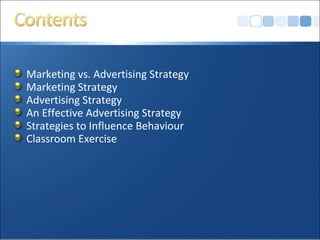
Marketing vs. Advertising Strategy
Marketing Strategy
Advertising Strategy
An Effective Advertising Strategy
Strategies to Influence Behaviour
Classroom Exercise
The terms marketing and advertising are often
used interchangeably. While these two concepts
are related, they are different.
Marketing is the process of taking goods or
services from the concept phase to the point
where customers will want to purchase those
goods or products from an individual business or
brand.
Marketing involves:
The Four Ps: product, price, place, and promotion
Strategy development and execution
Ongoing communications and sustained audience
engagement
Advertising is one component of the marketing
process. The primary goal is to influence buying
behaviours.
An advertising strategy can be defined as a
blueprint to help sell a given product/service to
consumers.
There are almost as many different advertising
strategies are there are products to advertise,
and each company follows its own unique
strategy plans
The ad strategy should support the overall
marketing strategy, which supports a brand’s
even broader business plan.
An effective advertising plan or strategy starts
with developing an understanding of five key
criteria:
The product itself and its advantages (Product
Assessment)
Purpose the product fulfils, what features it includes and
what advantages it offers over other products intended for
the same purpose. These qualities will form the core of the
advertising's branding, helping to define the message of
the strategy and the features the company wishes to
emphasize in its ads.
State of the Market (Competitors, Target Audience
etc)
Who are my competitors, who are my customers (primary,
secondary), why will they buy, how much will they buy etc
The Purpose of Advertising (Goals & Objectives)
A knowledge of the possible market -- including
competitors, customer preferences and conditions for
selling -- and an understanding of the product itself can
then lead to developing a specifics set of goals for the
advertising for instance increase sales by 15%. It can help
forms a road map by which the company can gauge the
advertising's success as the strategy continues.
What should be said/done to influence the
behaviour of the customers (Positioning &
Messaging)
Budgeting and Implementation (Media Planning &
Buying)
Essentially how much money we can spend, where do we
spend it
Review
Is it working? What do I need to change?
The more motivated and easier to perform the
behaviour, the higher the likelihood of that
behaviour. So in order to influence behaviour you
need to influence behavioural motivation and
behavioural ease.
Motivation Drivers: ‘Utility’, ‘Modelling’,
‘Reframing’, ‘Evocation’, ‘Ownership’,
‘Collectivism’
Ease Drivers: ‘Skill-up’, ‘Eliminate Complexity’
Motivation Drivers
Utility: Advertising as a service – advertising that
adds value by helping people achieve their goals
(value = ability to meet my goal/cost (money, time,
effort)
Example: https://www.youtube.com/watch?
v=MGJifBHm8_s&feature=youtu.be
Motivation Drivers
Modelling: Using aspirational high-profile
personalities – celebrities and experts – to inspire or
inform behaviour
Example: https://www.youtube.com/watch?
v=Tldlt2RhrDw
Motivation Drivers
Reframing: Ads that reframe a target behaviour in a
positive light, by tapping into pre-existing
assumptions and behaviour.
Example: https://www.youtube.com/watch?
v=sDewR2jM138&feature=youtu.be
Motivation Drivers
Evocation: Ads that stir powerful emotions to
motivate behaviour.
Example:
https://www.youtube.com/watch?v=zhPklt9nYas
Ownership: Inviting the audience to be part of the
campaign, so they own it as their own
Example:
https://vimeo.com/46072805
Ease Drivers
Skill-up: ads that show someone either how to do a
target behaviour, or how to do it more easily.
Example:
https://www.youtube.com/watch?v=vYBbXjFho90
Eliminate Complexity: ads that remove or reduce
barriers – real, imaginary or anticipated – to
undertaking a target behaviour, making it as
effortless as possible
Example:
https://www.youtube.com/watch?
v=M9v9HpR4qTU&feature=youtu.be
Classroom ExerciseClassroom Exercise
Use one of the techniques discussed to create
an ad to reduce plastic use
Advertising Strategy & Influencing Behaviour

Advertising Strategy & Influencing Behaviour

  • 1.
  • 2.
    Marketing vs. AdvertisingStrategy Marketing Strategy Advertising Strategy An Effective Advertising Strategy Strategies to Influence Behaviour Classroom Exercise
  • 3.
    The terms marketingand advertising are often used interchangeably. While these two concepts are related, they are different.
  • 4.
    Marketing is theprocess of taking goods or services from the concept phase to the point where customers will want to purchase those goods or products from an individual business or brand.
  • 5.
    Marketing involves: The FourPs: product, price, place, and promotion Strategy development and execution Ongoing communications and sustained audience engagement
  • 6.
    Advertising is onecomponent of the marketing process. The primary goal is to influence buying behaviours. An advertising strategy can be defined as a blueprint to help sell a given product/service to consumers.
  • 7.
    There are almostas many different advertising strategies are there are products to advertise, and each company follows its own unique strategy plans The ad strategy should support the overall marketing strategy, which supports a brand’s even broader business plan.
  • 8.
    An effective advertisingplan or strategy starts with developing an understanding of five key criteria: The product itself and its advantages (Product Assessment) Purpose the product fulfils, what features it includes and what advantages it offers over other products intended for the same purpose. These qualities will form the core of the advertising's branding, helping to define the message of the strategy and the features the company wishes to emphasize in its ads.
  • 9.
    State of theMarket (Competitors, Target Audience etc) Who are my competitors, who are my customers (primary, secondary), why will they buy, how much will they buy etc The Purpose of Advertising (Goals & Objectives) A knowledge of the possible market -- including competitors, customer preferences and conditions for selling -- and an understanding of the product itself can then lead to developing a specifics set of goals for the advertising for instance increase sales by 15%. It can help forms a road map by which the company can gauge the advertising's success as the strategy continues.
  • 10.
    What should besaid/done to influence the behaviour of the customers (Positioning & Messaging) Budgeting and Implementation (Media Planning & Buying) Essentially how much money we can spend, where do we spend it Review Is it working? What do I need to change?
  • 11.
    The more motivatedand easier to perform the behaviour, the higher the likelihood of that behaviour. So in order to influence behaviour you need to influence behavioural motivation and behavioural ease. Motivation Drivers: ‘Utility’, ‘Modelling’, ‘Reframing’, ‘Evocation’, ‘Ownership’, ‘Collectivism’ Ease Drivers: ‘Skill-up’, ‘Eliminate Complexity’
  • 12.
    Motivation Drivers Utility: Advertisingas a service – advertising that adds value by helping people achieve their goals (value = ability to meet my goal/cost (money, time, effort) Example: https://www.youtube.com/watch? v=MGJifBHm8_s&feature=youtu.be
  • 13.
    Motivation Drivers Modelling: Usingaspirational high-profile personalities – celebrities and experts – to inspire or inform behaviour Example: https://www.youtube.com/watch? v=Tldlt2RhrDw
  • 14.
    Motivation Drivers Reframing: Adsthat reframe a target behaviour in a positive light, by tapping into pre-existing assumptions and behaviour. Example: https://www.youtube.com/watch? v=sDewR2jM138&feature=youtu.be
  • 15.
    Motivation Drivers Evocation: Adsthat stir powerful emotions to motivate behaviour. Example: https://www.youtube.com/watch?v=zhPklt9nYas Ownership: Inviting the audience to be part of the campaign, so they own it as their own Example: https://vimeo.com/46072805
  • 16.
    Ease Drivers Skill-up: adsthat show someone either how to do a target behaviour, or how to do it more easily. Example: https://www.youtube.com/watch?v=vYBbXjFho90 Eliminate Complexity: ads that remove or reduce barriers – real, imaginary or anticipated – to undertaking a target behaviour, making it as effortless as possible Example: https://www.youtube.com/watch? v=M9v9HpR4qTU&feature=youtu.be
  • 17.
    Classroom ExerciseClassroom Exercise Useone of the techniques discussed to create an ad to reduce plastic use

Editor's Notes

  • #12 Influencing Perception vs Influencing Behavior Adam Ferrier is a fan of ‘Action Advertising’ – influencing people by influencing actions rather than perceptions. Drawing on the evidence that advertising is notoriously poor at direct persuasion, Ferrier outlines 10 ways to influence actions instead. For Ferrier, advertising is and must be about behaviour change; ultimately if no behaviour is changed as a result of advertising, advertising is valueless.