Marketing Communications
Plan
Chapter :01
Thivyaashani Sivasubramaniam
Assistant lecturer, Department of Economics and Business Studies,
Vavuniya Campus, University of Jaffna.
BBA(Hon),PGEDBM,DEF,CBF
Objectives
1. Understanding the fundamentals of Integrated Marketing
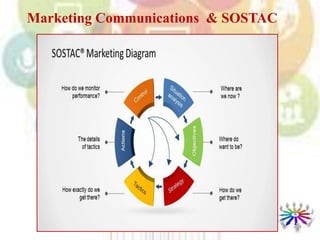
2. Understanding the SOSTAC model
3. Understanding the process of Communications Plan
4. Understanding the benefits of Communications plan
Marketing Communications
Marketing Mix from Marketers & Customers’ view
4Ps 4Cs
Product Customer Value
Price Cost
Place Convenience
Promotion Communication
From the marketing point of view, communication or the
promotion mix can achieve the following functions:
1. Informing
2. Persuading
3. Reminding
Functions of the Marketing Communications
Marketing Communications
Marketing communications is essentially a part of the marketing
mix. The marketing mix defines the 4Ps of marketing, price, place,
product and promotion, and Promotion is what marketing
communications is all about.
MARKETING COMMUNICATIONS has been defined as the
sharing of information, concepts, and meanings about products,
services and the organization that sell them, by the source and
receiver.
Marketing Communications
Market communication, that is, messages flow between the firm
which is its source and four main groups of receivers:
1. Consumers
2. Various sales supporting personnel such as wholesalers, retailers and
other middlemen in the marketing system
3. Material and resource suppliers such as financial and governmental
agencies
4. Other members of the distribution channels and the marketing system
not directly under the control of the selling firm, such as advertising
agencies, sales agents and others
Consumer Information Processing Model
A consumer processes message or stimuli received,
transforms them into information in the brain and
stores in memory.
1. EXPOSURE: Occurs when a stimulus or message comes within the
range of the individual’s sensory receptor nerves.
2. ATTENTION: Occurs when the stimulus or message activates one or
more sensory receptor nerves and the resulting sensations go to the
brain for processing.
3. INTERPRETATION: It is the assignment of meaning to sensations.
4. MEMORY: stimuli or messages are transformed into information and
transferred through a short-term active component into a long-term
storage component.
Consumer information processing model-
Process
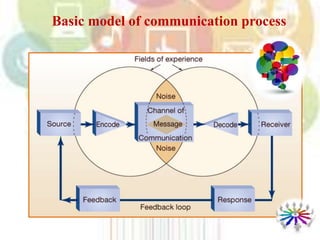
Basic model of communication process
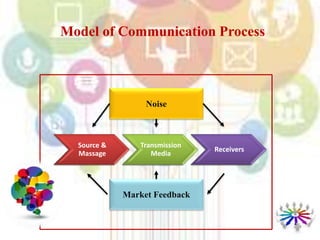
Model of Communication Process
Source &
Massage
Transmission
Media
Receivers
Noise
Market Feedback
The Evolution of Integrated Marketing
Communication
During the 1980s, many companies came to see the need for more of
a strategic integration of their promotional tools. The process
provides for synergy among the various promotional tools toward
achieving common objectives.
Researchers into this field found that integrated marketing
communication requires firms to develop a total marketing
communications strategy that recognizes how all firm’s marketing
activities, not just promotion communicate with its customers.
Integrated marketing communication seeks to have a company’s
entire marketing and promotional activities project a consistent
unified image to the market place.
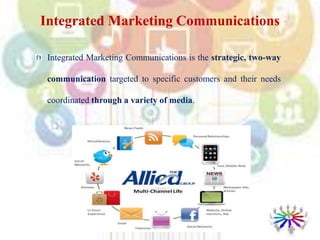
Integrated Marketing Communications
Integrated Marketing Communications is the strategic, two-way
communication targeted to specific customers and their needs
coordinated through a variety of media.
Integrated Marketing Communication
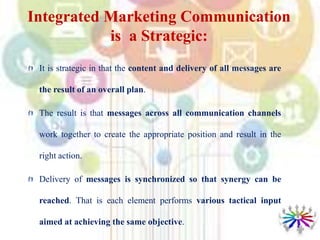
is a Strategic:
It is strategic in that the content and delivery of all messages are
the result of an overall plan.
The result is that messages across all communication channels
work together to create the appropriate position and result in the
right action.
Delivery of messages is synchronized so that synergy can be
reached. That is each element performs various tactical input
aimed at achieving the same objective.
Integrated Marketing Communication is a
Two-ways:
Integrated marketing communication is a two-way dialogue between the
marketer and the target audience. Without feedback, marketers may
never really know if anyone is listening. Feedback is shared within the
organization for learning purposes so that the strategy can be adapted to fit
customer’s needs and provide value.
While a single point of communication may be one-way, for example, an
advertisement in a magazine, the point being made for IMC is that, any
communication, such as an advertisement, should be part of, and reflect a
dialogue with customers.
Integrated Marketing Communication Is
Meets Customer’s Needs:
Integrated Marketing Communication (IMC) meets the information
needs of the buyer, results in the desired position, and secures the
appropriate action at the right time.
If IMC does not provide value to the buyer, then the buyer will not
participate in the dialogue. IMC seeks the answer to the question
concerning what the buyer wants or needs to know in order to make
the next decision. That decision may be to visit the trade show booth,
or to place an order, or to elevate the marketer to preferred account
status
The Integrated Marketing Communications
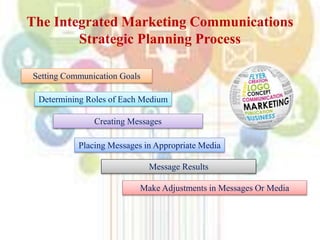
Strategic Planning Process
Setting Communication Goals
Determining Roles of Each Medium
Creating Messages
Placing Messages in Appropriate Media
Message Results
Make Adjustments in Messages Or Media
Marketing Communications & SOSTAC
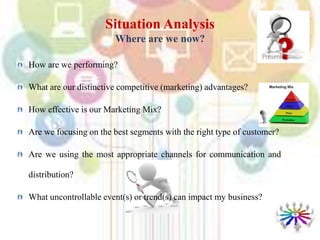
How are we performing?
What are our distinctive competitive (marketing) advantages?
How effective is our Marketing Mix?
Are we focusing on the best segments with the right type of customer?
Are we using the most appropriate channels for communication and
distribution?
What uncontrollable event(s) or trend(s) can impact my business?
Situation Analysis
Where are we now?
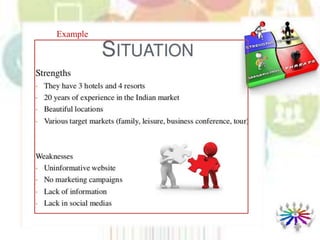
Example
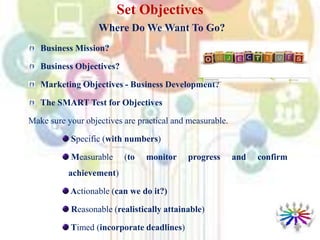
Set Objectives
Where Do We Want To Go?
Business Mission?
Business Objectives?
Marketing Objectives - Business Development?
The SMART Test for Objectives
Make sure your objectives are practical and measurable.
Specific (with numbers)
Measurable (to monitor progress and confirm
achievement)
Actionable (can we do it?)
Reasonable (realistically attainable)
Timed (incorporate deadlines)
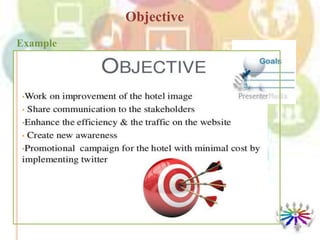
Objective
Example
Strategy
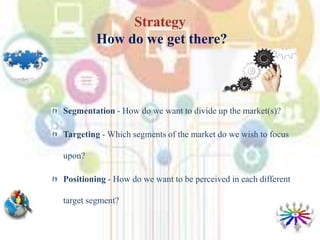
How do we get there?
Segmentation - How do we want to divide up the market(s)?
Targeting - Which segments of the market do we wish to focus
upon?
Positioning - How do we want to be perceived in each different
target segment?
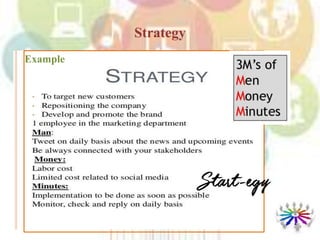
Strategy
Example
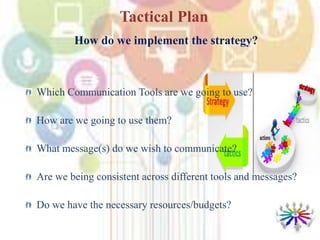
Tactical Plan
How do we implement the strategy?
Which Communication Tools are we going to use?
How are we going to use them?
What message(s) do we wish to communicate?
Are we being consistent across different tools and messages?
Do we have the necessary resources/budgets?
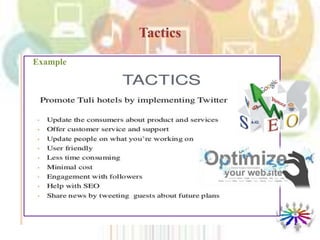
Tactics
Example
Action Plan
Who, What, When?
Who is going to do what?
When are they going to do it?
What is the resource allocation for the action?
What are the key performance measurements?
How is performance going to be recorded?
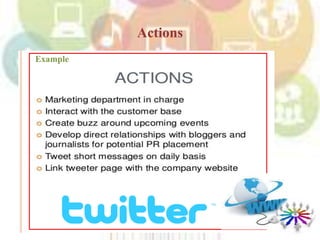
Actions
Example
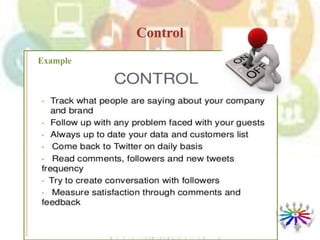
Control
Keeping track of progress
Do action performance measurements relate to
objectives?
Responsibility for measurement?
Frequency of measurement?
Resources for measurement?
Review of measurements?
Actions on variance?
Control
Example
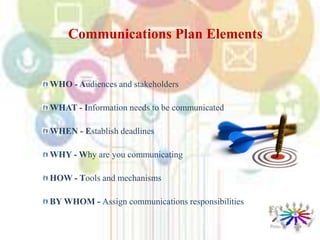
WHO - Audiences and stakeholders
WHAT - Information needs to be communicated
WHEN - Establish deadlines
WHY - Why are you communicating
HOW - Tools and mechanisms
BY WHOM - Assign communications responsibilities
Communications Plan Elements
Benefits of a Communications Plan
Proactive
Helps control the agenda
Creates positive image
Avoid embarrassment
Builds trust
Builds confidence with partners
Profiles community for potential investors
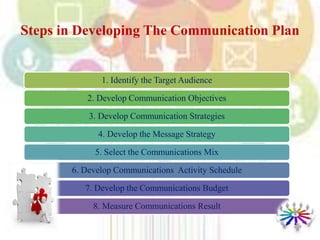
1. Identify the Target Audience
2. Develop Communication Objectives
3. Develop Communication Strategies
4. Develop the Message Strategy
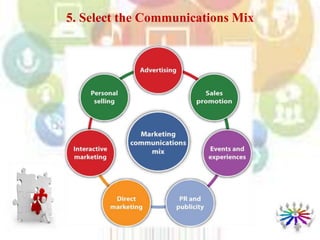
5. Select the Communications Mix
6. Develop Communications Activity Schedule
7. Develop the Communications Budget
8. Measure Communications Result
Steps in Developing The Communication Plan
Who are you trying to reach with your
communications?
1. Identify the Target Audience
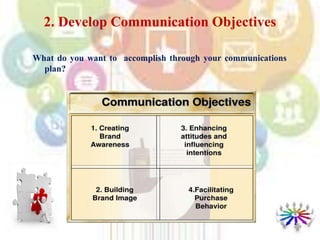
What do you want to accomplish through your communications
plan?
2. Develop Communication Objectives
What specific strategies will you use to achieve your goals?
What tasks do you need to complete as part of your strategies?
What tools are available to help you meet your goals?
3. Develop Communication Strategies
Examples of Communications Tools
 News releases
 News conferences
 Newspaper columns
 Mass E-mail updates
 Web sites
 Blogs
 Podcasts/webcasts
 Text message blasts
 Direct mail
 Flyers/posters
 Brochures
 Annual reports
 Speaking engagements
 Community meetings
 Focus groups
 Newsletters
Strategy is an idea, a conceptualization of how a goal can be achieved?
Examples of communication strategies
Develop key messages
Prioritize key audience
Identify ways to reach audience
Develop best practices for social media
Define & convey brand & brand value to target audience
Expand marketing reach to engage more people in each target audience
4. Develop the message strategy
5. Select the Communications Mix
How do you roll out the implementation?
Create and manage a steady stream of activities.
Ensure coordination in timing and impact.
Build in evaluations before the end of the year.
Be clear on who does what & by when
6. Develop Communications activity Schedule
Staff costs
Materials development
Website implementation and maintenance
Software & hardware
Consulting
Technology systems
7. Develop the Communications Budget
Measure Impact
Use anecdotal as well as quantifiable measurements
Benchmark prior to starting
Identify mix of outputs & outcomes. Outputs are a
measure of your efforts. Outcomes are the changes that
occur.
8. Measure Communications result
Thank you

Chapter 01

  • 1.
    Marketing Communications Plan Chapter :01 ThivyaashaniSivasubramaniam Assistant lecturer, Department of Economics and Business Studies, Vavuniya Campus, University of Jaffna. BBA(Hon),PGEDBM,DEF,CBF
  • 2.
    Objectives 1. Understanding thefundamentals of Integrated Marketing 2. Understanding the SOSTAC model 3. Understanding the process of Communications Plan 4. Understanding the benefits of Communications plan
  • 3.
    Marketing Communications Marketing Mixfrom Marketers & Customers’ view 4Ps 4Cs Product Customer Value Price Cost Place Convenience Promotion Communication
  • 4.
    From the marketingpoint of view, communication or the promotion mix can achieve the following functions: 1. Informing 2. Persuading 3. Reminding Functions of the Marketing Communications
  • 5.
    Marketing Communications Marketing communicationsis essentially a part of the marketing mix. The marketing mix defines the 4Ps of marketing, price, place, product and promotion, and Promotion is what marketing communications is all about. MARKETING COMMUNICATIONS has been defined as the sharing of information, concepts, and meanings about products, services and the organization that sell them, by the source and receiver.
  • 6.
    Marketing Communications Market communication,that is, messages flow between the firm which is its source and four main groups of receivers: 1. Consumers 2. Various sales supporting personnel such as wholesalers, retailers and other middlemen in the marketing system 3. Material and resource suppliers such as financial and governmental agencies 4. Other members of the distribution channels and the marketing system not directly under the control of the selling firm, such as advertising agencies, sales agents and others
  • 7.
    Consumer Information ProcessingModel A consumer processes message or stimuli received, transforms them into information in the brain and stores in memory.
  • 8.
    1. EXPOSURE: Occurswhen a stimulus or message comes within the range of the individual’s sensory receptor nerves. 2. ATTENTION: Occurs when the stimulus or message activates one or more sensory receptor nerves and the resulting sensations go to the brain for processing. 3. INTERPRETATION: It is the assignment of meaning to sensations. 4. MEMORY: stimuli or messages are transformed into information and transferred through a short-term active component into a long-term storage component. Consumer information processing model- Process
  • 9.
    Basic model ofcommunication process
  • 10.
    Model of CommunicationProcess Source & Massage Transmission Media Receivers Noise Market Feedback
  • 11.
    The Evolution ofIntegrated Marketing Communication During the 1980s, many companies came to see the need for more of a strategic integration of their promotional tools. The process provides for synergy among the various promotional tools toward achieving common objectives. Researchers into this field found that integrated marketing communication requires firms to develop a total marketing communications strategy that recognizes how all firm’s marketing activities, not just promotion communicate with its customers. Integrated marketing communication seeks to have a company’s entire marketing and promotional activities project a consistent unified image to the market place.
  • 12.
    Integrated Marketing Communications IntegratedMarketing Communications is the strategic, two-way communication targeted to specific customers and their needs coordinated through a variety of media.
  • 13.
    Integrated Marketing Communication isa Strategic: It is strategic in that the content and delivery of all messages are the result of an overall plan. The result is that messages across all communication channels work together to create the appropriate position and result in the right action. Delivery of messages is synchronized so that synergy can be reached. That is each element performs various tactical input aimed at achieving the same objective.
  • 14.
    Integrated Marketing Communicationis a Two-ways: Integrated marketing communication is a two-way dialogue between the marketer and the target audience. Without feedback, marketers may never really know if anyone is listening. Feedback is shared within the organization for learning purposes so that the strategy can be adapted to fit customer’s needs and provide value. While a single point of communication may be one-way, for example, an advertisement in a magazine, the point being made for IMC is that, any communication, such as an advertisement, should be part of, and reflect a dialogue with customers.
  • 15.
    Integrated Marketing CommunicationIs Meets Customer’s Needs: Integrated Marketing Communication (IMC) meets the information needs of the buyer, results in the desired position, and secures the appropriate action at the right time. If IMC does not provide value to the buyer, then the buyer will not participate in the dialogue. IMC seeks the answer to the question concerning what the buyer wants or needs to know in order to make the next decision. That decision may be to visit the trade show booth, or to place an order, or to elevate the marketer to preferred account status
  • 16.
    The Integrated MarketingCommunications Strategic Planning Process Setting Communication Goals Determining Roles of Each Medium Creating Messages Placing Messages in Appropriate Media Message Results Make Adjustments in Messages Or Media
  • 17.
  • 18.
    How are weperforming? What are our distinctive competitive (marketing) advantages? How effective is our Marketing Mix? Are we focusing on the best segments with the right type of customer? Are we using the most appropriate channels for communication and distribution? What uncontrollable event(s) or trend(s) can impact my business? Situation Analysis Where are we now?
  • 19.
  • 20.
    Set Objectives Where DoWe Want To Go? Business Mission? Business Objectives? Marketing Objectives - Business Development? The SMART Test for Objectives Make sure your objectives are practical and measurable. Specific (with numbers) Measurable (to monitor progress and confirm achievement) Actionable (can we do it?) Reasonable (realistically attainable) Timed (incorporate deadlines)
  • 21.
  • 22.
    Strategy How do weget there? Segmentation - How do we want to divide up the market(s)? Targeting - Which segments of the market do we wish to focus upon? Positioning - How do we want to be perceived in each different target segment?
  • 23.
  • 24.
    Tactical Plan How dowe implement the strategy? Which Communication Tools are we going to use? How are we going to use them? What message(s) do we wish to communicate? Are we being consistent across different tools and messages? Do we have the necessary resources/budgets?
  • 25.
  • 26.
    Action Plan Who, What,When? Who is going to do what? When are they going to do it? What is the resource allocation for the action? What are the key performance measurements? How is performance going to be recorded?
  • 27.
  • 28.
    Control Keeping track ofprogress Do action performance measurements relate to objectives? Responsibility for measurement? Frequency of measurement? Resources for measurement? Review of measurements? Actions on variance?
  • 29.
  • 30.
    WHO - Audiencesand stakeholders WHAT - Information needs to be communicated WHEN - Establish deadlines WHY - Why are you communicating HOW - Tools and mechanisms BY WHOM - Assign communications responsibilities Communications Plan Elements
  • 31.
    Benefits of aCommunications Plan Proactive Helps control the agenda Creates positive image Avoid embarrassment Builds trust Builds confidence with partners Profiles community for potential investors
  • 32.
    1. Identify theTarget Audience 2. Develop Communication Objectives 3. Develop Communication Strategies 4. Develop the Message Strategy 5. Select the Communications Mix 6. Develop Communications Activity Schedule 7. Develop the Communications Budget 8. Measure Communications Result Steps in Developing The Communication Plan
  • 33.
    Who are youtrying to reach with your communications? 1. Identify the Target Audience
  • 34.
    What do youwant to accomplish through your communications plan? 2. Develop Communication Objectives
  • 35.
    What specific strategieswill you use to achieve your goals? What tasks do you need to complete as part of your strategies? What tools are available to help you meet your goals? 3. Develop Communication Strategies
  • 36.
    Examples of CommunicationsTools  News releases  News conferences  Newspaper columns  Mass E-mail updates  Web sites  Blogs  Podcasts/webcasts  Text message blasts  Direct mail  Flyers/posters  Brochures  Annual reports  Speaking engagements  Community meetings  Focus groups  Newsletters
  • 37.
    Strategy is anidea, a conceptualization of how a goal can be achieved? Examples of communication strategies Develop key messages Prioritize key audience Identify ways to reach audience Develop best practices for social media Define & convey brand & brand value to target audience Expand marketing reach to engage more people in each target audience 4. Develop the message strategy
  • 38.
    5. Select theCommunications Mix
  • 39.
    How do youroll out the implementation? Create and manage a steady stream of activities. Ensure coordination in timing and impact. Build in evaluations before the end of the year. Be clear on who does what & by when 6. Develop Communications activity Schedule
  • 40.
    Staff costs Materials development Websiteimplementation and maintenance Software & hardware Consulting Technology systems 7. Develop the Communications Budget
  • 41.
    Measure Impact Use anecdotalas well as quantifiable measurements Benchmark prior to starting Identify mix of outputs & outcomes. Outputs are a measure of your efforts. Outcomes are the changes that occur. 8. Measure Communications result
  • 42.