Advertising Campaign Planning
What exactly people do?
From-
BADM Dept.
WHAT IS AN AD CAMPAIGN
• An ad campaign includes series of ads,
• placed in various media,
• that are designed to meet objectives, and
• are based on analysis of marketing &
communication situations
ADVERTISING CAMPAIGN
• An advertising campaign is a series of
advertisement messages that share a single idea
and theme which make up an integrated marketing
communication (IMC). Advertising campaigns
appear in different media across a specific time
frame.
• Advertising campaigns are the groups of
advertising messages which are similar in nature.
• An advertising campaign is an organized series of
advertising messages with identical or similar messages
over a particular period of time.
• It is an orderly planned effort consisting of related but self
contained & independent advertisements.
• Though the campaign is conveyed through different media,
it has a single theme & unified approach.
CAMPAIGN PLANNING
• PARAMETERS OF CAMPAIGN PLANNING:
 Total advertising budget
 Media availability
 Consumer profile
 Product profile
 Campaign’s duration & its timing
 Advertising & marketing objectives
 Distribution channels
• Review of previous advertising effort
• Creative considerations
• New plans
POINTS TO BE CONSIDERED WHILE
PLANNING AD CAMPAIGN
Identify the problem
Budget
Pre testing
Target audience
Media selection
The language
Visual & the copy
Timing & duration
Post testing
Effect on sales
Planning An Ad Campaign
Steps Involved
ESSENTIAL STEPS
1. Appraisal of advertising
opportunity
2. Analyze & define
the target market
3. Set advertising
objectives
6. Create ads, pre-
test and release ads
7. Evaluate final results
(Post-testing)
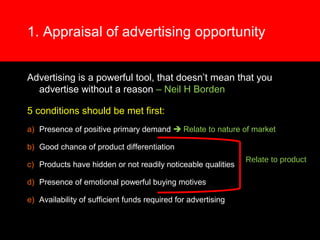
1. Appraisal of advertising opportunity
Advertising is a powerful tool, that doesn’t mean that you
advertise without a reason – Neil H Borden
5 conditions should be met first:
a) Presence of positive primary demand  Relate to nature of market
b) Good chance of product differentiation
c) Products have hidden or not readily noticeable qualities
d) Presence of emotional powerful buying motives
e) Availability of sufficient funds required for advertising
Relate to product
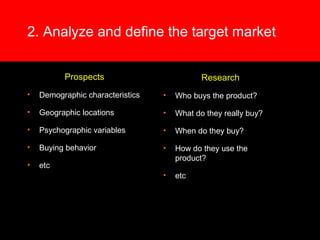
2. Analyze and define the target market
Prospects
• Demographic characteristics
• Geographic locations
• Psychographic variables
• Buying behavior
• etc
Research
• Who buys the product?
• What do they really buy?
• When do they buy?
• How do they use the
product?
• etc
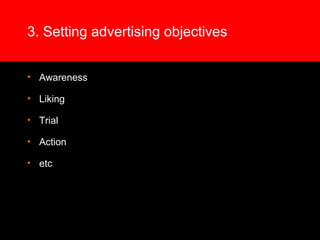
3. Setting advertising objectives
• Awareness
• Liking
• Trial
• Action
• etc
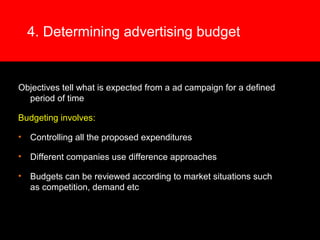
4. Determining advertising budget
Objectives tell what is expected from a ad campaign for a defined
period of time
Budgeting involves:
• Controlling all the proposed expenditures
• Different companies use difference approaches
• Budgets can be reviewed according to market situations such
as competition, demand etc
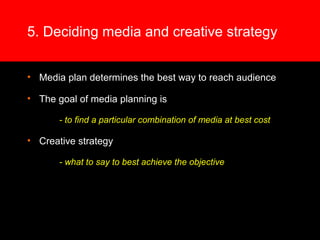
5. Deciding media and creative strategy
• Media plan determines the best way to reach audience
• The goal of media planning is
- to find a particular combination of media at best cost
• Creative strategy
- what to say to best achieve the objective
6. Creating ads and pre-test
• Ad should be pre-tested before actual execution
- to avoid costly mistakes
- increase its efficiency
Some techniques used for ad pre-test:
• Market tests
• Focus groups
• Surveys
• etc
7. Evaluating the final results (post-
testing)
Few techniques are:
• Recall (what portion of ad)
• Recognition (logo, headline, punchline etc)
• Inquiry
• Trial

Advertising campaign planning

  • 1.
    Advertising Campaign Planning Whatexactly people do? From- BADM Dept.
  • 2.
    WHAT IS ANAD CAMPAIGN • An ad campaign includes series of ads, • placed in various media, • that are designed to meet objectives, and • are based on analysis of marketing & communication situations
  • 3.
    ADVERTISING CAMPAIGN • Anadvertising campaign is a series of advertisement messages that share a single idea and theme which make up an integrated marketing communication (IMC). Advertising campaigns appear in different media across a specific time frame. • Advertising campaigns are the groups of advertising messages which are similar in nature.
  • 4.
    • An advertisingcampaign is an organized series of advertising messages with identical or similar messages over a particular period of time. • It is an orderly planned effort consisting of related but self contained & independent advertisements. • Though the campaign is conveyed through different media, it has a single theme & unified approach.
  • 5.
    CAMPAIGN PLANNING • PARAMETERSOF CAMPAIGN PLANNING:  Total advertising budget  Media availability  Consumer profile  Product profile  Campaign’s duration & its timing  Advertising & marketing objectives  Distribution channels
  • 6.
    • Review ofprevious advertising effort • Creative considerations • New plans
  • 7.
    POINTS TO BECONSIDERED WHILE PLANNING AD CAMPAIGN Identify the problem Budget Pre testing Target audience Media selection The language Visual & the copy Timing & duration Post testing Effect on sales
  • 8.
    Planning An AdCampaign Steps Involved
  • 9.
    ESSENTIAL STEPS 1. Appraisalof advertising opportunity 2. Analyze & define the target market 3. Set advertising objectives 6. Create ads, pre- test and release ads 7. Evaluate final results (Post-testing)
  • 10.
    1. Appraisal ofadvertising opportunity Advertising is a powerful tool, that doesn’t mean that you advertise without a reason – Neil H Borden 5 conditions should be met first: a) Presence of positive primary demand  Relate to nature of market b) Good chance of product differentiation c) Products have hidden or not readily noticeable qualities d) Presence of emotional powerful buying motives e) Availability of sufficient funds required for advertising Relate to product
  • 11.
    2. Analyze anddefine the target market Prospects • Demographic characteristics • Geographic locations • Psychographic variables • Buying behavior • etc Research • Who buys the product? • What do they really buy? • When do they buy? • How do they use the product? • etc
  • 12.
    3. Setting advertisingobjectives • Awareness • Liking • Trial • Action • etc
  • 13.
    4. Determining advertisingbudget Objectives tell what is expected from a ad campaign for a defined period of time Budgeting involves: • Controlling all the proposed expenditures • Different companies use difference approaches • Budgets can be reviewed according to market situations such as competition, demand etc
  • 14.
    5. Deciding mediaand creative strategy • Media plan determines the best way to reach audience • The goal of media planning is - to find a particular combination of media at best cost • Creative strategy - what to say to best achieve the objective
  • 15.
    6. Creating adsand pre-test • Ad should be pre-tested before actual execution - to avoid costly mistakes - increase its efficiency Some techniques used for ad pre-test: • Market tests • Focus groups • Surveys • etc
  • 16.
    7. Evaluating thefinal results (post- testing) Few techniques are: • Recall (what portion of ad) • Recognition (logo, headline, punchline etc) • Inquiry • Trial