







Promotion
Application
through
IMC
Purpose of Communication
 Develop brand awareness
 Increase category demand
 Change customer belief or attitude
 Enhance purchase actions
 Encourage repeat purchases
 Build customer traffic
 Enhance firm image
 Increase market share
 Increase sales
 Reinforce purchase decisions
 Show Mac Vs PC
Marketing and IMC
Marketing, as we all know is creating and retaining
consumers/customers.
But marketing actions must take into consideration not only
customers and potential customers but also other stakeholders
(Stakeholders are individuals or groups who can affect or be
affected by, an organization) : employees, customers, investors,
suppliers, distribution channel members, the community, the
media, special interest and activist groups and government
regulatory agencies.
In other words, a stake holder is anyone who has a stake in the
success or failure of an organization.
WHAT IMC MEANS
We all know that equity of a brand or a company is the
relationship between the customer and the brand or organization.
IMC is an process for managing the customer relationship that
drive brand value.
More specifically, it is a cross-functional process for creating and
nourish­ing profitable relationships with customers and other
stakeholders by strategically controlling or influencing all
messages sent to these groups and encouraging data-driven,
purposeful dialogue with them. To make sure the definition is
clear, let's look at of its major elements:
1. Cross functional process means that all of the company's
major departments (and outside communication agencies) that
touch the customer must way of working together in the
planning and monitoring of brand relationships.
2. Creating and nourishing stakeholder relationships
means attracting new and then interacting with them to find
ways the company can further satisfy their wants and needs.
The more satisfied customers or other stakeholders are, the
more business or support they will generally give to a company.
Nourishing means not only retaining customers and stakeholders
but also increasing the company's percentage of their category
purchases and support.
3. Profitable customer relationships are specified because
not all relationships are of equal value to a company. Some
customers are more profitable to a company than others
because of the quantity they buy, the types of products they
buy, or the amount of servicing they require.
4. Strategically controlling or influencing all messages means
recognizing that everything a company does sends a message
­how it makes its products, how products perform, how it sets
prices, through what kinds of stores it provides its services or
sells its products, and how its employees act. In other words, all
aspects of the marketing mix deliver messages and all of these
messages need to be either strategically controlled or influenced.
To strategically control or influence brand messages means to
plan and monitor them to ensure they have consistent meaning.
5. Encouraging purposeful dialogue recognizes that
customers are tired of intrusive telemarketing calls, junk mail,
interruptive commercials, and overcommercialization of events.
Customers want the ability to interact with companies and
initiate a discussion when they have a need to do so, and to
have this dialogue in a way and at a time convenient to them.
The interactivity discussion explains how companies can make
it easier for their customers and prospects to make purchases,
ask questions, complain when something goes wrong, or give
compliments when they are especially pleased. Communication,
in other words, is at the heart of every relationship.
IMC objectives
 To support sales increases
 To encourage trial
 To create awareness
 To inform about a feature or benefit
 To remind
 To reassure
 To create an image
 To modify attitudes
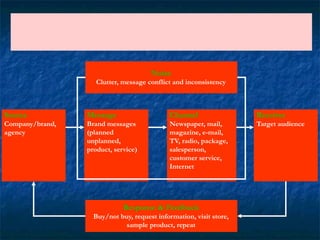
An Interactive Marketing Communication Model
(1 of 3)
Source
Company/brand,
agency
Message
Brand messages
(planned
unplanned,
product, service)
Channel
Newspaper, mail,
magazine, e-mail,
TV, radio, package,
salesperson,
customer service,
Internet
Receiver
Target audience
Response & Feedback
Buy/not buy, request information, visit store,
sample product, repeat
Noise
Clutter, message conflict and inconsistency
IMC Model (2 of 3)
 Sender - party sending the message
 Encoding - message in symbolic form
 Message - word, pictures and symbols that
the sender transmits
 Media - the communication channel e.g radio
 Decoding - receiver assigns meaning to
symbols encoded by the sender
IMC Model (3 of 3)
 Response - reaction of the receiver after
being exposed to the to the message
 Feedback - the part of the receiver’s
response after being communicated to the
sender
 Noise - unplanned static or distortion
during the communication process e.g.
competitor action (Creature Comforts?)
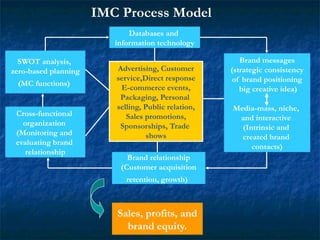
Databases and
information technology
SWOT analysis,
zero-based planning
(MC functions)
Cross-functional
organization
(Monitoring and
evaluating brand
relationship
Brand messages
(strategic consistency
of brand positioning
big creative idea)
Media-mass, niche,
and interactive
(Intrinsic and
created brand
contacts)
Advertising, Customer
service,Direct response
E-commerce events,
Packaging, Personal
selling, Public relation,
Sales promotions,
Sponsorships, Trade
shows
Brand relationship
(Customer acquisition
retention, growth)
Sales, profits, and
brand equity.
IMC Process Model
Importance of IMC
 From media advertising to multiple forms of communication.
 From mass media to more specialized (niche) media, which are cantered
on specific target audiences.
 From a manufacturer-dominated market to a retailer-dominated,
consumer-controlled market.
 From general-focus advertising and marketing to data-based marketing.
 From low agency accountability to greater agency accountability,
particularly in advertising.
 From traditional compensation to performance-based compensation
(increased sales or benefits to the company).
 From limited Internet access to 24/7 Internet availability and access to
goods and services.
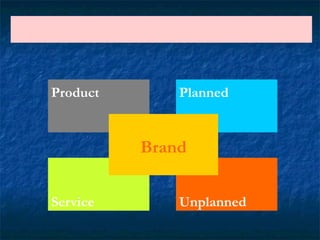
The IMC Message Typology
Product Planned
Service Unplanned
Brand
• The Four Sources of Brand Messages
Planned Messages
Planned messages are the marketing
communication messages delivered by
advertising, sales promotion, personal
sales, merchandising materials, press
releases, events, sponsorships, packaging,
and annual reports, to name a few.
Show winner IMC
Product Messages
The second type of message is the product message;
these include all messages sent by a product’s design,
performance, pricing, and distribution.
Product Design
The design of a product can send powerful messages.
Operating on the principle that if it looks good, it must
be good, companies in the auto industry have always
maintained a staff of industrial designers to style cars.
Show Honda
Product Performance
Although product design is important, product
performance is even more important when it comes to
sending brand messages. As most marketers know, how
well a product performs or how well a service is
delivered, relative to expectations, is a major
determinant of whether or not customers become
repeat buyers.
Show Madonna
Pricing and Distribution
The brand messages sent by price and distribution are
often not recognized for their importance in a brand’s
overall communication. There’s a big perceived
difference, for example, between cosmetics sold at New
Market and those sold at One Stop Mall.
Service Messages
Service messages come from contact with service
representatives, receptionists, secretaries, delivery
people, and all other representatives of a company.
Service messages are usually personal, real-time
interfaces between a company and a customer- and this
is what makes them especially strong.
Unplanned Messages
Unplanned messages include brand- or company-
related news stories, gossip, rumors, actions of special
interest groups, comments by the trade and by
competitors, findings by government agencies or
research institutions, and word of mouth.
Employee Messages
Employees are an important communication source,
and their views are highly credible to people they know,
as well as to reporters who interview them, particularly
in a crisis situation.
News Media
For most companies, the most critical unplanned
messages come from the news media. Such messages
often reach a relatively large audience and are seen as
having especially high credibility.
Disasters and Crises
Another type of unplanned message handled by public
relations is generated by company-related disasters. The
crisis, disaster, or emergency is the most unwanted of
unplanned messages, but crises are also a fact of life.
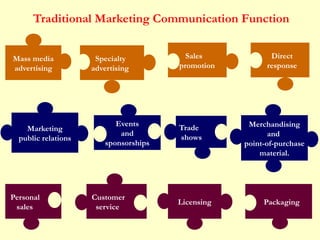
THE MARKETING COMMUNICATION FUNCTION
Mass media
advertising
Specialty
advertising
Sales
promotion
Marketing
public relations
Personal
sales
Events
and
sponsorships
Customer
service
Trade
shows
Licensing
Direct
response
Merchandising
and
point-of-purchase
material.
Packaging
Traditional Marketing Communication Function
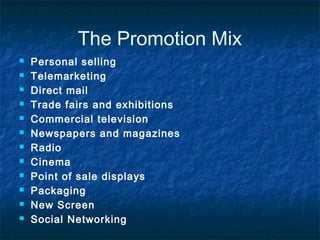
The Promotion Mix
 Personal selling
 Telemarketing
 Direct mail
 Trade fairs and exhibitions
 Commercial television
 Newspapers and magazines
 Radio
 Cinema
 Point of sale displays
 Packaging
 New Screen
 Social Networking
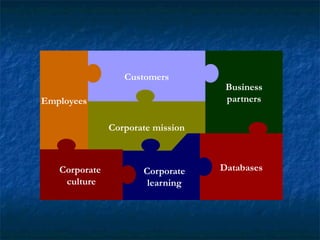
WHAT NEEDS TO BE INTEGRATED ?
Employees
Customers
Corporate mission
Business
partners
DatabasesCorporate
culture
Corporate
learning
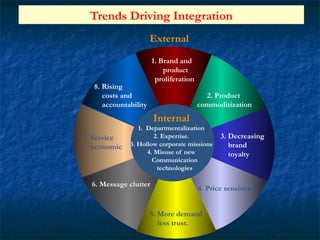
TRENDS DRIVING INTEGRATION ?
1. Brand and
product
proliferation
2. Product
commoditization
3. Decreasing
brand
toyalty
4. Price sensitive
5. More demand
less trust.
6. Message clutter
7. Service
economic
8. Rising
costs and
accountability
Internal
1. Departmentalization
2. Expertise.
3. Hollow corporate missions
4. Misuse of new
Communication
technologies
Trends Driving Integration
External
Direct
respon
se
Marketing
services
Event
sponsorsh
ip
Marketing
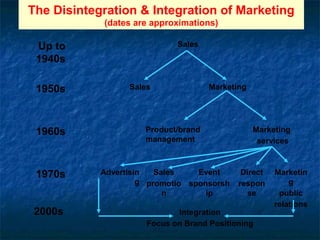
1970s
1960s
1950s
Up to
1940s
Advertisin
g
Sales
Sales
promotio
n
Product/brand
management
Sales
Marketin
g
public
relations
The Disintegration & Integration of Marketing
(dates are approximations)
2000s Integration
Focus on Brand Positioning
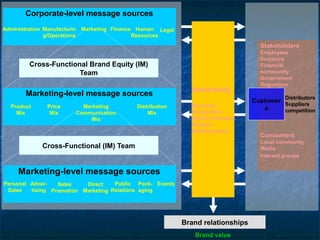
A Communication-Based
Marketing Model for Managing
Relationships
Corporate-level message sources
Administration Manufacturin
g/Operations
Marketing Finance Human
Resources
Legal
Marketing-level message sources
Product
Mix
Price
Mix
Marketing
Communication
Mix
Distribution
Mix
Marketing-level message sources
Personal
Sales
Adver-
tising
Sales
Promotion
Public
Relations
Direct
Marketing
Pack-
aging
Events
Stakeholders
Employees
Investors
Financial
community
Government
Regulators
Consumers
Local community
Media
Interest groups
Customer
s
Distributors
Suppliers
competition
Brand relationships
Brand value
Interactivity
Recourse
Recognition
Responsiveness
Respect
Reinforcement
Cross-Functional Brand Equity (IM)
Team
Cross-Functional (IM) Team
The Promotion Elements
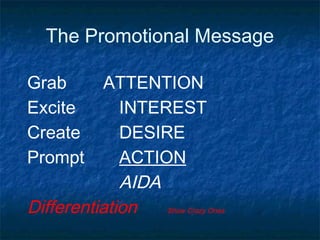
The Promotional Message
Grab ATTENTION
Excite INTEREST
Create DESIRE
Prompt ACTION
AIDA
Differentiation Show Crazy Ones
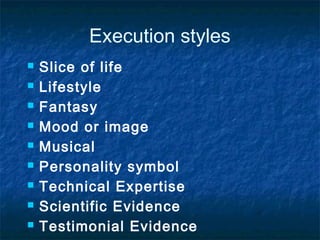
Execution styles
 Slice of life
 Lifestyle
 Fantasy
 Mood or image
 Musical
 Personality symbol
 Technical Expertise
 Scientific Evidence
 Testimonial Evidence
Media choice?
 Marketing objectives
 Definition of problem e.g falling
awareness
 Evaluation of different tools
 choice of optimum mix of promotional
methods
 Integration into overall marketing
communication programme
Questions

Imc

  • 1.
  • 2.
    Purpose of Communication Develop brand awareness  Increase category demand  Change customer belief or attitude  Enhance purchase actions  Encourage repeat purchases  Build customer traffic  Enhance firm image  Increase market share  Increase sales  Reinforce purchase decisions  Show Mac Vs PC
  • 3.
    Marketing and IMC Marketing,as we all know is creating and retaining consumers/customers. But marketing actions must take into consideration not only customers and potential customers but also other stakeholders (Stakeholders are individuals or groups who can affect or be affected by, an organization) : employees, customers, investors, suppliers, distribution channel members, the community, the media, special interest and activist groups and government regulatory agencies. In other words, a stake holder is anyone who has a stake in the success or failure of an organization.
  • 4.
    WHAT IMC MEANS Weall know that equity of a brand or a company is the relationship between the customer and the brand or organization. IMC is an process for managing the customer relationship that drive brand value. More specifically, it is a cross-functional process for creating and nourish­ing profitable relationships with customers and other stakeholders by strategically controlling or influencing all messages sent to these groups and encouraging data-driven, purposeful dialogue with them. To make sure the definition is clear, let's look at of its major elements:
  • 5.
    1. Cross functionalprocess means that all of the company's major departments (and outside communication agencies) that touch the customer must way of working together in the planning and monitoring of brand relationships. 2. Creating and nourishing stakeholder relationships means attracting new and then interacting with them to find ways the company can further satisfy their wants and needs. The more satisfied customers or other stakeholders are, the more business or support they will generally give to a company. Nourishing means not only retaining customers and stakeholders but also increasing the company's percentage of their category purchases and support.
  • 6.
    3. Profitable customerrelationships are specified because not all relationships are of equal value to a company. Some customers are more profitable to a company than others because of the quantity they buy, the types of products they buy, or the amount of servicing they require. 4. Strategically controlling or influencing all messages means recognizing that everything a company does sends a message ­how it makes its products, how products perform, how it sets prices, through what kinds of stores it provides its services or sells its products, and how its employees act. In other words, all aspects of the marketing mix deliver messages and all of these messages need to be either strategically controlled or influenced. To strategically control or influence brand messages means to plan and monitor them to ensure they have consistent meaning.
  • 7.
    5. Encouraging purposefuldialogue recognizes that customers are tired of intrusive telemarketing calls, junk mail, interruptive commercials, and overcommercialization of events. Customers want the ability to interact with companies and initiate a discussion when they have a need to do so, and to have this dialogue in a way and at a time convenient to them. The interactivity discussion explains how companies can make it easier for their customers and prospects to make purchases, ask questions, complain when something goes wrong, or give compliments when they are especially pleased. Communication, in other words, is at the heart of every relationship.
  • 8.
    IMC objectives  Tosupport sales increases  To encourage trial  To create awareness  To inform about a feature or benefit  To remind  To reassure  To create an image  To modify attitudes
  • 9.
    An Interactive MarketingCommunication Model (1 of 3) Source Company/brand, agency Message Brand messages (planned unplanned, product, service) Channel Newspaper, mail, magazine, e-mail, TV, radio, package, salesperson, customer service, Internet Receiver Target audience Response & Feedback Buy/not buy, request information, visit store, sample product, repeat Noise Clutter, message conflict and inconsistency
  • 10.
    IMC Model (2of 3)  Sender - party sending the message  Encoding - message in symbolic form  Message - word, pictures and symbols that the sender transmits  Media - the communication channel e.g radio  Decoding - receiver assigns meaning to symbols encoded by the sender
  • 11.
    IMC Model (3of 3)  Response - reaction of the receiver after being exposed to the to the message  Feedback - the part of the receiver’s response after being communicated to the sender  Noise - unplanned static or distortion during the communication process e.g. competitor action (Creature Comforts?)
  • 12.
    Databases and information technology SWOTanalysis, zero-based planning (MC functions) Cross-functional organization (Monitoring and evaluating brand relationship Brand messages (strategic consistency of brand positioning big creative idea) Media-mass, niche, and interactive (Intrinsic and created brand contacts) Advertising, Customer service,Direct response E-commerce events, Packaging, Personal selling, Public relation, Sales promotions, Sponsorships, Trade shows Brand relationship (Customer acquisition retention, growth) Sales, profits, and brand equity. IMC Process Model
  • 13.
    Importance of IMC From media advertising to multiple forms of communication.  From mass media to more specialized (niche) media, which are cantered on specific target audiences.  From a manufacturer-dominated market to a retailer-dominated, consumer-controlled market.  From general-focus advertising and marketing to data-based marketing.  From low agency accountability to greater agency accountability, particularly in advertising.  From traditional compensation to performance-based compensation (increased sales or benefits to the company).  From limited Internet access to 24/7 Internet availability and access to goods and services.
  • 14.
    The IMC MessageTypology Product Planned Service Unplanned Brand
  • 15.
    • The FourSources of Brand Messages Planned Messages Planned messages are the marketing communication messages delivered by advertising, sales promotion, personal sales, merchandising materials, press releases, events, sponsorships, packaging, and annual reports, to name a few. Show winner IMC
  • 16.
    Product Messages The secondtype of message is the product message; these include all messages sent by a product’s design, performance, pricing, and distribution. Product Design The design of a product can send powerful messages. Operating on the principle that if it looks good, it must be good, companies in the auto industry have always maintained a staff of industrial designers to style cars. Show Honda
  • 17.
    Product Performance Although productdesign is important, product performance is even more important when it comes to sending brand messages. As most marketers know, how well a product performs or how well a service is delivered, relative to expectations, is a major determinant of whether or not customers become repeat buyers. Show Madonna
  • 18.
    Pricing and Distribution Thebrand messages sent by price and distribution are often not recognized for their importance in a brand’s overall communication. There’s a big perceived difference, for example, between cosmetics sold at New Market and those sold at One Stop Mall.
  • 19.
    Service Messages Service messagescome from contact with service representatives, receptionists, secretaries, delivery people, and all other representatives of a company. Service messages are usually personal, real-time interfaces between a company and a customer- and this is what makes them especially strong.
  • 20.
    Unplanned Messages Unplanned messagesinclude brand- or company- related news stories, gossip, rumors, actions of special interest groups, comments by the trade and by competitors, findings by government agencies or research institutions, and word of mouth. Employee Messages Employees are an important communication source, and their views are highly credible to people they know, as well as to reporters who interview them, particularly in a crisis situation.
  • 21.
    News Media For mostcompanies, the most critical unplanned messages come from the news media. Such messages often reach a relatively large audience and are seen as having especially high credibility. Disasters and Crises Another type of unplanned message handled by public relations is generated by company-related disasters. The crisis, disaster, or emergency is the most unwanted of unplanned messages, but crises are also a fact of life.
  • 22.
  • 23.
  • 24.
    The Promotion Mix Personal selling  Telemarketing  Direct mail  Trade fairs and exhibitions  Commercial television  Newspapers and magazines  Radio  Cinema  Point of sale displays  Packaging  New Screen  Social Networking
  • 25.
    WHAT NEEDS TOBE INTEGRATED ?
  • 26.
  • 27.
  • 28.
    1. Brand and product proliferation 2.Product commoditization 3. Decreasing brand toyalty 4. Price sensitive 5. More demand less trust. 6. Message clutter 7. Service economic 8. Rising costs and accountability Internal 1. Departmentalization 2. Expertise. 3. Hollow corporate missions 4. Misuse of new Communication technologies Trends Driving Integration External
  • 29.
  • 30.
    A Communication-Based Marketing Modelfor Managing Relationships
  • 31.
    Corporate-level message sources AdministrationManufacturin g/Operations Marketing Finance Human Resources Legal Marketing-level message sources Product Mix Price Mix Marketing Communication Mix Distribution Mix Marketing-level message sources Personal Sales Adver- tising Sales Promotion Public Relations Direct Marketing Pack- aging Events Stakeholders Employees Investors Financial community Government Regulators Consumers Local community Media Interest groups Customer s Distributors Suppliers competition Brand relationships Brand value Interactivity Recourse Recognition Responsiveness Respect Reinforcement Cross-Functional Brand Equity (IM) Team Cross-Functional (IM) Team
  • 32.
  • 33.
    The Promotional Message GrabATTENTION Excite INTEREST Create DESIRE Prompt ACTION AIDA Differentiation Show Crazy Ones
  • 34.
    Execution styles  Sliceof life  Lifestyle  Fantasy  Mood or image  Musical  Personality symbol  Technical Expertise  Scientific Evidence  Testimonial Evidence
  • 35.
    Media choice?  Marketingobjectives  Definition of problem e.g falling awareness  Evaluation of different tools  choice of optimum mix of promotional methods  Integration into overall marketing communication programme
  • 36.