Adversarial Attacks on A.I.
Systems
1
Anant Jain
Co-founder, commonlounge.com (Compose Labs)
https://commonlounge.com

https://index.anantja.in
NEXTCon
Online AI Tech Talk Series
Friday, Jan 18
2
Are adversarial examples simply a fun toy
problem for researchers?
Or an example of a deeper and more chronic
frailty in our models?
Motivation
What are Adversarial attacks?
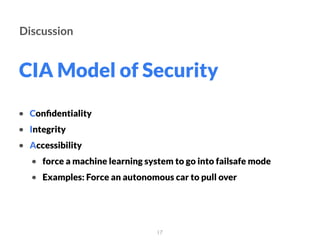
CIA Model of Security
Threat models
Examples and demos of Adversarial attacks
Proposed Defenses against adversarial attacks
Intuition behind Adversarial attacks
What’s next?
3
Outline
What are Adversarial attacks?
CIA Model of Security
Threat models
Examples and demos of Adversarial attacks
Proposed Defenses against adversarial attacks
Intuition behind Adversarial attacks
What’s next?
4
Outline
What exactly is “learnt” in
Machine Learning?
5
Introduction
6
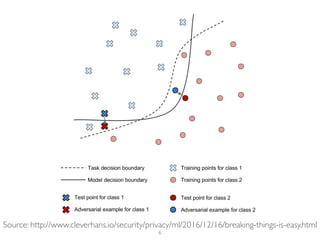
Source: http://www.cleverhans.io/security/privacy/ml/2016/12/16/breaking-things-is-easy.html
What exactly is “learnt” in
Machine Learning?
Discussion
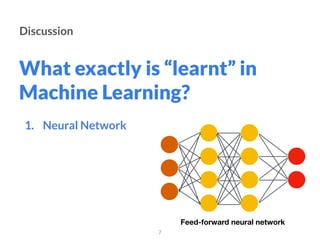
1. Neural Network
7
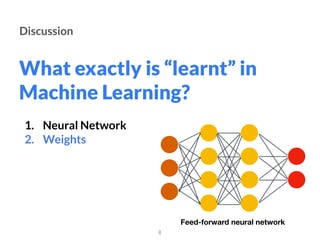
Feed-forward neural network
What exactly is “learnt” in
Machine Learning?
Discussion
Feed-forward neural network
1. Neural Network
2. Weights
3. Back-propagation
8
What exactly is “learnt” in
Machine Learning?
Discussion
1. Neural Network
2. Weights
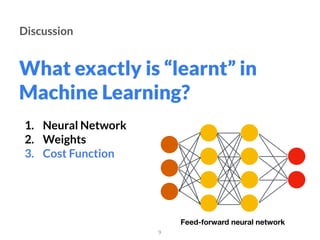
3. Cost Function
9
Feed-forward neural network
What exactly is “learnt” in
Machine Learning?
Discussion
1. Neural Network
2. Weights
3. Cost Function
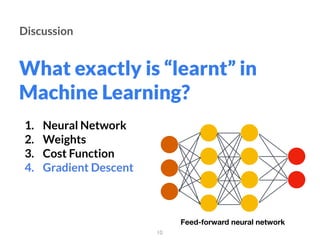
4. Gradient Descent
10
Feed-forward neural network
What exactly is “learnt” in
Machine Learning?
Discussion
1. Neural Network
2. Weights
3. Cost Function
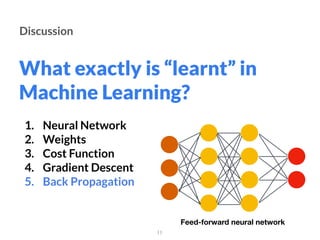
4. Gradient Descent
5. Back Propagation
11
Feed-forward neural network
12
Source: http://www.cleverhans.io/security/privacy/ml/2016/12/16/breaking-things-is-easy.html
What are Adversarial attacks?
CIA Model of Security
Threat models
Examples and demos of Adversarial attacks
Proposed Defenses against adversarial attacks
Intuition behind Adversarial attacks
What’s next?
13
Outline
CIA Model of Security
14
Discussion
CIA Model of Security
15
Discussion
• Confidentiality
• Must not leak the training data used to train it
• Eg: sensitive medical data
CIA Model of Security
16
Discussion
• Confidentiality
• Integrity:
• should not be possible to alter predictions
• during training by poisoning training data sets
• during inference by showing the system adversarial examples
CIA Model of Security
17
Discussion
• Confidentiality
• Integrity
• Accessibility
• force a machine learning system to go into failsafe mode
• Examples: Force an autonomous car to pull over
What are Adversarial attacks?
CIA Model of Security
Threat models
Examples and demos of Adversarial attacks
Proposed Defenses against adversarial attacks
Intuition behind Adversarial attacks
What’s next?
18
Outline
Threat Models
19
Discussion
Threat Models
20
Discussion
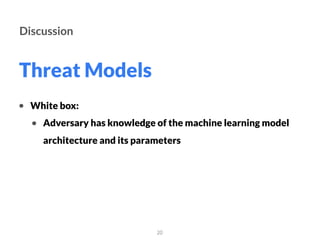
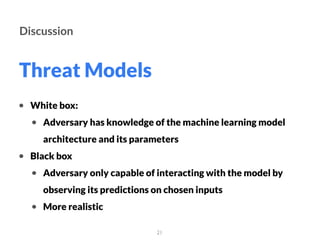
• White box:
• Adversary has knowledge of the machine learning model
architecture and its parameters
Threat Models
21
Discussion
• White box:
• Adversary has knowledge of the machine learning model
architecture and its parameters
• Black box
• Adversary only capable of interacting with the model by
observing its predictions on chosen inputs
• More realistic
Threat Models
22
Discussion
Threat Models
23
Discussion
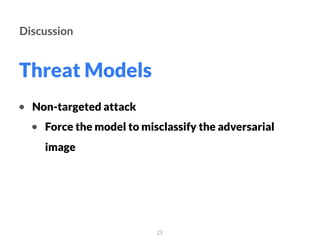
• Non-targeted attack
• Force the model to misclassify the adversarial
image
Threat Models
24
Discussion
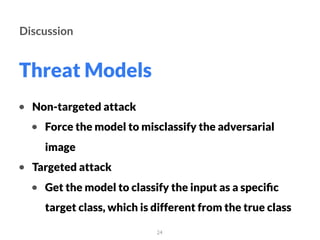
• Non-targeted attack
• Force the model to misclassify the adversarial
image
• Targeted attack
• Get the model to classify the input as a specific
target class, which is different from the true class
25
Discussion
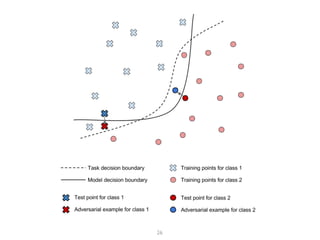
What are Adversarial Attacks?
26
27
Common Attacks
28
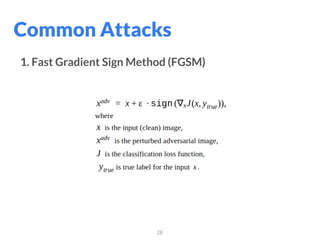
Common Attacks
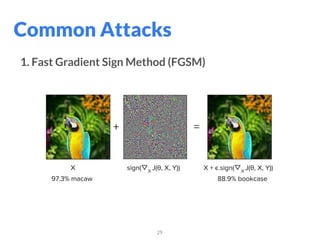
1. Fast Gradient Sign Method (FGSM)
29
Common Attacks
1. Fast Gradient Sign Method (FGSM)
30
Common Attacks
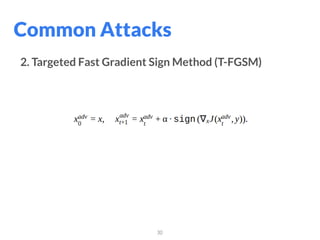
2. Targeted Fast Gradient Sign Method (T-FGSM)
31
Common Attacks
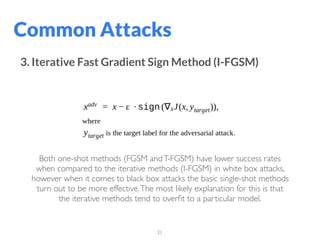
3. Iterative Fast Gradient Sign Method (I-FGSM)
Both one-shot methods (FGSM andT-FGSM) have lower success rates
when compared to the iterative methods (I-FGSM) in white box attacks,
however when it comes to black box attacks the basic single-shot methods
turn out to be more effective.The most likely explanation for this is that
the iterative methods tend to overfit to a particular model.
32
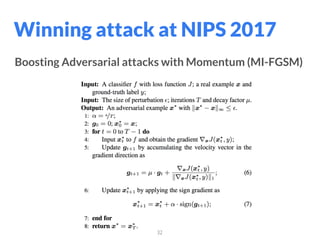
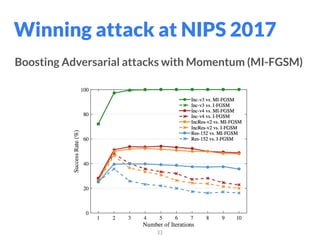
Boosting Adversarial attacks with Momentum (MI-FGSM)
Winning attack at NIPS 2017
33
Boosting Adversarial attacks with Momentum (MI-FGSM)
Winning attack at NIPS 2017
34
More attacks
35
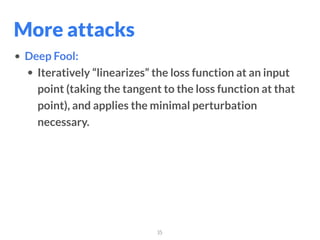
• Deep Fool:
• Iteratively “linearizes” the loss function at an input
point (taking the tangent to the loss function at that
point), and applies the minimal perturbation
necessary.
More attacks
36
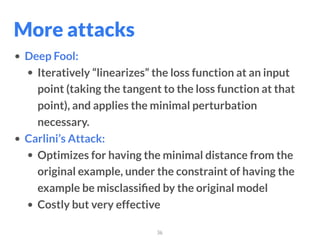
• Deep Fool:
• Iteratively “linearizes” the loss function at an input
point (taking the tangent to the loss function at that
point), and applies the minimal perturbation
necessary.
• Carlini’s Attack:
• Optimizes for having the minimal distance from the
original example, under the constraint of having the
example be misclassified by the original model
• Costly but very effective
More attacks
What are Adversarial attacks?
CIA Model of Security
Threat models
Examples and demos of Adversarial attacks
Proposed Defenses against adversarial attacks
Intuition behind Adversarial attacks
What’s next?
37
Outline
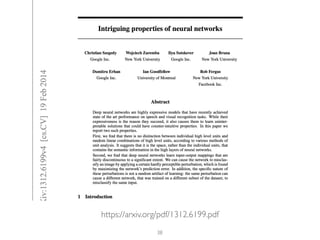
38
https://arxiv.org/pdf/1312.6199.pdf
39
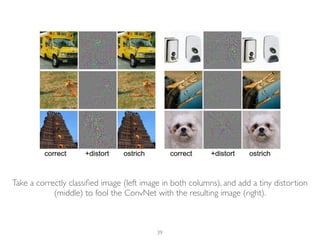
Take a correctly classified image (left image in both columns), and add a tiny distortion
(middle) to fool the ConvNet with the resulting image (right).
40
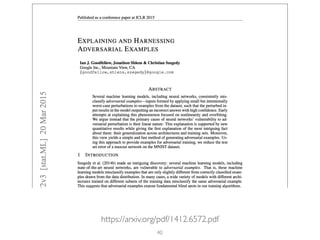
https://arxiv.org/pdf/1412.6572.pdf
41
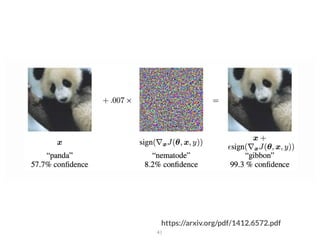
https://arxiv.org/pdf/1412.6572.pdf
42
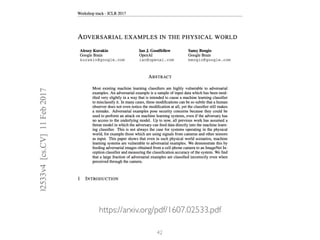
https://arxiv.org/pdf/1607.02533.pdf
43
Source: http://www.cleverhans.io/security/priva
easy.html
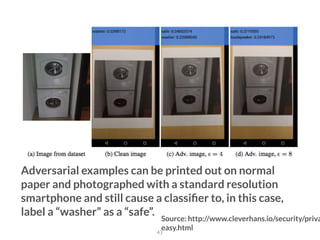
Adversarial examples can be printed out on normal
paper and photographed with a standard resolution
smartphone and still cause a classifier to, in this case,
label a “washer” as a “safe”.
44
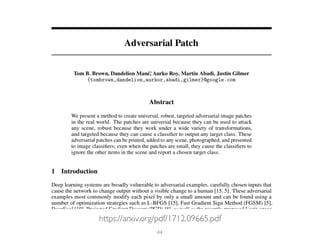
https://arxiv.org/pdf/1712.09665.pdf
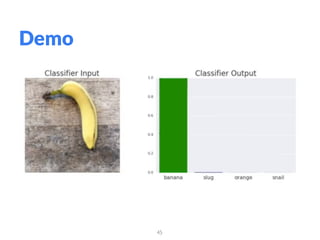
Demo
45
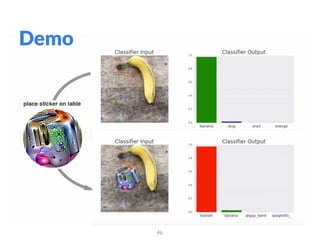
Demo
46
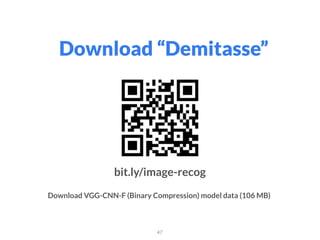
Download “Demitasse”
47
bit.ly/image-recog
Download VGG-CNN-F (Binary Compression) model data (106 MB)
What are the implications of
these attacks?
48
Discussion
What are the implications of
these attacks?
49
Discussion
•Self Driving Cars: A patch may make a car think that a Stop
Sign is a Yield Sign
What are the implications of
these attacks?
50
Discussion
•Self Driving Cars: A patch may make a car think that a Stop
Sign is a Yield Sign
•Alexa: Voice-based Personal Assistants: Transmit sounds
that sound like noise, but give specific commands (video)
What are the implications of
these attacks?
51
Discussion
•Self Driving Cars: A patch may make a car think that a Stop
Sign is a Yield Sign
•Alexa: Voice-based Personal Assistants: Transmit sounds
that sound like noise, but give specific commands (video)
•Ebay: Sell livestock and other banned substances.
52
Three remarkable factors about
Adversarial examples
53
Three remarkable factors about
Adversarial examples
• Small perturbation
• Amount of noise added is imperceivable
54
Three remarkable factors about
Adversarial examples
• Small perturbation
• Amount of noise added is imperceivable
• High Confidence
• It was easy to attain high confidence in the
incorrect classification
55
Three remarkable factors about
Adversarial examples
• Small perturbation
• Amount of noise added is imperceivable
• High Confidence
• It was easy to attain high confidence in the
incorrect classification
• Transferability
• Didn’t depend on the specific ConvNet used for
the task.
What are Adversarial attacks?
CIA Model of Security
Threat models
Examples and demos of Adversarial attacks
Proposed Defenses against adversarial attacks
Intuition behind Adversarial attacks
What’s next?
56
Outline
How do you defend A.I.
systems from these attacks?
57
Discussion
How do you defend A.I.
systems from these attacks?
58
Discussion
• Adversarial training 
• Generate a lot of adversarial examples and explicitly
train the model not to be fooled by each of them
• Improves the generalization of a model when presented
with adversarial examples at test time.
How do you defend A.I.
systems from these attacks?
59
Discussion
• Defensive distillation smooths the model’s decision surface
in adversarial directions exploited by the adversary.
• Train the model to output probabilities of different
classes, rather than hard decisions about which class to
output.
• Creates a model whose surface is smoothed in the
directions an adversary will typically try to exploit.
What are Adversarial attacks?
CIA Model of Security
Threat models
Examples and demos of Adversarial attacks
Proposed Defenses against adversarial attacks
Intuition behind Adversarial attacks
What’s next?
60
Outline
61
Are adversarial examples simply a fun toy
problem for researchers?
Or an example of a deeper and more chronic
frailty in our models?
Motivation
62
Model linearity
63
Model linearity
• Linear models’ behavior outside of the region where
training data is concentrated is quite pathological.
64
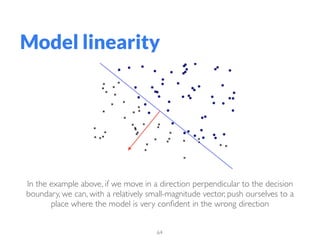
Model linearity
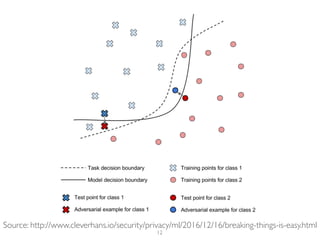
In the example above, if we move in a direction perpendicular to the decision
boundary, we can, with a relatively small-magnitude vector, push ourselves to a
place where the model is very confident in the wrong direction
65
Model linearity
• Linear models’ behavior outside of the region where
training data is concentrated is quite pathological.

• In a high-dimensional space, each individual pixel might
only increase by a very small amount, but have those
small differences contribute to a dramatic difference in
the weights * inputs dot product.
66
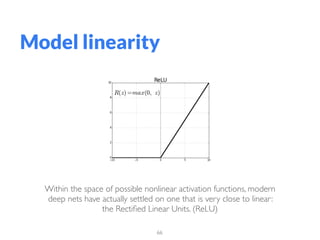
Model linearity
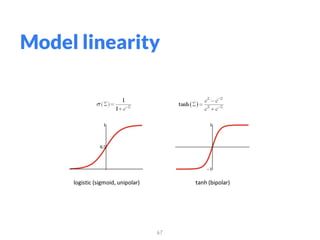
Within the space of possible nonlinear activation functions, modern
deep nets have actually settled on one that is very close to linear:
the Rectified Linear Units. (ReLU)
67
Model linearity
68
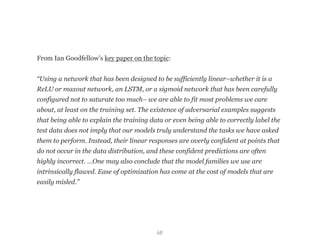
From Ian Goodfellow’s key paper on the topic:

“Using a network that has been designed to be sufficiently linear–whether it is a
ReLU or maxout network, an LSTM, or a sigmoid network that has been carefully
configured not to saturate too much– we are able to fit most problems we care
about, at least on the training set. The existence of adversarial examples suggests
that being able to explain the training data or even being able to correctly label the
test data does not imply that our models truly understand the tasks we have asked
them to perform. Instead, their linear responses are overly confident at points that
do not occur in the data distribution, and these confident predictions are often
highly incorrect. …One may also conclude that the model families we use are
intrinsically flawed. Ease of optimization has come at the cost of models that are
easily misled.”
What are Adversarial attacks?
CIA Model of Security
Threat models
Examples and demos of Adversarial attacks
Proposed Defenses against adversarial attacks
Intuition behind Adversarial attacks
What’s next?
69
Outline
• We would like our models to be able to “fail
gracefully” when used in production
70
What’s next?
• We would like our models to be able to “fail
gracefully” when used in production
• We would want to push our models to exhibit
appropriately low confidence when they’re operating
out of distribution
71
What’s next?
• We would like our models to be able to “fail
gracefully” when used in production
• We would want to push our models to exhibit
appropriately low confidence when they’re operating
out of distribution
• Real problem here: models exhibiting unpredictable
and overly confident performance outside of the
training distribution. Adversarial examples are
actually just an imperfect proxy to this problem.
72
What’s next?
Machine Learning is itself just another
tool, susceptible to adversarial attacks.
These can have huge implications,
especially in a world with self-driving cars
and other automation.
73
Summary
Thanks for attending the talk!
74
Anant Jain
Co-founder, commonlounge.com (Compose Labs)
https://commonlounge.com/pathfinder

https://index.anantja.in
Commonlounge.com is an online-learning platform similar to Coursera/Udacity,
except our courses are in the form of lists of text-based tutorials, quizzes and step-
by-step projects instead of videos. 


Check out our Deep Learning Course!
Bonus
Privacy issues in ML (and how
the two can be unexpected allies)
75
Privacy issues in ML (and how
the two can be unexpected allies)
76
Bonus
• Lack of fairness and transparency when learning
algorithms process the training data.
Privacy issues in ML (and how
the two can be unexpected allies)
77
Bonus
• Lack of fairness and transparency when learning
algorithms process the training data.
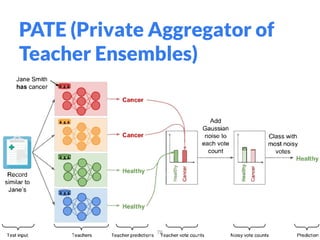
• Training data leakage: How do you make sure that ML
Systems do not memorize sensitive information about the
training set, such as the specific medical histories of
individual patients? Differential Privacy
PATE (Private Aggregator of
Teacher Ensembles)
78
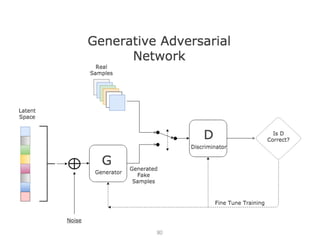
Generative Adversarial
Networks (GANs)
79
Bonus
Generative Adversarial
Networks (GANs)
80
Applications of GANs
81
Bonus
Applications of GANs
82
Bonus
•Creativity suites (Photo, video editing): Interactive image
editing (Adobe Research), Fashion, Digital Art (Deep
Dream 2.0)
Applications of GANs
83
Bonus
•Creativity suites (Photo, video editing): Interactive image
editing (Adobe Research), Fashion, Digital Art (Deep
Dream 2.0)
•3D objects: Shape Estimation (from 2D images), Shape
Manipulation
Applications of GANs
84
Bonus
•Creativity suites (Photo, video editing): Interactive image
editing (Adobe Research), Fashion, Digital Art (Deep
Dream 2.0)
•3D objects: Shape Estimation (from 2D images), Shape
Manipulation
•Medical (Insilico Medicine): Drug discovery, Molecule
development
Applications of GANs
85
Bonus
•Creativity suites (Photo, video editing): Interactive image
editing (Adobe Research), Fashion, Digital Art (Deep Dream 2.0)
•3D objects: Shape Estimation (from 2D images), Shape
Manipulation
•Medical (Insilico Medicine): Drug discovery, Molecule
development
•Games / Simulation: Generating realistic environments
(buildings, graphics, etc), includes inferring physical laws, and
relation of objects to one another
Applications of GANs
86
Bonus
• Creativity suites (Photo, video editing): Interactive image editing
(Adobe Research), Fashion, Digital Art (Deep Dream 2.0)
• 3D objects: Shape Estimation (from 2D images), Shape
Manipulation
• Medical (Insilico Medicine): Drug discovery, Molecule
development
• Games / Simulation: Generating realistic environments (buildings,
graphics, etc), includes inferring physical laws, and relation of
objects to one another
• Robotics: Augmenting real-world training with virtual training

Adversarial Attacks on A.I. Systems — NextCon, Jan 2019

  • 1.
    Adversarial Attacks onA.I. Systems 1 Anant Jain Co-founder, commonlounge.com (Compose Labs) https://commonlounge.com
 https://index.anantja.in NEXTCon Online AI Tech Talk Series Friday, Jan 18
  • 2.
    2 Are adversarial examplessimply a fun toy problem for researchers? Or an example of a deeper and more chronic frailty in our models? Motivation
  • 3.
    What are Adversarialattacks? CIA Model of Security Threat models Examples and demos of Adversarial attacks Proposed Defenses against adversarial attacks Intuition behind Adversarial attacks What’s next? 3 Outline
  • 4.
    What are Adversarialattacks? CIA Model of Security Threat models Examples and demos of Adversarial attacks Proposed Defenses against adversarial attacks Intuition behind Adversarial attacks What’s next? 4 Outline
  • 5.
    What exactly is“learnt” in Machine Learning? 5 Introduction
  • 6.
  • 7.
    What exactly is“learnt” in Machine Learning? Discussion 1. Neural Network 7 Feed-forward neural network
  • 8.
    What exactly is“learnt” in Machine Learning? Discussion Feed-forward neural network 1. Neural Network 2. Weights 3. Back-propagation 8
  • 9.
    What exactly is“learnt” in Machine Learning? Discussion 1. Neural Network 2. Weights 3. Cost Function 9 Feed-forward neural network
  • 10.
    What exactly is“learnt” in Machine Learning? Discussion 1. Neural Network 2. Weights 3. Cost Function 4. Gradient Descent 10 Feed-forward neural network
  • 11.
    What exactly is“learnt” in Machine Learning? Discussion 1. Neural Network 2. Weights 3. Cost Function 4. Gradient Descent 5. Back Propagation 11 Feed-forward neural network
  • 12.
  • 13.
    What are Adversarialattacks? CIA Model of Security Threat models Examples and demos of Adversarial attacks Proposed Defenses against adversarial attacks Intuition behind Adversarial attacks What’s next? 13 Outline
  • 14.
    CIA Model ofSecurity 14 Discussion
  • 15.
    CIA Model ofSecurity 15 Discussion • Confidentiality • Must not leak the training data used to train it • Eg: sensitive medical data
  • 16.
    CIA Model ofSecurity 16 Discussion • Confidentiality • Integrity: • should not be possible to alter predictions • during training by poisoning training data sets • during inference by showing the system adversarial examples
  • 17.
    CIA Model ofSecurity 17 Discussion • Confidentiality • Integrity • Accessibility • force a machine learning system to go into failsafe mode • Examples: Force an autonomous car to pull over
  • 18.
    What are Adversarialattacks? CIA Model of Security Threat models Examples and demos of Adversarial attacks Proposed Defenses against adversarial attacks Intuition behind Adversarial attacks What’s next? 18 Outline
  • 19.
  • 20.
    Threat Models 20 Discussion • Whitebox: • Adversary has knowledge of the machine learning model architecture and its parameters
  • 21.
    Threat Models 21 Discussion • Whitebox: • Adversary has knowledge of the machine learning model architecture and its parameters • Black box • Adversary only capable of interacting with the model by observing its predictions on chosen inputs • More realistic
  • 22.
  • 23.
    Threat Models 23 Discussion • Non-targetedattack • Force the model to misclassify the adversarial image
  • 24.
    Threat Models 24 Discussion • Non-targetedattack • Force the model to misclassify the adversarial image • Targeted attack • Get the model to classify the input as a specific target class, which is different from the true class
  • 25.
  • 26.
  • 27.
  • 28.
    28 Common Attacks 1. FastGradient Sign Method (FGSM)
  • 29.
    29 Common Attacks 1. FastGradient Sign Method (FGSM)
  • 30.
    30 Common Attacks 2. TargetedFast Gradient Sign Method (T-FGSM)
  • 31.
    31 Common Attacks 3. IterativeFast Gradient Sign Method (I-FGSM) Both one-shot methods (FGSM andT-FGSM) have lower success rates when compared to the iterative methods (I-FGSM) in white box attacks, however when it comes to black box attacks the basic single-shot methods turn out to be more effective.The most likely explanation for this is that the iterative methods tend to overfit to a particular model.
  • 32.
    32 Boosting Adversarial attackswith Momentum (MI-FGSM) Winning attack at NIPS 2017
  • 33.
    33 Boosting Adversarial attackswith Momentum (MI-FGSM) Winning attack at NIPS 2017
  • 34.
  • 35.
    35 • Deep Fool: •Iteratively “linearizes” the loss function at an input point (taking the tangent to the loss function at that point), and applies the minimal perturbation necessary. More attacks
  • 36.
    36 • Deep Fool: •Iteratively “linearizes” the loss function at an input point (taking the tangent to the loss function at that point), and applies the minimal perturbation necessary. • Carlini’s Attack: • Optimizes for having the minimal distance from the original example, under the constraint of having the example be misclassified by the original model • Costly but very effective More attacks
  • 37.
    What are Adversarialattacks? CIA Model of Security Threat models Examples and demos of Adversarial attacks Proposed Defenses against adversarial attacks Intuition behind Adversarial attacks What’s next? 37 Outline
  • 38.
  • 39.
    39 Take a correctlyclassified image (left image in both columns), and add a tiny distortion (middle) to fool the ConvNet with the resulting image (right).
  • 40.
  • 41.
  • 42.
  • 43.
    43 Source: http://www.cleverhans.io/security/priva easy.html Adversarial examplescan be printed out on normal paper and photographed with a standard resolution smartphone and still cause a classifier to, in this case, label a “washer” as a “safe”.
  • 44.
  • 45.
  • 46.
  • 47.
  • 48.
    What are theimplications of these attacks? 48 Discussion
  • 49.
    What are theimplications of these attacks? 49 Discussion •Self Driving Cars: A patch may make a car think that a Stop Sign is a Yield Sign
  • 50.
    What are theimplications of these attacks? 50 Discussion •Self Driving Cars: A patch may make a car think that a Stop Sign is a Yield Sign •Alexa: Voice-based Personal Assistants: Transmit sounds that sound like noise, but give specific commands (video)
  • 51.
    What are theimplications of these attacks? 51 Discussion •Self Driving Cars: A patch may make a car think that a Stop Sign is a Yield Sign •Alexa: Voice-based Personal Assistants: Transmit sounds that sound like noise, but give specific commands (video) •Ebay: Sell livestock and other banned substances.
  • 52.
    52 Three remarkable factorsabout Adversarial examples
  • 53.
    53 Three remarkable factorsabout Adversarial examples • Small perturbation • Amount of noise added is imperceivable
  • 54.
    54 Three remarkable factorsabout Adversarial examples • Small perturbation • Amount of noise added is imperceivable • High Confidence • It was easy to attain high confidence in the incorrect classification
  • 55.
    55 Three remarkable factorsabout Adversarial examples • Small perturbation • Amount of noise added is imperceivable • High Confidence • It was easy to attain high confidence in the incorrect classification • Transferability • Didn’t depend on the specific ConvNet used for the task.
  • 56.
    What are Adversarialattacks? CIA Model of Security Threat models Examples and demos of Adversarial attacks Proposed Defenses against adversarial attacks Intuition behind Adversarial attacks What’s next? 56 Outline
  • 57.
    How do youdefend A.I. systems from these attacks? 57 Discussion
  • 58.
    How do youdefend A.I. systems from these attacks? 58 Discussion • Adversarial training  • Generate a lot of adversarial examples and explicitly train the model not to be fooled by each of them • Improves the generalization of a model when presented with adversarial examples at test time.
  • 59.
    How do youdefend A.I. systems from these attacks? 59 Discussion • Defensive distillation smooths the model’s decision surface in adversarial directions exploited by the adversary. • Train the model to output probabilities of different classes, rather than hard decisions about which class to output. • Creates a model whose surface is smoothed in the directions an adversary will typically try to exploit.
  • 60.
    What are Adversarialattacks? CIA Model of Security Threat models Examples and demos of Adversarial attacks Proposed Defenses against adversarial attacks Intuition behind Adversarial attacks What’s next? 60 Outline
  • 61.
    61 Are adversarial examplessimply a fun toy problem for researchers? Or an example of a deeper and more chronic frailty in our models? Motivation
  • 62.
  • 63.
    63 Model linearity • Linearmodels’ behavior outside of the region where training data is concentrated is quite pathological.
  • 64.
    64 Model linearity In theexample above, if we move in a direction perpendicular to the decision boundary, we can, with a relatively small-magnitude vector, push ourselves to a place where the model is very confident in the wrong direction
  • 65.
    65 Model linearity • Linearmodels’ behavior outside of the region where training data is concentrated is quite pathological.
 • In a high-dimensional space, each individual pixel might only increase by a very small amount, but have those small differences contribute to a dramatic difference in the weights * inputs dot product.
  • 66.
    66 Model linearity Within thespace of possible nonlinear activation functions, modern deep nets have actually settled on one that is very close to linear: the Rectified Linear Units. (ReLU)
  • 67.
  • 68.
    68 From Ian Goodfellow’s keypaper on the topic:
 “Using a network that has been designed to be sufficiently linear–whether it is a ReLU or maxout network, an LSTM, or a sigmoid network that has been carefully configured not to saturate too much– we are able to fit most problems we care about, at least on the training set. The existence of adversarial examples suggests that being able to explain the training data or even being able to correctly label the test data does not imply that our models truly understand the tasks we have asked them to perform. Instead, their linear responses are overly confident at points that do not occur in the data distribution, and these confident predictions are often highly incorrect. …One may also conclude that the model families we use are intrinsically flawed. Ease of optimization has come at the cost of models that are easily misled.”
  • 69.
    What are Adversarialattacks? CIA Model of Security Threat models Examples and demos of Adversarial attacks Proposed Defenses against adversarial attacks Intuition behind Adversarial attacks What’s next? 69 Outline
  • 70.
    • We wouldlike our models to be able to “fail gracefully” when used in production 70 What’s next?
  • 71.
    • We wouldlike our models to be able to “fail gracefully” when used in production • We would want to push our models to exhibit appropriately low confidence when they’re operating out of distribution 71 What’s next?
  • 72.
    • We wouldlike our models to be able to “fail gracefully” when used in production • We would want to push our models to exhibit appropriately low confidence when they’re operating out of distribution • Real problem here: models exhibiting unpredictable and overly confident performance outside of the training distribution. Adversarial examples are actually just an imperfect proxy to this problem. 72 What’s next?
  • 73.
    Machine Learning isitself just another tool, susceptible to adversarial attacks. These can have huge implications, especially in a world with self-driving cars and other automation. 73 Summary
  • 74.
    Thanks for attendingthe talk! 74 Anant Jain Co-founder, commonlounge.com (Compose Labs) https://commonlounge.com/pathfinder
 https://index.anantja.in Commonlounge.com is an online-learning platform similar to Coursera/Udacity, except our courses are in the form of lists of text-based tutorials, quizzes and step- by-step projects instead of videos. 
 
 Check out our Deep Learning Course!
  • 75.
    Bonus Privacy issues inML (and how the two can be unexpected allies) 75
  • 76.
    Privacy issues inML (and how the two can be unexpected allies) 76 Bonus • Lack of fairness and transparency when learning algorithms process the training data.
  • 77.
    Privacy issues inML (and how the two can be unexpected allies) 77 Bonus • Lack of fairness and transparency when learning algorithms process the training data. • Training data leakage: How do you make sure that ML Systems do not memorize sensitive information about the training set, such as the specific medical histories of individual patients? Differential Privacy
  • 78.
    PATE (Private Aggregatorof Teacher Ensembles) 78
  • 79.
  • 80.
  • 81.
  • 82.
    Applications of GANs 82 Bonus •Creativitysuites (Photo, video editing): Interactive image editing (Adobe Research), Fashion, Digital Art (Deep Dream 2.0)
  • 83.
    Applications of GANs 83 Bonus •Creativitysuites (Photo, video editing): Interactive image editing (Adobe Research), Fashion, Digital Art (Deep Dream 2.0) •3D objects: Shape Estimation (from 2D images), Shape Manipulation
  • 84.
    Applications of GANs 84 Bonus •Creativitysuites (Photo, video editing): Interactive image editing (Adobe Research), Fashion, Digital Art (Deep Dream 2.0) •3D objects: Shape Estimation (from 2D images), Shape Manipulation •Medical (Insilico Medicine): Drug discovery, Molecule development
  • 85.
    Applications of GANs 85 Bonus •Creativitysuites (Photo, video editing): Interactive image editing (Adobe Research), Fashion, Digital Art (Deep Dream 2.0) •3D objects: Shape Estimation (from 2D images), Shape Manipulation •Medical (Insilico Medicine): Drug discovery, Molecule development •Games / Simulation: Generating realistic environments (buildings, graphics, etc), includes inferring physical laws, and relation of objects to one another
  • 86.
    Applications of GANs 86 Bonus •Creativity suites (Photo, video editing): Interactive image editing (Adobe Research), Fashion, Digital Art (Deep Dream 2.0) • 3D objects: Shape Estimation (from 2D images), Shape Manipulation • Medical (Insilico Medicine): Drug discovery, Molecule development • Games / Simulation: Generating realistic environments (buildings, graphics, etc), includes inferring physical laws, and relation of objects to one another • Robotics: Augmenting real-world training with virtual training