Downloaded 13 times
![AI and machine learning
help to create new tools
[1] Image: https://pixabay.com/pl/sztuczna-inteligencja-ai-robota-2228610/
Some of them make us
rethink what is “real”](https://image.slidesharecdn.com/pawelzawistowski-180323120343/75/Machine-learning-security-Pawel-Zawistowski-Warsaw-University-of-Technology-Adform-2-2048.jpg)
![lyrebird.ai
“Lyrebird allows you to create a digital voice that sounds like you with only one minute of audio.” [1]
[1] Quote & image: https://lyrebird.ai/](https://image.slidesharecdn.com/pawelzawistowski-180323120343/75/Machine-learning-security-Pawel-Zawistowski-Warsaw-University-of-Technology-Adform-3-2048.jpg)
![Learning lip sync from audio
[1] Suwajanakorn, Supasorn, Steven M. Seitz, and Ira Kemelmacher-Shlizerman. "Synthesizing obama: learning lip sync from audio." ACM Transactions on Graphics (TOG) 36.4 (2017): 95.
[2] Image: https://youtu.be/9Yq67CjDqvw](https://image.slidesharecdn.com/pawelzawistowski-180323120343/75/Machine-learning-security-Pawel-Zawistowski-Warsaw-University-of-Technology-Adform-4-2048.jpg)
![FakeApp
”A desktop app for creating photorealistic faceswap videos made with deep learning” [1]
[1] http://www.fakeapp.org/
[2] Image: Nicolas Cage fake movie compilation: https://youtu.be/BU9YAHigNx8](https://image.slidesharecdn.com/pawelzawistowski-180323120343/75/Machine-learning-security-Pawel-Zawistowski-Warsaw-University-of-Technology-Adform-5-2048.jpg)
![ML through the security lens
[1] Image: https://pixabay.com/pl/streszczenie-geometryczny-%C5%9Bwiata-1278059/](https://image.slidesharecdn.com/pawelzawistowski-180323120343/75/Machine-learning-security-Pawel-Zawistowski-Warsaw-University-of-Technology-Adform-6-2048.jpg)
![Sharing datasets is tricky
[1] Image: https://www.theguardian.com/world/2018/jan/28/fitness-tracking-app-gives-away-location-of-secret-us-army-bases
A. Narayanan and V. Shmatikov. “Robust de-anonymization of large sparse datasets (how to break anonymity
of the Netflix prize dataset)”. IEEE Symposium on Security and Privacy. 2008.](https://image.slidesharecdn.com/pawelzawistowski-180323120343/75/Machine-learning-security-Pawel-Zawistowski-Warsaw-University-of-Technology-Adform-9-2048.jpg)
![A possible remedy: differential privacy
• A promise made to a data subject:
“You will not be affected, adversely or otherwise, by allowing your data to be
used in any study or analysis, no matter what other studies, data sets, or
information sources, are available.” [1]
• Adding randomness helps in protecting individual privacy.
[1] Dwork, C., & Roth, A. (2013). The Algorithmic Foundations of Differential Privacy. Foundations and Trends® in Theoretical Computer Science, 9(3–4), 211–407.](https://image.slidesharecdn.com/pawelzawistowski-180323120343/75/Machine-learning-security-Pawel-Zawistowski-Warsaw-University-of-Technology-Adform-10-2048.jpg)
![Rapid progress in image recognition
[1] Left image MNIST: https://upload.wikimedia.org/wikipedia/commons/2/27/MnistExamples.png
[2] Right image CIFAR: https://www.cs.toronto.edu/~kriz/cifar.html
[3] Wan, Li, et al. "Regularization of neural networks using dropconnect." International Conference on Machine Learning. 2013.
[4] Graham, Benjamin. "Fractional max-pooling." arXiv preprint arXiv:1412.6071 (2014)
MNIST: 99.79% [3]
CIFAR-10: 96.53% [4]](https://image.slidesharecdn.com/pawelzawistowski-180323120343/75/Machine-learning-security-Pawel-Zawistowski-Warsaw-University-of-Technology-Adform-14-2048.jpg)
![“5 days after Microsoft announced it had beat the human benchmark of 5.1% errors with a 4.94% error
grabbing neural network, Google announced it had one-upped Microsoft by 0.04%” [1]
[1] https://www.eetimes.com/document.asp?doc_id=1325712
“Human level” results](https://image.slidesharecdn.com/pawelzawistowski-180323120343/75/Machine-learning-security-Pawel-Zawistowski-Warsaw-University-of-Technology-Adform-15-2048.jpg)
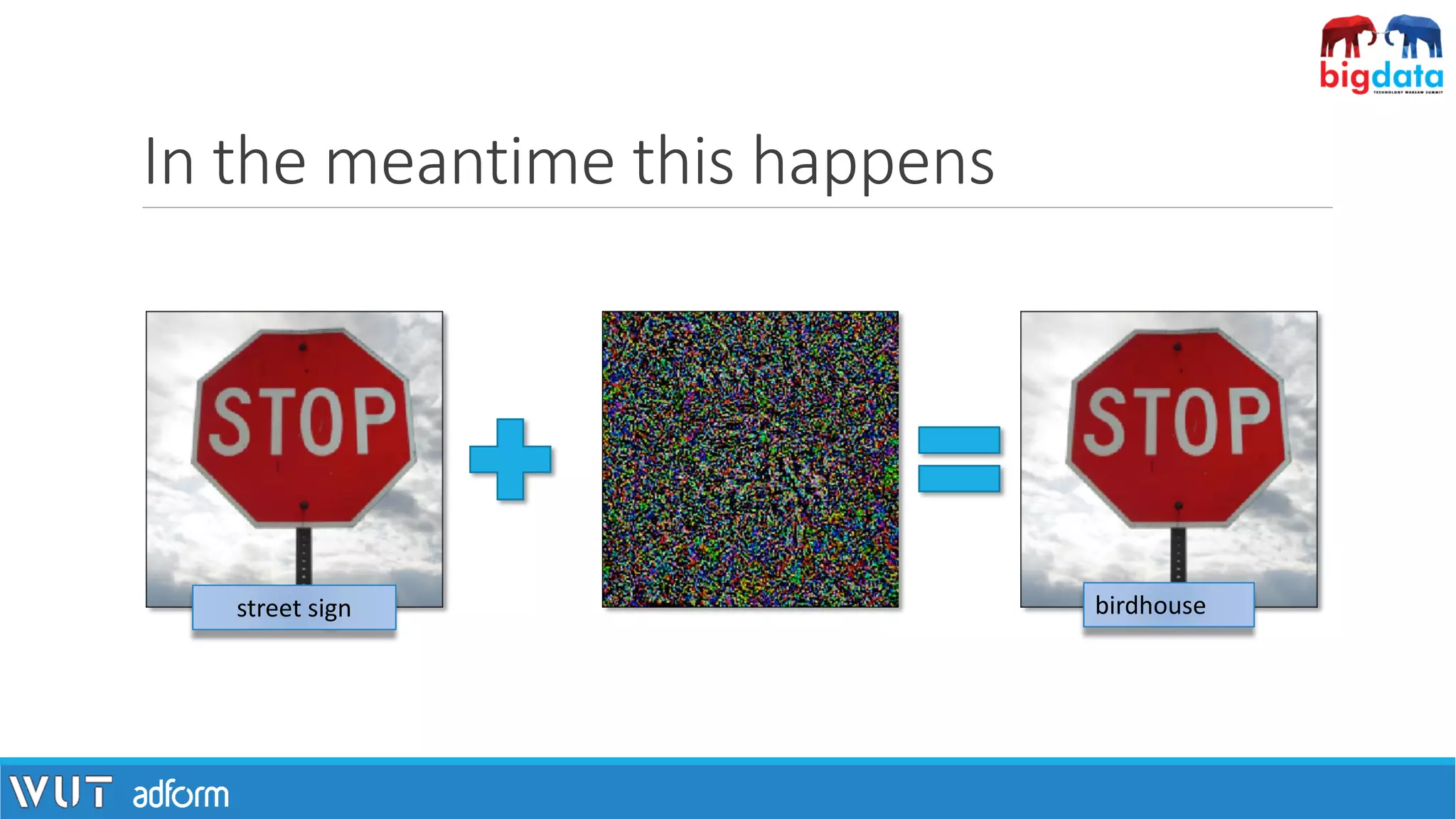
![Adversarial examples
[1] I. J. Goodfellow, J. Shlens, and C. Szegedy, “Explaining and Harnessing Adversarial Examples”, 2014.
“[…] inputs formed by applying small but intentionally worst-case perturbations […] (which) results in
the model outputting an incorrect answer with high confidence” [1]
Goodfellow et al.](https://image.slidesharecdn.com/pawelzawistowski-180323120343/75/Machine-learning-security-Pawel-Zawistowski-Warsaw-University-of-Technology-Adform-17-2048.jpg)
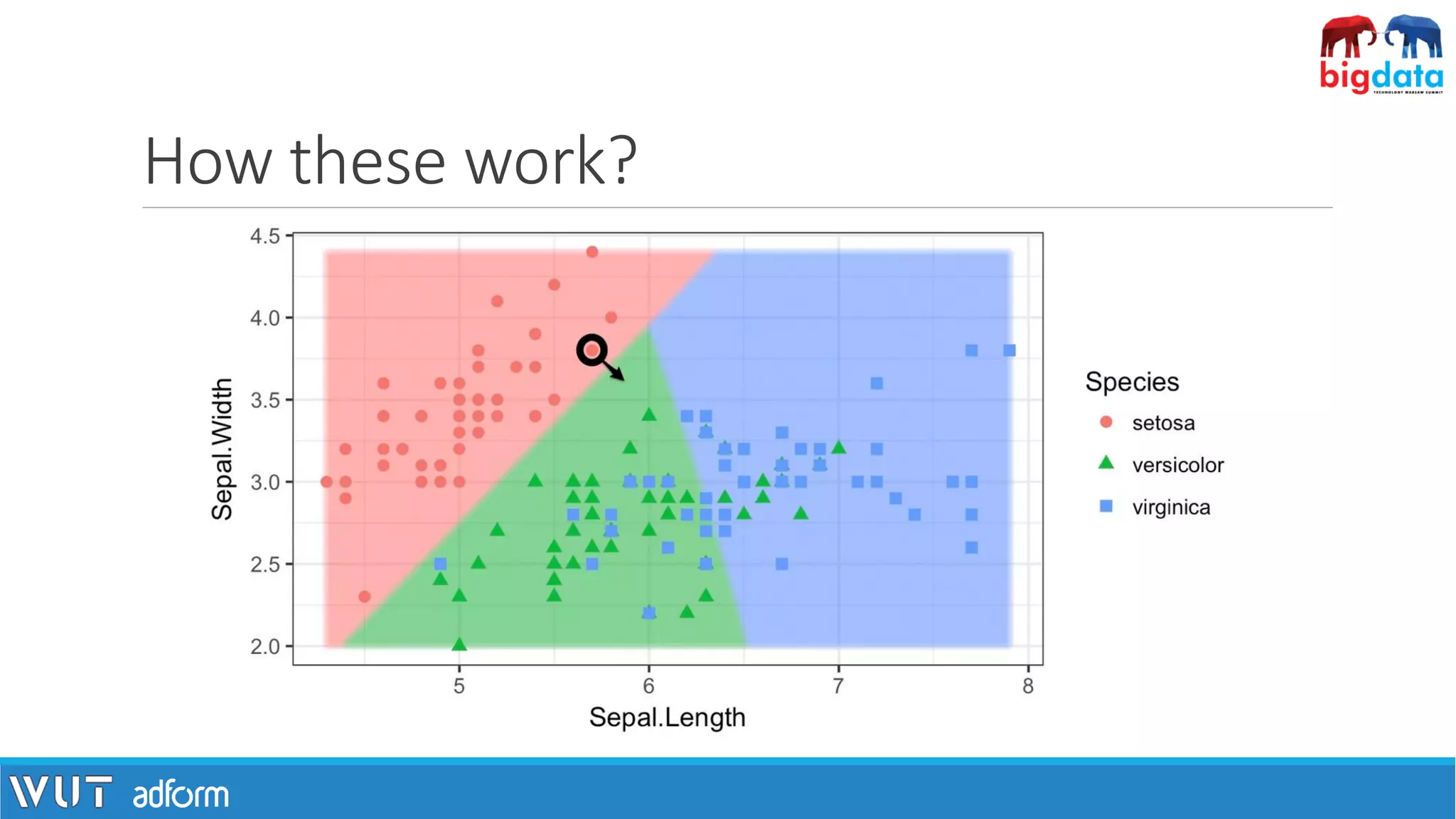
![How these work?
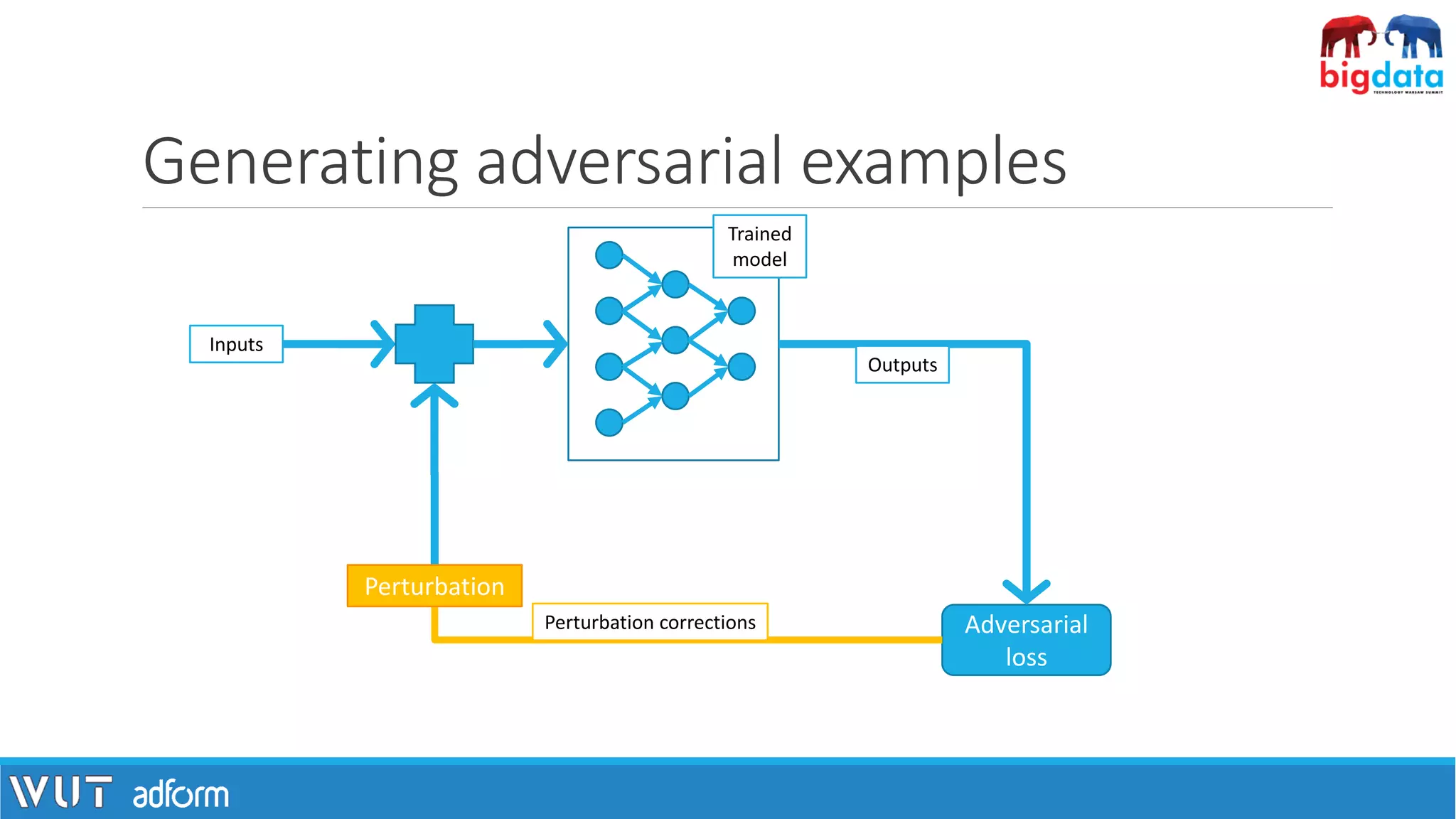
▪Given a classifier f(x) we need to find a (minimal) perturbation r for which
f(x+r) ≠ f(x).
▪Finding r can be realized as an optimization task.
[1] Black box https://cdn.pixabay.com/photo/2014/04/03/10/22/black-box-310220_960_720.png
[2] White box https://cdn.pixabay.com/photo/2013/07/12/13/55/box-147574_960_720.png](https://image.slidesharecdn.com/pawelzawistowski-180323120343/75/Machine-learning-security-Pawel-Zawistowski-Warsaw-University-of-Technology-Adform-18-2048.jpg)
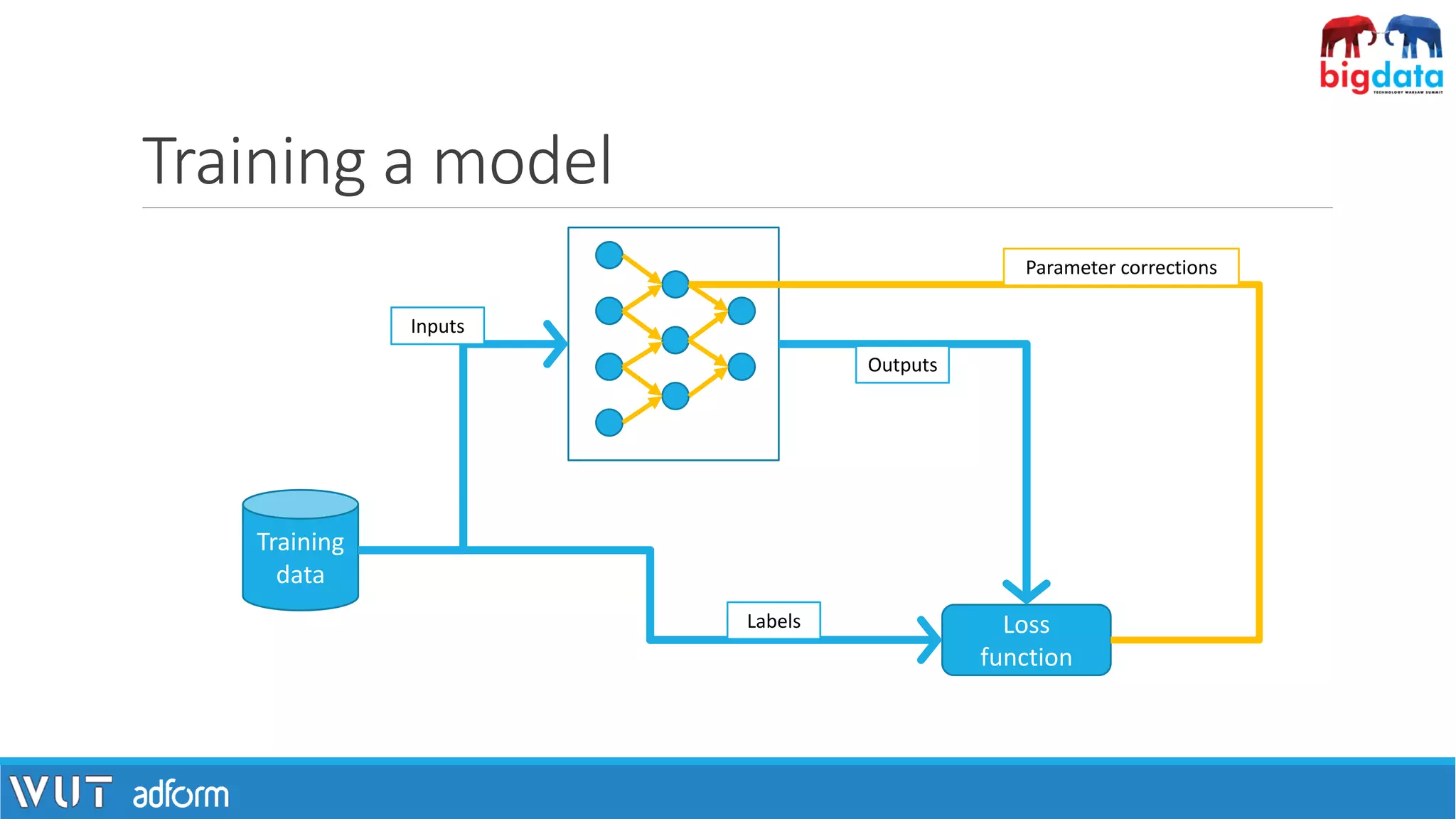
![One step further: adversarial patch
[1] Brown, T. B., Mané, D., Roy, A., Abadi, M., & Gilmer, J. (n.d.). „Adversarial Patch”
toaster](https://image.slidesharecdn.com/pawelzawistowski-180323120343/75/Machine-learning-security-Pawel-Zawistowski-Warsaw-University-of-Technology-Adform-22-2048.jpg)
![Two steps further: adversarial object
[1] Athalye, A., Engstrom, L., Ilyas, A., & Kwok, K. (2017). Synthesizing Robust Adversarial Examples.
[2] Images: http://www.labsix.org/physical-objects-that-fool-neural-nets/
Trained
model
Adversarial
attack
Adversarial
3D model
3D Printing](https://image.slidesharecdn.com/pawelzawistowski-180323120343/75/Machine-learning-security-Pawel-Zawistowski-Warsaw-University-of-Technology-Adform-23-2048.jpg)
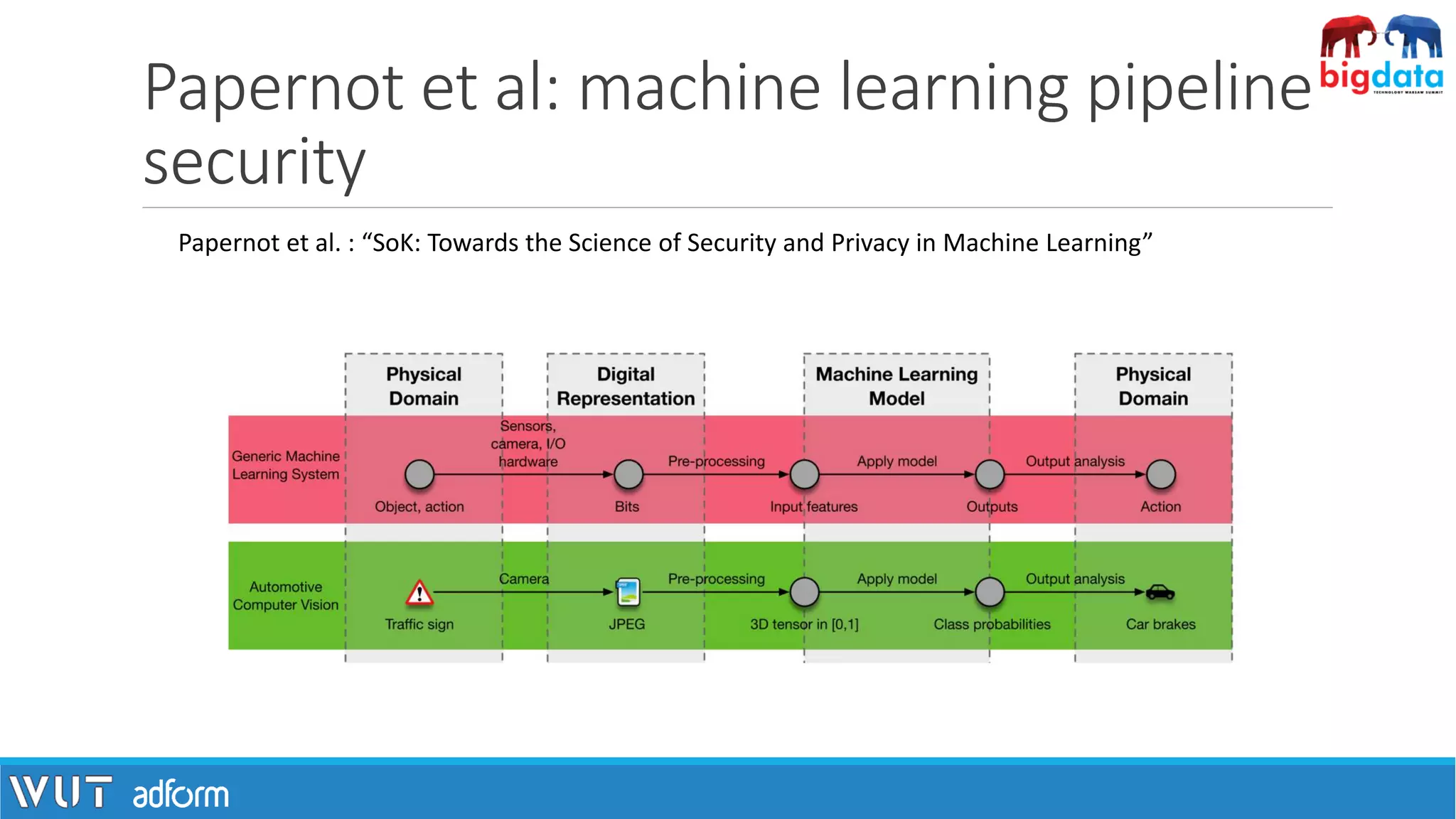
![Defense methods – first attempts
• Gradient masking.
• Defensive distillation.
[1] Image: http://cdn.emgn.com/wp-content/uploads/2016/01/society-will-fail-emgn-16.jpg](https://image.slidesharecdn.com/pawelzawistowski-180323120343/75/Machine-learning-security-Pawel-Zawistowski-Warsaw-University-of-Technology-Adform-25-2048.jpg)
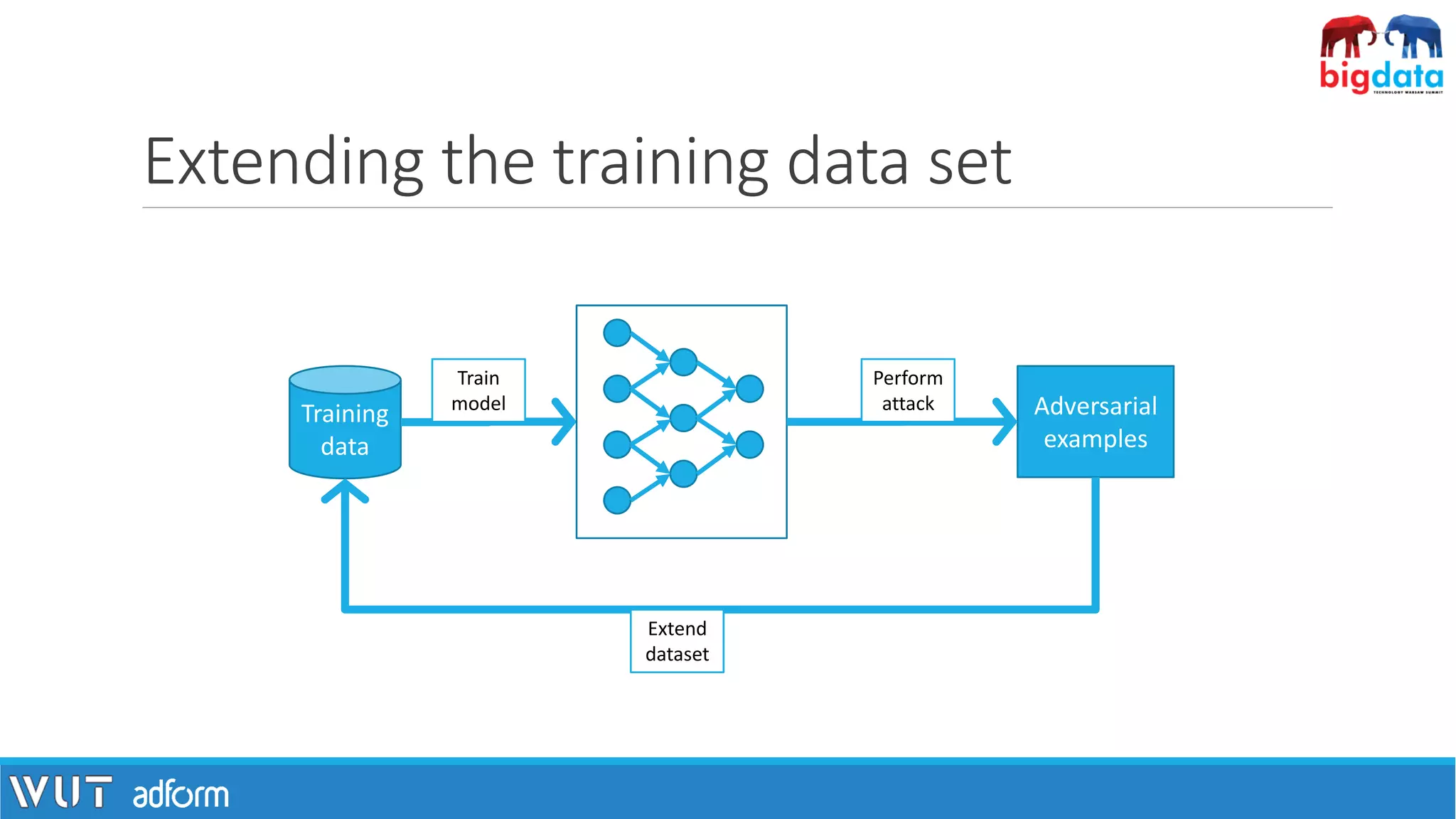
![Conclusions
[1] http://maxpixel.freegreatpicture.com/](https://image.slidesharecdn.com/pawelzawistowski-180323120343/75/Machine-learning-security-Pawel-Zawistowski-Warsaw-University-of-Technology-Adform-29-2048.jpg)
![„In the history of science and technology, the
engineering artifacts have almost always
preceded the theoretical understanding[…] if you
are not happy with our understanding of the
methods you use everyday, fix it” [2]
Yann LeCun
[1] http://maxpixel.freegreatpicture.com/
[2] comment to a Ali Rahimi's "Test of Time" award talk at NIPS](https://image.slidesharecdn.com/pawelzawistowski-180323120343/75/Machine-learning-security-Pawel-Zawistowski-Warsaw-University-of-Technology-Adform-30-2048.jpg)
![Thank you for your
attention!
ON THE SIDE NOTE – WE’RE HIRING! ☺
[1] http://maxpixel.freegreatpicture.com/](https://image.slidesharecdn.com/pawelzawistowski-180323120343/75/Machine-learning-security-Pawel-Zawistowski-Warsaw-University-of-Technology-Adform-31-2048.jpg)

The document discusses the intersection of machine learning and security, highlighting tools like Lyrebird and FakeApp that create realistic digital content. It examines the CIA triad in the context of machine learning, focusing on confidentiality, integrity, and availability, and suggests differential privacy as a potential remedy for data anonymity issues. Additionally, it covers the challenges posed by adversarial examples in machine learning and presents initial defense methods against such attacks.


![[DSC Europe 25] Dragan Vucic - Building the Learning Organization - How AI Tr...](https://cdn.slidesharecdn.com/ss_thumbnails/8brigo2sbu6qur6gxrra-7-251205085715-6ae07d24-thumbnail.jpg?width=640&height=640&fit=bounds)
![[DSC Europe 25] Jim Sterne - Adopting Generative AI Capabilities Into the Ent...](https://cdn.slidesharecdn.com/ss_thumbnails/sxhpofuorcagxsaulkmt-3-251204082258-7e66bc48-thumbnail.jpg?width=640&height=640&fit=bounds)
![[DSC Europe 25] Dusan Jovicic - AI Story: From on-prem to cloud and back agai...](https://cdn.slidesharecdn.com/ss_thumbnails/8kp49m6uq22ifnbwhfnk-2-251205085715-964d11a6-thumbnail.jpg?width=640&height=640&fit=bounds)


![[DSC Europe 25] Boris Perkovic - Lost in performance.pptx](https://cdn.slidesharecdn.com/ss_thumbnails/uq5hrp7vsuahqkxzifux-1-251204082258-fd2ee09d-thumbnail.jpg?width=640&height=640&fit=bounds)
![[DSC Europe 25] Goran Obradovic - The Rise of Sovereign AI: Building the Regi...](https://cdn.slidesharecdn.com/ss_thumbnails/7nw2xxixrxqdxvrb5wca-6-251205085714-ab09a2ac-thumbnail.jpg?width=640&height=640&fit=bounds)
![[DSC Europe 25] Bogdan Daniel Maruneac - AI - It starts with you.pptx](https://cdn.slidesharecdn.com/ss_thumbnails/odov3snhrcqs9hx5ny2n-4-251205085715-f1daacfe-thumbnail.jpg?width=640&height=640&fit=bounds)


![[DSC Europe 25] Max Talanov - Non digital NNs.pptx](https://cdn.slidesharecdn.com/ss_thumbnails/wif8tr3gtua74qvtopke-non-digital-nns-251205090438-26b0eea6-thumbnail.jpg?width=640&height=640&fit=bounds)


