Adversarial Image Attacks
By Koshin Khodiyar
linkedin.com/in/koshin-khodiyar-2a79311b2/
Contents ● What is are
Adversarial Image
Attacks?
● Adversarial examples
● Nightshade
What is Machine
Learning?
Artificial
Intelligence
Machine
Learning
REF:
https://www.geeksforgeeks.org/artificial-neural-networks-and-its-applications/
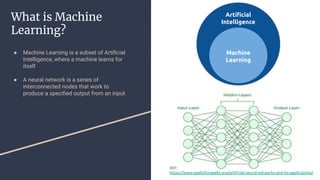
● Machine Learning is a subset of Artificial
Intelligence, where a machine learns for
itself
● A neural network is a series of
interconnected nodes that work to
produce a specified output from an input
How Machine
Learning Works
REF: Confidence-Guided-Open-World [Li et al]
● A neural network is trained on
labelled data and can practice
classifying the image with feedback
● It is then tested against images it
hasn’t seen before
● If the neural network is trained on the
training data too much it will start to
overfit, and when given test data will
not necessarily give accurate results
What is an Adversarial
Image Attack?
● Purposefully causing a ML model to produce mispredictions
when identifying data
● There are 3 main fields:
○ Image recognition
○ Natural language
○ Auditory processing
● As a field it is relatively new as it has only been around since
2013
REF:
Making an Invisibility Cloak: Real World Adversarial Attacks on Object
Detectors [Wu et al]
https://arxiv.org/abs/1312.6199
What does an Adversarial Image Attack look like?
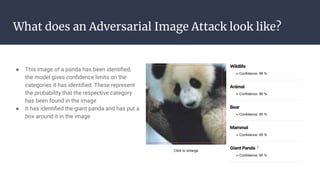
● This image of a panda has been identified,
the model gives confidence limits on the
categories it has identified. These represent
the probability that the respective category
has been found in the image
● It has identified the giant panda and has put a
box around it in the image
What does an Adversarial Image Attack look like?
REF: https://openai.com/research/attacking-machine-learning-with-adversarial-examples
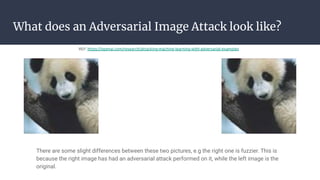
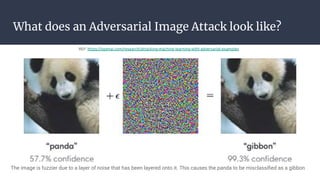
There are some slight differences between these two pictures, e.g the right one is fuzzier. This is
because the right image has had an adversarial attack performed on it, while the left image is the
original.
What does an Adversarial Image Attack look like?
REF: https://openai.com/research/attacking-machine-learning-with-adversarial-examples
The image is fuzzier due to a layer of noise that has been layered onto it. This causes the panda to be misclassified as a gibbon
Panda Gibbon
A Brief Overview
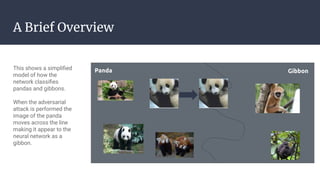
This shows a simplified
model of how the
network classifies
pandas and gibbons.
When the adversarial
attack is performed the
image of the panda
moves across the line
making it appear to the
neural network as a
gibbon.
REF: https://www.youtube.com/watch?v=i1sp4X57TL4
Adversarial Patch - Tom Brown
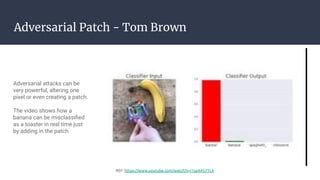
Adversarial attacks can be
very powerful, altering one
pixel or even creating a patch.
The video shows how a
banana can be misclassified
as a toaster in real time just
by adding in the patch.
Real World Example: Stop Sign
REF: Robust Physical-World Attacks on
Deep Learning Models [Ekyholt et al]
Researchers in Michigan placed
small pieces of tape on this stop
sign which caused the model to
misclassify it as a 45 mph speed
limit sign.
When this technology is used in the
real world it has the potential to go
wrong very drastically.
Adversarial Examples
REF: Making an Invisibility Cloak: Real World Adversarial Attacks on Object Detectors [Wu et al]
The adversarial attack varies in
effectiveness, due to a variety of
factors, a small rotation or slight
illumination. Can cause the attack to
stop working.
The man is wearing an adversarial
patch as a jumper. This stops him
being recognised by the image
recognition network. However in a
slightly different environment, his is
recognised and identified.
Nightshade: a Defensive use
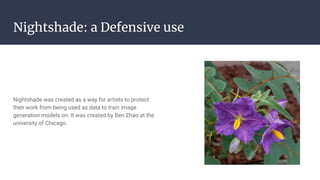
Nightshade was created as a way for artists to protect
their work from being used as data to train image
generation models on. It was created by Ben Zhao at the
university of Chicago.
Nightshade: a Defensive use
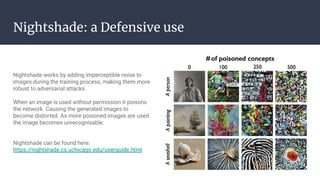
Nightshade works by adding imperceptible noise to
images during the training process, making them more
robust to adversarial attacks.
When an image is used without permission it poisons
the network. Causing the generated images to
become distorted. As more poisoned images are used
the image becomes unrecognisable.
Nightshade can be found here:
https://nightshade.cs.uchicago.edu/userguide.html
Ethical Considerations
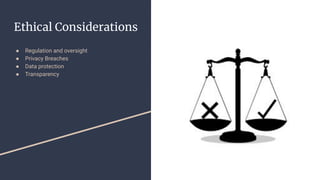
● Regulation and oversight
● Privacy Breaches
● Data protection
● Transparency
Further Reading
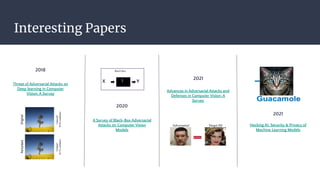
2018
Threat of Adversarial Attacks on
Deep learning in Computer
Vision: A Survey
2021
Advances in Adversarial Attacks and
Defenses in Computer Vision: A
Survey
2021
Hacking AI: Security & Privacy of
Machine Learning Models
?
Black Box
X Y
2020
A Survey of Black-Box Adversarial
Attacks on Computer Vision
Models
Interesting Papers
linkedin.com/in/koshin-khodiyar-2a79311b2/

Presentation about adversarial image attacks

  • 1.
    Adversarial Image Attacks ByKoshin Khodiyar linkedin.com/in/koshin-khodiyar-2a79311b2/
  • 2.
    Contents ● Whatis are Adversarial Image Attacks? ● Adversarial examples ● Nightshade
  • 3.
    What is Machine Learning? Artificial Intelligence Machine Learning REF: https://www.geeksforgeeks.org/artificial-neural-networks-and-its-applications/ ●Machine Learning is a subset of Artificial Intelligence, where a machine learns for itself ● A neural network is a series of interconnected nodes that work to produce a specified output from an input
  • 4.
    How Machine Learning Works REF:Confidence-Guided-Open-World [Li et al] ● A neural network is trained on labelled data and can practice classifying the image with feedback ● It is then tested against images it hasn’t seen before ● If the neural network is trained on the training data too much it will start to overfit, and when given test data will not necessarily give accurate results
  • 5.
    What is anAdversarial Image Attack? ● Purposefully causing a ML model to produce mispredictions when identifying data ● There are 3 main fields: ○ Image recognition ○ Natural language ○ Auditory processing ● As a field it is relatively new as it has only been around since 2013 REF: Making an Invisibility Cloak: Real World Adversarial Attacks on Object Detectors [Wu et al] https://arxiv.org/abs/1312.6199
  • 6.
    What does anAdversarial Image Attack look like? ● This image of a panda has been identified, the model gives confidence limits on the categories it has identified. These represent the probability that the respective category has been found in the image ● It has identified the giant panda and has put a box around it in the image
  • 7.
    What does anAdversarial Image Attack look like? REF: https://openai.com/research/attacking-machine-learning-with-adversarial-examples There are some slight differences between these two pictures, e.g the right one is fuzzier. This is because the right image has had an adversarial attack performed on it, while the left image is the original.
  • 8.
    What does anAdversarial Image Attack look like? REF: https://openai.com/research/attacking-machine-learning-with-adversarial-examples The image is fuzzier due to a layer of noise that has been layered onto it. This causes the panda to be misclassified as a gibbon
  • 9.
    Panda Gibbon A BriefOverview This shows a simplified model of how the network classifies pandas and gibbons. When the adversarial attack is performed the image of the panda moves across the line making it appear to the neural network as a gibbon.
  • 10.
    REF: https://www.youtube.com/watch?v=i1sp4X57TL4 Adversarial Patch- Tom Brown Adversarial attacks can be very powerful, altering one pixel or even creating a patch. The video shows how a banana can be misclassified as a toaster in real time just by adding in the patch.
  • 11.
    Real World Example:Stop Sign REF: Robust Physical-World Attacks on Deep Learning Models [Ekyholt et al] Researchers in Michigan placed small pieces of tape on this stop sign which caused the model to misclassify it as a 45 mph speed limit sign. When this technology is used in the real world it has the potential to go wrong very drastically.
  • 12.
    Adversarial Examples REF: Makingan Invisibility Cloak: Real World Adversarial Attacks on Object Detectors [Wu et al] The adversarial attack varies in effectiveness, due to a variety of factors, a small rotation or slight illumination. Can cause the attack to stop working. The man is wearing an adversarial patch as a jumper. This stops him being recognised by the image recognition network. However in a slightly different environment, his is recognised and identified.
  • 13.
    Nightshade: a Defensiveuse Nightshade was created as a way for artists to protect their work from being used as data to train image generation models on. It was created by Ben Zhao at the university of Chicago.
  • 14.
    Nightshade: a Defensiveuse Nightshade works by adding imperceptible noise to images during the training process, making them more robust to adversarial attacks. When an image is used without permission it poisons the network. Causing the generated images to become distorted. As more poisoned images are used the image becomes unrecognisable. Nightshade can be found here: https://nightshade.cs.uchicago.edu/userguide.html
  • 15.
    Ethical Considerations ● Regulationand oversight ● Privacy Breaches ● Data protection ● Transparency
  • 16.
    Further Reading 2018 Threat ofAdversarial Attacks on Deep learning in Computer Vision: A Survey 2021 Advances in Adversarial Attacks and Defenses in Computer Vision: A Survey 2021 Hacking AI: Security & Privacy of Machine Learning Models ? Black Box X Y 2020 A Survey of Black-Box Adversarial Attacks on Computer Vision Models Interesting Papers
  • 17.